Springwatch 2026 episode 6 brought Chris Packham and Michaela Strachan back to the storm-touched shores of the Crom National Trust Estate in County Fermanagh, where a single promise opened the night: every animal had survived the previous 24 hours. That mattered. Recent days had been brutal viewing, with Irish stoats and pine martens predating nests across the reserve. Predators arrived, broods shrank, and viewers held their breath. Yet the live cameras showed life settling rather than ending. Buzzards once bullied down from three chicks to two were thriving. A favoured grebe nest endured. The episode balanced loss against survival with rare honesty.
Across the water, Iolo Williams broadcast live from the Natural History Museum in London, turning his attention to the capital’s overlooked invertebrate life. His patch could not have contrasted more sharply with the Fermanagh moorland and oak wood. One presenter stood among ancient trees and lekking grouse. The other crouched in a transformed urban garden bristling with sensors and rare flies. Together they framed the central argument of Springwatch 2026 episode 6: wildlife thrives wherever we make room for it, from thousand-year-old yews to a green space wedged beside a museum.
The night carried real stakes. Swifts laid their first eggs. A starling violently evicted an intruder. A rare butterfly clung to survival on one farmer’s land. A wildlife filmmaker began hunting one of nature’s strangest crimes. Springwatch 2026 episode 6 wove these threads into a portrait of a season balanced between fragility and resilience. What follows is the full story of that broadcast, organised by the creatures, places, and behaviours that defined it.
The programme opened under threatening skies. Packham and Strachan acknowledged the storm rolling across Crom, warning of incoming rain while insisting it would not dampen the night. Their optimism felt earned rather than performed. The reserve had endured a punishing run of predation, and the presenters did not hide it. Irish stoats and pine martens had been raiding nests, claiming chicks and eggs across the estate.
Strachan delivered the relief directly. Everything filmed by the live cameras remained alive across the previous day, at least for now. The phrasing carried weight, because nature offers no guarantees beyond the present moment. Buzzards that began with three chicks had dropped to two after aggression inside the nest. Now those two were doing well.
That mix of grief and recovery set the tone. Predators must eat, the presenters reminded viewers, and a healthy reserve supports them. The honesty mattered. Springwatch 2026 episode 6 refused to sanitise the season, presenting predation as part of a functioning ecosystem rather than a tragedy to be edited away.
Springwatch 2026 episode 6
Swift Eggs, Sticky Saliva, And The Astonishing Engineering Of A Courtyard Nest
The courtyard cameras quickly became the heart of the night. Swallows, house martins, and swifts filled the air with activity, and the swift nest delivered the episode’s first triumph. Over the weekend, the cameras captured one white egg, then a second laid on Sunday morning at 7.43am. Swifts typically lay two to three eggs, so a third remained possible.
The behaviour proved as remarkable as the eggs. One adult brought in a buzzard feather, then began an extraordinary ritual. It gagged, bobbed its head, and produced a ball of spit, depositing it carefully along the rim of the nest. That saliva acts as glue. A gland beneath the swift’s tongue produces especially sticky secretions, allowing it to cement the feather firmly to the nest wall.
The presenters also marvelled at how swifts enter their cramped quarters. The birds twist sideways at a steep angle to squeeze through a crack in the wall, moving so fast the eye can barely follow. Some approaches looked like failed attempts. The presenters debated whether these were returning adults, intruders, or young prospecting birds nicknamed bangers for their habit of flying straight into occupied entrances. With nest sites in short supply, competition stays fierce.
The Brutal Starling Eviction That Revealed A Hidden Housing Crisis
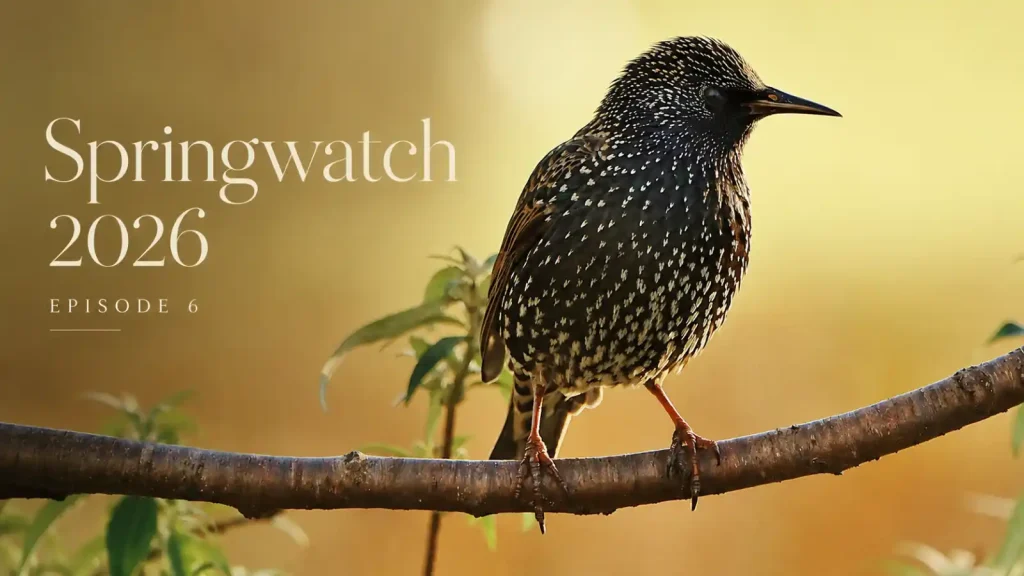
Few moments in Springwatch 2026 episode 6 hit harder than the starling sequence. A starling fussing over its nest suddenly heard something and bolted, leaving its eggs exposed. The outside camera revealed the cause: a swift trying to force its way in. The starling’s response was instant and savage.
In slow motion, the violence became clear. The starling chose to take the fight outside, latching onto the swift’s tail and wings, then using its own wings to drag the intruder backwards out of the hole. Packham summed it up bluntly, calling the starling anything but a genteel animal.
The clash exposed a deeper problem. Both species favour the same nesting sites, and resident starlings claim them first in March and April. Swifts, as migrants, do not return until May, leaving them perpetually scouting for any opening, even occupied ones. Strachan posed the key question: where did these birds nest before buildings existed? The answer is hollow trees and rock faces, habitats now scarce. The solution is simple and within reach. Put up swift boxes and house martin cups, the presenters urged, and help the birds out.
A Thousand Beakfuls Of Mud And A House Martin Filmed Inside Its Nest For The First Time
The courtyard’s roughly 45 pairs of house martins offered a gentler story, though not a peaceful one. These birds build cup nests from mud under the eaves, and the wetter weather of recent days actually helped them. Softer mud is easier to gather, which matters enormously given that a single nest requires around a thousand beakfuls.
A puddle some 20 metres from the courtyard became the local building supply, with martins shuttling back and forth to mend and extend their nests. Most shared the mud happily. Two did not, breaking into what the presenters cheerfully dubbed a house martin mud fight. The squabble underlined how social nesting brings both benefits and friction, with shared vigilance against predators balanced against constant competition.
Then came a genuine first. The cameras went inside a house martin nest, a vantage point the presenters believed had never been achieved before. The footage revealed a decorated interior, complete with a feather. Curiously, white feathers appear far more often than other colours in these nests, a quirk the team promised to explore later in the week.
The Blackcap’s Berry Blunder And A Warbler For Generation Z
A blackcap nest holding five chicks produced one of the night’s most charming episodes of trial and error. The female arrived first, delivering a beakful of insects to her vibrating, eager brood. The chicks barely settled before demanding more. Then the male appeared, and his idea of feeding went comically wrong.
He arrived clutching an ivy berry, the kind of food blackcaps eat through autumn and winter rather than feed to tiny chicks in spring. Diligently, he worked around the entire brood, trying to stuff the oversized berry into mouths far too small to accept it. The presenters compared it to a human swallowing a melon whole. The female eventually solved the problem the only sensible way, taking the berry and swallowing it herself.
His instinct was not entirely foolish. Later the female returned with her own berry, and this time it worked, immediately stimulating a chick to produce a fecal sac that she promptly consumed. Packham framed the blackcap as a conservation success story. The species has expanded its range by 240% in Ireland over 50 years and 50% in the UK, driven by shifting migration patterns and warmer springs. He called it a warbler for Generation Z, filling the gap left by declining willow warblers.
A Garden Beside The Natural History Museum That Hides A Quarter Of London’s Wildlife
Iolo Williams anchored the urban half of Springwatch 2026 episode 6 from outside his favourite building in London. He stayed in the green space rather than venturing inside, because that space had been completely transformed. Reopened in 2024, it has become an outdoor laboratory and a hotbed of scientific research, so changed that Williams barely recognised it from his last visit in 2018.
His whistle-stop tour revealed a patchwork of mini habitats. The pond drew a bathing sparrowhawk and supported smooth newts, water boatmen, beetles, and 15 species of dragonfly and damselfly, including the willow emerald, a coloniser first recorded in 1979. A mini woodland of London plane, oak, and hazel already hosted breeding wrens, blue tits, and dunnocks, plus a family of long-tailed tits filmed by camera operator Steve. Sensors throughout the garden record temperature, humidity, rainfall, sunlight, traffic noise, birdsong, and insects.
The most important section tests plant resilience to a warming climate. Researchers compare native and non-native species across cooler and hotter zones, the latter intensified by paving and glass. Red valerian and dark mullein draw bumblebees, while the work hints at which plants might fill our gardens by 2050. Dr Erica McAllister later delivered the headline figure. The site has yielded 3,500 species, roughly a quarter of all those recorded in Greater London, despite being 77 times smaller.
The Black Grouse Lek Where A Single Patch Of Moorland Decides Everything
Williams introduced one of the episode’s most cinematic sequences, a courtship display high on the Pennines. At dawn, male black grouse gather to lek, filling the uplands with a strange bubbling chorus that can carry up to four kilometres thanks to air sacs in the throat. They have focused their lives on this ancient arena, and on one tiny goal within it: the centre.
The competition is fierce and astonishingly high-stakes. For generations, males have battled for a few square metres of open ground, because controlling the inner circle signals the strongest genes. They square up like heavyweights, heads low and tails raised, bubbling and lunging. Their lyre-shaped tails flare to flash white petticoats, while blood-engorged wattles burn brighter against the heather.
On this misty April morning, the judging panel arrived. Grey hens, the females, show up for only a handful of days a year. Black grouse form no pair bonds, so each hen raises her chicks alone and chooses purely for genes. The hens select from males in the heart of the lek, reading clean, intact tails as proof of survival and bubbling calls as proof of stamina. For the dominant male, victory may crown five years of effort. It can also be his last, but his genes pass on, and his descendants will return to contest the same prized patch.
Crom’s Conjoined Yews And The Oak That Is An Ecosystem In Itself
Back at Crom, the presenters turned to two of the most extraordinary organisms on the reserve: a conjoined pair of ancient yew trees. Yews are dioecious, so this pair includes a male producing pollen and a female bearing seed. Their tangled foliage spreads across a circumference of 150 metres. Their age is uncertain but likely sits between 400 and 1,000 years, and they were already present when the castle was built in 1611, making them the oldest trees in Northern Ireland.
Even so, they are young by yew standards. The Fortingall yew in Perthshire, the oldest tree in the UK, is thought to be three to seven thousand years old, germinating in the Stone Age. The presenters reflected on how such longevity humbles human timescales, with Strachan sitting beneath the canopy to feel its calm. The exchange led into a sobering statistic. After the last ice age, around 80% of Ireland was wooded. By 1925, that figure had collapsed to just 1%.
Crom matters precisely because it resists that decline, holding the largest remaining body of oak wood in Northern Ireland. An old oak becomes ancient at around 400 years and can live up to a thousand. As it ages, dead boughs, splits, and crevices create surfaces for life. Studies show that as many as 2,300 species can survive on a single oak, with 326 dependent on it. A survey of Crom’s woods turned up a striped oak bug, looper caterpillars, a blunt-stretch spider, and the plaited door snail, a species rare in Ireland that finds its stronghold here in Fermanagh.
One Farmer, One Rare Butterfly, And The Quiet Power Of Doing Nothing
Williams introduced a profile that doubled as the episode’s emotional core. Fadian is 90 acres of farmland overlooking Lough Erne near Enniskillen, farmed by George for the last 27 years. He never farmed intensively, balancing his love of farming with his love of wildlife. The land has received no fertiliser and no chemicals, left largely as it has been for a century. Had it been otherwise, George reflected, there would be nothing here but green grass.
His light touch produced something precious. Cattle graze the land down, and rushes are mowed each March to encourage flowers. The result is a thriving population of orchids and Devil’s-bit scabious, the vital food plant of the rare marsh fritillary butterfly. The caterpillars live communally, weaving a concentrated web that takes teamwork to build, then surviving together for months before dispersing to pupate. A count last year recorded over 700 individual webs, a colossal total for one small parcel of land.
The marsh fritillary survives in fragile meta-populations, dense clusters that rarely move more than 50 to 100 metres. When one dies out, recolonisation is hard, which explains the species’ wider struggle. George’s farm bucks that trend, ranking among the strongest sites Williams knows. The team returned to find adults on the wing, freshly emerged and pumping up wings Williams likened to a section of Persian carpet. With people like George on the case, the butterfly has a future in this part of Ireland.
A Filmmaker, A Reed Warbler Nest, And The Trickster That Follows
Wildlife artist and filmmaker Robert Fuller set himself a tricky challenge in a Yorkshire nature reserve he is always drawn to in spring. Channels carved by swans helped him navigate the reed beds in search of one species in particular, the reed warbler, freshly arrived from Africa and starting to build. He wanted to film a nest under construction, and he found exactly that.
The footage revealed astonishing craftsmanship. Reed warblers weave nesting material around slippery reeds, using leaf nodes as anchors so the structure stays suspended over water and safe from predators. The pair added moss and the white down of pussy willow flowers, shaping a cup with the beak alone before laying their first egg. They lay one egg a day until the clutch of four is complete, then incubate for around 12 days.
But where reed warblers nest, a trickster often follows. That evening, Fuller heard the cuckoos return. Cuckoos parasitise reed warbler nests, laying their own eggs for the smaller birds to raise, and Fuller hopes to capture this phenomenon on film. His next mission is to scour the reed beds for a cuckoo chick. Back in the studio, Packham wagered a pound that a cuckoo would target the very nest on screen, setting up a storyline to follow as the series continues.
Hedgehog Battles, A Drawstring Defence, And A Beetle That Catapults Itself To Safety
The urban thread closed with hedgehogs, captured on home security cameras by viewers William and Helen. Two males fought by lowering their heads and raising their spines, with the subordinate barged in the flanks until it rolled into a ball and was pushed away like a football. The presenters ruled out territory as the cause, since gardens often host several hedgehogs peacefully. Food, mating, and breeding are the likelier triggers.
The biology behind the defence proved fascinating. A hedgehog carries between three and five thousand spines, hollow modified hairs that weigh a remarkable 35% of its body weight. Using a prop devised by Lucy Lapwing, Packham demonstrated the mechanics. The panniculus carnosus muscle contracts to pull the spiny skin down over the body, while a second muscle, the orbicularis, tightens like a drawstring on a sports bag, tucking the nose and feet inside. Two muscles transform a vulnerable animal into a formidable, near-impregnable ball.
The night ended on a flash of colour. Packham presented the coppery click beetle, named for the hinge between thorax and abdomen that it flexes to catapult itself off a leaf and away from predators. The violet sheen made it far more striking than the plain brown oak click beetles usually seen at this time of year. As rain threatened once more, the presenters previewed the days ahead: a hunt for pine martens, a celebration of the misunderstood hornet, and a journey among the high-rises of Canary Wharf. Springwatch 2026 episode 6 closed exactly as it began, perched between weather and wonder, with the cameras still rolling and every creature, for now, still alive.
FAQ Springwatch 2026 episode 6
Q: Where is Springwatch 2026 episode 6 filmed?
A: Chris Packham and Michaela Strachan present from the Crom National Trust Estate in County Fermanagh, Northern Ireland. Meanwhile, Iolo Williams broadcasts live from outside the Natural History Museum in London, focusing on urban wildlife. The two locations contrast ancient Fermanagh oak wood and moorland with a transformed city green space.
Q: Why were so many nests being predated at Crom?
A: Irish stoats and pine martens hunt across the reserve, raiding nests for chicks and eggs. The presenters stressed that predation is part of a healthy ecosystem rather than a failure, since predators must eat too. Despite a tough run, all the filmed animals survived the previous 24 hours, and the bullied buzzard brood stabilised at two healthy chicks.
Q: How do swifts glue feathers into their nests?
A: Swifts produce especially sticky saliva from a gland beneath the tongue. One adult brought in a buzzard feather, gagged up a ball of spit, then deposited it along the nest rim as glue. This cemented the feather firmly to the wall. The same saliva binds the entire nest structure together, making it a natural adhesive.
Q: Why did the starling attack the swift?
A: Both species compete for the same cavity nest sites, and the swift was trying to force its way in. The starling latched onto the intruder’s tail and wings, then used its own wings to drag it backwards out of the hole. Resident starlings claim sites first in spring, leaving migrant swifts constantly scouting for any opening, even occupied ones.
Q: How many beakfuls of mud does a house martin nest need?
A: Each cup nest requires around a thousand beakfuls of mud. The roughly 45 pairs at Crom gather material from a nearby puddle, and wetter weather actually helps by softening the mud. The episode also showed footage filmed inside a house martin nest for what the presenters believed was the first time, revealing a feather-decorated interior.
Q: Why is the blackcap called a warbler for Generation Z?
A: Blackcaps have expanded their range by 240% in Ireland over 50 years and 50% in the UK, driven by shifting migration patterns and warmer springs. Packham used the phrase because they fill the gap left by declining willow warblers. The episode also showed a male comically trying to feed an oversized ivy berry to chicks too small to swallow it.
Q: How many species live in the Natural History Museum garden?
A: Dr Erica McAllister revealed that 3,500 species have been recorded there, roughly a quarter of all those known in Greater London, despite the site being 77 times smaller. Reopened in 2024, the garden mixes mini habitats with sensors tracking temperature, humidity, rainfall, and birdsong. Researchers also test which plants will tolerate a warming climate.
Q: How does the black grouse lek actually work?
A: Male black grouse gather daily on a Pennine arena, competing to control its centre. Their bubbling call, produced by throat air sacs, can carry up to four kilometres. Grey hens visit for only a few days a year and choose purely for genes, reading clean tails as proof of survival. Black grouse form no pair bonds, so females raise chicks alone.
Q: What is George doing to save the marsh fritillary butterfly?
A: George farms 90 acres near Enniskillen without fertiliser or chemicals, grazing cattle and mowing rushes each March to encourage flowers. This supports Devil’s-bit scabious, the butterfly’s vital food plant. A count last year recorded over 700 caterpillar webs. Because marsh fritillaries live in fragile meta-populations that rarely move far, his light-touch land is one of the strongest sites in the region.
Q: How does a hedgehog roll itself into a ball?
A: Two muscles make it possible. The panniculus carnosus contracts to pull the spiny skin down over the body, while the orbicularis muscle tightens like a sports bag drawstring, tucking the nose and feet inside. A hedgehog carries three to five thousand spines, hollow modified hairs weighing 35% of its body weight, protecting the soft, vulnerable underbelly.