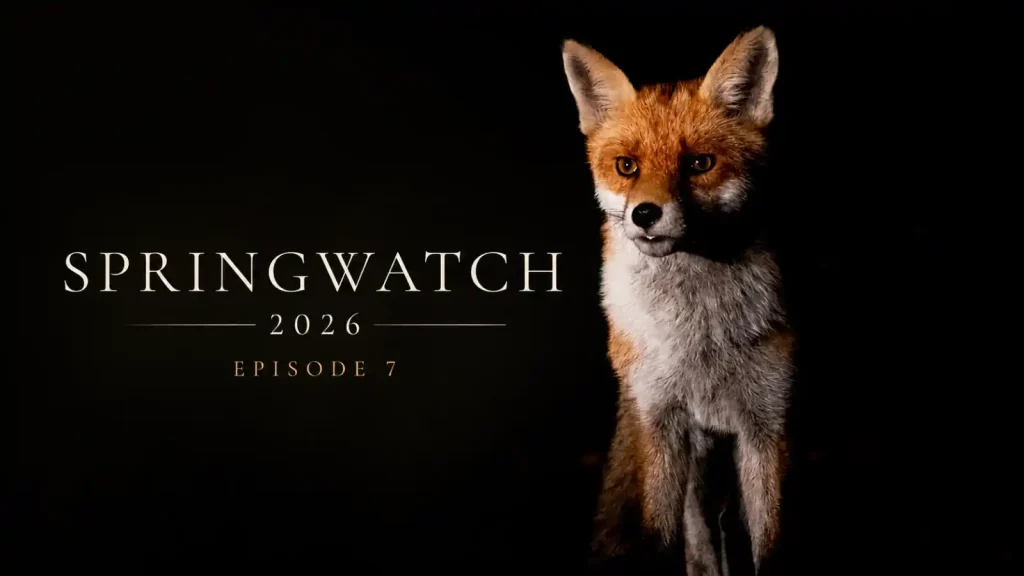
Springwatch 2026 episode 7 delivered one of the season’s most dramatic blends of survival, predation and surprising urban wildlife, broadcast live from the rain-soaked Crom Estate in County Fermanagh, Northern Ireland. Chris Packham and Michaela Strachan guided viewers through a day battered by 11 millimetres of rain in 24 hours, yet the foul weather only sharpened the stakes for the birds nesting across the National Trust reserve.
From a great tit family making its perilous first flight to a parasitic wasp turning a ladybird into a so-called zombie babysitter, the programme leaned hard into the strange machinery of nature. Meanwhile, Iolo Williams broadcast from the heart of London, revealing the unexpected wildlife thriving along the River Thames and within the steel canyons of Canary Wharf.
The emotional core of Springwatch 2026 episode 7 was tension. Rain threatened exposed nests, pine martens stalked young chicks, and a heron and a pike loomed near the reserve’s grebe family. Every story carried real consequences, and the presenters refused to soften them. This was wildlife filmmaking as drama, with predators, prey and weather all writing the script in real time.
What made the episode feel urgent was its honesty. Some chicks survive. Some do not. The cameras at Crom captured both possibilities hanging in the balance, while Iolo’s London segments offered a hopeful counterpoint, proving that even a once-dead river and a concrete financial district can become refuges for remarkable wildlife.
The weather defined everything. After starting the series a week earlier in sunshine and shorts, the team woke to a dour, damp Crom Estate, with buzzards, grebes and robins all soaked through. Chris Packham opened the programme with a wry catalogue of misery: wet buzzards, wet grebes, wet robins. The rain had clearly hit the birds hard, and the cameras lingered on a great crested grebe enduring a thorough drenching out on the water.
Yet even in the downpour, nature offered a small masterpiece of parenting. A little grebe became the standout, tucking three chicks beneath its wings to form what Chris called the perfect avian umbrella. The image of three tiny heads sheltering under a single parent captured the episode’s central theme: survival depends on small, instinctive acts of protection.
The buzzards fared reasonably well, shielded by an attentive adult. The grebe, however, took the prize for safeguarding its young. In a season already marked by predation and loss, these moments of successful sheltering mattered enormously. They reminded viewers that the difference between a brood surviving and failing can come down to a parent’s willingness to sit tight through the worst of the weather.
Springwatch 2026 episode 7
The First Successful Fledging of the Season at Crom
The great tit nest delivered the episode’s first genuine triumph. Over several days the chicks had transformed, developing the black cap, white cheeks and yellow plumage that mark the species. They had begun jumping up to peer at the outside world through the nest entrance, a clear sign that fledging was near.
The cold, wet morning kept them huddled at first, but just after half past nine the fledging process began. Over the next hour most of the young great tits made their way out, using a low-hanging bough and the ivy opposite the nest as their first landing points. One straggler clung on until just after half past one in the afternoon before finally joining the brood in the trees.
Crucially, all of them survived. Michaela Strachan confirmed it was a successful fledging, the first of the season, and therefore something to celebrate. The reason it mattered so much was the threat waiting below. Pine martens take around 80 percent of their food on the ground, so getting up into the trees was a matter of life and death. Staying aloft kept the young birds out of reach, turning an awful day to fledge into a quiet victory.
Pine Martens at Crom and the Mystery of Daylight Sightings
Pine martens dominated Springwatch 2026 episode 7, and their behaviour at Crom genuinely puzzled the team. Normally shy, nocturnal animals, they had been seen repeatedly in broad daylight by members of the crew. Chris Packham, unable to resist, headed out with wildlife cameraman Mark Yates to try to witness the phenomenon himself.
The martens had already proven themselves formidable nest raiders. They had taken the young of a grasshopper warbler and robins, and had twice visited a great tit nest box. Footage showed one creeping in through the ivy, dropping onto the double box and sniffing with obvious awareness of what lay inside. On its second attempt it tugged at the fabric protecting the nest, showing more effort than before, yet gave up surprisingly easily and descended to find food elsewhere. The great tits survived inside, a narrow escape that fed directly into the fledging drama.
Chris’s own field investigation turned to droppings, which he examined closely for scent and content. He found the marten scat unexpectedly full of seeds, tracing the source to ivy berries growing nearby. He admitted he would never have guessed pine martens ate ivy berries. He returned the dropping to its spot, explaining that it functions as a scent-based communication system, a particular perfume identifying that individual animal to others.
Why Pine Martens Behave Differently at the Reserve
The daylight activity raised a fascinating question about animal behaviour. Chris and the camera team staked out a log, using blackbird mobbing calls as a guide to the martens’ movements. Mark explained that blackbirds produce a distinctive rhythmic alarm when a marten is near, letting observers track the animal even when it stays hidden in the bracken just metres away.
On that occasion, Chris missed them, though two martens bounded out in front of the crew elsewhere. Another camera operator struck gold, filming a marten crossing a bridge in broad daylight, looking spiky and bedraggled from the rain. The footage was a rare prize, capturing a normally secretive predator entirely at ease in the open.
The explanation likely lies in the reserve itself. Chris suggested the unusual boldness stems from the density of animals, the quietness of the site, and the martens’ familiarity with visitors. Importantly, they face little or no persecution at Crom, so they simply do not fear humans the way martens elsewhere in the UK might. The reserve has effectively rewired their behaviour, offering a glimpse of how animals adapt when human pressure is removed.
The Zombie Babysitter: How a Parasitic Wasp Hijacks a Ladybird
The most extraordinary sequence answered a viewer’s puzzle. Jean Eastwood of West Yorkshire had photographed a ladybird that stayed in the same position all day, appearing to stand guard over something. The answer involved one of nature’s most unsettling relationships.
In a blooming English country garden, the seven-spot ladybird reigns as an apex predator of aphids, devouring around 60 a day. But even this armoured beetle has a nemesis: Dinocampus coccinellae, a tiny parasitic wasp. The female wasp, carrying a single egg, stalks the constantly moving ladybird, seeking the right angle to pierce its soft underbelly with a needle-like ovipositor. She inserts one egg and, as a parting gift, passes on a virus exquisitely tuned to control her victim.
The horror unfolds slowly. For weeks the larva feeds on the ladybird’s internal tissue while carefully avoiding vital organs, keeping its host alive. When the larva finally pushes out of the body, the virus triggers paralysis. The larva spins a silky cocoon between the ladybird’s immobilised legs, and the beetle, rooted to the spot, is programmed to defend the vulnerable larva at all costs. This grim phenomenon is called bodyguard manipulation, and it transforms the ladybird into a zombie babysitter.
Survival, Recovery and the Strange Mercy of Nature
What sets this parasite apart is its unexpected outcome. After just nine days, the adult wasp emerges and abandons its bodyguard in a heartbeat. The wasp reproduces asexually, so its next egg is already primed, and the young wasp immediately begins hunting for a new host. The cycle never pauses.
Remarkably, the process does not always kill the host. Around a quarter of the wasp’s victims survive their ordeal. Roughly 28 days after the attack, the virus wears off, and the ladybird recovers to continue its normal life. Chris described it as an astonishing piece of evolution, made all the more unusual because the host so often pulls through.
The segment showcased the programme’s appetite for nature’s darker mechanics, tempered by genuine wonder. Michaela found the whole thing freaky, while Chris embraced its horror-film logic with obvious delight. By contrast, the recovery of so many ladybirds added a note of strange mercy, a reminder that even the most parasitic relationships in nature rarely follow a simple script.
The River Thames: From Biologically Dead to a Wildlife Stronghold
Iolo Williams shifted the focus from rural Fermanagh to urban London, beginning along the River Thames. The contrast was deliberate and powerful. Until the 1950s the Thames was considered biologically dead, yet decades of work by conservation organisations, industry and successive governments cleaned it up, and wildlife has returned with a vengeance.
The surprises came quickly. Arriving at lunchtime, Iolo spotted a harbour seal popping its head above the water. He was then joined by Alison Debney of the Zoological Society of London, an expert on wetlands and a champion for Thames wildlife. She described a river of astonishing complexity, running from an outer estuary rich in seagrass, salt marsh and native oysters, through the freshwater reaches where fish spawn over gravel beds.
The species list defied expectation. The estuary holds top predators including tope, smooth-hound and catsharks, alongside harbour seals. Critically endangered European eels swim upriver, counted using eel traps, and Alison even found a juvenile short-snouted seahorse nearby, suggesting a breeding population. Further upstream lives the water vole, one of the UK’s most threatened mammals. Crucially, this recovery is ongoing. Conservationists are planting seagrass in the outer estuary, breaking rivers out of concrete and repairing banks to support the water vole’s return.
Eden Dock and the Greening of Canary Wharf
Iolo’s most striking London story unfolded at Canary Wharf, in the heart of Docklands. A rejuvenation project called Eden Dock has transformed what was once an ecological wasteland. Before-and-after images revealed the change: where there had been only deep water, an aquatic desert in ecological terms, there is now a thriving, vegetated habitat.
The engineering was clever and deliberate. Designers created shallow areas and banks, vegetated them with native plants including yellow flag iris and rushes, and built floating islands planted with shrubs. In the deeper water they installed artificial reefs that act as nurseries for fish. The result is a layered habitat that draws in waterfowl among the surrounding skyscrapers and crowds.
The wildlife arrived in response. Iolo noted good numbers of tufted duck, a diving duck that builds up over winter, alongside Canada geese, coot and breeding moorhen. Great crested grebes have appeared too. For Iolo, the real triumph was connecting people with nature in a place surrounded by buildings and workers. Only when people see and appreciate urban wildlife, he argued, will they fight to protect it.
Cuckoos, Reed Warblers and One of Nature’s Greatest Deceptions
Wildlife filmmaker Robert Fuller contributed a gripping insert from Yorkshire, capturing reed warblers nesting in the reeds near his home. The birds, summer visitors returned from Africa, had hatched four healthy chicks, with the female brooding while the male delivered food. The footage was tender, but a distant call signalled danger.
Robert had been hearing a male cuckoo, calling from the treetops to attract a mate. Cuckoos never build their own nests. Instead they deceive other species into raising their young, laying eggs in unsuspecting hosts’ nests. When a cuckoo chick hatches, it instinctively ejects all remaining eggs and chicks, monopolising its foster parents’ care. Reed warbler nests are among their favourite targets, and a female cuckoo can lay up to 25 eggs in a season.
After combing through 15 nests, Robert hit the jackpot, finding a cuckoo chick around a week old, his first sighting in over 30 years. Already it filled the entire nest, dwarfing the tiny warblers still feeding it. The chick’s call is designed to mimic a whole brood, manipulating the parents into bringing more food than a full clutch of their own would demand. Chris and Michaela marvelled at the spectacle, and the episode promised viewers more of the cuckoo’s story to come.
Hornets, Herons and the Predators Circling Crom’s Grebes
The episode also championed an often-feared insect: the European hornet. Far from a villain, the hornet is a vital pollinator and a gardener’s friend, more docile than the common wasp despite its fearsome size. Footage showed an adult capturing a honey bee and expertly snipping away the head, legs, wings and sting before carrying the protein-rich remains back to feed its carnivorous larvae. Chris detailed the colony’s life cycle, from a single overwintered queen building a comb of around 12 cells to nests that can hold between 400 and 1,700 hornets, all constructed from chewed wood and saliva moulded into precise hexagonal cells for thermoregulation.
Back at Crom, danger pressed in on the grebes from every side. Michaela worried about the exposed little grebe nest, vulnerable to wind and rain, while predators including otters, mink and a persistent heron prowled nearby. Beneath the jetty, the fish cam revealed striped perch and a lurking pike, a fish that can grow to monstrous size and, according to a Northern Ireland study, occasionally takes mammals, amphibians and even fledgling birds.
Other nests offered hope. A robin fed five chicks just days old, a sedge warbler tended four young, and the barn swallows had grown enormously, their adult plumage emerging as they prepared to fledge. A Korean study cited in the programme explained why the swallows had chosen to nest near busy doorways: human activity deters predators and boosts breeding success. As Springwatch 2026 episode 7 closed, the message was clear. At Crom, in London and across the wider landscape, survival hangs on weather, timing and the constant, calculated gamble between predator and prey.
FAQ Springwatch 2026 episode 7
Q: Why do little grebes shelter their chicks under their wings?
A: Little grebes tuck their chicks beneath their wings to shield them from rain, wind and cold. During the heavy weather at Crom, one parent sheltered three chicks this way, forming what Chris Packham called the perfect avian umbrella. The behaviour keeps vulnerable young dry and warm, and in poor conditions it can mean the difference between a brood surviving and failing.
Q: Why are pine martens at Crom being seen in daylight?
A: Pine martens are normally shy, nocturnal animals, yet the crew repeatedly saw them active in broad daylight. The likely explanation is the reserve itself. A high density of animals, a quiet environment and familiarity with visitors all reduce their caution. Importantly, they face little or no persecution at Crom, so they simply do not fear humans the way martens elsewhere in the UK might.
Q: Why was the great tit fledging so important this season?
A: It was the first successful fledging of the season at Crom, and all the chicks survived despite a cold, wet day. The stakes were high because pine martens take around 80 percent of their food on the ground. Getting up into the trees on that first flight kept the young birds out of reach, turning a terrible day to fledge into a quiet victory.
Q: What is the zombie babysitter ladybird phenomenon?
A: A parasitic wasp called Dinocampus coccinellae lays a single egg inside a ladybird and passes on a virus that controls its host. The larva feeds on the ladybird’s internal tissue for weeks, then emerges and spins a cocoon between the beetle’s paralysed legs. The ladybird is programmed to guard the larva, a form of mind control known as bodyguard manipulation.
Q: Can a ladybird survive being parasitised by the wasp?
A: Surprisingly, yes. Around a quarter of the wasp’s victims survive their ordeal. After the adult wasp emerges, roughly 28 days after the attack, the virus wears off and the ladybird recovers to continue a normal life. This recovery is unusual for parasitoid relationships, which is part of why Chris Packham described it as such an astonishing piece of evolution.
Q: Was the River Thames really biologically dead?
A: Until the 1950s the Thames was considered biologically dead. Decades of work by conservation organisations, industry and successive governments cleaned it up, and wildlife has returned dramatically. Today the river supports harbour seals, critically endangered European eels, sharks in the outer estuary, a juvenile short-snouted seahorse and water voles, one of the UK’s most threatened mammals.
Q: How do cuckoos trick reed warblers into raising their young?
A: Cuckoos never build their own nests. Instead they lay eggs in an unsuspecting host’s nest, with reed warblers among their favourite targets. When the cuckoo chick hatches, it instinctively ejects all remaining eggs and chicks, removing competition. Its call mimics a whole brood, manipulating the warblers into delivering more food than a full clutch of their own would demand.
Q: How did Eden Dock transform Canary Wharf for wildlife?
A: Eden Dock turned an ecological wasteland into a thriving habitat. Designers created shallow areas and banks, planted native species like yellow flag iris and rushes, and built floating islands. Artificial reefs in the deeper water act as fish nurseries. The result now draws tufted duck, coot, breeding moorhen and great crested grebes among the surrounding skyscrapers.
Q: Are European hornets dangerous or beneficial in the garden?
A: Despite their fearsome size, European hornets are more docile than common wasps and act as valuable pollinators. They are a gardener’s friend, eating many insects others consider pests. Hornets sting mainly in response to movement and the smell of mammalian breath, so moving slowly near a nest reduces the risk significantly.
Q: Why do swallows nest near busy human doorways?
A: A Korean study of 149 nests found swallows deliberately chose to nest near human activity, especially active doorways, where breeding and fledging success increased. The constant presence of people deters predators, and parents that worry less about threats can spend more time foraging and feeding their young. People and swallows, it turns out, are a good mix.