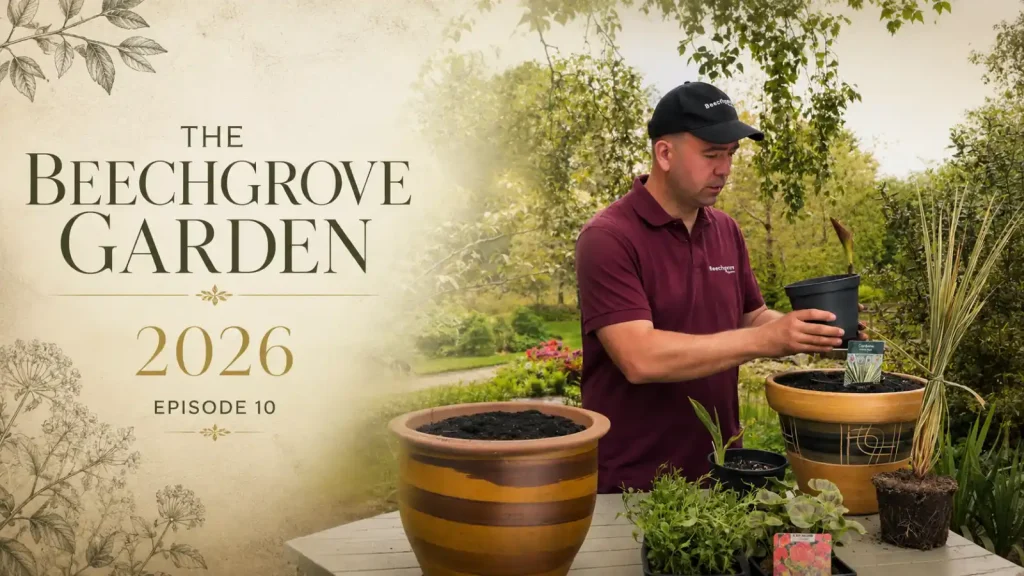
The Beechgrove Garden 2026 episode 10 hands over the plot just outside Aberdeen to Brian Cunningham and Calum Clunie, and the result is one of the most practical instalments of the year. Early summer is a turning point for any Scottish garden, and this episode meets that moment head-on with hands-on lessons in summer pruning, bedding plant displays, hanging baskets, rhododendron management and the art of squeezing real productivity from a small space. Frost has finally loosened its grip in the north-east, plants are bursting with energy, and the timing of every job suddenly matters.
What makes this episode land so firmly is its honesty about the everyday problems gardeners actually face. Overgrown borders that have spiralled out of control. Rhododendrons that were given room years ago and have since grown into a tangled, crammed mass. Tender plants that refuse to bulk up on schedule. Rather than presenting a flawless showpiece, Brian and Calum work through these frustrations with calm, achievable solutions that suit ordinary back gardens as much as a famous television plot.
Across the half-hour, the action splits between the main Beechgrove garden and Calum’s twin commitments — a realistic family-sized veg plot and a fiercely contested competition border built entirely around scent. There is also a return visit to Jenna McDonald’s allotment near Perth, where wedding flowers and clever companion planting share the same beds. Together, these strands turn The Beechgrove Garden 2026 episode 10 into a masterclass in working with the season rather than against it.
The episode opens in a corner of the Beechgrove garden devoted to foliage and flowers, with a clear ambition: to bring a touch of the exotic to north-east Scotland. It is a bold aim in a climate defined by hard winters, and the section quickly becomes a lesson in patience. A paulownia that was hard-pruned back in April now sits as a stubby stem, cut almost to the ground, with only young shoots beginning to push out. The vision is a multi-stemmed plant, but it will take a couple of years to fill the space with foliage again.
That gap creates an immediate problem. Bare soil never stays bare for long, and weeds will happily colonise any exposed ground. The fix is refreshingly simple. Temporary plantings of dahlias — the seed-raised Bishop’s Children, prized for bronzy, purple-tinged foliage and vibrant pinks, oranges, reds and yellows — slot in to cover the soil and inject colour while the main plant recovers. It is a reminder that the best gardens are managed in layers of time, not single moments.
The standout teaching moment comes with an evergreen Fatsia japonica that has begun to encroach on a path beside the pond, creating a slip risk. Early summer is the ideal window to cut into evergreens like this: the frost risk has passed, the plant is loaded with energy about to burst into growth, and the new foliage has the whole summer to toughen up before facing another Aberdeen winter.
Crucially, this is staged pruning, spread over two or three years, removing no more than a quarter of the plant at a time to avoid shocking it. After a quick check for nesting birds, the offending stems are taken back hard, and fresh shoots are already breaking away to fill the gaps being created.
The Beechgrove Garden 2026 episode 10
Bedding Plants For Borders And Baskets That Deliver All-Summer Colour
Bedding plants earn a starring role in The Beechgrove Garden 2026 episode 10, and Calum frames them perfectly: temporary plants that deliver high impact and loads of colour right through the summer. The honesty continues with a canna that simply hasn’t grown fast enough to serve as the tropical centrepiece he wanted. Instead of forcing it, he grows it on quietly in its pot, plans to overwinter it, and earmarks it as a future star — a small lesson in not fighting a plant’s natural pace.
The replacement centrepiece is a cordyline, paired with a genuinely useful overwintering trick. These plants struggle in cold winters, so Calum keeps them in pots near the house for residual warmth and ties the foliage up to protect the crown. The detail that matters: never use twine, which does more harm than good. Tying the leaves shields the central growing point and stops rain and snow pooling and rotting it out. With a pre-planted pot trick giving him a ready-made hole, the cordyline drops neatly into place, underplanted with cascading lobelia that will drape over the sides for a tropical finish, sited in bright but indirect light to protect the foliage.
For high impact with low maintenance, geraniums are the recommendation. Bigger pots mean bigger displays and less frequent watering, and a single colour — here a salmon geranium — draws the eye far more effectively than a mix. Five plants go in, four around the edge and one in the centre, set into home-made Beechgrove compost boosted with a slow-release fertiliser. These tolerate a little neglect, shrug off the odd missed watering, and flower from late spring until the first hard frost if deadheaded occasionally.
The basket section closes the loop with structure and technique. A mixed hanging basket uses lobelia to cover the lower half, an upright osteospermum at the centre, and trailing plants around the outside to create that coveted ball effect. The aftercare is just as important as the planting. New baskets spend a week in the glasshouse to establish, then move outside, fed once a week now and twice weekly through summer, switching to a tomato feed in July to push out more blooms. Constant deadheading keeps the plant flowering rather than setting seed — the secret behind baskets that become, in Calum’s words, the envy of the street.
Why Early Summer Is The Moment To Tackle Overgrown Rhododendrons
Rhododendrons are brilliant plants for Scottish gardens, ranging from compact alpine varieties to woodland giants, and this episode gives them serious attention. In an expertly managed setting they need almost no intervention. The reality in most residential gardens is very different: rhododendrons planted with what seemed like ample room have grown into each other, crammed and impossible to separate. The Beechgrove Garden 2026 episode 10 confronts exactly this scenario and offers a graded approach to fixing it.
Before any rhododendron work begins, Brian addresses their plant partners. A variegated pyrus is reverting to pure green in places, where the stronger mother plant is reasserting itself and crowding out the variegated foliage. Tracing the reverting stem back to its origin and removing it preserves the variegated form and opens up valuable space beside a neighbouring vaccinium. It is the kind of subtle intervention that protects a plant’s character before it slips away unnoticed.
The timing principle is the key takeaway. Rhododendrons are mostly grown for their showy spring and early-summer blooms, and once those flowers fade, that is the perfect moment for maintenance. Some varieties also offer wonderful foliage, with a rich brown felt called indumentum on the underside of the leaves — beautiful, but easy to over-prioritise at the expense of the blooms. The gentler technique here is nibbling: tracing a wayward shoot back to a healthier shoot growing in the right direction and removing it, working steadily around the plant. Repeated every two or three years, this light-touch approach avoids any need for drastic action.
Managing A Crammed Border When Three Plants Live Where Two Belong
The most decisive moment of the episode arrives when Brian diagnoses a classic overcrowding problem: three plants growing where only two will truly thrive. Alongside a couple of rhododendrons sits a striking enkianthus, the variety Red Bells, hung with clusters of dangling red flowers. The judgement call is clear — remove the rhododendron in the middle so the other two can flourish with the room they need. It is the sort of difficult decision many gardeners avoid, and watching it carried out with confidence is genuinely instructive.
There is a reassuring bonus. This particular rhododendron is rough-barked, which means it stands a strong chance of regenerating after drastic pruning, sending out fresh shoots rather than dying back. The technique on display is precise and worth copying. Running a finger down the stem reveals a small bump known as the plant node, the point from which new shoots are most likely to emerge. Cutting a couple of centimetres above that node gives the plant the best possible chance of breaking again.
The mechanics of the cut also matter. To bring down a substantial branch safely, the first cut goes in behind to take the weight off, preventing tearing, before the final clean cut is made. Once the central plant is removed, light floods back into the border, and the remaining gaps will fill in as the surviving plants respond. The closing advice applies to every drastic job in the garden: after cutting back hard, give the plant a good drink and a generous mulch to help it recover. The result is a more balanced, healthier border and a repeatable method for managing any tricky, congested planting.
Companion Planting And Wedding Flowers At Jenna’s Perth Allotment
The episode’s allotment strand returns to Jenna McDonald near Perth, last seen in April and now juggling a particularly personal project. She is getting married later in the summer and has turned much of her allotment over to growing flowers for the big day, while still finding room for vegetables. It is a warm human-interest thread that grounds the gardening in real life, and the planting choices reflect both celebration and practicality.
The vegetable plan centres on a winter squash called Fictor, producing bright orange teardrop fruits ready to harvest from September, alongside a Genoese courgette. To maximise the bed without sacrificing the wedding flowers, Jenna interplants sunflowers — dwarf Sunspot sunflowers raised from seed along the edges, and the tall Velvet Queen with coppery, burgundy petals and a dark centre sown through the middle as future cut flowers. Space is the constant pressure, and every plant is asked to earn its place.
The cleverest detail is the science behind the pairing. Sunflowers are allelopathic, releasing natural toxins from their roots that can stunt neighbouring plants. Planted among potatoes, they would produce a disappointing crop. Squashes, however, are unaffected, partly because their shallow roots sit clear of the sunflowers’ deep taproots, and the taller sunflowers even provide useful shade. This is companion planting at its most strategic — understanding which plants help each other and which quietly compete underground.
Sweet Alyssum, Sweet Peas And The Beneficial Insects Working Behind The Scenes
Inside a communal polytunnel, the focus shifts to heat-loving crops — chillies, tomatoes and cucumbers — and the supporting cast that protects them. Sweet alyssum is the chosen companion, valued for tiny, nectar-rich flowers that attract pollinators and beneficial insects which then predate on pests like aphids and whitefly. Because alyssum enjoys the same consistent watering and rich soil as the crops, it sits comfortably among them, and planting two seedlings together rather than separating them creates a denser, more compact plant. It is biological pest control built quietly into the planting plan.
Sweet peas provide a story of contrasts. Earlier sowings, supported on a wigwam made from old apple-tree cuttings and planted into plenty of well-rotted manure, have romped away. A later batch — grown from a sweet pea Swiss roll — are considerably smaller and leggy, but far from lost. Lifted carefully by the leaves to protect the stems, they reveal long taproots that demand a deep planting hole, and they go into another pot of rich manure with fresh canes to catch up.
The technique throughout stays gentle and considered. Holes are made deep enough to protect established roots, compost is firmed in, and the leggy stems are twisted gently around the cane to encourage them upward. The reward, in time, will be plenty of gorgeous scented sweet peas. It is a section that rewards careful watching, full of small choices that separate a thriving plant from a struggling one.
Maximising A Small Family Veg Plot With Recycled Planters And Mini Greenhouses
One of the episode’s most relatable segments recreates the kind of veg plot an average family might actually have at home, with a clear goal: grow enough for a family of four while maximising every inch of space. Runner beans that were protected under fleece against frosty evenings are finally uncovered now that night-time temperatures have warmed, freeing them to climb their canes. From there, the inventiveness ramps up with the same money-saving spirit that runs through the whole plot.
Space is conjured from unlikely places. A courgette goes straight into the compost heap, exploiting the warmth and steady feed of decomposing material, with the plant’s broad leaves expected to shade and protect the soil from drying out. A recycled pallet, lined with membrane and filled with earth, becomes a productive planter already setting strawberries and housing two of three lettuce crops. Even glasshouse growing is democratised through inexpensive mini greenhouses, proving that productive gardening need not depend on space or budget.
The crop choices are tuned for small-space success. Tumbling tomatoes in yellow and red varieties promise heavy yields — a single tumbling tomato in a five-litre pot delivered over 50 fruits the previous year — alongside peppers and a mini cucumber called Tiny Tot, which grows to around 11cm and suits a child’s lunchbox. The cucumber is supported using a scrunched ball of string buried in the planting hole and trained diagonally upward, lifting it off the ground to protect the crop and reduce the risk of powdery mildew. It is a neat, no-cost solution to a common greenhouse problem.
Calum’s Fragrant Competition Plot And The Pursuit Of Scent
The competition plot brings narrative tension to The Beechgrove Garden 2026 episode 10, with this year’s challenge built around the senses. Calum has drawn Smell — secretly the one he wanted — and as reigning champion he is playing his plans close to his chest. The design philosophy is to pack as many aspects of horticulture as possible into a small plot while keeping every element tied to fragrance, from the freshly cut lawn to the planting itself.
The layout reveals a gardener loosening up. Known for regimented straight lines, Calum turns a square bed into four triangles, planting phlox, lilies, freesia and chocolate cosmos for scent, with a row of carrots threaded through for the beautiful smell released at harvest. Budget-conscious touches appear throughout: a planter turned on its side to display pots and add height, and grass grown from seed rather than laid as turf, roughed up and reseeded to patch the patchy areas before judging.
There is genuine rivalry at stake. Carol will judge by getting her nose right into the fragrance, and Brian warns that fellow competitor Ruth is the one to watch, the gardener most likely to take Calum’s crown. His response — bring it on — sets up a contest that will run through the series. It is a reminder that even an instructional gardening programme thrives on a little competitive spirit, and the scent theme gives every planting decision a clear, sensory purpose.
Handy Hints On Tree Care And Peony Disbudding For Bigger Blooms
The episode rounds out with practical handy hints that reward returning to plants long after they go in the ground. A rowan, the upright variety Autumn Spire chosen for small spaces because it grows up rather than out, illustrates the danger of planting and forgetting. The tree has grown enough that its tie is now buckling and effectively strangling the trunk, creating a weak point that strong winds could snap. Loosening the tie lets the tree breathe while the stake continues to do its supporting job.
Two further checks protect the tree’s future. Young shoots at the base are snipped away with secateurs, and one in particular is identified as growth from below the graft. Because Autumn Spire has been grafted onto a rootstock, any shoot from that rootstock could become dominant, take over and replace the variety that was actually paid for. Removing it preserves the tree the gardener chose. These are small, easily missed jobs with outsized long-term consequences.
The final hint heads to a cut-flower garden and a peony, the variety Shirley Temple, where the aim is big, healthy, strong blooms. Disbudding the smaller side shoots channels all the plant’s energy into the main bud, producing one impressive flower rather than several modest ones. And there is reassurance for anyone alarmed by ants on their peony buds: the flowers leak a sugary nectar that simply attracts them, and the ants repay the favour by dealing with any aphids that venture in.
Taken as a whole, The Beechgrove Garden 2026 episode 10 is a clinic in seasonal timing and practical judgement. Whether the task is staged pruning of an exotic shrub, light-touch rhododendron maintenance, companion planting for healthier crops, or wringing a full harvest from a tiny back garden, the message stays consistent — work with the energy of early summer, intervene with care, and plants will repay the effort. It leaves viewers not just informed but genuinely equipped to head outside and get the secateurs out.
FAQ The Beechgrove Garden 2026 episode 10
Q: Why should you prune evergreens like Fatsia japonica in early summer?
A: Early summer is ideal because the frost risk has passed and the plant is full of energy about to burst into growth. Cutting now gives the new foliage the entire summer to toughen up before facing another harsh winter. For larger evergreens, stagger the work over two or three years and never remove more than a quarter at once to avoid shocking the plant.
Q: How do you overwinter a cordyline in a cold climate?
A: Keep cordylines in pots near the house so they catch residual warmth, then tie the foliage up to protect the crown. This stops rain and snow pooling in the centre and rotting the growing point. Never use twine to tie them, as it does more harm than good and can damage the plant.
Q: When is the best time to prune rhododendrons?
A: Prune rhododendrons once their showy spring and early-summer blooms fade, which is the perfect window for maintenance. For most plants a light-touch approach works best: trace a wayward shoot back to a healthier shoot growing in the right direction and remove it. Repeated every two or three years, this nibbling method avoids any need for drastic action.
Q: Can a rhododendron grow back after hard pruning?
A: Yes, rough-barked rhododendrons have a strong chance of regenerating after drastic pruning, sending out fresh shoots. The key is the plant node, a small bump felt along the stem, where new growth emerges. Cut a couple of centimetres above that node, and always cut in behind a heavy branch first to take the weight off before the final clean cut.
Q: Why do sunflowers and squash grow well together but sunflowers harm potatoes?
A: Sunflowers are allelopathic, releasing natural toxins from their roots that can stunt nearby plants. Potatoes suffer badly, ending up small. Squashes, however, are unaffected because their shallow roots sit clear of the sunflower’s deep taproots. The taller sunflowers also provide useful shade, making them a smart companion for squash but a poor neighbour for potatoes.
Q: How do you keep hanging baskets flowering all summer?
A: Establish new baskets in the glasshouse for a week before hanging them outside. Feed once a week now, increasing to twice weekly through summer, and switch to a tomato feed in July to push out more blooms. Most importantly, deadhead constantly. This stops the plant setting seed and keeps it producing fresh flowers instead.
Q: What should you do when three shrubs are crammed into one border?
A: Remove the weakest or most central plant so the remaining two get the room they need to flourish. Once the crowded shrub is taken out, light floods back into the border and the survivors fill the gaps as they respond. After any drastic cut, give the plant a good drink and a generous mulch to aid recovery.
Q: How do you support a cucumber to prevent powdery mildew?
A: Bury a scrunched ball of string in the planting hole, set the cucumber on top so its weight holds the string, and train the plant diagonally upward. Never tie string directly to the stem, as it will break. Lifting the plant off the ground protects the crop and reduces the risk of powdery mildew that comes from sprawling growth.
Q: Why is there a shoot growing from the base of my grafted tree?
A: Growth below the graft comes from the rootstock, not the variety you bought. Left in place, it can become dominant and take over the tree, replacing the variety you paid for. Snip it off with secateurs along with any other young basal shoots. Also check the tree tie regularly, as a buckling tie can strangle the trunk and weaken it.
Q: Why are ants on my peony buds and should I worry?
A: Ants appear because peony buds leak a sugary nectar that attracts them, so there is no cause for concern. They can even help by dealing with any aphids that venture in. For bigger, stronger blooms, disbud the smaller side shoots so all the plant’s energy channels into the main bud, producing one impressive flower instead of several modest ones.