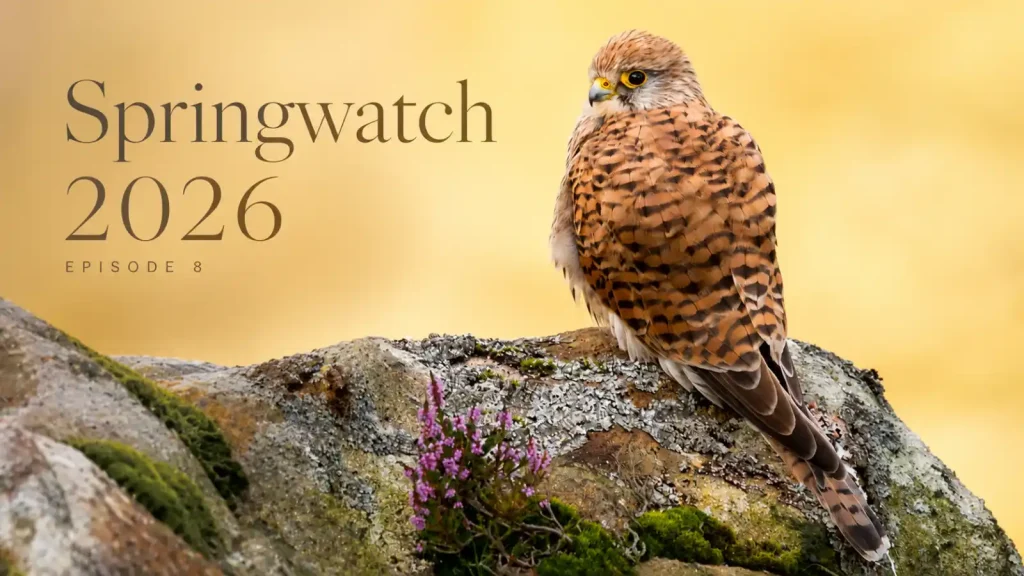
Springwatch 2026 episode 8 brought the second week to a close from the rain-soaked National Trust reserve at Crom in Fermanagh, Northern Ireland, where Chris Packham and Michaela Strachan tracked a dramatic mix of new life, sudden loss and behaviour rarely caught on camera.
A starling nest hatched in real time, a blackcap brood vanished overnight to a pine marten, and one of the most unsettling stories in British wildlife — a mother spider eaten alive by her own young — played out on the studio screens. Meanwhile, Iolo Williams wrapped up a week-long road trip through London, releasing harvest mice in Ealing and finally meeting a creature he had chased for years.
The cold snap framed everything. Temperatures dropped so sharply that Strachan joked she had zoomed into Winterwatch, and the chill shaped the fate of nearly every nest on the live cameras. Swallows piled together for warmth, little grebes stayed put longer than expected, and chicks that might have fledged in warmer conditions held on for one more day. The weather was not background detail. It was the deciding factor in whether some of these young birds survived the weekend.
This was an episode built on contrast. Tender, hopeful moments sat beside brutal predation and biological extremes, and the presenters never softened the difficult parts. That honesty is what gave Springwatch 2026 episode 8 its weight, turning a routine end-of-week round-up into one of the most memorable instalments of the series so far.
The starling nest tucked between the bricks delivered one of the episode’s quiet triumphs. Over 24 hours, the live cameras captured the first egg hatching as the adult shifted off the clutch, revealing a chick squeezing free of a glorious blue shell. The footage was intimate enough to show the chick using its egg tooth to score a crack right around the egg’s circumference before forcing its way out, visibly exhausted by the effort.
By the time the cameras caught up, four chicks had emerged and a single egg remained. The presenters explained that a full clutch can take a day to hatch entirely, with the hope of five chicks by morning. Both early arrivals were already begging for food, helpless and naked, facing roughly three weeks of growth before they could fledge.
The blue of the eggshells became a story in itself. Scientists have identified a pigment called biliverdin in those shells, and it is not decorative. The pigment acts as an antioxidant and antiviral, protecting developing embryos inside the nest and sometimes shielding the chicks after they hatch. It is the same base pigment behind the pale blue of song thrush and blackbird eggs. As the team noted, there is always a reason in nature — even the colour of a shell earns its place.
Springwatch 2026 episode 8
Pine Marten Predation Ends the Crom Blackcap Brood Overnight
Not every nest on Springwatch 2026 episode 8 ended in hope. The blackcap nest, home to four well-fed chicks the previous day, had simply disappeared by the time the cameras went live. The whole structure was gone, leaving only the question of what had taken it.
The answer came from footage recorded in the early hours. At two minutes past three, the brooding adult flew out, disturbed by something rustling in the undergrowth. Nest watchers braced for the stoat that had earlier predated a nearby bullfinch nest. Instead, the culprit was a pine marten. The camera did not capture the chicks being taken, but it showed the marten gripping the nest, dragging it down and clearing it entirely.
The returning adult’s confusion was hard to watch — both chicks and nest were gone. Yet the presenters offered genuine reassurance grounded in biology rather than sentiment. Blackcaps frequently nest again within a season, and with plenty of breeding time left, this pair stands a real chance of raising another brood. Loss on Springwatch is rarely the end of the story.
Matrophagy Explained: The Black Lace Weaver Spider’s Ultimate Sacrifice
The episode’s most extraordinary segment came from a viewer photograph of a black lace weaver spider — and a teaser earlier in the show telling audiences not to Google the word matrophagy. The wait paid off. This unassuming spider, often dismissed as merely menacing, carries one of the most remarkable life histories in the British countryside.
Living in crevices, the female produces an egg sac that hatches into anywhere from 60 to 180 spiderlings, all clustered on the natal web. They do not leave to find food. Instead, the mother feeds them with trophic eggs — unfertilised, nutrient-packed eggs that give the young enough energy to moult and grow. Even after moulting, they remain on the web, where in many spider species the young would simply start eating each other.
What happens next is darker and stranger. The mother finds a spot on the web and begins to drum and tremble, synchronising the spiderlings into a single mass. She presses herself down among them, and they swarm over her body, plunging their fangs into the soft parts of her abdomen. They inject an enzyme that dissolves her internal organs, then slowly suck her dry, killing her in the process. This is matrophagy — eating your own mother — and it is the literal definition of maternal sacrifice.
Crucially, it works. Studies of this species show that spiderlings whose mother gives herself up grow larger, moult more regularly and leave the nest in far better condition than those that do not consume her. Their odds of survival rise sharply. As Strachan observed, every mother has reminded a child what she sacrificed for them — but this really is the ultimate version.
Releasing Harvest Mice in Ealing: Iolo’s Urban Wildlife Mission
Iolo Williams closed his London road trip in a surprisingly verdant corner of Ealing, where conservation has taken root in the most urban of settings. His base was Horsenden Hill, a large green space he had never visited but was immediately struck by — ancient woodland mixing oak and ash, drumming woodpeckers, song thrushes, and scrub alive with whitethroats and tit flocks gathering caterpillars.
The headline project was a harvest mouse release led by an army of volunteers and a coalition of organisations. These mice are astonishingly delicate, weighing about the same as a 20 pence coin, with a prehensile tail used to grip vegetation as they move between plants. Their average lifespan is barely 18 months. The meadow had been deliberately managed for them, planted with knapweed and hogweed to create the varied structure they depend on.
Volunteer Emma Woods explained the bigger picture. The project began roughly six years ago, conceived partly to restore a missing link in the food chain for the area’s absent birds of prey and apex predators. The team has since released along connected wildlife corridors threading through West London’s canals, hoping the mice will travel and establish new pockets of colonies. The evening Iolo joined them marked a milestone: the 3,500th mouse released. His own attempt at handling one ended in cheerful chaos, the mice burrowing and escaping until he conceded he would never make it as a harvest mouse wrangler.
Jackdaw Real Estate Wars at Crom’s Boathouse Nests
From the rooftops of a Peak District village came a study of jackdaws as property obsessives. The United Kingdom’s smallest corvid, with its silvery sheen and pale, calculating eyes, treats nest sites like prime real estate — and in a high-demand spring, location is everything. These deeply monogamous birds form bonds long before breeding, reinforced through courtship and mutual preening, and those partnerships often last for years.
As cavity nesters, jackdaws compete fiercely for church towers, chimney stacks, attic spaces and gaps beneath eaves. The best addresses go to the most experienced or persistent pairs. One couple in the film secured a grand church attic with an enviable lookout, though its open entrance left them exposed to weather and predators. After 20 days of incubation, their efforts paid off with chicks that would spend four to five weeks inside before trading the attic for the rooftops.
The Crom boathouse offered the live drama. There, the team watched adults repeatedly carrying dried mud into the nest and throwing grit over their youngsters — behaviour the presenters theorised was a form of in-nest dust bathing, removing excess feather oil and controlling parasites like bird lice. Nearby, a single-chick nest tended by one parent became the target of a prospecting pair who trampled the chick while inspecting the property for themselves. When the parent returned, feathers genuinely flew, with biting and leg-pulling until the intruders were driven off. The chick, remarkably, survived it all and continued to develop well.
Soprano Pipistrelle Bats and the Spectacle of the Night Roost
Bats threaded through the whole episode, but the standout came when James Stevens canoed to a remote house sheltering a thousand-strong colony of soprano pipistrelles in its attic. After camping out and setting an alarm for 3am, he captured the bats returning at dawn, circling in a swarm to communicate and relocate their roost, attempting their landings again and again before clattering into the wood.
This was no ordinary gathering. The colony is almost entirely heavily pregnant females, having formed a maternity roost to raise their pups. At this time of year their appetite peaks as they gorge on tiny insects through the night. Each female will produce a single pup, meaning the swarm will grow even more spectacular by late summer when the young take to the air.
Back in the studio, Packham unpicked the science. The single “pipistrelle” of decades past is now known to be three species — common, soprano and Nathusius’s. The common pipistrelle is a generalist, but the sopranos at Crom favour ecotones, the rich edges where wood meets water. With the loch’s shoreline and scattered islands, the reserve is close to perfect for them, and the boathouse alone hosts all eight of Northern Ireland’s bat species. Out over the water they aerial hawk, snatching thousands of midges from the air in flight.
The Reed Warbler and Cuckoo: A Side-by-Side Story of Survival
Wildlife filmmaker Robert Fuller delivered one of the season’s most affecting strands from a Yorkshire reed bed, where he had found both a reed warbler nest and, extraordinarily, a cuckoo chick being raised in a second warbler nest. The chance to compare the two side by side produced a portrait of two utterly different childhoods unfolding metres apart.
The reed warbler chicks grew with startling speed, fledging in as little as 11 days. Fuller filmed them taking their first tentative trips out of the nest and back again, calling from the reeds, until one by one they made their way to the top and prepared for lives that will eventually carry them all the way to Africa. Their growth from day one to day nine was, by any measure, extraordinary.
The cuckoo’s story was stranger and more demanding. Its foster parents hauled in far larger prey — damselflies, even bumblebee-mimic hoverflies — yet the chick begged relentlessly, quite literally bursting out of a nest never built to hold its weight. As fledging approached, it switched to a new chipping call designed to help the warblers locate it once it left, before reverting to its begging call whenever food arrived.
The image of a tiny reed warbler perched on the back of a vastly larger cuckoo, posting food into its mouth, captured everything bizarre and moving about the relationship. The cuckoo has now taken its first flight toward independence and will be fed for a few more weeks before its own journey to Africa.
The Surprising Physics of Why a Pike Hovers in Water
The episode’s final lesson turned the familiar idea of hovering on its head. We picture kestrels, hoverflies and hummingbird hawk-moths, all using wings — but the fish cam revealed that the pike hovers too, hanging motionless in the water. The assumption was that stillness saves energy. The reality is the opposite. A hovering pike burns roughly twice the energy it would use resting on the bottom.
That cost demands an explanation. A fish controls its depth using a buoyancy organ, adjusting gas to sit where it wants in the water column. But buoyancy alone cannot stop a fish pitching up and down or rolling side to side in shifting currents. The challenge is sharper for the pike because its centre of mass and centre of buoyancy do not align, making stable hovering genuinely difficult. A broad-bodied fish like a crucian carp has those centres closer together and more surface area to resist rolling, so it holds position far more easily.
The pike’s long, slender shape forces a compromise, with most of its fins bunched toward the tail and working constantly to counter every current. The payoff lies in its hunting strategy. As a sit-and-wait predator, the pike hovers in ambush, then uses those rear fins and a powerful tail to explode forward in a sudden burst of speed, closing on prey before it can react. All that wasted-looking stillness is actually a loaded spring — a clear example of how Springwatch 2026 episode 8 found the deeper logic behind even the quietest behaviour.
As the programme signed off, viewer photographs rounded out the wildlife on show: an osprey carrying a fish with two toes pointing forward and two back so it can fly with its catch facing into the wind, and a grey seal popping up beside a kayaker far upriver on the Dee, proof of a waterway full of fish. With the live cameras running from 10 each morning through the weekend, and the promise of honey buzzards to come, the wildlife of Springwatch 2026 carried its momentum straight into week three.
FAQ Springwatch 2026 episode 8
Q: Why are starling eggs blue?
A: Starling eggs get their pale blue colour from a pigment called biliverdin. The pigment acts as both an antioxidant and antiviral, protecting the developing embryos inside the nest and sometimes the chicks after they hatch. It is the same base pigment found in song thrush and blackbird eggs, so the colour serves a clear biological purpose rather than being decorative.
Q: What predated the blackcap nest on Springwatch 2026?
A: A pine marten took the entire blackcap brood overnight at Crom. Footage recorded just after 3am showed the adult flying out after being disturbed, then revealed the marten gripping the nest, dragging it down and clearing it completely. The four chicks and the nest itself were gone by morning, though blackcaps frequently nest again within the same season.
Q: What is matrophagy in spiders?
A: Matrophagy means eating your own mother, and the black lace weaver spider practises it. After feeding her spiderlings nutrient-rich trophic eggs, the mother drums on the web to draw them together, then lets them swarm her body. They inject an enzyme that dissolves her organs and slowly suck her dry. Spiderlings that consume her grow larger and survive better.
Q: Where is Springwatch 2026 being filmed?
A: Springwatch 2026 is broadcasting from the National Trust reserve at Crom in Fermanagh, Northern Ireland. The site offered exceptional wildlife access, with a boathouse hosting jackdaw nests and all eight of Northern Ireland’s bat species. Its loch shoreline and scattered islands create rich edge habitats that suit soprano pipistrelle bats particularly well.
Q: Why are harvest mice being released in Ealing?
A: Volunteers are releasing harvest mice across Ealing to restore a missing link in the local food chain for absent birds of prey and apex predators. The project began roughly six years ago and now releases along connected wildlife corridors threading through West London’s canals. The evening Iolo Williams joined them marked the 3,500th mouse released into the wild.
Q: Why do jackdaws bring mud into their nests?
A: Jackdaws were filmed repeatedly carrying dried mud into the nest and throwing grit over their chicks. The leading theory is in-nest dust bathing, which removes excess oil from feathers and controls parasites such as bird lice. Corvids are known to eat soil and grit to help grind up seeds, but this persistent, deliberate behaviour appeared aimed at the developing young.
Q: How many bats are in a soprano pipistrelle maternity roost?
A: A thousand-strong colony of soprano pipistrelles roosts in the attic of a remote house near Crom. The colony is almost entirely heavily pregnant females that have formed a maternity roost to raise their pups. Each female produces a single pup, so the dawn swarm will grow even more spectacular by late summer when the young first take to the air.
Q: How does a cuckoo chick survive in a reed warbler nest?
A: The cuckoo chick survives by exploiting its foster parents’ instincts, begging relentlessly while the warblers haul in larger prey like damselflies and hoverflies. As fledging nears, it adopts a chipping call that helps the warblers locate it once it leaves the nest. The fragile reed warbler nest is never built to hold a cuckoo’s weight, making fledging especially difficult.
Q: Why does a pike hover in water?
A: A pike hovers as an ambush tactic, hanging motionless until prey approaches. Contrary to expectation, hovering burns roughly twice the energy of resting on the bottom, because the pike’s centre of mass and centre of buoyancy do not align. Its rear-set fins work constantly to counter currents, then launch a sudden burst of speed to seize prey.
Q: How fast do reed warbler chicks fledge?
A: Reed warbler chicks can fledge in as little as 11 days, with remarkably fast growth between day one and day nine. They first take short trips out of the nest and back before making their way up through the reeds. Within a few weeks they will fly as confidently as their parents, ready for the long migration to Africa.