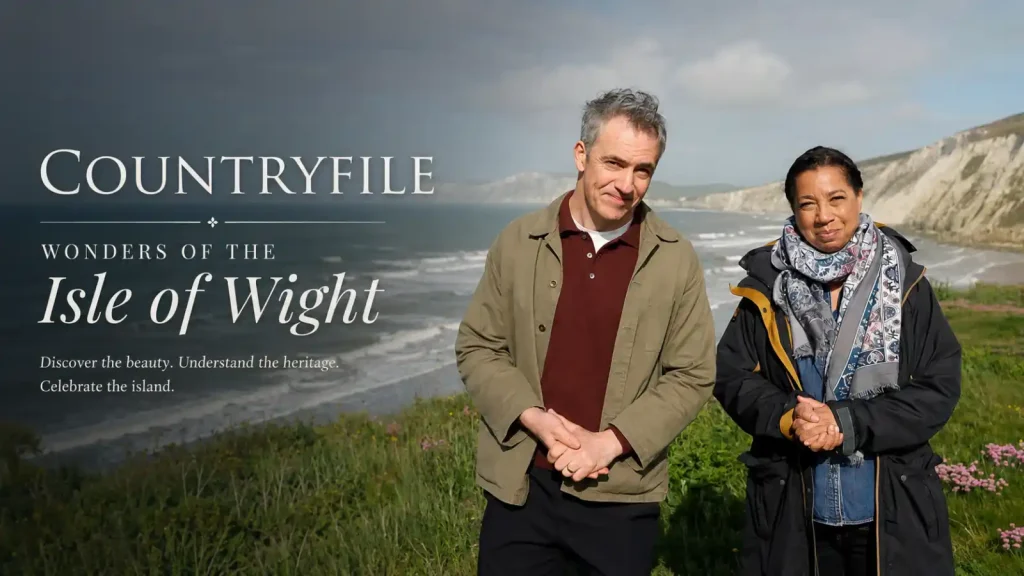
Countryfile – Wonders of the Isle of Wight takes Joe Crowley, Margherita Taylor and Adam Henson to a version of the island that most holidaymakers never encounter. Tourists tend to know the place for its beaches and busy seaside towns. The three presenters look elsewhere. They set out to uncover the corners shaped by geology, climate and geography rather than crowds and deckchairs.
What makes this stretch of England so unusual starts beneath the surface. The Isle of Wight sits on rare geology that has moulded its land in ways visitors rarely stop to consider. That rock, combined with the island’s far-southern position, has produced a landscape full of genuine surprises. Crowley, Taylor and Henson follow those clues, trading the familiar holiday postcard for something stranger and more revealing.
The island’s southerly location does more than guarantee sunshine. Sitting further south than almost anywhere else in the country, it enjoys a climate that behaves unlike the mainland’s. Warmth lingers. Conditions soften. Plants that should struggle this far north instead find a home here, and the presenters trace exactly how that happens.
Geology and position together explain the island’s distinctive habitats. Adam Henson, a farmer by trade, brings a practical eye to the way the land works and what it can support. Margherita Taylor and Joe Crowley widen the focus, drawing out the human and natural stories layered across the terrain. Between them, the trio build a portrait of an island defined by what lies under and around it, not by its resorts.
One of the episode’s biggest surprises grows in the fields. The mild southern climate allows the island to support crops more commonly linked to warmer countries. These are not the hardy staples you might expect along the English coast. They are plants that thrive in the heat, coaxed into life by a pocket of Britain that feels closer to the Mediterranean than the Channel. Henson, with his farming background, is the natural guide to how growers make that possible.
The coastline tells an equally unexpected story. The waters around the Isle of Wight hold unusual marine life, the kind that rewards anyone willing to look past the obvious. Beneath the waves and along the shore, species flourish that owe their presence to the same rare geology and gentle climate shaping the land above. Crowley and Taylor head to the water’s edge to meet them, turning a familiar seaside into something closer to a discovery.
Habitat, by its nature, is where all these threads meet. Distinctive landscapes form when geology, climate and location pull in the same direction, and the island offers a textbook case. Rock determines what grows. Position dictates how warm it stays. Together they create environments found in few other parts of Britain, and the presenters move through them with obvious curiosity.
The episode works because it resists the easy version of the Isle of Wight. Anyone can photograph a beach. Far fewer pause to ask why the island looks and behaves the way it does. By following geology, climate and southerly position, Crowley, Taylor and Henson reveal a place that has always been hiding in plain sight.
For viewers, the appeal is partly the company. Margherita Taylor brings warmth and curiosity to every encounter. Joe Crowley keeps the pace lively and the questions sharp. Adam Henson grounds the whole thing in real, working knowledge of land and farming. Their different strengths suit a subject this varied, where one moment turns on rock formations and the next on crops basking in unexpected sun.
Countryfile – Wonders of the Isle of Wight
This instalment also reframes what an island holiday destination can be. The Isle of Wight is rarely thought of as a place of scientific intrigue, yet its rare geology and southern climate make it exactly that. The presenters never lecture. They simply show how the ordinary holiday island conceals a far more interesting reality, one built from rock, warmth and a position that nudges it toward the exotic.
By the close, the message lands without force. Look past the beaches and the bustling towns, and the Isle of Wight becomes a study in how geography shapes life. Unusual marine life offshore. Distinctive habitats inland. Crops that have no business growing this far north, yet somehow do. Each strand traces back to the same rare foundations, and the trio leave viewers seeing the island anew.
The genius of the programme is its restraint. It does not oversell. It lets the island’s surprises speak for themselves, guided by three presenters who clearly enjoy the puzzle. Whether the focus falls on a warm-weather crop, a curious sea creature or a habitat found almost nowhere else, the throughline holds steady. This corner of England rewards the curious traveller far more than the casual one.
That, finally, is what the episode offers. A reason to look again at a place many assume they already know. The beaches remain. The holiday towns still hum. Behind them, though, sits a landscape shaped by forces most visitors never notice, and Crowley, Taylor and Henson make those forces impossible to ignore. By journey’s end, the Isle of Wight feels less like a familiar resort and more like a small, sunlit world worth exploring properly.
Countryfile – Wonders of the Isle of Wight
Countryfile – Wonders of the Isle of Wight reveals a side of the island that holidaymakers rarely notice, trading the postcard image of sandy beaches and seaside towns for something far stranger and more fragile. Joe Crowley, Margherita Taylor and Adam Henson spread out across the island to investigate how its southerly position and unusual geology have produced a landscape that behaves almost nothing like the rest of Britain. Sharks and stingrays gather in its shallow seas.
One of the country’s rarest bees clings on at a population of just a handful. Citrus trees and garlic thrive where they have no business growing. Throughout Countryfile – Wonders of the Isle of Wight, a single thread keeps surfacing: this is a place constantly remaking itself, where rare species hold on as new ones move in and the coastline itself refuses to stay still.
The island sits about a mile from the Hampshire coast at its closest point, opposite Portsmouth, covering roughly 150 square miles with Newport at its centre. It is the only English county that is entirely an island, and that isolation, combined with a mild climate, has turned it into a natural laboratory. Some of what the team finds is encouraging. Some of it is a warning.
What follows is a journey through warm shallow waters, chalk downland, a botanic garden that feels almost tropical, Britain’s biggest garlic farm, a half-acre field holding the last native population of a vanishing plant, and a coastal path engineered to survive a shoreline that keeps falling into the sea.
Sharks and Stingrays Are Quietly Colonising the Isle of Wight’s Shallow Seas
Along the island’s northern shore, facing the Solent, the seabed is shallow and sheltered, and it supports a surprising density of marine life. Sharks and rays are gathering off these shores, and scientists are only beginning to work out why. Theo Vickers, a PhD student from the island studying at the University of Portsmouth, is leading the effort to understand them, focusing in particular on the common stingray, a charismatic species found in only a few spots across Britain.
Much of what is known about these animals has come from anglers rather than formal science. Vickers wants to change that. His research maps where inshore sharks and rays appear around the island, including catsharks, dogfish, smooth hounds and thornback rays, and asks how they use these habitats. The Solent offers a genuine mosaic: seagrass meadows, salt marsh, sandbanks, gravel banks, and kelpy rocky reefs along the south coast. The site the team works on is a major seagrass meadow, one of the Solent’s biggest inshore habitats, and Vickers suspects features like gravel banks and seagrass matter enormously to stingrays that feed and forage there.
The stakes reach beyond curiosity. If these animals use the island’s waters to feed, shelter or breed, that knowledge could shape decisions on marine protection zones and how activity in these waters is managed in future. Understanding comes first; protection follows.
How Baited Underwater Cameras Are Mapping the Island’s Hidden Marine Life
To gather evidence, the team heads roughly 100 metres into the Solent on paddleboards, carrying baited remote underwater video stations, known as BRUVs. Each is a simple frame with a mounted camera and a bait arm holding local mackerel. The bait draws in sharks, rays, bony fish and crustaceans, and the footage reveals the relative abundance of species moving through the bay. The kit is low-cost and effective, and fellow PhD student Joe Sargeant works the seabed on snorkel to spot the more elusive animals directly.
Timing is deliberate. The cameras go down as the tide floods in, when deeper, safer water tempts larger and more predatory species into the habitat. At low tide the area can be less than two metres deep; at high tide, perhaps three. The clarity on the day is excellent, and almost immediately Joe spots a catshark from the surface. The shallow, busy nature of the water becomes clear, threaded as it is by ferries and container ships passing nearby.
The cameras themselves capture no sharks this time, which is simply how field research goes. They do record a small group of large mullet moving along a shingle bank, confirming a hunch about fish using that route, and a European spider crab, probably a small female, picking at the bait cage in a dense seagrass meadow. Joe, meanwhile, finds two catsharks resting together on the seabed, likely a male and female, not hunting but at rest.
Why a Working Solent Coexists With Thriving Marine Wildlife
No stingrays surface on camera that day. Even so, data from earlier deployments suggests they appear here more often than once believed, though exactly why remains unknown. The mystery is part of what makes the research urgent. These are not pristine, remote waters; they are some of the busiest in the country.
That contrast carries the segment’s strongest message. Enormous ferries and container ships pass constantly, and yet a few metres down lies a haven for sharks, rays and the species they depend on. The two worlds sit side by side. As Vickers frames it, an urbanised marine environment and rich wildlife can coexist, provided the sea is looked after properly.
It is a hopeful note grounded in conditions. Coexistence is possible, but not automatic. It depends on decisions still to be made about how these waters are protected, the very decisions Vickers’ data is designed to inform.
Britain’s Rarest Bee Survives at Culver Down by the Slimmest Margin
The island’s rare wildlife is not confined to the sea. On the chalk downland at Culver Down lives the potter flower bee, one of Britain’s rarest insects, found in only a handful of places nationwide. These bees nest in coastal cliffs, burrowing into softer top layers of exposed soil, and they preferentially feed on ground ivy, a plant flowering early in the season when little else is available.
The numbers are sobering. Countryside manager Paul Davies, who has worked for the National Trust for more than three decades protecting endangered species, explains that over three years of surveying the team recorded just 22 bees. So far this season, only four. Before they were rediscovered two years ago, the bee had not been recorded at the site for 17 years. It survives at desperately low numbers, surfacing on roughly four sites in the UK.
The bee earns its name through extraordinary behaviour. It takes nectar from ground ivy and, the team believes, mixes it with sand to form a small concrete pot, which it fills with nectar and pollen and lays its eggs into, provisioning the larvae inside. That single detail, a wild bee building and stocking a sealed nursery, captures why losing it would mean losing something genuinely irreplaceable.
How Hebridean Sheep Became Conservation’s Unlikely Allies
Saving the potter flower bee comes down to a deceptively simple goal: more ground ivy. The more of this plant the chalk grassland holds, the more nectar and pollen the bees can draw on early in the season. The solution arrived on four legs.
A flock of Hebridean sheep, managed by National Trust ranger Sean Adams, grazes 17 acres of headland. As an old breed, they favour the rough vegetation, eating exactly the coarse growth that conservationists want controlled. They avoid ground ivy because of its pungent smell, so a quick crush of the leaves between the fingers explains, in one sharp scent, why the sheep leave it alone. By clearing competing plants and sparing the ivy, the flock lets it proliferate. Under this regime for only two years on Culver Down, the difference was visible within a single year.
Recording the results falls to a team of dedicated volunteers armed with nets and marking pots. Captured bees are coaxed into a pot and marked on the thorax with a yellow dot from a water-based pen, which prevents recapturing the same insect and reduces post-capture stress before release. Volunteers like Fiona and Theresa spend hours walking the chalk downlands, mapping the vital ground ivy and searching for the bees, identifiable by a distinctive golden spur.
A Single Afternoon That Lifted a Whole Season’s Hopes
Finding a potter flower bee is no small thing when so few exist. On a blustery day, conditions are wrong; the bees stay sheltered and the search comes up empty. Yet the volunteers describe earlier triumphs, including one found just the week before after three or four hours of searching, spotted right at the last minute. The emotion in those moments is real, the payoff for patience measured in hours per sighting.
Davies is clear about what success would mean. After years of restoring the site, and with the bee having hung on for so long, improved habitat management could finally let it proliferate and perhaps spread to other sites. That would be, in his words, genuinely special.
The episode delivers exactly that lift. The very next day, in calmer conditions, the team spotted three potter flower bees in a single afternoon, boosting the season’s total from four to seven. In a population this fragile, three bees is not a footnote. It is nearly doubling the year’s count, and a reminder of how much rests on small margins.
Britain’s Hottest Garden Is Rewriting the Rules of What Can Grow Outdoors
The Isle of Wight enjoys a mild climate, but one pocket on the south coast is a true anomaly, with conditions often compared to the Mediterranean. At Ventnor Botanic Garden, giant water lilies and towering palms grow in the open air, and the place feels almost tropical. The plants thriving here offer a glimpse of what might become possible elsewhere in Britain as temperatures rise.
Head gardener Wayne Williams explains why the microclimate is real rather than wishful thinking. The garden sits on the south of the island, sheltered by the Undercliff, which blocks the north winds, and arranged across south-facing terraces. The site bills itself as Britain’s hottest garden, meaning above all that it stays milder in winter, running around five degrees warmer than most mainland locations, which is critical for the plants grown here. Add the moderating warmth of the surrounding sea, and palms, cacti, succulents and Mediterranean species survive outdoors year-round, plants that elsewhere would need a glasshouse.
The gardens have always been experimental, and that spirit endures. The team continually tests the limits of what can be grown in the open, which makes Ventnor a genuinely pioneering place, somewhere growers can attempt what would fail almost anywhere else in the country.
Inside the UK’s First Outdoor Citrus Grove on the Isle of Wight
The boldest experiment is the UK’s first citrus grove, 40 trees strong, planted only in March 2025. It holds lemons, oranges, grapefruit and Buddha’s hand citrus, the curious finger-shaped fruit. The first year was about roots; this year is about top growth, with fresh deep-purple leaves and flower buds appearing, and a few home-grown lemons already forming.
The grove sits in a sheltered bowl where the wind still howls in the trees above but barely reaches the plants. Williams demonstrates the conditions with a soil pH test, drawing a sample from about 10cm down, mixing it with bottled water to avoid a false reading, and matching the colour against a chart. The result lands at a neutral pH of seven, the ideal balance of acidity and alkalinity. Because the underlying ground is chalk, organic matter on the surface helps keep that balance, and citrus appreciates plenty of it.
Proof that the idea works stands nearby: a 20-year-old lemon tree loaded with fruit. For years it was brought indoors each winter, until about 15 years ago someone left it out and it survived, which inspired the wider grove. The implications stretch beyond ornament. As the climate shifts, traditional crops like apples may struggle here, needing cold to flower, while citrus becomes viable. Both private and public gardens are watching Ventnor to learn what they may grow in years to come, and there is real excitement at the thought that farmers might one day grow citrus commercially on the island.
How Three Generations Built Britain’s Largest Garlic Farm
Garlic belongs to warmer corners of Europe, yet the Isle of Wight is home to Britain’s largest garlic producer. Adam Henson visits the Boswell family, who have grown garlic here for more than 50 years across three generations. It began when grandmother Norah planted some in her market garden 70 years ago, and the family scaled up commercially in the 1970s, drawn to a crop with a growing market when recipes still treated a single clove as optional.
The island suits garlic for concrete reasons. It boasts one of the highest light intensities in the UK, and the free-draining soil south of the downs gives the crop what it likes. The plant cannot be direct-drilled because every bulb starts from a single clove, planted with a four-row, cup-fed planter into a prepared seed bed, a fact that surprises even Adam after a lifetime in farming. The family grows elephant garlic plus five or six other varieties, and a bulb peeled six weeks before harvest is already cricket-ball size.
Crucially, garlic alone does not sustain the farm. The Boswells run a deeply diversified business that employs around 100 people: a tourist attraction, a restaurant, a shop, a wholesale arm, and seed garlic for amateur growers. They have stretched garlic in every conceivable direction, producing some 60 products, from garlic beer to garlic ice cream. Nothing goes to waste, including the flowering scapes harvested for the kitchen.
Why Going Organic Reshaped Both the Land and the Family Business
The move to organic farming, championed by Natasha’s husband Barnes, has transformed the farm, adding new hedgerows and ponds that clean the waste water. It was not painless. For a couple of years yields fell radically, prompting a few knowing giggles from the family, though everyone had backed the shift. By the second year the gamble paid off, and last season delivered one of their best harvests ever.
Garlic is a nutrient-hungry crop that takes a heavy toll on the soil, so each field needs at least five years to recover before garlic returns. To rebuild fertility naturally, Barnes grazes cattle across last year’s crop fields, moving the herd daily so each patch is eaten down then rested. The mix of breeds, including traditional Herefords, Highlands and Angus crosses, lives outside year-round and is Pasture for Life certified, eating only the diverse sward of chicory, plantain, clover and 18 species in total. That diversity, supported by building rest into the system, is crucial to conditioning the soil so good garlic can grow again.
The harvested produce becomes the centre of a shared meal: green garlic with a milder flavour than the dried bulb, very mild scapes eaten whole, and garlic smoked over oak chippings for 48 hours then folded into butter. Barnes describes a journey of proving the farm’s commercial footing before earning the freedom to experiment, willing to embrace ideas he cheerfully admits sounded weird. The family hopes that proving the system works will one day encourage more farmers to fit garlic into their rotations, since, as they note, everyone’s pantry holds it now.
The Last Native Field Cow-Wheat in Britain Is Fighting Back
The island shelters plants that have clung on where they have vanished elsewhere. It holds several Sites of Special Scientific Interest, including one of the smallest in the world, home to one of the UK’s rarest plants: field cow-wheat. Once a common sight in arable fields, the plant was pushed to the edge of extinction by intensive farming and the drive for higher food production. Thanks to a small, determined team, it is recovering.
Jamie Marsh of the local Wildlife Trust has spent 15 years conserving field cow-wheat, and thousands of plants now grow in under half an acre at St Lawrence Field Nature Reserve, the last native site in the whole of the UK. The flower is striking, with purple blooms and yellow fringes that look almost tropical and orchid-like. Its history is unexpectedly dramatic: a hemiparasite, it once latched onto crops like barley and wheat, its seeds resembling wheat grains and getting mixed into harvests, where it turned flour black and bread discoloured. People were once paid to remove it. This bank, on the edge of the arable, became its last bastion.
The plant matters beyond its beauty. It anchors a web of other species, drawing in pollinating bumblebees, while ants gather and carry off its dropped seeds, which is how it spreads. Lose field cow-wheat and the loss ripples outward, because bees feed birds, and the whole food chain feels the absence of a single species. As the team puts it, the country has lost too much already and cannot keep losing.
The Hands-On Work of Saving a Plant From Disappearing
Protecting field cow-wheat means an almost counterintuitive task: clearing trees. Volunteers use tools called tree poppers to lever saplings out by the roots, because if the trees grow they will shade out the area and stop the plant from growing. Getting that balance right is the whole job, and on this site the cow-wheat is the priority. Volunteers Karen and Tracey describe the work clearing brambles, gorse and saplings as exciting and satisfying, knowing each effort might help a plant in danger survive and expand beyond its tiny foothold.
Monitoring is just as careful. Pippa Leicester and Kate Garnham have spent five years tracking the population, using quadrats to count not only flowering plants but those yet to emerge, and measuring how far the species has spread into the field as a gauge of its health. They also watch for ants and bumblebees, the partners that pollinate the flowers and disperse the seeds, because the plant cannot be understood in isolation from the creatures around it.
The next stage is ambitious. The team is ploughing a field to sow a mix of winter oats and forage rye, allowing the cow-wheat to piggyback on these new plants and spread naturally through the landscape. An autumn-sown crop is timed to coincide with seed germination and a gentle overwintering establishment. The dream is a vibrant, self-sustaining population, and one day, a sea of purple stretching across the whole field.
A Coastal Path Built to Survive a Shoreline That Keeps Collapsing
The best way to experience the island’s wildlife may be the King Charles III England Coast Path. When complete, the national route will stretch almost 2,700 miles around the entire English coastline, and on the Isle of Wight it forms a continuous 92-mile trail now in its final stages. True to the island’s character, this section is different: it will be the only English county completely enclosed by the path, so with enough time and stamina a walker could loop the whole island.
That ambition collides with a coastline that refuses to stay still. Chloe Walker-Panse of Natural England describes a genuinely dynamic shore, ranging from the nature reserves and estuaries of Newtown and the boating community at Cowes to the tourist beaches of the east. Geology dictates the pace of change. The harder chalk erodes slowly, while the softer mud, sand, silt and clay on the west side go in big chunks.
When clays become saturated they pulse, separate and slip. A recent erosion event at Bonchurch closed a road and forced residents to evacuate overnight; elsewhere the cliff retreats by around half a metre a year, a figure that becomes enormous over time. A 2023 storm destroyed an entire section of path in a single night, taking a footbridge with it.
Rather than fixing the route in place, the project is engineered to adapt. Under a mechanism called rollback, the path can be moved back as the cliff erodes, effectively future-proofing it, where a traditional right of way, once lost, is slow and difficult to reinstate. Designations like the SSSI and nearby houses limit how far back it can go, so in places the trail moves inland, crosses a new footbridge, then rejoins the cliff top to keep that coastal feel.
At Grange Chine, an SSSI valued for its geology and wildlife, that approach is already in practice, with timber steps and a prefabricated footbridge craned into position to stay one step ahead of the sea. It is, by design, a never-ending project, one that will keep evolving along with the island itself.
The day ends as warmly as it began, with Adam sending the others an ice cream and challenging them to guess the flavour: black garlic and chocolate, a fitting final flourish for an island that keeps confounding expectations. From sharks in busy shipping lanes to a bee that builds its own nursery, from outdoor lemons to the last native cow-wheat in Britain, Countryfile – Wonders of the Isle of Wight makes one thing plain. This is a place defined not by stillness but by constant change, where the people who know it best work, season after season, to help its rarest life hold on.
FAQ Countryfile – Wonders of the Isle of Wight
Q: Why are sharks and stingrays gathering around the Isle of Wight?
A: Scientists are still working that out. The Solent offers a rich mosaic of habitats, including seagrass meadows, salt marsh, sandbanks, gravel banks and rocky reefs. Researchers believe features like seagrass and gravel banks matter most, likely providing places where species such as the common stingray feed and forage in shallow, sheltered water.
Q: How do baited underwater cameras study marine life in the Solent?
A: Each baited remote underwater video station, or BRUV, is a simple frame with a mounted camera and a bait arm holding local mackerel. The bait draws in sharks, rays, fish and crustaceans, and the footage reveals the relative abundance of species moving through the bay. The kit is low-cost and effective, deployed as the tide floods in.
Q: Can busy shipping lanes and rich marine wildlife really coexist?
A: Yes, and the Solent proves it. Huge ferries and container ships pass constantly, yet a few metres below lies a haven for sharks, rays and the species they depend on. Coexistence is not automatic, however. It depends on protecting the marine environment properly and making the right decisions about how these waters are managed.
Q: What makes the potter flower bee one of Britain’s rarest insects?
A: It survives at desperately low numbers on roughly four UK sites. At Culver Down, surveyors recorded just 22 bees over three years, and before its rediscovery two years ago it had gone unrecorded for 17 years. The bee earns its name by mixing ground ivy nectar with sand to build a sealed pot, which it stocks with nectar and pollen for its larvae.
Q: How does grazing sheep help protect a rare bee?
A: Hebridean sheep eat the coarse vegetation that conservationists want controlled but avoid ground ivy because of its pungent smell. By clearing competing plants and sparing the ivy, the flock lets it proliferate, giving the potter flower bee more early-season nectar and pollen. After two years of this grazing regime on Culver Down, the difference was visible within a single year.
Q: Where is the UK’s first outdoor citrus grove and what grows there?
A: It is at Ventnor Botanic Garden on the Isle of Wight, planted in March 2025 with 40 trees. The grove holds lemons, oranges, grapefruit and the finger-shaped Buddha’s hand citrus. A sheltered bowl, neutral soil and the garden’s mild winters make it possible, with home-grown lemons already forming on trees still in their early years.
Q: Why is Ventnor Botanic Garden called Britain’s hottest garden?
A: The title refers mainly to winter mildness. The garden runs around five degrees warmer than most mainland locations, which is critical for the plants grown there. Sitting on the south of the island, sheltered by the Undercliff and arranged across south-facing terraces, it keeps palms, cacti and Mediterranean species thriving outdoors year-round.
Q: How does the Isle of Wight grow Britain’s largest garlic crop?
A: The Boswell family have grown garlic here for over 50 years across three generations. The island offers one of the UK’s highest light intensities and free-draining soil south of the downs. Every plant starts from a single clove planted into a prepared seed bed, since garlic cannot be direct-drilled, and a bulb six weeks from harvest already reaches cricket-ball size.
Q: What changed when the garlic farm switched to organic methods?
A: Yields fell radically for a couple of years before recovering, with last season delivering one of the farm’s best harvests. Garlic is nutrient-hungry, so each field needs at least five years to recover. Cattle now graze former crop fields, moved daily to eat then rest each patch, naturally conditioning the soil so good garlic can grow again.
Q: How is the Isle of Wight coastal path built to survive erosion?
A: Through a mechanism called rollback. Instead of fixing the route in place, planners can move it back as cliffs erode, future-proofing it where a traditional right of way, once lost, is slow to reinstate. The softer western clays slip in big chunks, and a 2023 storm destroyed an entire section overnight, so the 92-mile trail is designed to adapt.