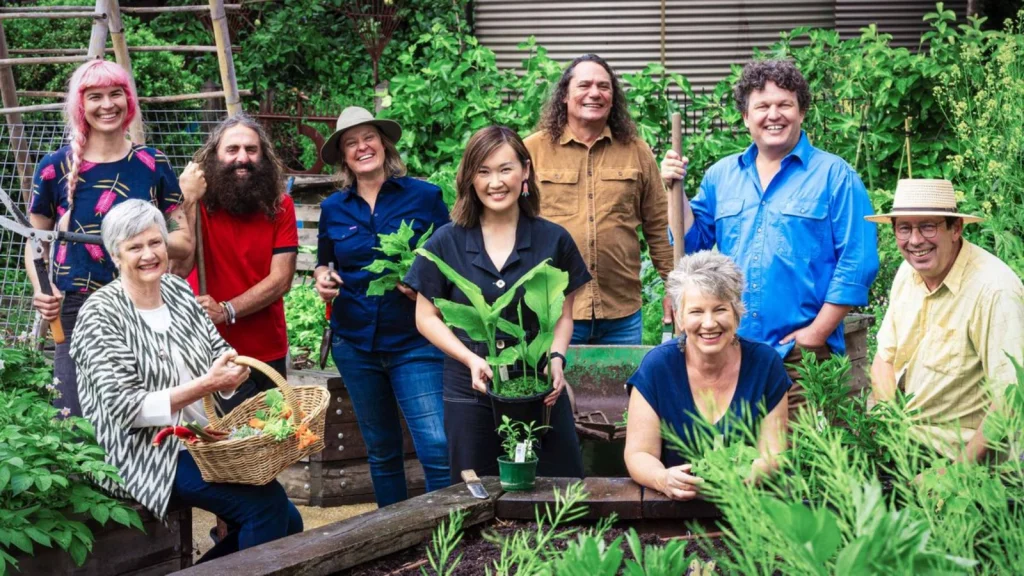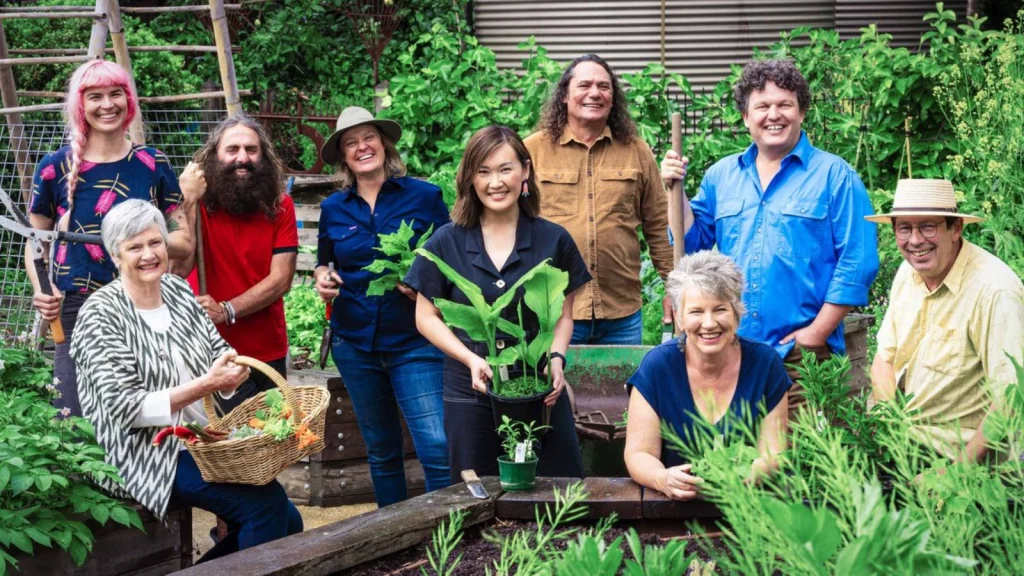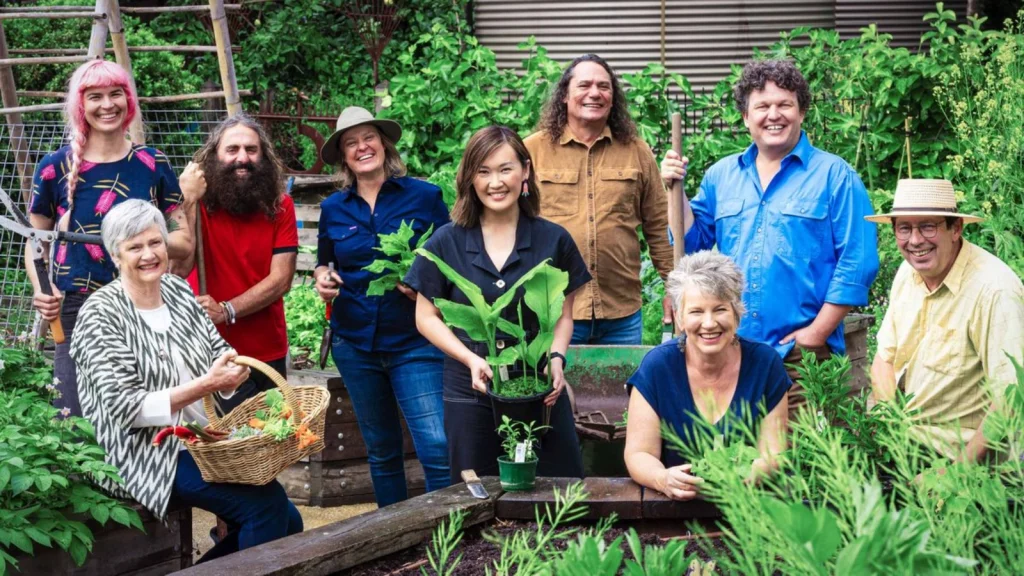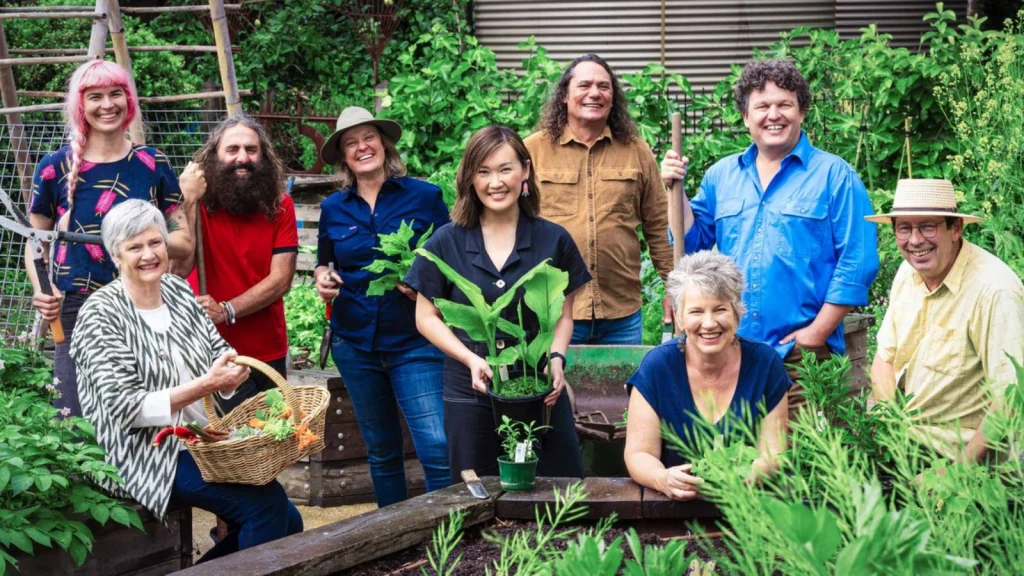
Gardening Australia 2026 Episode 17 turns winter into one of the most quietly revealing episodes of the series, moving from a former nursery owner’s two-decade plant sanctuary in Brisbane to a paddock north of Hobart filled with thousands of cool-climate cactus. This instalment of Gardening Australia 2026 weaves together six distinct stories — a family of avid gardeners, a national insect expo, hands-on mower maintenance, a garden built entirely from rescued plants, an unlikely Tasmanian cactus collection, and a seed-saver who has turned obscure edibles into a livelihood. What ties them together is a single idea: that the most rewarding gardens are built on patience, curiosity and respect for the living systems beneath our feet.
The episode leans hard into the season. Across the country, gardeners are slowing down, planning ahead and rediscovering plants that actually prefer the cold. From Costa Georgiadis wandering a provincial-style property in the Brisbane hills to Hannah Moloney crouching among spineless Bolivian cacti, the program makes a strong case that winter is anything but a dead zone for Australian gardening.
It is also an episode about people. Robin and Scott McClay, retired entomologist Dr Bert Candusio, plant-rescuer Rob Bergin, landscaper Matt Gamble and seed-saver Paulette Whitney each bring decades of obsession to the screen. Their stories double as practical masterclasses, packed with techniques any home gardener can copy, while celebrating the diversity that keeps gardens — and the broader environment — alive.
Costa opens Gardening Australia 2026 Episode 17 in the rolling hills of Brookfield, a rural-residential suburb about 16 kilometres from Brisbane’s CBD. There he reunites with passionate gardeners and former nursery owners Robin and Scott McClay, who have shaped their 2.5-acre property for almost two decades. Robin describes the guiding ambition simply: she has always loved country-style gardens, so this one was designed to bring the country to the city.
That country influence runs deep. Robin grew up in Roma in western Queensland, where both her parents were keen gardeners, and her grandparents gardened out west too. The result is a property that feels rambling and abundant, yet carefully composed. To keep order across so much variety, Robin divided the land into garden rooms, including a rainforest, a secret garden and an aloe garden, each with its own character.
Roses are clearly her first love. She points out a Delbard French rose planted the previous year, prized for its perfume, but names the Paul Bocuse rose as her all-time favourite, planted as a hedge that blooms almost constantly. A happy accident produced the property’s bold Red Bed: gifted some Home Run red roses, Robin planted them at the bottom of the garden, then realised she could see them from the patio. Her solution was simply more red, layering in aloes, euphorbias and calliandra so there is always strong colour against the deep greens.
Gardening Australia 2026 Episode 17
How a Spontaneous Nursery Purchase Shaped Decades of Australian Gardening
One of the episode’s most charming threads explains how the McClays became nursery owners almost by chance. After moving to Brookfield in 2008 and visiting the local nursery for a few plants, Robin asked the woman behind the counter whether any nurseries were for sale. The answer — “You’re in luck! This one!” — set everything in motion. Robin came home, floated the idea to Scott, and the rest, as she puts it, is history.
Owning a nursery while building a garden, Robin says, was like having a lolly shop. There was always something new and tempting, even as she told herself she did not need anything else. That endless supply explains the sheer botanical range on display, and it shows how a working knowledge of plants translates into confident garden design.
The lush, enclosed subtropical corridor she created is a standout lesson in layering. Started 13 years ago on what was once all lawn, it was planted gradually with trees until the couple decided to remove the grass entirely and add pathways. Mass plantings of walking iris and clivias form the understory, while a fiddle-leaf fig now towers around 10 metres tall and anthuriums grow nearly as big as Costa. These are the conditions, Robin notes, that these plants genuinely love — proof that mimicking a plant’s preferred environment beats fighting it.
A Family Legacy: Passing the Garden and the Business to the Next Generation
Beyond the design, the McClay story is about continuity. Robin and Scott have handed the reins of their nursery business to two of their daughters, Anna and Prue, who describe their parents as a huge influence on their outlook. Gardening was simply part of their lives growing up, and it is something they have come to appreciate more as they have gotten older.
Between them, the daughters are raising seven children while running the business and gardening, making the most of it all. Robin and Scott are visibly proud, and Robin admits she now loves going down to the nursery to relax — and, inevitably, to bring home more plants. The youngest family members have embraced it too, with one grandchild delightedly planting up a gnome with a tiny plant in its hand.
That secret garden has its own evolution. A cascading lilly pilly hedge once grew so tall that nobody could see inside, so it was removed and replaced with a lower buxus hedge, turning a hidden space into a formal garden where the grandchildren now play hide-and-seek. It is a small but useful reminder for any gardener: structures that once worked can be reworked as a garden — and a family — changes.
Inside the National Insect Expo, Where Australia’s Smallest Creatures Take Centre Stage
Millie Ross travels to Woodend in central Victoria for the National Insect Expo, a buzzing celebration of the underrated species that keep our gardens working. Now in its third year, the event is the creation of retired entomologist Dr Bert Candusio, and it gathers researchers, breeders and hobbyists from around Australia to share their passion for invertebrates.
Bert’s message is pointedly ecological. He argues that conservation has to start from the ground up, not the top down: if you want to save charismatic animals like elephants or jaguars, you first protect the insects and invertebrates that form the foundation of all ecological systems. A healthy, diverse insect population, he explains, ultimately benefits the environment and the humans who share it. The stakes are real — Bert’s own Central Victorian Regional Insect Collection of 250,000 specimens needs a new home, and he dreams the not-for-profit expo will eventually help fund a national invertebrate research centre.
The numbers reinforce why this matters. Insects make up to 75 per cent of all living organisms and are vital in gardens everywhere. Yet according to Zoos Victoria’s Jessie Sinclair, Australia could be losing three invertebrate species every week, which makes the expo’s mission to make people love bugs both urgent and difficult.
Stick Insects, Silkworms and the Spiders That Aren’t Spiders
The expo floor is a parade of living wonders. Rhys Dockrill, drawn to stick insects as a boy, shows Millie a “gargantuan” — one of Australia’s largest stick insects — alongside a spiny leaf insect common in backyards from Sydney northwards. Many feed on plants in the Myrtaceae family, especially eucalyptus, which makes sense given how widely it grows across the country. Rhys flags an important conservation gap: outside national parks there is currently little legal protection for these animals, so anyone wanting one as a pet should seek out ethical, captive-bred specimens rather than collecting from the wild.
Elsewhere, silkworms spark a wave of nostalgia. Steven Gill recalls raising them in a shoebox as a child, feeding them mulberry leaves and watching their life cycle, while marvelling at silk as the strongest yet lightest fibre in nature. Declan introduces harvestmen — memorably described as spiders that aren’t spiders — essential predators that hunt tiny pests in leaf litter, doing a hidden job beneath the garden. Even slime mould earns its place as an important decomposer, vacuuming up decaying matter on the forest floor.
Not every insect is welcome, though. CitrusWatch’s Jacqui Mitchell uses the expo to raise the alarm about the Asian citrus psyllid, a tiny pest not yet established in Australia. It can carry Huanglongbing, also known as citrus greening disease, which can kill a tree within seven years. Her advice for gardeners is simple: photograph anything suspicious and report it to state biosecurity. The broader takeaway, echoed across the stands, is to skip the pesticides — diversity, not chemicals, is the real key to a thriving garden.
Clarence Slewa’s Lawn Mower Maintenance Guide for a Sharper, Longer-Lasting Machine
Clarence Slewa delivers one of the episode’s most practical segments: a step-by-step guide to keeping a mower in tip-top working order. He notes that the mechanical lawn mower was invented by Edwin Beard Budding in 1830 and has come a long way since, before getting down to the unglamorous business of safety. Work only when the mower is cool and switched off, watch for fuel and oil spills, and tighten the fuel cap before moving anything around.
Blades come first, because Clarence considers them the most important part on any mower, petrol or battery. Rather than sharpening each blade in situ, he removes the entire base plate to do both at once, then restores the cutting edge with a stone for a clean finish, keeping the original angle intact. His simplest tip is the most valuable: hose the deck clean after every use, let it dry, and you will avoid most dramas.
The engine gets equal attention. For a four-stroke mower he recommends straight 95 unleaded with separate oil, checking the dipstick between the minimum and maximum marks and replacing oil that looks thin or black. With no sump plug on this model, he sends it to professionals who can pump out the old oil cleanly and safely.
He cleans the air filter so the fuel-air mix stays clear, and gently removes carbon build-up from the spark plug with wet-and-dry paper — crucially, without changing the spark gap. Battery owners get tailored advice too: never charge overnight, avoid overheating, store batteries in a cool, dry spot or a lithium-battery box, and book an annual service. A few small checks, Clarence promises, deliver a better lawn and the soft purr of a well-running engine.
Rob Bergin’s Rescued-Plant Garden Turns Discarded Trees Into a Botanical Treasure Trove
Sophie Thomson visits Bellevue Heights, south of Adelaide, to explore Rob Bergin and Carolyn David’s one-hectare garden — a place built almost entirely from rescued and rehomed plants. Most of the specimens came from other people’s gardens around Adelaide and were transplanted here, where mature trees that would be feature specimens elsewhere grow in abundance. Carolyn describes the result as a green, fresh retreat that feels like a completely different place.
The rescue mission began about 12 years ago. As Adelaide blocks were subdivided, mature backyard trees were being chopped, chipped and sent to the tip with no value attached. Around the same time Rob started a small earth-moving business, which meant he was often clearing whole backyards — and salvaging the trees that would otherwise be lost. Carolyn likens him to a vet bringing wounded animals home. The early philosophy was refreshingly low-pressure: plant it, let it provide shade, and if it grows, it grows.
The techniques are as impressive as the plants. A 55-year-old dragon tree’s age is read through its branching, with each bifurcation representing 12 to 15 years. A 10- to 12-metre date palm was lifted with a two-metre cube rootball, dropped into a snug hole, watered in with sandy loam and never moved again.
Rob also propagates from cuttings — an aloe taken from a tree he could not relocate now stands as a mature plant of its own. By placing big trees first, he creates shade and sheltered microclimates that let tree ferns and delicate understory plants follow. Quirky finds round out the scene, including a Port Adelaide telephone box and a Fordson tractor that Carolyn famously mistook for the pea straw Rob went to collect. What he treasures most, though, is the quiet morning ritual of walking the garden and gathering his thoughts.
Hannah Moloney Discovers the Cool-Climate Cactus Thriving North of Hobart
In one of the episode’s most surprising stories, Hannah Moloney heads about half an hour north of Hobart to Bridgewater, where landscaper Matt Gamble has converted a paddock into a considered display of his cactus collection. Far from the rocky outcrops of South America, hundreds of cacti now grow among the gum trees. Matt started with succulents because he thought they would be harder to kill, then moved into cactus once he realised some could grow outdoors in Tasmania rather than being confined to a hothouse — and is now several thousand plants deep.
Many are forms of Trichocereus, the San Pedro cactus, which Matt loves for their hardiness and variability. Some, originating in Peru, are blue, fat and spiny; others from Bolivia are essentially spineless and soft enough to pat — everything you don’t expect when you picture a cactus. Growing from seed unlocks the real magic, producing hundreds of hybrids and remarkable shapes, including crested forms with a fan-like profile and monstrose mutations with a melted, sculptural look. A trip to South America showed Matt that these plants prefer regular rain in their growing season and warm-but-not-hot conditions, which explains why Tasmania’s break from extreme heat suits them so well.
Matt’s design is as deliberate as his plant choice. He builds free-draining beds on top of heavy clay using fill collected through his work, then pairs the cacti with soft native grasses — Poas, Lomandras and Dianellas — for striking contrast and wildlife habitat. Two mulches do double duty: gum bark for softness, and gravel to keep moisture away from the base of the cactus where it could cause rot. The payoff is a series of microclimates within a small footprint. Matt also helps run an annual show called CacTasmania, part of a reviving community keen to prove that cactus are not all desert plants — plenty handle a cooler climate and even enjoy a drink.
Paulette Whitney’s Seed-to-Pickle Philosophy Champions Rare and Resilient Edibles
The episode closes with Paulette Whitney, a seed-saver, nursery worker, plantswoman, pickler and storyteller living on Muwinina land in the foothills of Kunanyi. Her business runs from seed to pickles, staying involved at every stage of a plant growing, being harvested and being eaten. The land itself was chosen deliberately: rather than disturb healthy bush, she and her husband Matt sought a degraded property they could repair, care for and tend, planting only local-genetics native plants in the wider landscape.
Paulette’s passion is unusual edibles, and her garden reads like a living library. There is Portuguese kale, a perennial tree cabbage whose white flower stems are picked like broccolini and prized by chefs. There is stem mustard, first met at an Asian grocer as a salty, sour, spicy pickle, now grown for its leaves, pickle-ready stems and rapini-like flowers. Oca, a clover-like Oxalis tuber from her mother’s garden, started as four varieties that crossed into about 40, including a long-keeping, lemony favourite she calls Granny’s Garden. Skirret, an obscure root vegetable, makes its own antifreeze, turning carbohydrates into sugars as frost approaches — proof that cold can be a flavour ally rather than an enemy.
Underpinning it all is a serious commitment to food sovereignty. As she and Matt move into their 50s, they are shifting toward less labour-intensive seed-saving, focused on saving locally adapted seeds and teaching others to do the same. The aim is resilience: if a shock like COVID empties the shelves, people should have the means and skills to grow and save their own seed, and to grow plants better adapted to climate change. Her driving principle is delight — she wants to taste everything she grows — and her greatest reward is sharing, whether that’s a chef sending a photo of a finished dish or a child happily eating a bowl of home-grown lettuce.
Why This Episode of Gardening Australia 2026 Matters for Every Home Gardener
Taken together, the stories in this episode make winter feel like the most productive season of the year. The cool-season jobs segment reinforces the point with practical, region-specific advice: cool-temperate gardeners can still sow sweet peas and plant mid- and late-season onions, warm-temperate gardeners can rely on calendulas and fast-growing fenugreek, subtropical growers can plant bare-root roses, and tropical gardeners can sow sunflowers and culantro. The unifying advice is to plan now for warm-season edibles, hold off feeding plants while growth slows, and let the garden rest where it needs to.
What lingers is the shared philosophy across every segment. Robin’s layered garden rooms, Bert’s ground-up conservation, Rob’s rescued giants, Matt’s free-draining microclimates and Paulette’s seed-saving all point in the same direction — work with the living system rather than against it. Diversity, patience and observation do the heavy lifting, whether you’re nurturing native grasses around spineless cacti or coaxing flavour from a frost-sweetened root crop.
That is the quiet power of Gardening Australia 2026 Episode 17. It treats the smallest creatures, the discarded trees and the obscure vegetables as the real heroes of a healthy garden, and it hands viewers the specific, repeatable techniques to follow suit. By the time Paulette describes the joy of feeding her family something interesting and nourishing, the message of this episode of Australian gardening is unmistakable: a great garden is less about control and more about connection — to the soil, the seasons and the countless living things that make it all tick.
FAQ Gardening Australia 2026 Episode 17
Q: Can you grow cactus outdoors in Tasmania’s cool climate?
A: Yes. Landscaper Matt Gamble grows hundreds of cacti outdoors near Hobart, many of them Trichocereus, or San Pedro cactus. These are not desert plants and actually prefer warm-but-not-hot conditions with regular rain in their growing season. Tasmania’s break from extreme heat suits them perfectly, and the key requirement is free-draining soil so the roots never sit in moisture for too long.
Q: How do you transplant a large mature tree without killing it?
A: The secret is a generous rootball. Rob Bergin lifted a 10- to 12-metre date palm with a two-metre cube rootball, dropped it into a snug hole, straightened it with a crane, then watered it in with sandy loam. Once settled, it never moved again. A big, intact rootball keeps the tree stable and gives it enough reserves to recover from the shock of relocation.
Q: Why are insects so important in the garden?
A: Insects and invertebrates make up to 75 per cent of all living organisms and form the foundation of every ecological system. They pollinate plants, prey on pests, recycle nutrients and feed larger animals. As retired entomologist Dr Bert Candusio puts it, real conservation starts from the ground up, because protecting bigger species depends on a healthy, diverse invertebrate population first.
Q: How do you sharpen lawn mower blades at home?
A: Work only when the mower is cool and switched off. Rather than sharpening each blade in place, remove the whole base plate so you can do both blades at once. A stone gives the cleanest finish, and the most important rule is keeping the same cutting angle that already exists. Always hose the deck clean after each use to avoid build-up.
Q: What makes crested and monstrose cactus look so unusual?
A: Both are natural growth mutations. Crested cactus grow in a flattened fan shape instead of a normal column, while monstrose forms develop a lumpy, melted appearance as they grow. Matt Gamble grows many from seed specifically to produce these weird and wonderful shapes. Some crested plants still push out normal sections that can flower, making them genuinely one-of-a-kind specimens.
Q: What is the Asian citrus psyllid and why is it dangerous?
A: It is a tiny insect not yet established in Australia that carries Huanglongbing, also known as citrus greening disease. The disease can kill a citrus tree within seven years, so this pest could devastate the country’s citrus. It is easily mistaken for a harmless native psyllid, so gardeners should photograph anything suspicious and report it to their state biosecurity.
Q: What are garden rooms and how do they work?
A: Garden rooms divide a large property into distinct, themed spaces to create order and variety. At her Brookfield property, Robin McClay built a rainforest, a secret garden and an aloe garden, each with its own character. Hedges, pathways and feature trees define the boundaries. The approach lets a rambling, abundant garden still feel composed, and it gives visitors a sense of discovery as they move through it.
Q: Are there cactus without spines you can actually touch?
A: Yes. Some Trichocereus varieties originating in Bolivia are essentially spineless and soft enough to pat, which is the opposite of what most people expect from a cactus. By contrast, Peruvian forms tend to be blue, fat and heavily spined. This variability within a single group is one of the main reasons collectors find them so appealing and user-friendly.
Q: Why is seed-saving important for food resilience?
A: Saving locally adapted seeds gives people the means and skills to grow their own food when supply shocks hit, as seed-saver Paulette Whitney experienced during COVID when lettuce vanished from shelves. Locally saved seed also produces plants better adapted to a region and more resilient to climate change. Teaching others to save seed spreads that security across whole communities.
Q: Why do some root vegetables taste sweeter after frost?
A: Cold weather triggers a survival response. Vegetables like skirret make their own antifreeze, converting stored carbohydrates into sugars as a frost approaches. This protects the plant from freezing while making the harvest noticeably sweeter and more delicious. It is why many gardeners wait until plants have been frosted before lifting crops, getting both better flavour and firm tubers that store well.