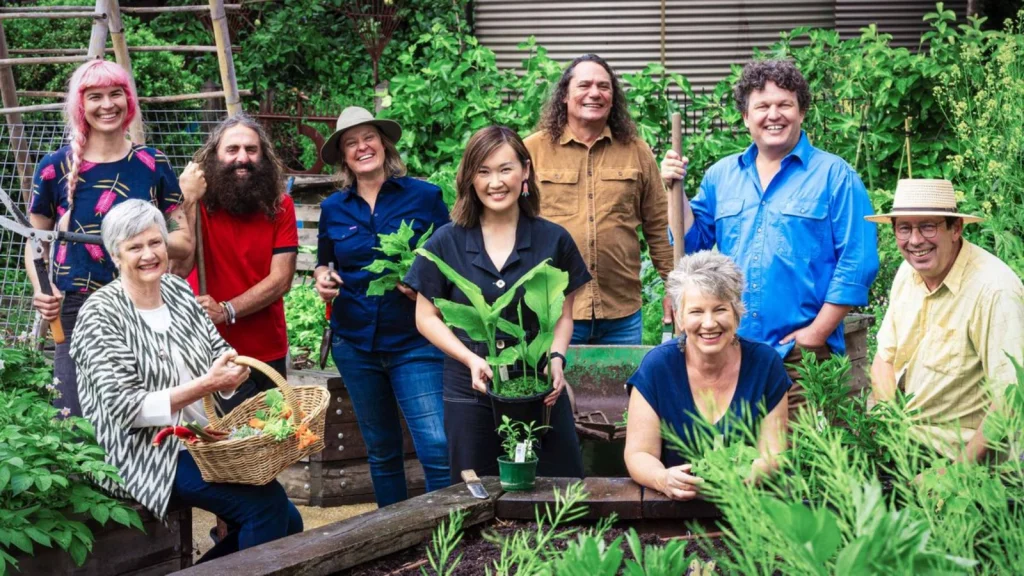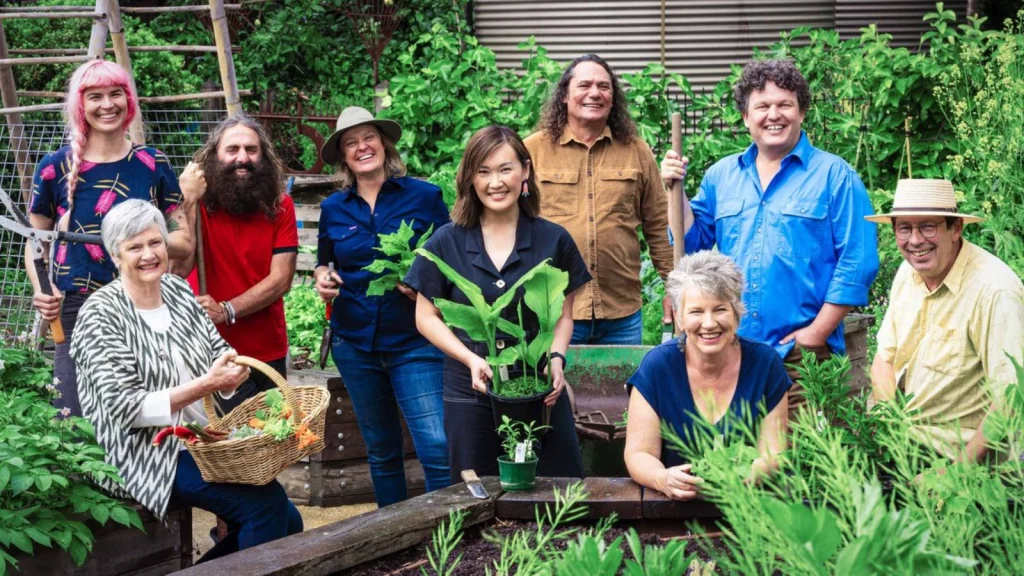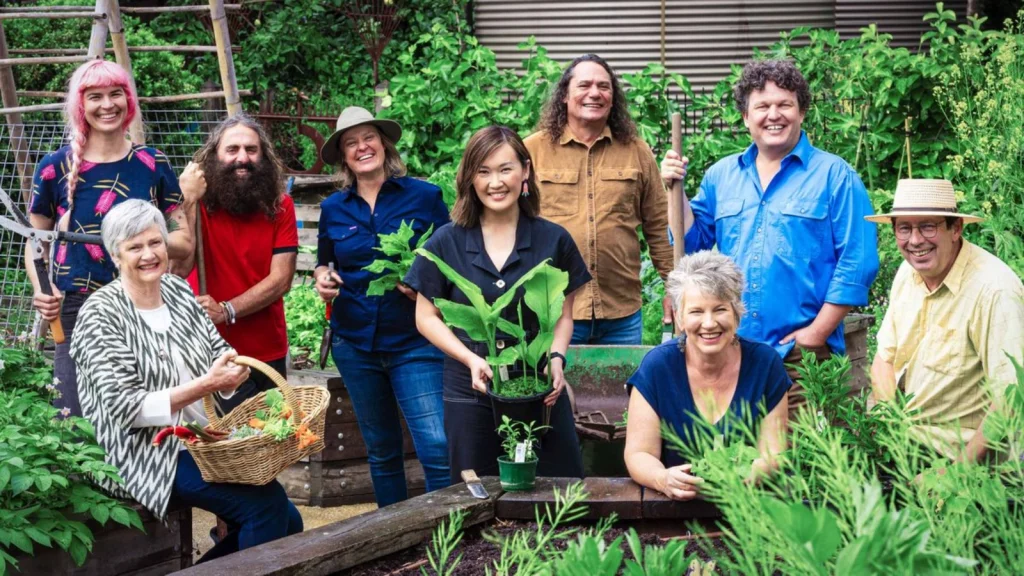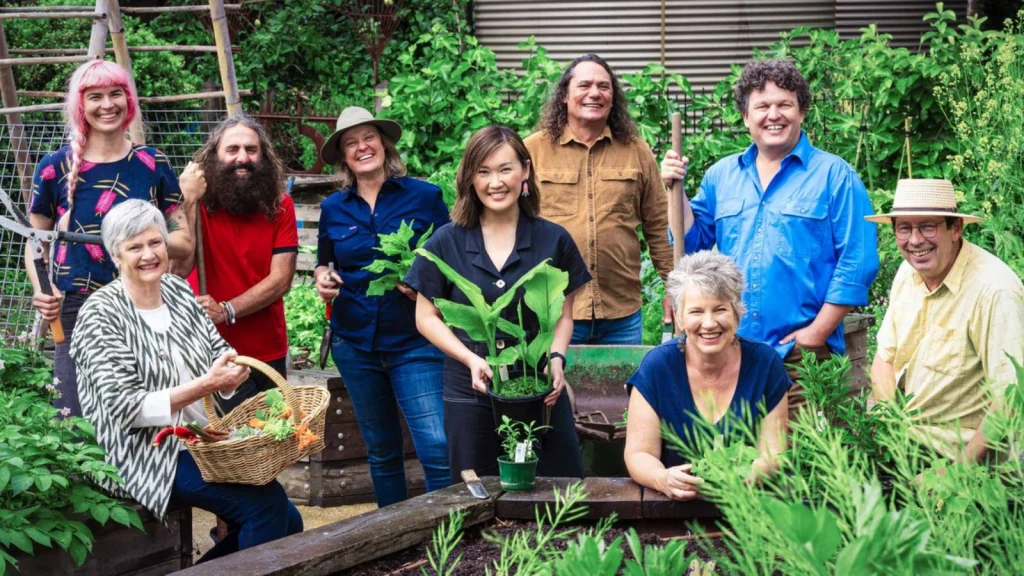
Gardening Australia 2026 Episode 16 sweeps across the country to celebrate transformation in its most unexpected forms, from a reclaimed petrochemical site on Sydney Harbour to a hand-built castle in the Tasmanian wilderness. This is one of the season’s richest instalments, weaving together rare Australian native plants, a couple’s decade-spanning fairytale garden, brilliant begonias for hanging baskets, and a rehabilitation garden that quietly changes lives. Costa Georgiadis, Hannah Moloney, Tammy Huynh, Millie Ross, Josh Byrne, and Jerry Coleby-Williams each bring a distinct story, and together they show how gardening reshapes land, people, and possibility.
The episode moves with real momentum. Costa returns to a park he first visited fifteen years ago and finds nature reclaiming industrial concrete. Millie travels to Western Victoria to meet a propagator who has spent forty years coaxing impossible plants into home gardens. Hannah steps inside a 17-metre brick castle covered in handmade ceramic flowers. Each segment rewards close attention, because the practical lessons sit alongside genuine emotional stakes.
What unites these stories is a single idea: gardens are never finished, and neither are the people who tend them. Whether it’s a community fighting two decades for a foreshore park, a chef cooking produce grown by people in recovery, or an artist drawing flight paths of birds into stitched textile work, Gardening Australia 2026 Episode 16 makes the case that horticulture is one of our most powerful tools for renewal.
Costa opens the episode with a question that doubles as a planning dilemma. Imagine you are a government authority, and an old industrial site comes up for grabs, filled with ageing infrastructure and contaminated with unknown substances. Developers want luxury apartments. The community wants a park. On the most spectacular harbour in the world, that was a very big ask.
Ballast Point Park, established in 2009, sits on Wangal country in the suburb of Birchgrove. It is small, just two-and-a-half hectares, roughly twenty-five suburban quarter-acre blocks. In Darug language the park was named Walama, meaning “to return”, and the name carries the whole story. The site had served as a petrochemical refinery for almost eighty years, packed with concrete and steel, churning out lubricants and fuels behind five-metre-high tank walls.
Local resident Diana was part of the community push to reclaim the land. She explained that the campaign began in the mid-1980s, twenty years before the park finally opened. It was a long, heavy haul, but she described the strength of an engaged community as enormous. Once land is developed, she warned, it is gone forever, and this was an opportunity that would never be repeated.
Gardening Australia 2026 Episode 16
Why Adaptive Reuse Made This One of Sydney’s Most Loved Parks
The design strategy at the heart of Ballast Point is called adaptive reuse, and Adrian, who led the design team, walked Costa through its logic. Rather than bulldoze the past and cart it to landfill, the landscape deliberately retains strong memories of what came before. Industrial elements stay visible, so visitors are never left wondering what they are looking at.
The park’s name turned out to be its design principle. Ships once arrived from Europe, unloaded their goods, and left with nothing to export, so workers cut local sandstone and loaded it as ballast for the return voyage to London or Manchester. When the design team began, they refused to repeat that extraction. Instead of cutting up another site to repair this one, they recycled construction waste, bricks, concrete, and modern ballast, to build the park itself. That choice lowered the carbon footprint and created a striking aesthetic at the same time.
Nature did the rest. The team selected only locally endemic species and sourced seed to regenerate a gene pool native to the site, aiming to return it toward a pre-colonial state. Figs, tree ferns, banksia, lomandra, casuarina, westringia, and a grove of melaleuca now frame the harbour views and fill the nooks. With them have come insects, birds, skinks, and geckos. Costa pointed to a fig forcing its roots into cracked sandstone, drawing out moisture and building a microclimate where maidenhair ferns, lichen, and moss now thrive. Eighty years of heavy industry, he noted, could not keep nature down.
Anita, chief executive with Placemaking New South Wales, described ongoing care as “urban acupuncture”, a light-touch approach that protects an already beautiful design rather than meddling with it. The community remains fiercely engaged, treating one of the Inner West’s most loved parks as their own backyard and offering weekly feedback. For Costa, the lesson is plain. When we open the door for nature, it returns with the same spirit as the locals and declares the place its own.
Costa’s Practical Autumn Answers on Roses, Jackfruit, and Stone Fruit
Between the bigger stories, Gardening Australia 2026 Episode 16 delivers the kind of grounded advice that keeps gardeners coming back. The questions are seasonal and specific, and the answers reward anyone planning their autumn jobs.
On pruning roses, the guidance splits cleanly into two groups. Spring-flowering roses, including banksia roses and many old-fashioned varieties, bloom only in spring, so you prune them hard immediately after flowering. Leave them until winter and you cut away the very wood that produces next season’s flowers. Repeat-flowering roses, such as standard bonicas, bloom from spring through autumn, so you prune them in mid to late winter. In frosty areas, hold off until mid-August so tender new growth escapes the cold.
Can you grow jackfruit in Sydney? It is a true tropical tree that loves heat, humidity, and frost-free conditions, so the city is genuinely touch and go, especially in cooler suburbs. It can still be done. Young trees need protection from cold snaps, a warm north-facing microclimate, shelter from wind, and excellent drainage. The featured tree, about twenty years old, may never match tropical yields, but with the right position it stays healthy and productive. For gardeners drowning in plums and nectarines, the fix is fruit leather: wash the fruit, remove the pits, blend, smear about five millimetres onto baking paper, then dehydrate at sixty degrees for up to twelve hours, or use the oven instead.
Tammy’s Brilliant Begonia Basket Brings Foliage to Eye Level
Tammy Huynh takes inspiration from a perennial favourite and turns it into a lightweight, portable showpiece. Begonias form a huge genus native to subtropical and tropical climates, and they have adapted to a wide range of conditions, which makes them popular and forgiving garden plants. The one firm rule is frost, which will kill them outright.
At the Royal Botanic Garden in Sydney, a collection of begonias grows happily in shade and dappled light beneath the trees. The foliage is the real drawcard on rhizomatous begonias, and their compact mounding habit makes them ideal for hanging baskets. To source her plants, Tammy visits the Growing Friends nursery, run by volunteers who propagate and sell from the Botanic Gardens living collection. Her selection is a study in texture and colour: the velvety, pink-haired Begonia listada with its lime lightning strike, the lime-edged Burgundy Lime, the silvery-pink Think Pink with red undersides, the curled and chocolate-edged Limbo Rock, the leathery mazae, and the shimmering all-silver Opalescent.
The word rhizomatous simply means these plants grow from a specialised thickened stem, a rhizome, that stores water and nutrients. That reserve lets them tolerate some neglect, including inconsistent watering and temperature swings, which Tammy notes is good news for the time-poor. She lines a wide, shallow 45cm basket with coir fibre, adds quality potting mix combined with pre-dampened perlite for drainage, and plants five or six begonias as a maximum.
She waters at the roots rather than the leaves to avoid unsightly marks, warns that the plants hate soggy roots, and recommends underwatering when in doubt. A light feed every fortnight during active growth and a fine bark mulch finish the job, leaving all that colour and texture at eye level.
Inside Castle Phoenix: The DIY Fairytale Garden in Tasmania’s Huon Valley
Hannah Moloney’s Tasmanian story is the episode’s most extraordinary. Once upon a time, ex-Queensland couple Francis and Christina moved to the Huon Valley to live happily ever after, and the only thing missing from their picturesque village was a castle. So they built their own. Welcome to Castle Phoenix, which the couple describe not as a house but as the biggest art project they have ever undertaken, engineered to last.
They have been at it for fifteen-and-a-half years. The front wave wall went up while they waited for plans to be finalised, and crucially the walls double as garden beds. The plant choices are gloriously eclectic, driven by colour and shape rather than any plan, gathered on impulse from nurseries. There are crab apples with dark pink blossom and fruit for jelly, tigridias, gladioli, and liliums, all the cold-weather plants the couple could never grow back in Mackay. Around one corner, thirty thousand handmade ceramic pansies adorn a Gaudi-esque garden bed, a project ten years in the making and, rare for this couple, actually finished.
The pair met by chance in a Mackay motel, where Francis was tiling and Christina was taking private art lessons while painting a portrait of her father. Their art teacher matchmade them, Francis proposed three weeks later, and decades on they remain happily engaged with three rings that do not fit. The castle itself is staggering: four storeys, seventeen metres of solid brick, eight conical rooftops. Inside, a flower-covered foyer climbs from floor to ceiling, every bloom handmade because nothing like it could be bought.
The throne room will hold around fifteen thousand hand-pressed tiles. A ceramic maple tree, modelled from five real October Glory leaves imprinted in plasticine and finished in five glazes, dominates one space they dream of turning into a Roman bathroom with a reflecting pool. A stream became a dam, then what they now call a lake, edged with collected water irises in every colour. Ordinary became extraordinary, and there is no stopping them.
Phil Vaughan’s Forty-Year Mission to Save Rare Australian Native Plants
Millie Ross travels to Western Victoria, near the small town of Pomonal beside Gariwerd, the Grampians National Park, to meet propagator Phil Vaughan. For forty years Phil has built a reputation for growing rare and unusual Australian native plant species and getting them into home gardens. His mission, as he puts it, is to inspire people and show them what this country has.
Phil’s first job is changing perceptions. Many people dismiss native plants as scratchy, prickly, open, and short-lived, then admit they grow roses. His reply lands perfectly: stop pruning roses and they become scratchy, prickly, open, and short-lived too. He has nothing against roses, he insists, you just slip a trowel under them and turn them into mulch for your native plants. The point is that natives reward care like any other plant, and his garden exists to prove it, doubling as a source of cutting and grafting material and a showroom where buyers can choose non-mainstream plants with their own eyes.
Grafting is where Phil’s expertise becomes remarkable. He has lost count of how many species he grows, thousands upon thousands, and many of the trickiest come from Western Australia. The Qualup bell, normally a few sparse bells in the wild, becomes a large dense plant when grafted, the rootstock pushing vigour into the top. The geleznowia, which some said would never sell, produces long-stemmed forms for the cut flower trade and compact domes covered top to bottom in flower.
Because these plants are hard to strike from cuttings and variable from seed, grafting onto a Correa glabra rootstock is the winning move. When direct grafting fails, as with the wind-snapping Diplolaena angustifolia, Phil bridges the incompatibility with an interstock, a compatible plant grafted between species. Each combination is trialled for around five years to confirm long-term compatibility, because unlike rose grafting there is no thousand-year history to draw on. He is starting from a clean slate.
Beneath the horticultural skill lies genuine urgency. Phil is frightened by how fast wild plants are disappearing, and calls it very, very sad. He wants his children to see the wildflowers he has seen, and fears that at the current rate they will not. On growing natives well, his advice is blunt and memorable: the three most important things are good drainage, good drainage, and good drainage. Sand over gravel delivers it. Ninety per cent of plants die from operator error, he says, usually people overwatering and killing plants with kindness.
Jerry’s Guide to Cloning Cacti and Understanding Plant Sports
Jerry Coleby-Williams uses a powder puff cactus from Mexico to explain a foundational propagation principle that every gardener should understand. When we propagate plants, we have two main options: seed and cuttings. Seed produces many plants quickly, and while they resemble the parent, each is slightly different genetically. Cuttings, by contrast, produce clones that are genetically identical to one another.
The fascinating exception is the sport. A sport is a slight change in a plant’s genetic makeup, a mutation that throws up different flowers or foliage. Gardeners spot them on camellias, azaleas, and sometimes roses. Because a sport cannot be reliably reproduced from seed, it must be cloned from cuttings to preserve its character.
Jerry’s demonstration plant is unusually unstable, sporting again and again before his eyes, one form mutating into the next, including a crested form, in a chain that simply does not stop. It is a delightful contradiction, because it defeats the very rule that cuttings produce identical clones. Sports, as Jerry puts it, completely change the game, and they capture exactly why he finds gardening so endlessly fantastic.
Where a Gardener and an Artist Build Beauty Into a Perth Bush Block
Josh Byrne explores what happens when a gardener and an artist build a home on a bush block, and finds a blank canvas for both. Artist Yvonne Wadley and her husband Ken fell in love with a one-hectare parcel in Perth’s hills in 2010, and Yvonne shaped the garden in deliberate relation to the house so she could draw maximum inspiration from the surroundings for her creative work.
Beauty drives everything Yvonne does, in her art and in her garden design. She wanted flat, restful space as a foil for the bush, so they laid a little lawn, then framed it with tall trees that tower and make the space feel cosy. Garden paths lead the eye inward, exactly as they would in a painting. The couple created zones, a native section and an exotic space at the front of the house, with the design also factoring in fire safety by keeping trees and shrubs away from the building.
Fifteen years on, the garden has settled, and Ken tends seven or eight raised vegetable beds while championing the long-term native section of hakeas, grevilleas, petrophile, and verticordias. Pink fairy orchids, cowslips, and blue lady orchids have begun emerging and self-sowing from the litter layer, a quiet joy.
For Yvonne, the garden is a working studio. She photographs it constantly, picks from it, and draws on its greens, textures, and patterns, all of which end up in her artwork. She moves between watercolour, her first love for its lightness and air, pastels for their grainy weight, botanical work, and most recently charcoal, which she finds refreshing for letting her work in a single colour.
One stitched textile piece, Birdsong, maps the flight paths of local birds, including pigeons low down and 28s up high, picking up their colours in the lines and their intonation in the stitches that rise and fall with the sound. The space, she says, feeds the spirit, and that calmness flows directly into her art, because beauty blesses people.
How a Tasmanian Rehabilitation Garden Helps People Heal
The episode closes on its most moving story. Plants feed us, shelter us, and clothe us, but for some they offer a path to heal. Bettina Hockey works as a support worker and garden manager at Missiondale, a residential rehab centre near Evandale in Tasmania run by Launceston City Mission. She sees every client who arrives as a new connection to life, and says she learns enormously from each individual.
Clients enter the program after detoxing and stay anywhere from a few weeks to six months, moving through groups, psychologists, and case workers alongside skills development in the garden. The work teaches day-to-day living and employment skills, and clients describe its impact in their own words: motivation restored, routines rebuilt, emotional regulation back up to scratch, and real hope for the future. One man arrived weak and directionless and now plans his life as a happier person. Another values the pride, routine, and simple pleasure of being outside. They praise Bettina’s patience, her guidance, and her insistence that they learn and plan their own plots.
Bettina herself came to this work after a career in teaching, applying her old skills in a new direction. She inherited a near-bare garden with one functioning hothouse and, with keen clients and volunteers like Greg, built it into something abundant: an orchard, more beds, polytunnels. Across roughly two thousand square metres, half an acre, the garden now yields around three tonnes of produce a year.
Those vegetables are washed and sent straight to chef Catherine’s kitchen for lunch and dinner, fresher than anything money can buy. Catherine, a chef of more than forty years, calls it her dream job. For Bettina, the deeper lesson is responsibility, learning to look after plants the way you look after friends and family, an amazing and rewarding cycle that keeps her wanting to do better every year.
That spirit of steady, hopeful work runs through the entire instalment. Gardening Australia 2026 Episode 16 gathers a reclaimed harbour park, a homemade castle, a propagator racing to save vanishing wildflowers, and a garden that helps people rebuild their lives, and it lets them speak to one another. The seasonal jobs reinforce the theme, from pruning Japanese maples and roses to planting tubestock, sowing strawberry runners, taking hydrangea cuttings, and building bee hotels for native bees. Across every story, the message holds: put your hands in the earth, care for what you grow, and watch something ordinary become extraordinary.
Conclusion
That spirit of steady, hopeful work runs through the entire instalment. Gardening Australia gathers a reclaimed harbour park, a homemade castle, a propagator racing to save vanishing wildflowers, and a garden that helps people rebuild their lives, and it lets them speak to one another.
Your Autumn Weekend Checklist:
To tie the episode’s themes into your own backyard, here are the key seasonal tasks highlighted this week:
- [ ] Prune Japanese maples and spring-flowering roses.
- [ ] Plant out winter tubestock.
- [ ] Sow fresh strawberry runners.
- [ ] Take hydrangea cuttings for propagation.
- [ ] Build or clean out bee hotels for native bees.
Across every story, the message holds: put your hands in the earth, care for what you grow, and watch something ordinary become extraordinary.
For more seasonal inspiration and garden stories, revisit the previous instalment in Gardening Australia 2026 Episode 15.
FAQ Gardening Australia 2026 Episode 16
Q: What is Ballast Point Park and why was it created?
A: Ballast Point Park is a two-and-a-half-hectare foreshore park on Sydney Harbour, established in 2009 in the suburb of Birchgrove on Wangal country. The site spent almost eighty years as a petrochemical refinery before the community campaigned to reclaim it. In Darug language it was named Walama, meaning "to return", reflecting both the land’s recovery and nature’s comeback.
Q: How does adaptive reuse work in landscape design?
A: Adaptive reuse keeps existing structures and materials rather than demolishing them. At Ballast Point, the design team retained industrial walls and recycled construction waste, bricks, and concrete to build the park itself. This avoided cutting up another site for materials, lowered the carbon footprint, and created a striking aesthetic that preserves strong memories of the site’s industrial past.
Q: When should you prune roses in autumn and winter?
A: It depends on the rose. Prune spring-flowering roses, such as banksia and old-fashioned varieties, hard immediately after flowering, because pruning in winter removes the wood that produces blooms. Prune repeat-flowering roses, like standard bonicas, in mid to late winter. In frosty areas, wait until mid-August so tender new growth escapes cold damage.
Q: Can you grow jackfruit in Sydney’s cooler climate?
A: Yes, though it is touch and go, especially in cooler suburbs. Jackfruit is a true tropical tree that loves heat, humidity, and frost-free conditions. Choose the warmest north-facing microclimate you have, protect young trees from cold snaps, shelter them from wind, and ensure excellent drainage. Yields stay smaller than in the tropics, but a healthy tree is achievable.
Q: Why are rhizomatous begonias ideal for hanging baskets?
A: Their compact mounding habit and striking foliage make them perfect for baskets at eye level. The term rhizomatous means they grow from a thickened stem that stores water and nutrients, so they tolerate inconsistent watering and temperature swings. Use a wide, shallow basket lined with coir, add free-draining mix with perlite, and plant five or six maximum.
Q: What is Castle Phoenix in Tasmania’s Huon Valley?
A: Castle Phoenix is a hand-built castle created by ex-Queensland couple Francis and Christina over fifteen-and-a-half years. It stands four storeys and seventeen metres tall, made of solid brick with eight conical rooftops. The couple treat it as their biggest art project, filling it with handmade ceramic flowers, around thirty thousand handmade pansies outdoors, and walls that double as garden beds.
Q: Why do growers graft rare Australian native plants?
A: Grafting lets growers cultivate species that are difficult to strike from cuttings or variable from seed. A vigorous rootstock, often Correa glabra, pushes growth into the top, producing larger, denser plants than appear in the wild. When two species are incompatible, an interstock is grafted between them as a bridge. Each combination is trialled for around five years to confirm compatibility.
Q: What is the most important factor for growing native plants?
A: Good drainage, repeated three times for emphasis. Native plants do not want water sitting on the surface around the collar of the plant. Sand over gravel delivers the free-draining conditions that support the widest range of species. Around ninety per cent of plants die from operator error, usually overwatering, so restraint matters more than constant attention.
Q: What is a plant sport and how is it propagated?
A: A sport is a slight genetic mutation that produces different flowers or foliage, often seen on camellias, azaleas, and roses. Because seed will not reliably reproduce it, you must clone a sport from cuttings to keep its character. Some sports are highly unstable and mutate repeatedly, even producing crested forms, which defeats the usual rule that cuttings yield identical clones.
Q: How do rehabilitation gardens help people in recovery?
A: At Missiondale near Evandale in Tasmania, gardening builds day-to-day living and work skills alongside groups, psychologists, and case workers. Clients rebuild routine, motivation, and emotional regulation while planning their own plots. The half-acre garden produces around three tonnes of fresh produce yearly, sent straight to the kitchen, giving clients pride, purpose, and a tangible path toward healthier lives.