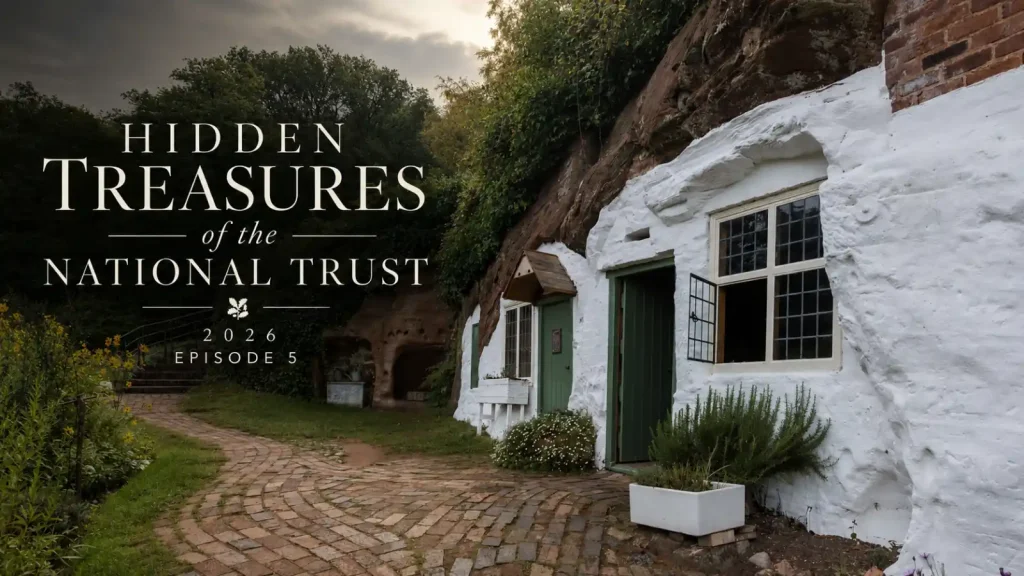
Hidden Treasures of the National Trust 2026 episode 5 turns its attention away from gilded staterooms and toward the people who powered Britain’s age of industry, telling the story of a 13-year-old boy bound to a cotton mill in 1785 and the working families who carved their homes directly into a sandstone hillside.
At Quarry Bank Mill in Cheshire and the Rock Houses of Kinver Edge in Staffordshire, conservators, curators, rangers and volunteers fight to preserve the fragile evidence of ordinary lives. A single torn indenture, a working spinning mule, and a cluster of cave dwellings become the threads of a much larger human story.
This is history told from below. Instead of the usual focus on aristocratic founders and country-house treasures, the episode centres on the people who toiled twelve hours a day, six days a week, turning raw cotton into cloth and fortunes into the pockets of the few. Their names rarely survive. Their homes rarely last. That is exactly why the work happening at these two sites matters so urgently.
What emerges is a portrait of industrial Britain that refuses to look away from its human cost. There is the spinning mule that revolutionised textile manufacturing and the child apprentices who paid for that progress with their childhoods. There are the damp-fighting volunteers protecting real-life hobbit holes, and the rangers using English longhorn cattle to defend one of the rarest habitats in the country. Each strand connects to a single idea: that working-class history deserves the same care lavished on palaces.
Lying in a lush Cheshire valley beside the River Bollin sits a building that changed the course of history. Quarry Bank Mill was once part of one of the largest cotton empires in the world. For curator Katie, who grew up in a mill town in the North West, looking after it is far more than a job. Her own heritage sits inside its walls, and she now helps tell the stories it holds.
The mill’s story begins at a pivotal moment, the Industrial Revolution, when society stood at a turning point and machines began replacing people for the first time. Samuel Greg, born in Ireland and sent to Manchester aged eight to work in his uncle’s cotton business, rode that rising tide. By 25 he was producing cotton at his own mill, where raw cotton went in one end and yarn came out the other across four floors of cutting-edge machinery.
At the heart of it all is the spinning mule. With 560 spindles, the machine could twist thick cotton fibre into yarn faster than ever before, mass-producing fabric that the middle classes could finally afford. Quarry Bank’s mule is among the last still working in Britain, producing yarn for heritage tailors to this day. Yet that achievement came at a steep human price, a tension that runs through every part of Hidden Treasures of the National Trust 2026 episode 5.
Hidden Treasures of the National Trust 2026 episode 5
The Annual Race to Service Britain’s Last Working Spinning Mule
Keeping an antique workhorse alive is a full-time job. Once a year the doors close and the mule undergoes a complete service, a delicate operation with an unforgiving clock attached. The team gets just 48 hours before the floor reopens to visitors, and the first challenge alone is daunting: removing the kilometre of cotton thread crisscrossing the machine.
Technical demonstrator Rex speaks the mule’s language. By disconnecting the slubbing gear and drawing the carriage back without feeding the cotton forwards, the team deliberately breaks all the threads to gain full access. This will be Rex’s 21st annual service. Of a certain age, he could have retired years ago and refuses to, calling it one of the best jobs in the world after first falling for the mill as a visitor.
A new generation is now learning the craft. Twenty-three-year-old Elizabeth, who started at 19 and cheerfully describes herself as a mill geek, finds the spinning machines both intimidating and awesome, drawing a sense of power from running them. Passing on these skills is the whole point, so that when Rex eventually steps away the machine is left in safe hands. With the mule lying in hundreds of individual pieces and the deadline closing in, every hand is needed.
A Torn Indenture From 1785 That Gives a Lost Child a Name
A new acquisition has arrived at Quarry Bank that tells the story of just one worker while holding the hidden history of many others. It is an apprentice indenture from 1785, one of the earliest in existence, and it binds Thomas Payne, a 13-year-old boy, into indentured service at the mill. Child labour was central to early industrial production, and these were the poorest children in society.
Many came from the workhouse or from families who could no longer care for them. Numerous apprentices were orphaned and dependent on the parish, and mill owners like Samuel Greg were happy to take them off the parish’s hands, presenting the arrangement as a chance to learn a skilled trade. Some were as young as nine or ten. Arriving from the countryside, they walked into noise, grime, heat and dust that one expert describes as the bowels of hell.
Once inside, the children signed a legally binding contract forcing them to work until early adulthood. Thomas may not even have understood what was happening. What matters is that he signed his mark, and that mark matters more today because so little evidence of the apprentices’ lives survives. There is a stark imbalance between what is known about the wealthy Greg family and what is known about ordinary working people. With this indenture, Thomas Payne stops being a faceless number and becomes a person who can be placed in the mill’s story.
Inside the Painstaking Conservation of a Document Almost Torn in Two
The precious paperwork is currently too fragile to display. The indenture is almost in two pieces, with several tears and a large split running nearly the whole length of one fold line. There is a real chance that part of the document could simply fall away. Conservator Sharon takes on the task of making sure this contract is still, in a sense, binding.
First she must iron out the wrinkles in the deteriorating paper, unfolding each area very gently to avoid causing further damage. The paper then needs a deep clean before any repairs, because an adhesive that is too wet can drag surface dirt into the fibres and leave tide marks. Sharon’s solution is wonderfully low-tech: grated eraser, shaved with a fine nutmeg grater and worked across the surface with a soft linen pad. As the gratings turn grey, she knows the dirt is lifting.
For the repairs themselves she reaches for Japanese tissue and wheat starch paste, working on the back of the document so the text remains untouched. Japanese papers are made from plants with very long fibres, producing material that is both fine and remarkably strong. Sharon admits she becomes emotionally drawn in, especially where children are involved, wondering what they felt and who their friends were. Honouring that moment in a young man’s life, she declares the indenture safe, happy and ready to go home.
Tracing Thomas Payne Through the Fading Records of Quarry Bank
Bringing Thomas Payne’s story to life takes more than careful conservation. Down in the mill’s archive, Katie hunts for any trace of him beyond the indenture, knowing only that he entered the apprentice house in 1785. Searching through lists of common mill-town surnames, Foden, Brearley, Blundell, she works alphabetically and methodically until a tiny reference finally surfaces.
There he is. A faint payment record, eleven and one over five, gives a sense that Thomas stayed for a meaningful length of time and probably left around the age of 21, when his apprenticeship ended. After that the trail goes cold. He appears in no rental agreements, and where he went remains unknown. Yet a skill in cotton at the dawn of the Industrial Revolution was genuinely valuable, granting a former apprentice a measure of autonomy.
Positioned on the boundary of Manchester, the boom town, Thomas could take his labour anywhere once the indenture was complete. That mobility hints at the broader forces reshaping Britain. In the booming cities, tensions over low wages and brutal hours were reaching boiling point, and industrial workforces, who effectively powered whole nations, were ripe for revolution. This wider unrest forms the political backdrop to Hidden Treasures of the National Trust 2026 episode 5.
When Reform Came Too Late for the Children of the Cotton Mills
By the early 19th century, demands for reform sparked a surge of unrest, and the government began to panic. For the first time it started to legislate, controlling the hours people could work and the education they were owed. The first legislation governing working conditions arrived in 1802 and concerned the welfare of apprentices specifically in cotton mills, a direct response to places like Quarry Bank.
But reform came too late for Thomas Payne. By 1802 he would have been around 30, his childhood already lost to the single piece of paper Sharon worked so hard to save. The danger those children faced was constant and real. Because the Gregs did not want production to stop, repairs and cleaning had to be carried out while the machines were still moving, creating an enormous risk of injury.
That risk had a name. A young lad called John Foden, working at the mill in the 1800s, went underneath a machine while it was running and failed to move clear in time. He was crushed to death. Staff today say the tragedy lands hardest when visitors arrive with children of the same age, a reminder that every one of these young workers had a personality and was dear to somebody. The mule’s modern caretakers, many with mill workers in their own family trees, feel the weight of that history even as the pressure mounts.
The Real-Life Hobbit Holes Carved Into a Staffordshire Hillside
On the edge of the industrial Black Country, a working-class community lived a life harking back to an older age. Carved into the sandstone of a Staffordshire hillside are the Rock Houses of Kinver Edge, a cluster of unique homes that volunteer Val is keen to defend from a common misunderstanding. What she dislikes most is when people call them caves.
The distinction matters. As Val explains, these dwellings were formed rather than built. Millions of years ago a tiny hole, widened by the eddying motion of the wind, grew into a cave, and then people arrived with tools and turned a round cave into a square room and a square room into a house. Need more space, and you simply chiselled a new bedroom out of the rock. Each home had a bedroom and a parlour, and remarkably, families lived here right up until the 1960s.
The earliest known inhabitant was Margaret of the Fox Earth, who lived here in the 1600s and was remembered in local folklore as a wise woman or healer. A woman living alone in those times invited suspicion, and some thought her a witch, though Val prefers the term white witch. By the 18th century the caves had become conventional homes for farm labourers, washerwomen, broom-makers, gamekeepers and ironworkers, offering rock-bottom rents and clean, green air far preferable to the smog of the Black Country, where it was said to be red at night and black in the daytime.
The Constant Battle Against Damp Inside Kinver Edge’s Rock Houses
Today, nature is the greatest threat to these homes. The rocks above are full of water, which drizzles down through the porous stone, and keeping watch for leaks falls to volunteer Sharon, who points out ceilings stained where rain has worked its way through. Conserving a building made of such a porous substance means a constant battle against deterioration on every surface.
Fighting that threat is an elite squad of volunteers working to a strict deadline, because the houses must be ready for the spring open-up while they remain closed to the public. The first task is to clear and expose the walls and ceilings so they can be swept, though overenthusiastic cleaning carries its own risk: scrub too hard and the ceiling itself could come down. The pressure, as one volunteer notes, is nonstop.
The team begins in Fletcher Cottage, named after Sarah and Joe Fletcher, who called it home for over 50 years in the late 1800s and waged their own half-century war against the damp. On her knees scrubbing mould from a washbasin, one volunteer thinks of Mrs Fletcher cooking, cleaning and sweeping these same floors, finding quiet meaning in the idea that they are still, in a way, looking after her house. To beat the damp on the exterior, painter Rob turns to lime wash, possibly the oldest paint in existence, used in Roman villas thousands of years ago and still unmatched for a place like this.
From Crumbling Ruin to Restored Home at the Postman’s Cottage
When the last families moved out in the 1960s, Kinver’s history began to crumble. Archive footage describes Holy Austin Rock in its heyday as a virtual rabbit warren with a dozen families living in it, then as a place reclaimed by nature where it was hard to believe tidy gardens and tiled roofs had ever stood. Restoration would demand serious money, and the real question was how many people thought the houses were worth saving.
In 1989 the National Trust took on the houses and began recreating every detail, from furniture down to fixtures and fittings. The work celebrates a long national fascination with how other people live, whether in a great country house or in something nestled in a nook of red sandstone. In 2012 attention turned to the last house to be restored, named Martindale’s after Harry Martindale, the local postman who once lived there.
For years one crucial feature was missing: a cooking range, the oven that heated water, dried clothes and sat at the heart of the home. The solution arrives through Brian, a lifelong fan of Kinver who once ran through ferns as tall as he was and who rescued an antique range from a demolition job, where it had sat hidden behind hardboard for decades. Cherished for years, it is finally donated to find a permanent home. National Trust tradesman Dan, an electrician unaccustomed to mortaring ovens into wonky cave walls, cuts 40% of the bricks to fit, balancing perfection against the rustic character of the place until the range stands complete after nearly 40 years of restoration.
How English Longhorn Cattle Are Saving a Rare Lowland Heath
Behind the Rock Houses lies 44 hectares of rare lowland heath, a landscape that survived the grip of the Industrial Revolution. This habitat is now becoming genuinely scarce, with only around 20% remaining of what existed 200 years ago. One ranger describes this surviving island in the Midlands as an intensive care unit for an extraordinary range of species, from adders, grass snakes, slowworms and common lizards to tree pipits, garden warblers, pantaloon bees and black oil beetles.
Protecting them falls to Kinver’s ranger team and some unusual assistants. Native-breed English longhorn cattle act as ecosystem engineers, grazing back the little trees that would otherwise turn the heath into woodland within years. By keeping the scrub in check, the cattle create the light and heat conditions that the rarest and most threatened species depend on. Graziers Adrian and Ollie know the herd as individuals, with strong personalities, favourites, family groups and even firm friendships.
Moving four cows to a fresh patch of heathland tests both the longhorns’ famously docile temperament and the rangers’ patience, since even chilled-out cattle occasionally bolt for the corner and demand a chase. Once settled, the herd quietly carries on its conservation work. This kind of long game defines the ranger’s life. As one team member reflects, much of the work he does he will never see the benefit of in his own lifetime, because it is about creating legacies for future generations to enjoy.
Counting 70 Species of Moth to Measure Conservation Success
The cattle’s grazing has triggered some unusual nocturnal activity on summer evenings. To check whether the longhorns are doing their job, the ranger team surveys the heathland’s wildlife, focusing on insects and invertebrates as a reliable indicator of environmental health. Moths matter especially, because they react very quickly to environmental change, so a rise in their abundance and diversity suggests the habitat work is paying off.
Leading the survey is dedicated enthusiast Dave, known affectionately at Kinver as the Mothman. A former birdwatcher hooked by a chance encounter with a moth stall at a bird fair some 16 years ago, Dave deploys a light trap whose glow draws the insects down onto the Perspex and into the box below. He will spend hours overnight counting and potting up specimens for identification before releasing them, a task demanding both patience and coffee.
The night proves spectacularly busy, with moths landing on faces, ears and clothing as 70 species pile up in a single trap. Among Dave’s favourites is the peppered moth, sometimes called Darwin’s moth, whose famous shift to a darker colour during the soot-blackened Industrial Revolution, and its return to pale once the Clean Air Act cleaned the air, perfectly illustrates that survival favours not the strongest but the most adaptable to change. That haul of 70 species is hard proof that the rangers and their longhorns are succeeding.
The Tolkien Connection and a Gentler Vision of Working-Class History
The arrival of mass-transit systems opened a whole new world for city workers, who for the first time could spend a day off in the countryside. At Kinver, something remarkable happened: families’ private homes became a tourist attraction, and the residents embraced it. Seeing thousands of visitors arriving every weekend, they pressed every spare chair, table and teapot into service, while some, like Helen’s family, sold postcards, one of which from around 1915 records a child delighting in butterflies and fresh fields.
Kinver’s reputation as a haven drew day-trippers escaping the smoke of Birmingham and the Black Country, and it may have drawn one especially famous Birmingham boy. It is widely believed that the young J.R.R. Tolkien, familiar with the area, was inspired by the Rock Houses when imagining the hobbit holes of Bilbo Baggins and the Shire. The appeal lies in the same gentle vision, a life that is slow, steady, simple and rural, something to strive for and to serve as a happy ending.
That gentler rhythm still defines Kinver today, where footpaths wind through open countryside kept litter-free by volunteers like Val and her wife Cath. As the winter deep-clean winds down and the restored range finally stands in pride of place at the postman’s cottage, the hearth once more becomes the heart of the home, the gathering point families would have crowded around to talk over their day.
This, ultimately, is the point of Hidden Treasures of the National Trust 2026 episode 5: these were not grand, titled people in fancy homes, but ordinary working-class families whose place in the national story matters precisely because there are more people like them than there ever were lords in great houses. Back at Quarry Bank, with Thomas Payne’s repaired indenture finally home and the stubborn mule coaxed back to life for another year, the same truth holds. It is all our history, and these objects still speak, if you listen hard enough.
FAQ Hidden Treasures of the National Trust 2026 episode 5
Q: What is the spinning mule at Quarry Bank Mill and why does it matter?
A: The spinning mule is a 560-spindle machine that twists thick cotton fibre into yarn far faster than earlier methods. It allowed mass production that made cotton fabric affordable for the middle classes. Quarry Bank’s mule is among the last still working in Britain, producing yarn for heritage tailors today, which makes its survival historically significant.
Q: How is Britain’s last working spinning mule serviced each year?
A: Once a year the mill floor closes and the team gets just 48 hours to fully service the mule before visitors return. They first break the kilometre of cotton thread crisscrossing it, then strip it into hundreds of pieces. Each part is meticulously cleaned and greased before everything is reassembled and tested.
Q: Who was Thomas Payne and what is his 1785 apprentice indenture?
A: Thomas Payne was a 13-year-old boy bound into indentured service at Quarry Bank Mill in 1785. His indenture is a legally binding contract forcing him to work until early adulthood. As one of the earliest surviving examples, it transforms him from a faceless statistic into a named person whose story can finally be told.
Q: Why did cotton mills rely so heavily on child labour?
A: Early industrial mills needed cheap, abundant labour, and the poorest children supplied it. Many came from workhouses or families who could no longer care for them, and numerous apprentices were orphaned. Owners like Samuel Greg took them off the parish’s hands, presenting brutal work as a chance to learn a skilled trade. Some were only nine or ten.
Q: How do conservators repair a fragile 240-year-old document?
A: Conservator Sharon first gently irons out the wrinkles, then cleans the surface using grated eraser shaved with a fine nutmeg grater. For the tears, she applies Japanese tissue and wheat starch paste to the back, preserving the text. The long-fibred Japanese paper is fine yet strong, allowing near-invisible repairs that leave the indenture robust enough to display.
Q: What are the Rock Houses at Kinver Edge and why aren’t they caves?
A: The Rock Houses are homes carved into a Staffordshire sandstone hillside, each with a bedroom and parlour. Volunteers insist they were formed, not built. Wind first eroded natural caves, then people enlarged them with tools, turning round hollows into square rooms. Working families lived in them right up until the 1960s.
Q: Why is damp the biggest threat to the Kinver Rock Houses?
A: The sandstone above the homes holds water, which slowly drizzles down through the porous rock onto walls and ceilings. Volunteers fight this constantly, scrubbing mould and watching for leaks. They must clean carefully, because over-vigorous scrubbing could bring a ceiling down. On the exterior, painter Rob uses traditional lime wash, a method dating back thousands of years.
Q: How do English longhorn cattle help conserve Kinver’s lowland heath?
A: The cattle act as ecosystem engineers, grazing back young trees that would otherwise turn the heath into woodland within years. This keeps the scrub in check and creates the light and heat conditions that rare species need. Lowland heath is now scarce, with only about 20% remaining of what existed two centuries ago.
Q: Why is the peppered moth known as Darwin’s moth?
A: The peppered moth is a famous example of rapid adaptation. Before industrialisation it stayed pale to blend with light bark. As soot blackened the landscape, it evolved a darker colour to avoid predators, then returned to pale once the Clean Air Act cleaned the air. It proves survival favours the most adaptable, not the strongest.
Q: Did Kinver Edge inspire Tolkien’s hobbit holes?
A: It is widely believed that the young J.R.R. Tolkien, a Birmingham boy familiar with the area, drew inspiration from the Rock Houses when imagining the hobbit holes of Bilbo Baggins and the Shire. The connection rests on his familiarity with Kinver and the homes’ resemblance to a slow, simple, rural way of life.