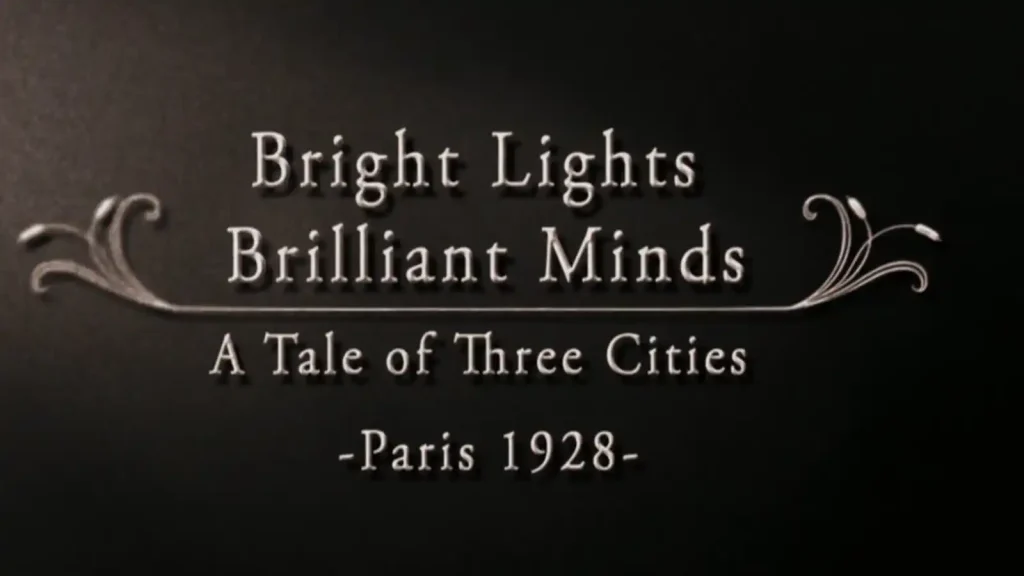
The documentary A Tale of Three Cities episode 2 – Paris explores the vibrant cultural landscape of the French capital in the pivotal year of 1928. This was a time when the city, finally shaking off the collective trauma of the First World War, became a global magnet for creativity and revolutionary ideas. Artists, writers, and thinkers flocked to its streets, each seeking to redefine the world in their own image. Consequently, Paris transformed into a crucible of innovation, a super-charged laboratory where the future was being actively and audaciously imagined and constructed. The air was thick with the promise of a new dawn, a stark contrast to the preceding years of solemn recovery.
The allure of Paris in the 1920s was multifaceted, attracting a diverse crowd of dreamers, innovators, and refugees from convention. For some, it was a sanctuary from the social and political constraints of their home countries, a place to escape stifling traditions or outright persecution. For others, it was an affordable place to live while pursuing artistic ambitions, where one could survive on very little while creating a masterpiece.
According to the documentary, one could come to Paris for three reasons: because you were rich, because you were poor, or because you wanted to do things you couldn’t do elsewhere. The wealthy came for high fashion and high culture; the poor came because one could “starve longer in Paris” than any other city; and the rebels came for the unparalleled freedom. This unique environment created a fertile ground for new movements to sprout and flourish.
This article will delve into the key movements and figures that defined this exceptional year, as presented in A Tale of Three Cities episode 2 – Paris. We will explore the unsettling world of the Surrealists, who sought to unlock the power of the unconscious mind. Furthermore, we will examine the lives of expatriate artists and writers who reinvented themselves in the city’s liberal atmosphere. Finally, we will look at the bold visions of modernist architects and painters who dreamed of building a utopian future from the ground up.
A decade after the Great War, Paris had successfully rebuilt its reputation as the most glamorous city in the world. The early 1920s had been marked by food queues and the lingering grief of a lost generation, but by 1928, a new, electrifying energy pulsed through its streets. This was the peak of a creative decade, a moment when living intensely in the present was the prevailing philosophy. The city became an interwar utopia where everything seemed possible, attracting a wave of international talent that included figures like Ernest Hemingway and George Gershwin, all drawn by the city’s magnetic pull.
The epicenter of this cultural explosion was Montparnasse, a cheap and lively neighborhood on the Left Bank that pulsed with artistic fervor. At its heart was the newly opened cafe, La Coupole, the largest restaurant in Paris at the time. Its vast, stunning Art Deco interior, with Cubist mosaics underfoot and 33 famous pillars painted by local artists, became the de facto headquarters for this new, cosmopolitan society. Here, amidst the constant clatter of conversation, clinking glasses, and swirling cigarette smoke, ideas were exchanged, manifestos were drafted, collaborations were born, and the artistic identity of an era was forged.
This unique atmosphere acted as a powerful magnet, drawing people from all corners of the globe. The promise of Paris was the promise of success and discovery, a place where one could learn directly from masters like Matisse or have a chance encounter with Picasso. This incredible concentration of talent and ambition meant that Paris was not just a passive backdrop for creativity; it was an active ingredient in the artistic process.
The city itself—its cafes, its salons, its very streets—seemed to accelerate innovation, pushing artists to create their most daring work. It was within this dynamic crucible that so many of the 20th century’s most influential artistic movements took shape, creating a legacy that continues to resonate today.
The Surrealist Revolution in A Tale of Three Cities episode 2 – Paris
In the wake of World War I, a profound sense of disillusionment with Western civilization took hold. The writer André Breton, having served as a doctor during the conflict and witnessed its mechanical slaughter firsthand, concluded that reason, logic, and capitalism had led only to disaster. His radical solution was Surrealism, a movement that aimed to spark a revolution from within by celebrating the absurd, the irrational, and the disruptive energy of the unconscious. Breton’s antidote to the horrors of war was a complete re-evaluation of the human experience, prioritizing dreams and instinct over conscious thought.
To facilitate this revolution, Breton and his colleagues opened the Bureau of Surrealist Research. This unconventional office invited the public to confess their darkest secrets, hidden desires, and unsettling dreams, hoping to compile an archive of the human subconscious. The goal was to explode bourgeois conventions and liberate the individual psyche. However, few people took up the offer, and the office files remained mostly empty. Undeterred, Breton channeled his vision into a literary work, publishing the surreal fantasy novel Nadja in 1928. The book chronicles a strange, aimless affair born from a chance encounter on a Parisian street, transforming the city itself into a mysterious and seductive dreamscape where the boundaries between reality and imagination completely dissolve.
While Breton worked in the cafes, another artist quietly explored the tension between dreams and reality from the suburbs. The Belgian painter René Magritte moved to Paris in 1927 and had his most productive year ever in 1928, creating over 100 paintings. Working from the quiet domesticity of his sitting room, Magritte produced some of the most iconic images of Surrealism. His famous painting, The Treachery of Images, depicts a pipe with the caption “Ceci n’est pas une pipe” (This is not a pipe). The work cleverly reminds the viewer that an image of a thing is not the thing itself, challenging our most basic assumptions about representation and reality.
Perhaps his most unsettling work from this period is The False Mirror. The painting shows a large, unblinking eye, its iris filled with a cloudy sky. As explained in the documentary, Magritte intended for the sky to be seen not as a reflection on the eye’s surface, but as existing inside the head. The viewer looks through the eye and into the subject’s mind, a perfect visual metaphor for the Surrealist project of bringing the interior world outside. Magritte’s work masterfully played with the bizarre and often amusing relationship between the seen and the unseen, using a precise, almost clinical style to depict impossible scenes, making them all the more disconcerting.
The movement’s reach expanded as two flamboyant Spaniards, Salvador Dalí and Luis Buñuel, arrived in Paris. Inspired by Breton, they set out to make the perfect surrealist film with one strict rule: nothing rational was permitted. Every image had to come from their dreams. The result was Un Chien Andalou (An Andalusian Dog), which premiered in 1928 to an audience of Paris’s artistic elite, including Picasso and Le Corbusier.
The film’s series of shocking, disconnected scenes—ants crawling from a hand, rotting donkeys on pianos—culminated in its most infamous sequence: a man slicing open a woman’s eye with a razor. Though a dead cow’s eye was used, the scene remains one of the most jarring in film history, a symbolic act of destroying conventional vision to usher the audience into a raw, unfiltered world of pure imagination.
A Haven for Expatriates and the Birth of New Identities
Paris in 1928 was not just a city of artistic movements but also a sanctuary for individuals seeking to reinvent themselves. Among the 200,000 foreigners living in the city were many émigrés who had fled war, revolution, and social constraint. One such figure was Tamara Gorska, a wealthy Russian who arrived in Paris after helping her husband escape from prison during the Russian Revolution. Having lost everything, she took control of her life, enrolled in art school, and transformed herself into the glamorous artist Tamara de Lempicka. She shed her past and constructed a new, powerful identity.
De Lempicka decided to paint portraits for the rich, focusing on modernity’s most alluring new character: the sexually liberated, independent woman. Her art is defined by its smooth, almost metallic surfaces, crisp lines, and a cool, detached glamour that perfectly captured the Art Deco aesthetic. Her subjects, often women like herself, exude confidence and power. The city also unlocked her wild side, and she famously sought lovers, both male and female, in the Bois de Boulogne. Her most renowned painting is a self-portrait, showing her at the wheel of a green Bugatti, her face set with determination—the very image of the new woman in the driving seat of her own destiny.
Americans also flocked to Paris, leaving behind an increasingly illiberal and prohibition-era United States. No one seemed to have a better time than the songwriter Cole Porter. Though already wealthy, his money went much further in Paris, allowing him to live an extravagant lifestyle filled with Art Deco furnishings, zebra-skin rugs, and a collection of 16 dressing gowns. In 1928, after years of hosting lavish parties and entertaining the city’s high society, Porter finally wrote his first hit, a musical aptly titled Paris. One of its songs, “Let’s Do It, Let’s Fall in Love,” became a worldwide sensation, its witty, sophisticated lyrics perfectly capturing the city’s romantic and playful spirit and marking a major turning point in his career.
For American writers, the city offered both inspiration and a supportive community. The epicenter of this literary world was Shakespeare and Company, an English-language bookshop run by Sylvia Beach. It was a mecca for writers like F. Scott Fitzgerald, Ezra Pound, and Ernest Hemingway. Hemingway, who arrived in Paris poor and unpublished, became the shop’s best customer. By 1928, he was a Parisian old hand, working as a journalist while meticulously honing his craft as a novelist. His crisp, economical prose, stripped back to the bone, was born from the necessity of sending stories by telegram across the Atlantic, forcing him to be concise and impactful.
This unique style, which Hemingway famously described as “architecture, not interior decoration,” reached its zenith in his 1929 novel A Farewell to Arms, which he was working on in 1928. The novel’s tale of love and war is told with short, declarative sentences and basic words, rigorously avoiding sentimentality to achieve a raw, powerful emotional effect. The simple, heartbreaking ending—”After a while I went out and left the hospital and walked back to the hotel in the rain”—took Hemingway 47 attempts to perfect. His time in Paris was crucial in transforming him from a journalist into one of the 20th century’s most influential novelists.
Black Artists and Modernist Dreamers in A Tale of Three Cities episode 2 – Paris
For African-American artists, Paris offered a more fundamental kind of freedom. In the United States, they faced systemic racism and segregation so pervasive it was, as one musician noted, an “insanity” difficult for outsiders to comprehend. They had to step off sidewalks for white people and lived under the constant threat of violence. In Paris, however, they found opportunities, dignity, and admiration. Many who had fought for France in WWI stayed, bringing with them a new sound: jazz. The French fell in love with it, coining the term “Négritude” or “love of everything black.” This obsession created a thriving jazz scene and turned black musicians from second-class citizens into celebrated superstars.
The greatest of these stars was the dancer Josephine Baker. Born into poverty in Missouri, she escaped a difficult youth and arrived in Paris to perform in a show advertised with the cringeworthy line “Come and see 25 Negroes in their natural state.” Baker, however, stole the show by masterfully subverting the owners’ casual racism with a performance that was uninhibited, cheeky, and utterly free. She embraced the “primitive” caricature but imbued it with such wit and self-awareness that she controlled the narrative completely.
Paris had never seen anything like it and fell head over heels. Though often lonely and unsettled by her fame—keeping a menagerie that included a pig and a cheetah in her hotel suite—Josephine Baker found more freedom in Paris than anywhere else, becoming one of the most distinctive artists of the decade.
While many lived for the moment, others were fixated on the future. A new generation of artists and architects, inspired by the clean lines and efficiency of the machine age, wanted to build a modernist utopia. The Dutch painter Piet Mondrian was one of these dreamers. He lived and worked in a meticulously designed studio that he saw as a prototype for this new world.
He developed a signature style of abstract painting, distilling the world to its most basic forms: vertical and horizontal lines and the three primary colors. For Mondrian, this was the visual DNA of the universe, a portrait of a pure, timeless, and harmonious reality that he believed could inspire a more orderly and spiritual society.
The most ambitious of these modernists was the Swiss architect Le Corbusier. He believed homes should be “machines for living in,” and his own Paris apartment was a showcase of his principles: open-plan, full of natural light, and eminently functional, rejecting the dark, ornate stuffiness of traditional bourgeois interiors. But Le Corbusier was not content with changing one building at a time; he wanted to transform the entire city. He viewed Paris as unhealthy, overcrowded, and antiquated, declaring that “surgery must be applied at the city’s centre and we must use the knife.”
His radical plan involved tearing down a huge swathe of the city’s historic center, including parts of the Marais and the area around Les Halles. He proposed replacing it with a grid of 60-story, cross-shaped skyscrapers set in parkland and connected by superhighways. His vision was startlingly modern, an attempt to make Paris cleaner, healthier, and more efficient by razing its chaotic past. Thankfully, his plan was never realized—the cultural cost would have been immeasurable—but his audacious dreams, fueled by the optimistic spirit of 1920s Paris, would have a defining, and often controversial, influence on the world we inhabit today.
The Enduring Magic of Creative Collisions
Paris in 1928 wasn’t just a city—it was a time machine, a place where the future was being frantically sketched in café corners and artist studios while the wounds of the past were still healing. What made this moment so extraordinary wasn’t any single movement or individual genius, but rather the electric collision of desperate dreamers, wealthy rebels, and visionary outsiders all converging on the same cobblestone streets.
The magic formula was deceptively simple: take people who had lost everything or rejected everything, give them just enough freedom and affordability to survive, then watch what happens when they bump into each other over coffee and cigarettes. André Breton’s surrealists were busy dynamiting the foundations of rational thought just as Hemingway was stripping language down to its bare bones. Josephine Baker was rewriting the rules of performance and identity while Le Corbusier was literally drawing plans to tear down the very city that sheltered them all.
This wasn’t just artistic cross-pollination—it was creative chaos in the best possible way. The Bureau of Surrealist Research may have collected few confessions, but the city itself became a living laboratory where everyone was simultaneously the researcher and the subject. Tamara de Lempicka could reinvent herself as a glamorous artist while Cole Porter perfected the art of sophisticated American songwriting, all within the same neighborhood where Magritte was painting eyes filled with sky and Mondrian was reducing reality to primary colors and perfect lines.
What’s remarkable is how this concentration of talent didn’t lead to artistic homogenization but to explosive diversity. Each movement pushed against the others, creating a productive tension that elevated everyone’s work. The jazz musicians weren’t trying to sound like the Surrealists, but both were responding to the same post-war hunger for authentic expression and radical freedom.
Perhaps most importantly, 1928 Paris proved that creativity thrives not in isolation but in community—messy, argumentative, inspiring community. These artists didn’t just happen to be in the same place; they needed each other, even when they disagreed. The conversations at La Coupole, the chance encounters at Shakespeare and Company, the cross-cultural exchanges in Montparnasse—these weren’t just social pleasantries but the actual engine of innovation.
Today, as we navigate our own era of uncertainty and rapid change, the lesson of 1920s Paris isn’t about replicating their specific artistic movements but about understanding the conditions that made such creative explosions possible. We need spaces—physical and virtual—where different voices can collide and collaborate. We need to protect the margins where the poor can “starve longer” while pursuing their art, and we need to welcome the refugees and rebels who bring fresh perspectives to stale conversations.
The modernist dream of rebuilding everything from scratch may have been too radical for its time, but the underlying impulse—to imagine better ways of living and creating—remains as vital today as it was in Montparnasse nearly a century ago. The question isn’t whether we can recreate 1928 Paris, but whether we’re brave enough to create the conditions for our own cultural revolution.
FAQ A Tale of Three Cities episode 2 – Paris
Q: What made Paris in 1928 such a powerful cultural magnet for international artists?
A: Paris in 1928 offered a unique combination of affordability, freedom, and creative community. Additionally, the city had recovered from World War I trauma and embraced radical experimentation. Furthermore, artists could “starve longer in Paris” than anywhere else while pursuing their craft. The concentration of talent in neighborhoods like Montparnasse created an electric atmosphere where chance encounters with masters like Picasso or Matisse could change careers overnight.
Q: Who were the most influential Surrealist artists working in Paris during 1928?
A: André Breton led the movement, publishing his surreal novel Nadja in 1928. Meanwhile, Belgian painter René Magritte created over 100 paintings that year, including iconic works like “The Treachery of Images.” Additionally, Salvador Dalí and Luis Buñuel collaborated on the shocking film “Un Chien Andalou,” which premiered to Paris’s artistic elite. However, each artist approached Surrealism differently, from Breton’s literary explorations to Magritte’s visual paradoxes.
Q: Why did American writers like Hemingway choose Paris over other cities in the 1920s?
A: American writers fled increasingly conservative, prohibition-era United States for Paris’s liberal atmosphere. Moreover, the favorable exchange rate made their dollars stretch further, allowing them to focus on writing rather than survival. Shakespeare and Company bookshop became their unofficial headquarters, providing community and literary resources. Furthermore, the city’s cafe culture encouraged the kind of intense conversations and collaborations that shaped modernist literature.
Q: What was La Coupole and why did it become central to Paris’s artistic scene?
A: La Coupole was Paris’s largest restaurant in 1928, featuring stunning Art Deco interiors with Cubist mosaics and 33 artist-painted pillars. Located in Montparnasse, it became the unofficial headquarters for the city’s cosmopolitan artistic community. Additionally, its vast space accommodated the constant flow of conversations, collaborations, and chance encounters that fueled creative innovation. Consequently, many artistic movements and manifestos were born amid its clatter of glasses and swirling cigarette smoke.
Q: How did African-American artists experience Paris differently than their home country?
A: African-American artists found unprecedented freedom in Paris, escaping systemic racism and segregation. Furthermore, French audiences embraced jazz music and coined “Négritude” to express their appreciation for Black culture. Artists like Josephine Baker transformed from second-class citizens into celebrated superstars. Additionally, they could walk freely without stepping off sidewalks for white people or facing constant threats of violence. This liberation allowed them to focus entirely on their artistic expression.
Q: What was the Bureau of Surrealist Research and did it achieve its goals?
A: The Bureau of Surrealist Research was André Breton’s unconventional office that invited public confessions of secrets, desires, and dreams. However, few people participated, leaving the files mostly empty. Nevertheless, this experiment reflected Surrealism’s core mission to explode bourgeois conventions and liberate the unconscious mind. Although the bureau failed practically, it symbolized the movement’s revolutionary approach to exploring human psychology and challenging rational thought through art and literature.
Q: Who was Tamara de Lempicka and what did she represent for women in the 1920s?
A: Tamara de Lempicka was a Russian émigré who reinvented herself as a glamorous Art Deco painter after losing everything in the revolution. Moreover, she embodied the “new woman” of the 1920s—sexually liberated, financially independent, and artistically ambitious. Her self-portrait behind the wheel of a green Bugatti became an icon of female empowerment. Additionally, her smooth, metallic painting style perfectly captured the era’s modern aesthetic while celebrating confident, powerful women.
Q: What were Le Corbusier’s radical architectural plans for transforming Paris?
A: Le Corbusier proposed demolishing huge sections of historic Paris, including parts of the Marais and Les Halles neighborhoods. Furthermore, he envisioned replacing them with 60-story cross-shaped skyscrapers set in parkland and connected by superhighways. His “machines for living” philosophy prioritized efficiency, natural light, and functionality over traditional aesthetics. Fortunately, these plans never materialized, preserving Paris’s cultural heritage while influencing controversial urban planning worldwide.
Q: How did Ernest Hemingway develop his distinctive writing style while living in Paris?
A: Hemingway’s crisp, economical prose emerged from practical necessity—sending stories by telegram across the Atlantic required extreme brevity. Additionally, he described his approach as “architecture, not interior decoration,” stripping away unnecessary words for maximum impact. His 1929 novel “A Farewell to Arms” exemplified this style, with its simple ending taking 47 attempts to perfect. Consequently, Paris transformed him from journalist to influential novelist through disciplined craft and literary community support.
Q: What lasting impact did the creative explosion of 1928 Paris have on modern culture?
A: The artistic movements born in 1928 Paris fundamentally shaped 20th-century culture across multiple disciplines. Furthermore, Surrealism influenced psychology, advertising, and contemporary art, while modernist architecture revolutionized urban planning worldwide. Additionally, the period established Paris’s reputation as a global creative capital and demonstrated how diverse communities can accelerate innovation. Moreover, the era’s emphasis on creative freedom and international collaboration continues inspiring artists, writers, and thinkers today.