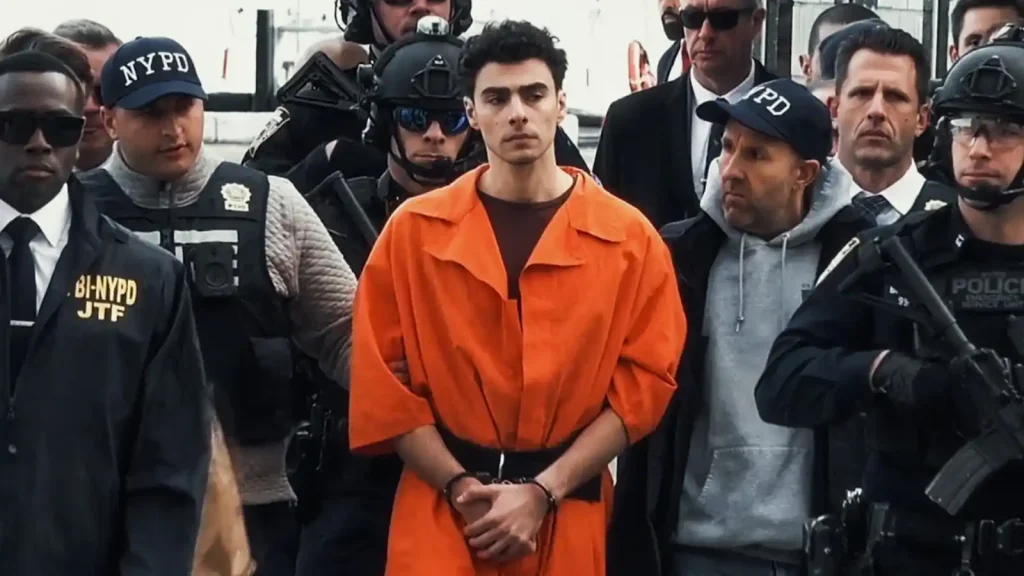
AI Confidential with Hannah Fry episode 3 opens in the aftermath of a killing that shook corporate America to its foundations. On a December morning in 2024, Brian Thompson, the CEO of UnitedHealthcare — the largest health insurance provider in the United States — was shot dead outside a hotel in Midtown Manhattan. The attacker moved with purpose and then vanished into the city. What followed was one of the most intensely covered manhunts in recent American history, ending with the arrest of a 26-year-old named Luigi Mangione.
The case immediately fractured public opinion. Mangione’s physical appearance prompted a wave of darkly satirical commentary online, with some corners of social media dubbing him the “hot assassin.” But beneath the superficial spectacle, something far more significant was taking shape. Across protest gatherings and online forums, a substantial number of voices emerged not to condemn Mangione but to express sympathy — even admiration. To them, he represented something: a reckoning with a system that had, in their view, failed ordinary people for decades.
The grievances underlying that sympathy were specific. UnitedHealthcare had been facing serious allegations that it deployed artificial intelligence to deny insurance claims — not through human judgment, but through automated decision-making processes that left patients without coverage at their most vulnerable moments. The company’s use of an AI model called nH Predict had come under scrutiny. Critics argued the system was being used to override the recommendations of treating physicians and discharge patients from care before they were medically ready.
What AI Confidential with Hannah Fry episode 3 makes plain is that this was never simply a crime story. It was a story about power, algorithms, profit, and the lives caught in between. Hannah Fry travels to the United States to speak directly with those affected — a widow who believes her husband died as a consequence of algorithmic denial, a UnitedHealthcare insider willing to share her concerns on record, and a young entrepreneur using AI to help prospective parents select genetic traits in embryos. Together, these threads form a portrait of a technology advancing far faster than the ethical and regulatory frameworks designed to govern it.
The Mangione case, in this context, becomes a lens rather than a centrepiece. It illuminates the rage that can accumulate when systems built for efficiency treat human lives as variables in an optimisation equation. Luigi Mangione himself had studied artificial intelligence at university — a detail that added an unsettling layer of irony to the entire episode. A man trained to understand these systems had allegedly turned against the man who ran one of the most contested deployments of them.
Understanding why so many people responded to Thompson’s death without the expected horror requires understanding what UnitedHealthcare’s AI system was accused of doing. The model, nH Predict, was alleged to have an extraordinarily high error rate — reportedly denying claims that, on appeal, were overturned more than 90 percent of the time. That statistic, if accurate, suggests the system was not functioning as a neutral arbiter of medical necessity. It was functioning as a barrier.
Hannah Fry speaks with a woman named Judy Sansoucie, whose husband Dale required post-acute rehabilitation care following a serious medical episode. UnitedHealthcare, according to Judy, denied coverage for his continued care and insisted he be discharged. Dale died. Judy’s account is not a legal finding — she is clear that she cannot prove causation — but her experience mirrors a pattern that has emerged in lawsuits and whistleblower testimony across the country. The human cost of algorithmic decision-making, in these accounts, is not theoretical. It has a name, a face, and a family left behind.
AI Confidential with Hannah Fry episode 3 does not present these accounts as settled fact. It presents them as a serious, documented controversy that demands public attention. The programme asks not just what happened in a single case, but what happens when an industry deploys AI at scale, without sufficient oversight, in a domain where the stakes are human life. That question runs beneath every interview, every data point, and every corporate statement examined throughout the episode.
AI Confidential with Hannah Fry Episode 3 and the Algorithm at the Centre of the Storm
The AI system known as nH Predict was not invented by UnitedHealthcare. It was developed by a company called NaviHealth, which UnitedHealthcare subsequently acquired. The model was trained on historical patient data to predict how long a recovery should take following a particular medical event. In theory, this sounds like a legitimate clinical tool — using data to establish reasonable expectations for treatment duration.
In practice, the allegations paint a different picture. Fry’s investigation surfaces testimony suggesting that nH Predict was used not as an advisory instrument but as a gatekeeping mechanism. Clinicians treating patients would recommend continued care. The algorithm would disagree. And in a system where the insurer controls payment, disagreement from the algorithm effectively meant denial of coverage. Patients and their families were then placed in an impossible position: appeal, pay out of pocket, or accept discharge regardless of their clinical condition.
A former UnitedHealthcare employee — referred to as a company insider in the programme — describes a culture in which financial targets and algorithmic outputs carried more weight than individual clinical assessments. She expresses concern that the system was being used in ways that prioritised cost reduction over patient welfare. Her testimony is measured and specific. She does not allege criminal intent. She describes something arguably more troubling: a structural dynamic in which harm could occur as a predictable byproduct of a profit-optimising system, without anyone needing to make a conscious decision to cause it.
The Human Toll Documented in AI Confidential with Hannah Fry Episode 3
Judy Sansoucie sits with Hannah Fry and recounts the final weeks of her husband Dale’s life in direct, unadorned terms. Dale had suffered a significant health crisis and required ongoing rehabilitative care. UnitedHealthcare, according to her account, concluded — through the application of its predictive model — that he had recovered sufficiently to be discharged. His treating clinicians, she says, did not agree.
What happened next illustrates the structural power imbalance at the heart of this controversy. Judy was not a healthcare professional. She was a spouse trying to navigate a system she had paid into for years, now being told, in effect, that the algorithm knew better than the doctors in the room. Her husband was sent home. He did not recover. He died.
Judy is careful not to make a legal claim she cannot prove. But she wants people to understand that the experience of fighting an algorithm for your husband’s life is not an abstraction. It is phone calls and paperwork and the creeping terror that the system supposed to help you is working against you. Her account does not prove that the AI killed Dale Sansoucie. It does prove that a family was placed in an agonising situation by a process they could neither fully understand nor effectively challenge. That, in itself, raises questions that any responsible society must confront.
Protest, Sympathy, and the Social Response Explored in AI Confidential with Hannah Fry Episode 3
The reaction to Brian Thompson’s death was, by any conventional standard, startling. Public figures and commentators expected expressions of shock and condemnation. What emerged instead — at least in significant segments of online discourse — was something closer to grim satisfaction. People posted about denied claims. They shared stories of loved ones refused coverage. They described the experience of battling insurance companies as a form of slow violence, and they found in Mangione’s act, whatever its moral status, a kind of symbolic rupture.
Hannah Fry engages with this reaction seriously rather than dismissively. She does not endorse it, but she examines what it reveals. A society in which a significant number of people respond to a CEO’s murder with ambivalence or approval is a society with a serious problem — and that problem is not the people. It is the system that generated such profound, widespread grievance.
The protesters who carried signs in support of Mangione were not, in the main, celebrating violence. They were expressing something about their relationship with institutions that had failed them. AI Confidential with Hannah Fry episode 3 captures this distinction with care. The story is not about whether Luigi Mangione was right or wrong. It is about what his case reveals about the experiences that made so many people willing to entertain the question at all.
The legal proceedings around Mangione were still developing at the time of filming. He faced multiple charges, including murder. His background — a graduate who had studied AI and its implications — was widely noted and widely interpreted. Some read it as irony. Others saw it as evidence of a particular kind of radicalisation, one rooted not in ideology but in intimate understanding of a system’s capacity for harm.
The Corporate Response and the Role of Regulation
UnitedHealthcare, for its part, denied the most serious allegations. The company maintained that nH Predict was a tool to assist clinical decision-making rather than replace it, and that coverage denials were always subject to human review. These statements stand in tension with the testimony gathered by Fry and her team, as well as with the statistical record of overturned denials on appeal.
The broader regulatory environment around AI in healthcare in the United States was, at the time of filming, still catching up to the pace of deployment. The systems being used by insurers were largely proprietary, their inner workings opaque to patients and physicians alike. There was no standard requirement for insurers to disclose how AI influenced coverage decisions, no mandatory audit process, and no clear liability framework for harms that could be attributed to algorithmic error.
This regulatory gap is not unique to healthcare. It reflects a wider pattern in which AI deployment has outstripped governance across multiple sectors. But in healthcare, the consequences of that gap are uniquely severe. When an algorithm makes an error in a content recommendation system, a user sees an irrelevant post. When an algorithm makes an error in a clinical coverage decision, a patient may go without care they need. The asymmetry of those outcomes demands a corresponding asymmetry in the rigour of oversight.
Embryo Selection and the Expanding Frontier Examined in AI Confidential with Hannah Fry Episode 3
The episode does not confine its examination of AI in healthcare to the insurance context. Hannah Fry also travels to meet the young founder of a company using artificial intelligence in a radically different medical domain: the selection of embryos based on genetic traits. The company uses AI to analyse embryos created through in vitro fertilisation and rank them according to predicted genetic characteristics — including traits that go beyond medical risk factors into territory that many bioethicists regard as deeply contested.
The entrepreneur behind the company speaks to Fry with the enthusiasm and moral confidence that characterises much of the technology sector’s engagement with biological questions. In his framing, giving parents access to better genetic information is simply an extension of informed choice. The more you know about an embryo’s likely characteristics, the better equipped you are to make a decision that aligns with your values and circumstances. He presents the service as empowerment.
Fry does not simply accept this framing. She probes the assumptions beneath it. Who defines which genetic traits are desirable? What happens to the embryos ranked lowest by the algorithm? What does it mean for society when access to this technology is available only to those who can afford IVF in the first place? These questions do not have easy answers, and the programme does not pretend otherwise. But asking them — specifically, seriously, and in the presence of the person building the technology — is exactly what responsible public engagement with AI requires.
Scientific Scrutiny and the Limits of Genetic Prediction
The scientific community’s response to embryo selection AI has been, to put it gently, sceptical. Fry speaks with researchers who question whether the predictive power claimed by such companies is supported by the evidence. Complex human traits — intelligence, personality, susceptibility to particular conditions — are determined by the interaction of thousands of genetic variants, environmental factors, and developmental processes that no current model can reliably simulate.
The concern among geneticists is not merely technical. It is that parents will make irreversible decisions — decisions about which embryos to implant — based on probabilistic outputs that carry far less certainty than they appear to. An algorithm that expresses its predictions with numerical precision can create an illusion of scientific authority that obscures the genuine uncertainty underlying its outputs. In a domain where the decisions are permanent and the stakes are human lives, that illusion is dangerous.
There is also a deeper ethical dimension. If AI-assisted embryo selection becomes normalised, and if the traits selected trend toward characteristics associated with social advantage — height, projected cognitive ability, freedom from disability — then the technology risks encoding existing social hierarchies into the biology of future generations. The children born from this process did not choose it. The society that surrounds them will nonetheless be shaped by it.
AI Confidential with Hannah Fry Episode 3 and the Question of Accountability
Running through every strand of this episode is a single insistent question: who is accountable when AI causes harm? In the UnitedHealthcare case, the company points to human oversight. The humans involved in that oversight point to the algorithm’s recommendations. The algorithm is a statistical model — it cannot be held responsible in any meaningful sense. The result is a diffusion of accountability so complete that responsibility effectively disappears.
This is not accidental. The opacity of algorithmic systems provides corporations with a form of moral insulation. When a human caseworker denies a claim, there is a name attached to that decision. There is a professional who can be questioned, a chain of authority that can be traced. When an algorithm denies a claim, the decision appears to emerge from a process — neutral, objective, data-driven — and the humans in the system can present themselves as merely implementing its outputs rather than making the choice themselves.
Hannah Fry has written and spoken extensively about the ways in which mathematical models can create this false impression of objectivity. A model is only as unbiased as the data it is trained on and the objectives it is optimised to achieve. If an insurer’s AI is trained on historical claims data from a system already structured to minimise payouts, it will learn to minimise payouts. If it is optimised to reduce costs, it will find ways to reduce costs. Calling the output of that process a neutral clinical determination is not accuracy — it is obfuscation.
The Broader Stakes Raised by AI Confidential with Hannah Fry Episode 3
The episode arrives at a moment when the integration of AI into healthcare systems is accelerating globally. Diagnostic AI that can detect cancers from imaging data, predictive models that identify patients at risk of deterioration, administrative systems that manage appointments and triage — these applications carry genuine promise. They could extend the reach of clinical expertise, reduce diagnostic error, and free clinicians to spend more time with patients.
But the UnitedHealthcare case demonstrates that promise and peril can exist within the same technological paradigm. The same capacity for pattern recognition that makes AI valuable in diagnosis makes it dangerous in the hands of institutions whose incentives are misaligned with patient welfare. The difference between a beneficial and a harmful deployment of AI in healthcare is not purely technical. It is structural, regulatory, and ethical.
What AI Confidential with Hannah Fry episode 3 ultimately argues — not didactically, but through the accumulation of evidence and testimony — is that society cannot afford to treat these questions as afterthoughts. The deployment of AI in healthcare is not a future development to be governed once the technology matures. It is happening now, at scale, in systems that affect millions of people. The governance must happen now too.
Judy Sansoucie’s testimony, the UnitedHealthcare insider’s concerns, the embryo selection entrepreneur’s certainties, and the geneticists’ scepticism — these are not isolated vignettes. They are facets of a single, urgent problem. Artificial intelligence is being woven into the fabric of healthcare at a pace that outstrips the ability of patients, clinicians, and regulators to understand what is being done to them and in whose interest.
What Comes Next: Accountability, Transparency, and Reform
The legal proceedings against Luigi Mangione will, in due course, resolve some of the immediate questions his case raises. Whether he is convicted, what sentence he receives, how the courts characterise his alleged actions — these outcomes will matter. But they will not resolve the questions that his case illuminated. No verdict will determine whether nH Predict caused patient harm. No sentence will establish what standard of oversight should govern AI systems making life-affecting decisions in the insurance industry.
Those questions require different processes: legislative action, regulatory development, corporate accountability, and sustained public pressure. Several US states were, at the time of filming, beginning to examine legislation that would require greater transparency from insurers using AI in coverage decisions. Patient advocacy organisations had filed lawsuits and submitted evidence to Congressional committees. The machinery of accountability was moving — slowly, as it always does when confronting a well-resourced industry.
AI Confidential with Hannah Fry episode 3 does not offer a roadmap for reform. It does something arguably more valuable: it makes the stakes concrete. Behind every statistic about denial rates and appeal outcomes, there is a Judy Sansoucie, sitting in a room, describing the last weeks of her husband’s life. Behind every confident assertion about the neutrality of algorithmic decision-making, there is a structural reality in which those algorithms serve the interests of their owners rather than their subjects.
The conversation that this episode demands is not about whether AI belongs in healthcare. That question is already answered by events on the ground. The conversation that matters now is about conditions — the conditions under which AI may legitimately operate in high-stakes medical contexts, the transparency requirements that must accompany its use, the liability frameworks that must exist when it fails, and the human oversight that must remain meaningful rather than nominal. Hannah Fry’s investigation makes clear that those conditions do not yet adequately exist. Getting them right is not a technical problem. It is a political and moral one, and the time to solve it is not after the next preventable harm. It is now.
FAQ AI Confidential with Hannah Fry episode 3
Q: What is AI Confidential with Hannah Fry episode 3 about?
A: AI Confidential with Hannah Fry episode 3 examines the role of artificial intelligence in the US healthcare system. It focuses on UnitedHealthcare’s use of an AI model called nH Predict to deny insurance claims, the killing of CEO Brian Thompson, the arrest of Luigi Mangione, and a separate investigation into AI-assisted embryo selection.
Q: Who is Luigi Mangione and why is he connected to AI?
A: Luigi Mangione is the 26-year-old arrested for the shooting of UnitedHealthcare CEO Brian Thompson in New York in December 2024. Notably, Mangione had studied artificial intelligence at university. This background added a layer of irony to the case, given the allegations surrounding UnitedHealthcare’s own use of AI systems.
Q: What is nH Predict and how did UnitedHealthcare use it?
A: nH Predict is an AI model originally developed by NaviHealth, a company UnitedHealthcare later acquired. It used historical patient data to predict appropriate recovery durations. Critics alleged that UnitedHealthcare deployed it as a gatekeeping tool, overriding treating physicians and denying continued care to patients before they were medically ready for discharge.
Q: What happened to Judy Sansoucie’s husband Dale?
A: Judy Sansoucie’s husband Dale required post-acute rehabilitative care following a serious health crisis. UnitedHealthcare denied ongoing coverage, and Dale was discharged despite the concerns of his treating clinicians. He subsequently died. Judy spoke to Hannah Fry about her experience fighting an algorithmic system that she felt had overruled the medical professionals caring for her husband.
Q: Why did some people publicly support Luigi Mangione after the shooting?
A: A significant number of people expressed sympathy for Mangione online and at protests. However, their support was rooted less in endorsing violence and more in expressing deep frustration with the US insurance system. Many shared personal experiences of denied claims, viewing Thompson’s death as a symbol of a system they felt had failed ordinary patients for years.
Q: What did the UnitedHealthcare insider reveal in the programme?
A: A former UnitedHealthcare employee spoke to Hannah Fry on record, describing a corporate culture in which financial targets and algorithmic outputs carried more weight than individual clinical assessments. She expressed concern that nH Predict was being used in ways that prioritised cost reduction over patient welfare. She did not allege deliberate criminal intent, but described a structure where harm was a predictable byproduct.
Q: How does AI Confidential with Hannah Fry episode 3 address embryo selection technology?
A: The episode also investigates a company using AI to rank IVF embryos by predicted genetic traits, including characteristics beyond standard medical risk factors. Hannah Fry interviews the young founder, who frames the technology as expanding parental choice. However, she challenges him on who defines desirable traits, who can afford access, and what happens to lower-ranked embryos.
Q: What do scientists say about AI-assisted embryo selection?
A: Geneticists interviewed in the programme express serious scepticism. Complex human traits involve thousands of genetic variants interacting with environmental and developmental factors. Furthermore, researchers warn that numerical precision in AI outputs can create a misleading impression of certainty. Parents risk making irreversible decisions based on probabilistic predictions that carry far less scientific reliability than they appear to.
Q: What regulatory gaps does AI Confidential with Hannah Fry episode 3 highlight?
A: At the time of filming, US insurers faced no standard requirement to disclose how AI influenced coverage decisions. Additionally, no mandatory audit process or clear liability framework existed for algorithmic errors in healthcare. Several states were beginning to examine relevant legislation, and patient advocacy groups had submitted evidence to Congressional committees, but meaningful regulatory oversight remained underdeveloped.
Q: What is the central argument of AI Confidential with Hannah Fry episode 3?
A: The episode argues that AI deployment in healthcare is already happening at scale, and governance must keep pace. Transparency requirements, liability frameworks, and meaningful human oversight are essential conditions for ethical AI use in medical contexts. Hannah Fry’s investigation concludes that the time to establish these safeguards is now — not after further preventable harm has occurred.