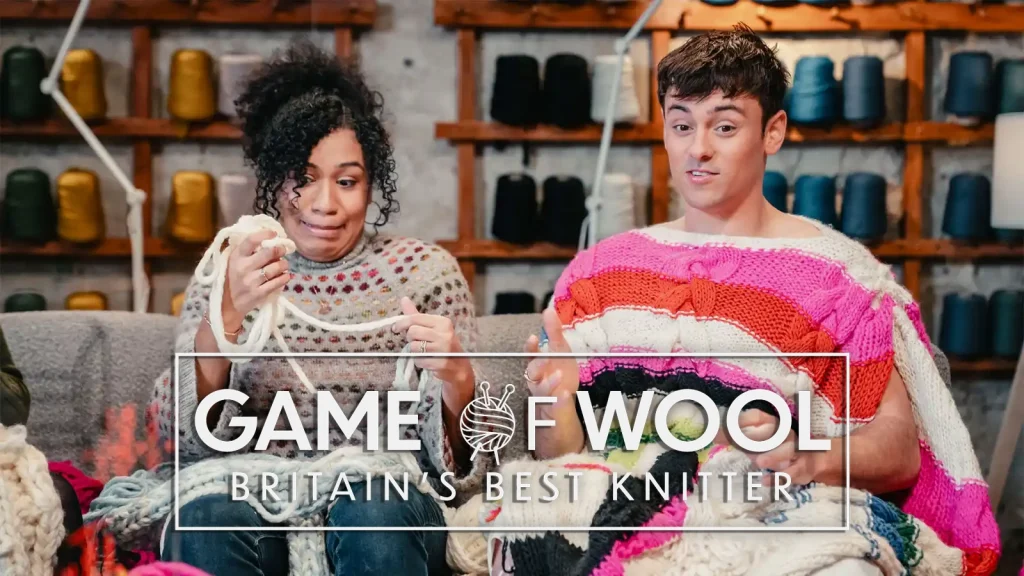
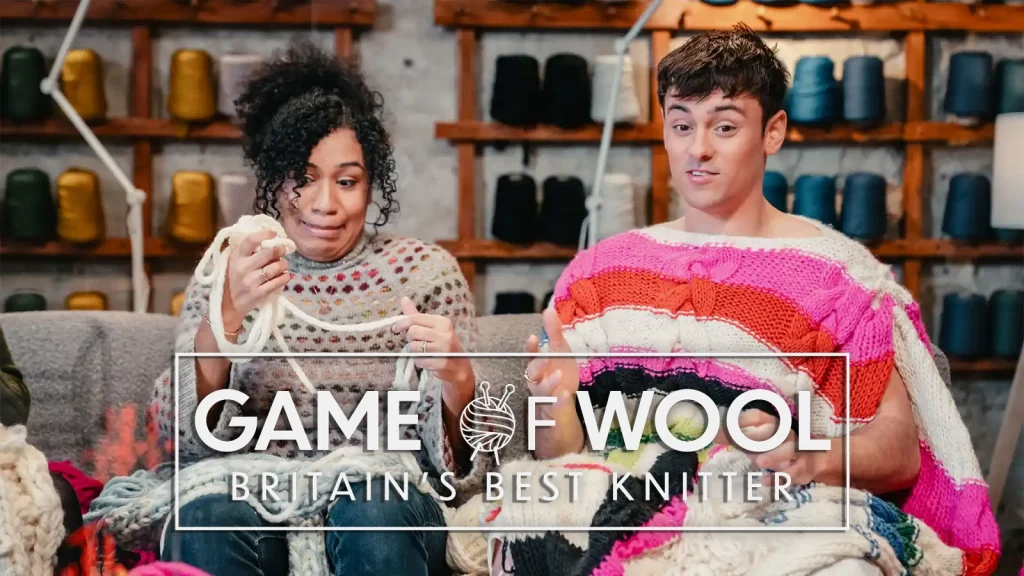
Game of Wool Britain’s Best Knitter episode 2: Welcome back to the wonderful world of Game of Wool! The search for the UK knitting champion is heating up, and the knitting room is buzzing. Game of Wool Britain’s Best Knitter episode 2 threw down the gauntlet with a brand-new theme: Icons Week. Our charismatic host, Tom Daley, returned, needles in hand, ready to support the contestants. We love seeing the Olympic champion diver knitting alongside the hopefuls. Tom Daley knitting brings such a relatable, calming energy to the competition.
However, the pressure is always on. The judges, the formidable Di Gilpin and the precise Shelia Greenwell, were back. They were expecting nothing less than iconic work from the remaining amateur knitters. This UK knitting show isn’t just about following a pattern. It’s about artistry, speed, and handling stress. The contestants are vying for the top spot, and in Icons Week, they had to prove they understood greatness.
The first task immediately tested the knitters’ technical skills. It was a surprise Pattern Challenge. What iconic item did the judges choose? A fabulous, fitted doggy outfit! Yes, the knitters were tasked with creating canine couture. This challenge was a brilliant test of shaping and precision. Crafting tiny knitting clothing for four-legged friends is much harder than it looks. The small scale means every single stitch is visible.
Di Gilpin’s pattern was notoriously complex. It featured tricky shaping for the leg holes and a neat button band. Consequently, several knitters looked bewildered from the start. They frantically counted rows, their brows furrowed in concentration. Shelia Greenwell watched closely, looking for consistency and a professional finish. Using vibrant skeins of wool, the knitters had to produce a perfect garment against the clock. It was a flurry of tiny needles and colorful yarn.
The judging for this challenge was intense. Tom Daley offered hugs and encouragement as the amateur knitters presented their tiny garments. Unfortunately, some pieces didn’t quite measure up. Di Gilpin pointed out uneven tension and poorly finished seams. One knitter’s outfit was declared “more of a muddle than a model.” On the other hand, a few knitters truly excelled. They produced doggy coats that were both technically perfect and utterly adorable. The winner of the first round clearly had an eye for detail.
Next, the Game of Wool TV show cranked up the synthesizer. For the main challenge, the knitters had to design and create a jumper inspired by an 80s icon. This was their chance to let their personalities shine. The brief was wide open. Would we see punk-rock rips, bold New Romantic frills, or Flashdance-inspired off-the-shoulder designs? The contestants dashed for their wool, grabbing neon pinks, electric blues, and deep blacks.
This challenge was all about interpretation. The knitters had to capture the spirit of an era known for being loud and proud. This wasn’t just knitting clothing; it was a statement. Furthermore, they had to draft their own patterns. This meant translating their big ideas into a wearable, well-fitted garment. The knitting room was a hive of activity. For example, one knitter bravely attempted a complex geometric intarsia pattern. Another focused on creating massive, structured shoulder pads.
Tom Daley, ever the supportive host, moved between the stations. He shared his own love for bold, expressive knits. But the clock was the true enemy. As the final hour loomed, the pressure became immense. One knitter accidentally dropped a crucial stitch, watching in horror as their work began to unravel. Meanwhile, another realized their measurements were completely off. This is the drama that makes Game of Wool such an addictive knitting competition. It shows the real highs and lows of creating projects made from wool.
Finally, it was time for the catwalk. The models showcased the 80s-inspired creations. The judges were ready. Whose 80s knit would be a top hit? And whose outfit would fail to merit credit?
Shelia Greenwell praised one jumper for its “audacious” use of color. It perfectly captured the rebellious energy of the 80s music scene. Conversely, Di Gilpin critiqued another piece for its poor construction. “The idea is here,” Di noted, “but the execution let you down.” The fit was sloppy, and the finishing was rushed. This knitting competition demands both vision and skill.
Game of Wool Britain’s Best Knitter episode 2
The knitter who excelled in the doggy challenge presented another stunning piece. Their 80s jumper was technically flawless and commercially viable. In contrast, the knitter who struggled earlier also presented a muddled 80s design. The judges felt it lacked a clear iconic reference. This show proves that knitting is a versatile art form. While this week focused on knitting clothing, the contestants are building skills that could apply to anything, from knitting jewellery to knitting home accessories or even knitting furniture.
In the end, the judges had to make a tough decision. The “Knitter of the Week” was awarded to the contestant with the bold, flawless 80s jumper. Their work was celebrated as a “total triumph.” Sadly, this also meant saying goodbye to one of the knitters. The contestant who struggled with both the dog coat’s precision and the 80s jumper’s concept was sent home.
There were tears, but also a huge amount of pride. Leaving the Game of Wool TV show is hard, but every contestant showed incredible heart. Game of Wool Britain’s Best Knitter episode 2 certainly delivered on the drama and the flair. The knitting challenges are getting tougher, and the search for the UK knitting champion continues. We cannot wait to see what Tom Daley and the judges have planned for next week!
Game of Wool Britain’s Best Knitter episode 2 review
The Game of Wool Britain’s Best Knitter episode 2 continued the search for the UK knitting champion with its challenging “Icons Week.” Nine amateur knitters remained in the competition, ready to battle for the ultimate crown. This magical UK knitting show, set in a Scottish Yarn Bar, tests the limits of their creativity and technical skill. The Game of Wool competition structure pushes contestants with two demanding knitting challenges each week. This episode, hosted by Tom Daley, required participants to translate iconic concepts into wearable art. The remaining knitters faced intense pressure from the very start.
This article will minutely examine the technical trials and creative triumphs of Game of Wool Britain’s Best Knitter episode 2. It will deconstruct the specific requirements of the two main tasks. Context is important, as the knitters had just settled in. In the previous week, they reinvented the fair isle tank top and were tasked with knitting a sofa. Now, the pressure was increasing. The first challenge was a solo task to design an iconic two-piece doggy outfit. The second was a team challenge to construct an 80s-inspired jumper. We will examine the specific projects made from wool and other yarns, focusing on the craft, techniques, and judging criteria.
Expert judges Di Gilpin (referred to as Diane) and Shelia Greenwell (referred to as Sheila) returned to assess the work. They are not just looking for attractive items; they demand technical excellence. The knitters must prove their understanding of garment construction, fit, and technique. For the first challenge, practicality was just as important as aesthetics. The judges demanded that the knitting clothing for the dogs be perfectly fitted. This meant the contestants had to master complex shaping. Diane and Sheila evaluated every single stitch.
The solo knit required contestants to create a two-piece outfit for two Italian greyhounds. This challenge required using both knitting and crochet techniques. The knitters had just 12 hours. The choice of Italian greyhounds was deliberate. Their “tricky body shape,” as noted in the competition, provided a significant anatomical hurdle. The theme was personal: a person or place iconic to them. This task was difficult due to the dogs’ shape. Small garments can be more complex, where one stitch can ruin the fit.
Following the solo task, the amateur knitters faced a demanding group challenge. They were split into three teams of three. Their mission was to create an iconic 80s jumper. This task was judged blind to ensure impartiality. The teams had 10 hours. This was a test of 80s aesthetics, demanding “graphic, really iconic, inventive designs.” The judges themselves wore vintage designs they had made in the 80s. The contestants were required to use only mohair wool, a notoriously fuzzy yarn.
The mohair wool made the required Intarsia knitting technique extremely difficult. The fuzzy fibers of mohair are notorious for obscuring stitch definition. This makes the clean color-blocking of Intarsia a true test of a knitter’s precision. Tom Daley host Tom Daley returned to support the contestants, even providing comfort during high-stress moments. The Game of Wool TV show highlighted the difference between knitting and crochet. Knitting uses two needles, while crochet uses a single hook. The following sections detail the execution of these knitting challenges.

The Iconic Doggy Outfit: A Solo Trial
The first trial pushed the nine contestants to their limits. Judges Di Gilpin and Shelia Greenwell tasked them with creating a two-piece “iconic doggy outfit.” This required a main body garment and a piece of headgear. The knitters had to use measurements from two Italian greyhounds, Dana and Dobby. The mandate to use both knit and crochet was a key hurdle. Many knitters specialize in one. Dipti, for example, admitted, “I’m not that great at knitting.” This forced contestants out of their comfort zones.
The theme was “iconic,” leaving the inspiration open to the contestant’s personal choice. However, the judges stressed that practicality was paramount. If the outfit did not fit the dog, it was considered a failure. This meant mastering shaping around the legs, neck, and rump. The headgear was especially difficult. Sheila noted that one misplaced stitch can be the difference between a secure fit and the hat falling off. This task, which might normally take 30 hours, had to be completed in just 12. Host Tom Daley offered support, and the concept of Tom Daley knitting alongside contestants highlights the craft’s appeal.
Creative Interpretations in Game of Wool Britain’s Best Knitter episode 2
Music was a popular theme. Meadow chose to recreate Freddie Mercury’s yellow tour jacket. Her design was ambitious, complete with buckles and “six-pence button fastenings.” She aimed to bring her “favourite frontman to life.” Meadow is still completing her A levels and sees this competition as a step toward her “end goal” of being a fashion designer. Meanwhile, Tracey opted for David Bowie’s Ziggy Stardust persona. She planned to use Mosaic Crochet to spell “Bowie” on the coat. This technique layers stitches, creating a very thick fabric. Her showstopper was a crocheted headpiece recreating the iconic spiky hairstyle.
After nearly being cast off last week, Dipti chose a “sparkly” unicorn. She used a mix of “fancy yarn” for a rainbow coat. She noted it’s “impossible to see the stitches” in such yarn. This made it “far easier to knit with it than it is to crochet,” a challenge for the crochet specialist.
Other contestants chose cultural themes. Lydia, for instance, drew inspiration from the Notting Hill Carnival. She planned a striking crown of knitted feathers. Her coat used a complex “feather and fan lace stitch.” This is a specific technique that uses yarn-overs and decreases to create a wavy pattern from holes. Lydia admitted she was “not a dog person.”
Stephanie was inspired by the Chelsea pensioners, recreating their classic red and black uniform. To achieve the stiff, tailored look of the uniform, she knitted with “two strands” of yarn. This created the “firm fabric” she wanted. It made the garment feel “like a coat… rather than a floppy jumper.”
Icons of place and art were also represented. Elsa celebrated a Glaswegian icon: the Duke of Wellington statue, which famously wears a traffic cone. She planned a grey jumper with Intarsia graffiti lettering. Her headgear was a crocheted cone hat. To enhance the “spray paint effect,” she later “brushed down the fibres” of the yarn.
Simon chose Gothic architecture, specifically Canterbury Cathedral. This highly conceptual piece used “moss stitch” (alternating knits and purls) to create a “stonework effect.” The design included a Knitted gothic arch. His plan for a crocheted “stained glass window” in the shape of a paw print was a risk, as he admitted, “I’m not a crocheter.”
Some knitters chose deeply personal icons. Isaac, for example, based his design on Gritty, the mascot for Philadelphia’s ice hockey team. This was an icon from his university time in Philadelphia. He planned a knitted jersey with an embroidered ice rink on the back. The headgear’s “loop stitch” was chosen specifically to mimic the mascot’s shaggy fur. He correctly worried the judges might find the icon “obscure.”
Holger was inspired by 18th-century Italian theatre. His flamboyant design featured a stripey pink and white coat. He planned “exaggerated balloon sleeves.” His balaclava-style headgear was meticulously planned. It included shaping “around the ear holes” for a secure, practical fit, topped with a “miniature crochet crown.”
Technical Flaws and Triumphs in the Solo Knit
During judging, Di Gilpin and Shelia Greenwell were meticulous. Several knitters received high praise. Lydia’s Notting Hill Carnival outfit was lauded. Its feather and fan lace pattern was deemed “entirely appropriate” as it allowed the dog to move. Dipti’s unicorn was also a success. The judges congratulated her on her knitting, which was her weaker skill. The horn was “bigger and better” than expected. Elsa’s graffiti lettering was called “fab,” with a “shadowing effect” that worked well.
The standout success was Holger’s Italian theatre outfit. His execution was described as “pretty flawless.” The judges noted the garment was “beautifully made.” Most importantly, he achieved a headpiece that was perfectly engineered and stayed on the dog. Di was moved to “happy tears” by the beauty of the piece. Holger clearly demonstrated superior design and construction skills.
Other contestants struggled with the brief’s practical demands. Isaac’s Gritty hat was fun, but the judges noted it was not secure. They stated, “one good shake and the headpiece goes.” Stephanie’s Chelsea pensioner coat had a well-tailored back. However, her “messy” sewing on the seams let her down. Furthermore, her tricorne hat was “incredibly cute” but “not engineered” for a dog’s head.
Tracey’s Bowie coat was a technical success in crochet but a practical failure. The thick Mosaic Crochet fabric was too “stiff.” It did not conform to the dog’s body. This resulted in a poor fit that left the dog’s “shoulders and a bare chest” exposed.
Simon’s “winging it” strategy for the crochet panel backfired. He ran out of time. He had to simplify his intricate, colorful paw print into one “basic shape.” The final “stained glass” was so large it “swallowed up” the moss stitch stonework. The judges “would have liked to see more different colors” there.
Meadow’s Freddie Mercury jacket faced significant criticism. The judges found the fit “too stretched” and “tightly pulled over the back.” While her crocheted crown was praised for its “excellent construction,” it was not secure. This meant her design failed the critical “practical part of the brief.” During the challenge, the judges also identified a technical flaw in her knitting. She was using a “twisted stitch.” This is a common mistake where the “needle is inadvertently inserted into the back of the loop.”
The 80s Team Challenge: A Game of Wool Britain’s Best Knitter episode 2 Task
For the second challenge in the Game of Wool competition, contestants were split into three teams. This was the group challenge, and it was judged blind. The task was to create an iconic 80s jumper in just 10 hours. The knitters were given a vintage 80s pattern as a base. All projects made from wool for this task had to use one specific type: mohair. This Game of Wool Britain’s Best Knitter episode 2 challenge was about collaboration and cohesion.
The use of mohair wool was the challenge’s main difficulty. Mohair is a “famously fuzzy and fluffy yarn.” This texture makes it very difficult to see the individual stitches. It also complicates the main technical requirement: Intarsia knitting. Intarsia is a technique used to create distinct blocks of colour. Achieving clean lines with fuzzy mohair requires immense precision.
The judges explained their own professional process for such tasks: “front, back and one person does both sleeves.” The teams had to “work together to make it cohesive.” Di explained that the “extra fibres” mean Intarsia skills “really need to be up there.” For curved shapes, knitters must “carefully plot their design.” It is like “building a curve out of Lego bricks.”
The teams were formed. Team 1 comprised Simon, Dipty, and Isaac. Team 2 included Holger, Tracey, and Lydia. Finally, Team 3 consisted of Elsa, Meadow, and Stephanie. Each team had to devise a cohesive design for their knitting clothing. Team 1 planned a cropped jumper with a balloon motif and asymmetrical sleeves. Team 3 chose an 80s music theme with a large guitar. Team 2, led by Holger, opted for a graphic checkerboard pattern.
Intarsia, Mohair, and Teamwork Under Pressure
Team 1’s balloon design required significant Intarsia work. Isaac, working on the front, had to create the curved balloon shapes. Dipty knitted shoulder pads, a classic 80s embellishment. Simon tackled the “balloon sleeves” themselves.
Team 2 experienced a clash of personalities. Tracey, who prefers “more is more,” wanted to add numerous embellishments. Holger, a “less is more” designer, resisted. Their checkerboard design was “a little bit easier to knit” as it involved “straight-up lines.” However, their internal conflict cost them time. They ran out of time to knit the second sleeve. This forced them to adapt, a common pressure in fashion. They decided to create a “big bow” for the empty shoulder instead.
Team 3 faced a catastrophic error. Meadow, attempting Intarsia for the first time, struggled with the guitar shape. A bigger problem soon emerged. Elsa had knitted the back panel with shoulder shaping on the right. Meadow had knitted the front panel with shaping on the left. The two main pieces would not join together. The judges would later note, “they decreased on the wrong sides.” The pressure caused Meadow to have a panic attack.
Meadow had to step away from the challenge. Tom Daley host Tom Daley followed to comfort her. He related the pressure to his own diving career, encouraging her to “get your head in the stitches” and “remembering why you knit.” This moment highlighted the supportive environment of the Game of Wool TV show. After returning, the team had to scramble, sewing the mismatched panels together. This resulted in a garment with a very low, revealing underarm. The Olympic champion diver knitting community often shares stories of the craft’s mental health benefits, which Tom Daley exemplified.
Judging the 80s: Blind Assessment and Final Results
The judges assessed the three 80s jumpers without knowing who made them. Team 3’s guitar jumper was immediately identified as having problems. The judges noted the ambitious design but poor execution. They saw holes in the Intarsia. They also quickly spotted the critical construction flaw, stating, “They don’t align.” The ambitious guitar was “not entirely worked.”
Team 1’s balloon jumper was received better. It was praised for its “dance vibe.” However, the judges felt the “length of this sleeve” was off. They also noted the shaping of the curve on the balloon was not charted correctly. Still, they praised the team’s cohesion. They found it “hard-pressed to say that it was three different knitters.” This UK knitting show emphasizes such teamwork.
The clear winner was Team 2’s checkerboard jumper. The judges called it a “dramatic design.” The “graphic” checkerboard was “beautifully knitted” and “good Intarsia.” They also loved the adaptation. The bow was not seen as a mistake, but as a “lovely detail.” They praised the team’s ability to “think on your feet.” They recognized it as a professional pivot: “that thing when you… know you haven’t got time… and you end up thinking, ‘What are we going to do?'” The judges felt this team was “all singing from the same hymn sheet.”
With both knitting challenges complete, it was time for the final judgment. The results of the team challenge were revealed. Holger was named the week’s “Big Knitter.” His flawless dog outfit and his leadership on the winning team jumper secured his victory. The judges then had to decide who would be cast off from Game of Wool. The bottom two were Stephanie and Meadow. Stephanie was criticized for her “sewing skills” and being on the “not a success at all” team.
The judges noted Meadow’s “over-ambitious” dog outfit and her poor Intarsia skills. Her “many mistakes” on the team jumper were critical. Ultimately, the judges decided that Meadow would be the one to leave. They felt that while she was creative, her “stitch work let her down.” Meadow, still studying for her A levels, was proud of her experience. She wanted to take what she learned on to university and her goal of becoming a fashion designer. Her elimination concluded the intense “Icons Week” in the quest for the UK knitting champion.
FAQ Game of Wool Britain’s Best Knitter episode 2
Q: What is Game of Wool Britain’s Best Knitter about?
A: Game of Wool is a UK knitting competition that searches for Britain’s best amateur knitter. Hosted by Olympic champion Tom Daley, the show features contestants tackling demanding challenges each week. Furthermore, judges Di Gilpin and Shelia Greenwell assess both technical skill and creative vision. The competition takes place in a Scottish Yarn Bar, where knitters create everything from garments to furniture. Consequently, the show demonstrates that knitting is a versatile art form requiring precision, speed, and artistic flair.
Q: What challenges did contestants face in Icons Week episode 2?
A: Episode 2 presented two demanding Icons Week challenges that tested different skills. Initially, knitters created a two-piece outfit for Italian greyhounds in just 12 hours, using both knitting and crochet techniques. The dogs’ tricky body shape made precise fitting extremely difficult. Subsequently, teams tackled an 80s-inspired jumper using mohair wool and Intarsia technique in only 10 hours. The fuzzy mohair fibers obscured stitch definition, making clean color-blocking particularly challenging. Additionally, the blind judging format added extra pressure to the team challenge.
Q: Why was the doggy outfit challenge so difficult?
A: The Italian greyhounds’ unusual body shape created significant anatomical hurdles for contestants. Moreover, the challenge required mastering complex shaping around legs, necks, and rumps within a condensed timeframe. Many knitters specialize in either knitting or crochet, yet this task demanded proficiency in both techniques. Small garments prove deceptively complex because every single stitch remains visible. Consequently, one misplaced stitch could ruin the entire fit, especially in the headgear portion. The judges emphasized that practicality was paramount—if the outfit didn’t fit properly, it failed regardless of aesthetic appeal.
Q: What creative themes did knitters choose for their dog outfits?
A: Contestants selected diverse iconic inspirations reflecting their personal interests and backgrounds. Music legends featured prominently, with Meadow recreating Freddie Mercury’s yellow tour jacket and Tracey interpreting David Bowie’s Ziggy Stardust persona. Cultural icons also appeared, including Lydia’s Notting Hill Carnival feathers and Stephanie’s Chelsea pensioners uniform. Notably, Elsa celebrated Glasgow’s Duke of Wellington statue with its famous traffic cone. Isaac chose Gritty, Philadelphia’s ice hockey mascot, while Holger drew inspiration from 18th-century Italian theatre. These varied choices demonstrated how personal icons span music, culture, sports, and historical references.
Q: Who won the doggy outfit challenge and why?
A: Holger emerged victorious with his Italian theatre-inspired outfit, which judges described as pretty flawless. His execution demonstrated superior design and construction skills throughout every element. The garment was beautifully made with meticulous attention to detail, particularly in the shaping around ear holes. Most importantly, his headpiece stayed securely on the dog’s head, meeting the practical requirements perfectly. Di Gilpin was moved to happy tears by the piece’s beauty. This success, combined with his leadership on the winning 80s jumper team, ultimately earned Holger the title of Big Knitter for Icons Week.
Q: What is Intarsia knitting and why was it challenging?
A: Intarsia is a specialized knitting technique that creates distinct blocks of color within a garment. The method requires carefully plotting designs, similar to building curves from Lego bricks. However, combining Intarsia with mohair wool proved exceptionally difficult in this challenge. Mohair’s famously fuzzy fibers obscure individual stitches, making precise color-blocking nearly impossible to see. Clean lines demand immense precision when working with such fluffy yarn. Additionally, curved shapes require advanced charting skills to execute properly. The judges emphasized that Intarsia abilities must be exceptional when working with mohair’s extra fibers.
Q: What went wrong with Team 3’s 80s jumper?
A: Team 3 experienced a catastrophic construction error that derailed their ambitious guitar design. Elsa knitted the back panel with shoulder shaping on the right side, while Meadow created the front with shaping on the left. Consequently, the two main pieces wouldn’t join together properly because they decreased on the wrong sides. This fundamental mistake created a garment with an extremely low, revealing underarm. Additionally, Meadow struggled with Intarsia for the first time, producing holes in the guitar motif. The pressure caused Meadow to have a panic attack, requiring support from host Tom Daley before she could continue working.
Q: How did Team 2 win the 80s jumper challenge?
A: Team 2 triumphed with their dramatic checkerboard design despite internal conflicts and time constraints. The graphic pattern featured beautifully executed Intarsia with clean, straight lines. When they ran out of time for the second sleeve, the team demonstrated professional problem-solving by creating a large bow instead. Judges praised this creative adaptation as thinking on your feet, recognizing it as a genuine fashion industry solution. The team worked cohesively, appearing to sing from the same hymn sheet throughout production. Their ability to pivot under pressure, combined with excellent technical execution, secured their victory in the blind judging assessment.
Q: What role does Tom Daley play on the show?
A: Olympic champion diver Tom Daley serves as the show’s charismatic host, bringing authentic passion for knitting to the competition. He moves between stations offering encouragement, hugs, and technical support to stressed contestants. Tom often knits alongside the participants, creating a relatable and calming presence in the intense environment. Importantly, he provides genuine emotional support during crises, as demonstrated when he comforted Meadow during her panic attack. He drew parallels between competitive pressure and his diving career, encouraging her to refocus on why she knits. His involvement highlights knitting’s mental health benefits and accessibility across all backgrounds.
Q: Who was eliminated in episode 2 and why?
A: Meadow departed the competition after judges identified consistent issues across both challenges. Her Freddie Mercury dog outfit was over-ambitious, featuring a fit that was too stretched and tightly pulled over the back. Although her crocheted crown showed excellent construction, it failed the practical requirement by not staying secure. During the team challenge, Meadow made numerous mistakes with her first Intarsia attempt, contributing significantly to Team 3’s failure. The judges ultimately felt that while her creativity was evident, her stitch work consistently let her down. Despite elimination, Meadow remained proud of her experience and planned to apply these skills toward her goal of becoming a fashion designer.