Gardening Australia 2025 Episode 40, marks a significant milestone in television history as it celebrates the remarkable 38-year tenure of presenter Jane Edmanson. For nearly four decades, Edmanson has been a steadfast presence on screens, guiding viewers through the shifting landscapes of horticulture with a blend of practical advice, botanical expertise, and genuine warmth. This episode serves not only as a farewell but as a comprehensive showcase of the values she has championed: conservation, education, and the intrinsic connection between people and plants.
The timing of this celebration is poignant, reflecting on the evolution of Australian gardening from the rigid structures of the past to more naturalistic, climate-conscious approaches. Throughout her career, Edmanson has witnessed a transformation in how domestic and public spaces are cultivated, moving toward a deeper appreciation for indigenous flora and sustainable practices. The episode underscores this shift by beginning at the Royal Botanic Gardens Victoria, a location that has been a second home to the presenter and a living laboratory for the industry’s future. By highlighting climate succession planting, the program emphasizes that the garden is not a static entity but a dynamic environment that must adapt to a hotter, drier future.
In Gardening Australia 2025 Episode 40, the narrative structure weaves together the past, present, and future of horticultural practice. It moves beyond simple planting tips to explore the emotional and communal resonance of cultivating the earth. Viewers are taken on a journey that includes a detailed tour of a newly completed Drylands garden, a nostalgic look at a hidden property designed by the legendary Edna Walling, and a heartwarming visit to a community market garden supporting asylum seekers. These diverse segments illustrate the program’s commitment to covering the full spectrum of the gardening world, from high-level landscape architecture to the humble vegetable patch used for community sustenance.
The episode also provides a rare glimpse into the personal history of one of the country’s most beloved figures in gardening shows. It traces Edmanson’s origins from a shy school teacher in the country town of Dimboola to a trailblazing woman in the nursery industry during the 1970s. Her story is one of perseverance against gender bias in a male-dominated field, serving as an inspiration for the current generation of horticulturists. This biographical context enriches the viewer’s understanding of her advice, grounding her technical knowledge in decades of hands-on experience and a lifelong passion for nature.
As the broadcast progresses, the focus shifts to the practical application of this knowledge in community settings. The inclusion of the Tamil Feast story demonstrates how a garden can act as a vehicle for social cohesion and cultural exchange. By connecting the produce grown at Joe’s Market Garden in Coburg with the culinary traditions of Sri Lankan refugees, the show highlights the universal language of food and flora. This segment reinforces the idea that gardening is not merely a solitary pursuit but a communal activity that can bridge cultural divides and provide a sense of belonging.
The narrative transitions smoothly from these community stories to the architectural heritage of Victoria. The exploration of the “Culraven” property offers a masterclass in garden design, showcasing how historical landscapes can be restored and maintained. This balance of modern climate resilience, social responsibility, and historical preservation defines the episode. It is a testament to the depth of content that has kept the program relevant for decades, proving that the subject matter is as vital today as it was when Edmanson first appeared on screen.
Gardening Australia 2025 Episode 40
Exploring the Drylands in Gardening Australia 2025 Episode 40
The episode opens with a visually striking tour of the southeastern corner of the Royal Botanic Gardens Victoria, located on Bunurong country. This area, once a simple expanse of lawn and grass, has been transformed into a sophisticated Drylands garden. This project was born from a desire to utilize wasted space and inject vitality into the landscape. The redesign, spearheaded by landscape architect Andrew Laidlaw, serves a dual purpose: it acts as an experimental zone for climate succession planting and stands as an educational resource for future generations. The selection of flora in this 2,500-square-meter space is deliberate, prioritizing species from regions with climates similar to the hotter, drier future predicted for Melbourne.
The planting palette featured in this segment is a masterclass in utilizing native plants to create texture and color without relying on high water consumption. The design incorporates a wildflower meadow that has generated significant enthusiasm among visitors. This “sea of color” features everlasting Rhodanthes and Swainsonas, interspersed with small purple flowers and yellow everlastings. The visual impact is designed to draw people in, using the “wow factor” of these blooms to introduce the public to species they may not have known existed. This approach aligns with the broader philosophy that aesthetic beauty and environmental responsibility can coexist harmoniously in modern landscaping.
Beyond the ground covers, the garden showcases mature trees that anchor the design. A standout specimen is the Angophora, a tree typically associated with the windswept ridges of Sydney. However, in the shelter of the Melbourne gardens, it grows straight rather than twisted, displaying a trunk with a distinct and appealing coloration. The design also incorporates fine fig trees with substantial buttress roots, creating a sense of permanence and age. Beneath these canopy trees, lower-growing plants like the Phebalium squamulosum add diversity. Despite its complex name, which Edmanson jokingly notes sounds like a disease, the Phebalium is a cure in itself—a visually pleasing shrub that thrives in these conditions.
Innovative Approaches to Climate-Resilient Planting
A key educational component of the Drylands garden is its approach to storytelling through landscape features. The garden includes dramatic, burnt timber trunks erected as sculptural elements. These black trunks are not merely decorative; they serve as a nod to the critical role bushfires play in the Australian landscape.
Many native plants are dependent on fire for regeneration, and this installation visually communicates that cycle of destruction and renewal. It draws the eye upward and provides a stark contrast to the softness of the surrounding vegetation, such as the masses of yellow flowering Senna. Formerly known as cassia, the Senna is highlighted for its drought tolerance once established, making it an ideal candidate for low-maintenance diy gardening projects in dry areas.
The layout of the garden encourages exploration through a gentle, winding path that invites visitors deeper into the space. Along this journey, the planting scheme utilizes texture to create softness. Catkin grevilleas, with their soft yellow hues, are viewed through screens of various grasses, creating a layered effect that draws the eye through the landscape. This naturalistic style is complemented by the inclusion of rare and critically endangered species, such as the grey billy buttons found in Victoria’s shrinking grasslands. By integrating these threatened species into a public display, the garden acts as a “living laboratory,” gathering knowledge that will guide conservation efforts and inspire home gardeners to value biodiversity.
Further enhancing the educational value, the garden features a “sitting circle” surrounded by cycads and palms. Dominating this area is the tall, shining Burrawang, a slow-growing plant native to the sclerophyll forests on the Queensland-New South Wales border. Capable of reaching seven meters in height, this plant produces massive cones weighing up to 40 kilograms, which are pollinated by native weevils. Nearby, the Cabbage Tree Palm serves as a marker for the littoral rainforests of the east coast. The dramatic Doryanthes, described whimsically as resembling an “Olympic torch,” adds architectural height. These plants, collected from across Australia through partnerships with seed banks and universities, demonstrate the immense variety available to those interested in diverse garden design.
A Career Defined by Passion and Education
The heart of Gardening Australia 2025 Episode 40 is the celebration of Jane Edmanson’s professional journey. Her retirement announcement is delivered with characteristic humility in the very gardens she has visited nearly a hundred times. She emphasizes that while she is leaving the show, she is not abandoning the horticultural world. Her career trajectory, detailed in a “My Garden Path” segment, reveals a lifelong dedication to teaching. Starting as a school teacher in Dimboola, she was encouraged by a headmaster to take students outdoors, a pivot that revealed her true vocation. This led her to the State Schools Nursery, where she mastered the mundane but essential tasks of pricking out plants and learning botanical names.
Edmanson’s career was built on breaking barriers. In the 1970s, the nursery industry was heavily male-dominated, and she faced rejection from nurserymen who refused to employ women. Her persistence eventually paved the way for her to become a trendsetter, and today, the industry sees a predominance of women. This shift is part of her legacy, as is her transition into media. Despite describing herself as a “very shy person” who would turn red at the slightest opportunity, she overcame her nerves to become a radio and television icon. Her broadcasting philosophy was simple: talk to the camera as if it were an inanimate object while knowing there are “nice people out there” wanting to learn.
Her approach to gardening shows has always been grounded in the practical reality of suburban life. After running a small suburban nursery in Preston, she learned that most people are not interested in “highfaluting” horticulture but in the basics of what to plant in their backyards. This understanding fueled her 28-year radio career, where she answered endless questions, famously noting that if she heard one more query about a lemon tree, she might go insane.
Yet, her patience and desire to inspire never waned. Her ethos is encapsulated in the plaque found in the Botanic Gardens: “Nurture nature and nature will nurture you.” It is a simple mantra that suggests if everyone adopted this care-oriented mindset, the world would be in a better state.
Cultivating Community Through Food and Culture
The episode transitions from the individual to the collective with a powerful segment on the “Tamil Feast,” a community initiative that exemplifies the social power of the garden. Edmanson and Costa Georgiadis visit Joe’s Market Garden in Coburg, Melbourne’s oldest and last-surviving inner-city market garden. Here, they meet Niro, a Tamil cook and organizer who shares his story of seeking asylum. Having fled a deadly war in Sri Lanka and survived a perilous three-week boat journey followed by years in detention, Niro now finds solace and purpose in the quiet of the garden. This narrative arc reinforces the show’s recurring theme that gardening is a sanctuary and a mechanism for healing.
The connection between the garden and the kitchen is vivid in this segment. The Tamil Feast involves a group of asylum seekers cooking traditional meals for the public, an event that has grown from casual gatherings to sell-out dinners three nights a week. The menu is dictated by the seasons, with the cooks communicating regularly with the head gardener, Emily Connors, to request specific crops like coriander or silverbeet. This relationship highlights a sustainable “farm-to-table” model where the menu is tweaked based on what is available in the paddock, ensuring freshness and reducing waste. It is a practical example of how garden hacks involving seasonal eating can be applied on a commercial scale to support community enterprises.
During the visit, the presenters assist in harvesting silverbeet, which Niro explains is used in a specific curry dish—a preparation unfamiliar to many locals who have limited uses for the vegetable. The cooking process is demystified in the kitchen, where the silverbeet is chopped roughly and combined with diced potato, cumin, fennel, black mustard seed, turmeric, and green chili. Notably, the dish is cooked without oil, relying on the moisture from the silverbeet to steam the mixture before coconut milk is added.
This exchange of culinary knowledge serves as a bridge between cultures, with Niro expressing pride in cooking for Australians and sharing his heritage. The garden becomes the common ground where these interactions flourish, proving that food and plants are universal languages that unify diverse populations.
Preserving History: The Hidden Edna Walling Garden
Following the exploration of community-focused horticulture, Gardening Australia 2025 Episode 40 shifts its lens to the preservation of Australia’s landscape design heritage. Edmanson travels to Olinda in the Dandenong Ranges, east of Melbourne, to visit “Culraven,” a property that represents a significant chapter in the country’s design history. Designed in the mid-1940s by the famed landscape architect Edna Walling, this six-acre garden is a rare surviving example of her work that has not been lost to subdivision or neglect. The segment serves as a masterclass in garden design, illustrating how historical layouts can be maintained and adapted by dedicated custodians.
The property is currently owned by Professor Hugh Taylor and Dr. Liz Dax, who have spent the last 25 years lovingly restoring the grounds. When they inherited the property, it suffered from a common issue in mature estates: overplanting. Walling was known for planting densely, and over decades, the canopy had closed in, blocking light and killing off the understory. The restoration process involved the difficult but necessary decision to remove some vegetation to re-establish the light and structure Walling originally intended. This delicate balance of removal and renewal is a critical lesson for anyone engaged in Australian gardening, particularly when managing established European-style woodland gardens in the Australian climate.
The structural integrity of Culraven is underpinned by the work of Eric Hammond and Ellis Stone, stonemasons who frequently collaborated with Walling. Edmanson points out the historic stone steps and walls, which display a profound appreciation for natural rock forms, now softened by decades of moss growth. These hardscaping elements frame the signature “garden rooms”—distinct areas separated by vegetation that offer intimacy and surprise as one moves through the landscape. One such room, described as having been filled with a carpet of bluebells just weeks prior, evokes the English countryside heritage that heavily influenced Walling’s childhood in Devon.
Architectural Structure and Botanical Curiosities
The botanical collection within Culraven is as impressive as its hardscaping, featuring monumental trees that anchor the garden. Edmanson marvels at a massive Copper Beech, noting the “pinkness” of its trunk and its imposing presence. Another standout specimen is a Mexican Hawthorn, estimated to be up to 100 years old. Its twisted, turning branches lead the owners to refer to it affectionately as the “Magic Faraway Tree,” highlighting how plants can take on character and myth within a family setting. These mature trees create a protective canopy, fostering a sense of wellness and peace that the owners describe as being “folded in” by the landscape.
The tour continues down a “birch walk,” a quintessential Walling feature. While some of the original silver birches have succumbed to age, they have been replanted to maintain the integrity of the design, ensuring the white trunks continue to provide vertical rhythm along the path. Beneath the trees, the planting scheme includes traditional favorites like Aquilegia (granny’s bonnets) and lily of the valley, reinforcing the English cottage aesthetic. However, the garden also holds surprises for the botanical enthusiast, such as the unusual Arisaema, which Edmanson admires for its strange, distinctive flowers tucked away in the shade.
Contrasting the shady woodland areas is a vibrant rock garden situated in the sunniest spot of the property. Here, pinks and purples dominate, demonstrating how microclimates within a large property can be utilized to grow a diverse range of species. For Taylor and Dax, the immense work required to maintain six acres is viewed not as a burden but as a “joyful responsibility”. Their stewardship ensures that this piece of history remains a living, breathing entity that can be shared with others, preserving the legacy of a woman who was a trailblazer in landscape architecture during an era when few women had careers.
A Farewell to an Icon: Celebrating 38 Years
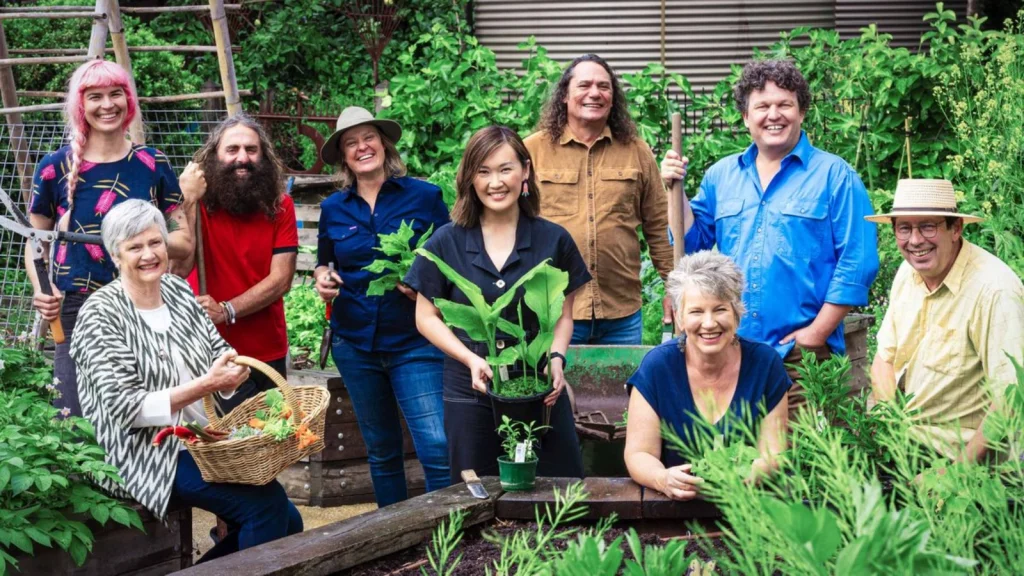
The final segment of Gardening Australia 2025 Episode 40 is an emotional tribute to Jane Edmanson, celebrating her status as the only remaining presenter from the show’s very first episode. The production team surprises her with a gathering of colleagues, friends, and family, creating a poignant send-off that highlights the deep respect she commands within the industry. Fellow presenter Costa Georgiadis delivers a moving speech, describing her as a “lighthouse” who has shone brightly for the Gardening Australia family for nearly four decades. He emphasizes that her ethos—her passion, storytelling, and straightforward nature—is now embedded in the “DNA” of the show forever.
The tribute includes a montage of archival footage that captures the breadth of her career. Viewers see clips from her first appearance, where she admits to feeling terrifyingly shy, to adventurous moments like flying in a helicopter to drop onto school ovals. The retrospective showcases her versatility, from knitting poppies and visiting orchid collections to wading into ponds. It also highlights her fun-loving side, including footage of her kicking a football, a skill that colleagues note she possesses in surprising measure. These clips serve as a reminder that gardening shows are driven as much by the personality of the presenter as by the plants themselves.
Colleagues describe Edmanson as “solid, authentic, talented, beautiful, spunky, and a bit edgy”. Sophie Thomson notes that Edmanson has been a “guiding light” for women in the industry, often opening doors and creating space for others to step into leadership roles. This mentorship is a crucial part of her legacy; she helped normalize the presence of women in horticultural media, planting the seed of possibility for the next generation of presenters. Her style is defined by a “no-nonsense” approach that does not suffer fools but is endlessly generous with knowledge, making gardening accessible and relatable to the average viewer.
The Enduring Wisdom of Practical Gardening
Throughout the celebration, a recurring theme is Edmanson’s practical, down-to-earth advice, epitomized by the “lemon tree” motif. Having answered listener questions on talkback radio for 28 years, she jokes that the most common query was always, “What is wrong with my lemon tree?”. The episode playfully acknowledges this with a final lemon presented to her on her farewell cake. This humor underscores her connection to the suburban gardener; she understood that people didn’t always want complex botanical science, but rather simple, actionable garden hacks to keep their backyard citrus healthy and productive.
In her final address, Edmanson reflects on the nature of the vocation she has dedicated her life to. She rejects the “highfaluting” side of the industry in favor of the basic joy of “pottering”. For her, the act of gardening is physically and mentally restorative—a way to disconnect from screens and “nestle in” to the natural world. She encourages viewers, regardless of age, to take up horticulture because “you never know where it leads,” promising that an interest in plants provides a lifetime of satisfaction. Her parting message is simple yet profound: “Keep digging, keep putting plants in the ground”.
The episode concludes with a sense of continuity. While Edmanson is retiring from the screen, she asserts she will still be watching with an “eagle eye” to critique the team’s hair and beards. She takes a moment to thank the behind-the-scenes crew—sound operators, camera operators, and producers—specifically mentioning Elizabeth, who has worked with her since the beginning. It is a classy exit that acknowledges the collaborative effort of television production. As the team cheers her off, the viewer is left with a profound appreciation for a career that has shaped the Australian backyard for nearly half a century.
Looking Ahead: The Season Finale
As the celebrations for Jane Edmanson conclude, the broadcast looks forward to the future, teasing the content for the upcoming season finale. Next week’s installment promises to continue the tradition of diverse and practical content. Costa will visit a garden situated on a steep, challenging site, demonstrating how native plants can be used for erosion control and stability—a vital topic for those dealing with difficult terrain. The segment is notable for featuring a first-time gardener, reinforcing the show’s message that expertise is acquired through doing.
The finale will also feature creative diy gardening projects, including a tutorial on making a floral ice bucket, perfect for summer entertaining. For wildlife enthusiasts, there will be a visit to the butterfly house at Melbourne Zoo to learn from experts how to entice butterflies into domestic gardens. Finally, the show will return to the theme of community agriculture with a trip to a flourishing market garden in South Western Sydney that grows traditional produce for a variety of local communities. These upcoming stories ensure that while the face of the show may change, the commitment to inspiring Australian gardeners remains as strong as ever.
FAQ Gardening Australia 2025 Episode 40
Q: What makes Gardening Australia 2025 Episode 40 historically significant?
A: This milestone episode celebrates Jane Edmanson’s remarkable 38-year tenure as presenter, marking her as the only remaining host from the show’s inaugural broadcast. Furthermore, the episode showcases the evolution of Australian horticulture from rigid traditional structures to naturalistic, climate-conscious approaches. The broadcast weaves together conservation education, community gardening initiatives, and historical preservation, demonstrating how the program has remained culturally relevant across nearly four decades of environmental change.
Q: What is the Drylands garden featured in the Royal Botanic Gardens Victoria?
A: The Drylands garden represents a transformative 2,500-square-meter space in the southeastern corner of the Royal Botanic Gardens Victoria on Bunurong country. Landscape architect Andrew Laidlaw designed this experimental zone for climate succession planting, prioritizing species from regions with climates similar to Melbourne’s predicted hotter, drier future. The garden showcases wildflower meadows featuring Rhodanthes and Swainsonas, alongside mature specimens like Angophora trees and drought-tolerant Senna, creating a visually stunning educational resource that balances aesthetic beauty with environmental responsibility.
Q: How does the Drylands garden incorporate bushfire education?
A: Dramatic burnt timber trunks erected as sculptural elements serve a crucial educational purpose within the garden’s design. These black trunks visually communicate the essential role bushfires play in the Australian landscape, acknowledging that many native plants depend on fire for regeneration. Additionally, the installation creates a striking contrast against surrounding vegetation like yellow flowering Senna, drawing visitors’ eyes upward while illustrating the natural cycle of destruction and renewal that characterizes Australian ecosystems.
Q: What barriers did Jane Edmanson overcome in her career?
A: Beginning her career in the 1970s, Edmanson faced significant gender discrimination in the heavily male-dominated nursery industry, with nurserymen frequently refusing to employ women. Despite describing herself as a very shy person who would turn red easily, she persevered to become a broadcasting icon across radio and television. Her persistence broke barriers and paved the way for women in horticulture, transforming an industry that now sees a predominance of female practitioners, making her a trailblazer whose legacy extends beyond gardening expertise.
Q: What is the Tamil Feast initiative at Joe’s Market Garden?
A: The Tamil Feast represents a powerful community initiative where asylum seekers from Sri Lanka prepare traditional meals using produce from Joe’s Market Garden in Coburg, Melbourne’s oldest surviving inner-city market garden. This farm-to-table model has grown from casual gatherings to sell-out dinners three nights weekly, with menus dictated by seasonal availability. Cooks communicate regularly with head gardener Emily Connors to request specific crops, demonstrating how gardens can serve as vehicles for social cohesion, cultural exchange, and healing while providing sustainable support for community enterprises.
Q: Who was Edna Walling and why is Culraven significant?
A: Edna Walling was a pioneering landscape architect whose mid-1940s design for Culraven represents a rare surviving example of her work in the Dandenong Ranges. The six-acre property showcases her signature garden rooms, created with stonemason collaborators Eric Hammond and Ellis Stone, featuring historic stone steps and walls now softened by moss. Current owners Professor Hugh Taylor and Dr. Liz Dax have spent 25 years restoring the grounds, carefully removing overgrown vegetation to re-establish the light and structure Walling originally intended, preserving an important chapter in Australian landscape design history.
Q: What restoration challenges did Culraven’s owners face?
A: The property suffered from a common issue in mature estates: overplanting that caused the canopy to close in, blocking essential light and killing the understory vegetation. Walling was known for dense planting schemes that, over decades, required thoughtful intervention to maintain design integrity. The owners faced difficult decisions about removing vegetation while preserving the garden’s character, demonstrating the delicate balance between removal and renewal necessary when managing established European-style woodland gardens adapted to Australian climate conditions.
Q: What notable plant specimens are featured at Culraven?
A: The botanical collection includes monumental specimens like a massive Copper Beech with distinctive pink-toned bark and a 100-year-old Mexican Hawthorn affectionately called the Magic Faraway Tree for its twisted branches. Traditional plantings include silver birches along the birch walk, Aquilegia, and lily of the valley, creating an English cottage aesthetic. Meanwhile, botanical curiosities like the unusual Arisaema with strange distinctive flowers add surprise elements, while the sunny rock garden showcases vibrant pinks and purples, demonstrating diverse microclimate utilization across the six-acre property.
Q: What was Jane Edmanson’s broadcasting philosophy?
A: Edmanson approached broadcasting with remarkable simplicity, talking to the camera as if it were an inanimate object while knowing there were nice people wanting to learn. After running a suburban nursery in Preston, she understood that most people weren’t interested in highfaluting horticulture but rather basic backyard advice. Her 28-year radio career answering endless questions, particularly about lemon trees, taught her the value of practical, accessible information over complex botanical science, making gardening relatable to average viewers through straightforward, no-nonsense communication.
Q: What content will the season finale feature?
A: The upcoming finale promises diverse practical content including Costa’s visit to a steep site demonstrating native plant erosion control, featuring a first-time gardener to reinforce that expertise comes through practice. Creative DIY projects will include making floral ice buckets for summer entertaining, while wildlife enthusiasts can learn butterfly attraction techniques from Melbourne Zoo experts. Finally, the show explores a flourishing market garden in South Western Sydney growing traditional produce for various local communities, ensuring the program’s commitment to inspiring Australian gardeners continues despite presenter changes.


