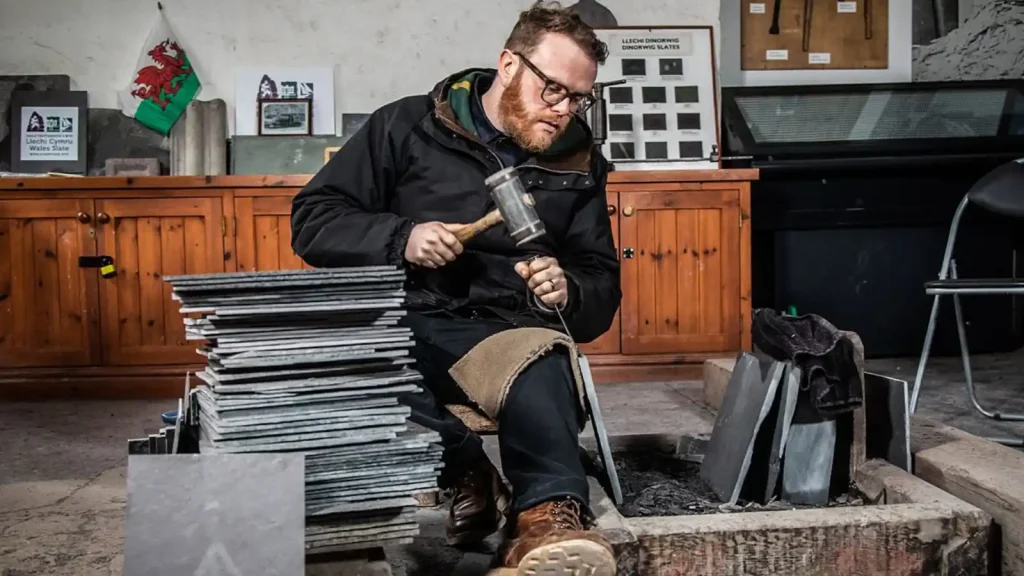
In Inside Museums Episode 5, presenter Huw Stephens travels to the heart of Snowdonia to uncover the rugged history of the Welsh slate industry. The landscape of this region is defined by its majestic mountains, but a closer inspection reveals the deep scars of an industrial past that once roofed the world. Stephens visits the National Slate Museum in Llanberis, a site that encapsulates the struggle between man and mountain, to explore how this raw material shaped the local economy, culture, and landscape.
The episode delves into a narrative that is equal parts engineering marvel and social struggle, highlighting the dichotomy of the Welsh slate industry history. While the industry generated vast fortunes for landowners and exported materials across the globe, it often came at a terrible cost to the workers. The programme provides a comprehensive look at how these communities fought for their rights, maintained their dignity through craftsmanship, and fostered a unique cultural identity that persists today.
Through interviews with curators and demonstrations by former quarrymen, the episode paints a vivid picture of the sheer scale of operations in North Wales. The National Slate Museum Llanberis serves as the backdrop for this exploration, itself a preserved artifact of the Victorian era. The story that unfolds is not just about rock and machinery, but about the resilience of the people who lived in the shadow of the quarries.
Snowdonia slate mining was a colossal undertaking that physically altered the geography of the region. Whole mountainsides were shattered and blasted to extract the “Welsh blue” slate, considered some of the best in the world due to its density and age. The geological miracle of this 500-million-year-old mud, compressed by the earth into a versatile building material, drove the industrial revolution’s housing boom and built empires from Cape Town to Calcutta.
However, Inside Museums Episode 5 does not shy away from the darker aspects of this heritage. It examines the brutal working conditions, the health hazards caused by silica dust, and the bitter industrial disputes that tore families apart. Yet, amidst the hardship, the episode uncovers a story of profound pride, where skilled workers turned a dangerous trade into an art form and created a rich tapestry of community life that is now recognized on a global stage.
Engineering Marvels and Industrial Self-Sufficiency
The National Slate Museum is housed within the historic Gilfach Ddu workshops, a sprawling complex built in 1870 at the base of the massive Dinorwig quarry. The architecture itself reflects the confidence of the era, designed to resemble a British imperial fort with a central courtyard and clock tower. These workshops were the engineering heart of a quarry that once employed 3,000 men, providing all the machinery and maintenance required to keep the operation running.
A centerpiece of the museum, and a focal point of the episode, is the magnificent waterwheel. Standing over 50 feet in diameter, it is the largest waterwheel in mainland Britain. Stephens describes the breathtaking experience of standing beneath the structure as water cascades down, powering the elaborate belt drive system that once ran the entire facility. The power source for this engineering giant is the Afon Hwch, a stream flowing directly from the slopes of Eryri Snowdon history, illustrating the direct connection between the natural landscape and industrial might.
The workshops at Gilfach Ddu were designed for total self-sufficiency. The isolation of the quarries meant that almost everything needed for the profitable extraction of slate had to be manufactured on-site. The facility included saw sheds where carpenters crafted everything from railway sleepers to wooden mallets, and a forge where blacksmiths labored over hearths to hammer out tools. The episode highlights the immense capability of these workshops, where skilled craftsmen trained by the company ensured the quarry could operate without external reliance.
Elen Roberts, the head of the museum, guides Stephens through the impressive foundry, a space where complex metal components were cast from molten iron. This area produced wheels, axles, and heavy machinery parts essential for the quarry’s railway systems and processing plants. The process involved creating precise molds in sand, into which the molten metal was poured to create the final shape. The preservation of these spaces allows visitors to feel as though the workers have simply downed their tools and left for the day, maintaining the atmosphere of a working industrial site.
The Art of the Pattern Maker
High above the foundry floor lies one of the most visually stunning collections within the Llanberis slate museum. The pattern loft houses thousands of intricately carved wooden patterns, used to create the molds for the iron castings below. These patterns range from massive cogwheels to delicate window frames, each carved by hand with exacting precision. The pattern maker was among the most highly skilled craftsmen in the quarry, required to calculate measurements that accounted for the contraction of cooling metal—using a ruler where every “inch” was actually one and one-sixteenth of an inch.
The collection reveals the specific aesthetic of the Dinorwig quarry, including the unique patterns for the workshop’s own windows. These designs were practical as well as beautiful; the multi-paned windows were created so that if a rock blast shattered the glass, only small individual panes would need replacing rather than a large sheet. This attention to detail and cost-efficiency underscores the Victorian drive for profit that underpinned the entire Welsh industrial archaeology.
Stephens learns that this priceless collection exists today largely due to the foresight of Hugh Richard Jones, a former chief engineer. When the quarry closed in 1969, assets were tagged for auction, and scrap merchants were ready to dismantle the machinery, including the great waterwheel. Jones intervened, preventing the “vultures” from stripping the site and ensuring the preservation of the workshops. His actions secured the legacy of the Welsh slate quarries, allowing future generations to understand the ingenuity that drove the industry.
The patterns themselves were largely the work of three generations of a single family in Llanberis, known locally as “Teulu Patrwm” or the “Pattern Family.” This lineage of craftsmanship highlights how skills were passed down through families, becoming a source of identity and status within the community. The sheer volume of patterns stored in the loft serves as a testament to the decades of production and the vast variety of machinery that kept the slate industry moving.
A Living Legacy of the Welsh Quarrymen History
While the machinery impresses, the heart of the story lies with the men who worked the rock. Inside Museums Episode 5 introduces Andrew “Johnjo” Jones, a sixth-generation quarryman who spent 32 years working at the Penrhyn quarry Bethesda. Now a demonstrator at the museum, Johnjo embodies the living history of the trade, showing visitors the traditional slate splitting craft that machines have never been able to fully replicate.
Johnjo explains that working with slate is a conversation between the craftsman and the material. He demonstrates how he observes the rock for faults, identifies which part of the mountain it came from, and “listens” to the slate as he works. Using a hammer and chisel, he deftly splits the rock into wafer-thin sheets, a skill passed down from father to son. This tactile connection to the geology is central to the Welsh quarrymen history, where knowledge was acquired through experience and intuition rather than textbooks.
The life of a quarryman, however, was fraught with danger. Johnjo recounts the harsh realities faced by his ancestors, including his great-grandfather who began working at the quarry at age 17. Workers were often paid based on what they produced, meaning that a day spent clearing poor-quality rock could result in no wages. They were also responsible for buying their own gunpowder, fuse wire, and tools, further squeezing their meager earnings. The physical toll was immense, with quarrying working conditions leading to violent accidents, broken bones, and the silent killer—dust.
Silica dust was a constant presence in the quarries, leading to silicosis, a lung disease that scarred the tissue and caused early death. In the 19th century, the average life expectancy for a quarryman was just 48 years. Johnjo speaks movingly about losing his own father to the effects of the dust, a tragedy that underscores the sacrifice made by thousands of men. Despite the pain and the anger at the lack of health and safety in the past, Johnjo expresses a deep sense of pride in his heritage and the camaraderie that existed among the men.
Domestic Realities in Gwynedd Slate Landscapes
To understand the full scope of life in the Welsh mining communities, the museum preserves Fron Haul, a row of traditional terraced workers’ houses. These cottages were not originally built in Llanberis but were moved stone by stone from Tan y Grisiau, near Blaenau Ffestiniog, to save them from demolition. The reconstruction of these homes allows the museum to present a chronological narrative of domestic life, with each house furnished to represent a different era and location within the slate districts.
The first house transports visitors to 1861 in Tan y Grisiau, representing the height of the industry. It depicts a time when the Blaenau Ffestiniog slate industry was booming, yet families still struggled to make ends meet. The cottages are small, yet census returns reveal they often housed large families of five or more, sometimes accommodating lodgers to bring in extra income. The cramped conditions required resilience, with entire family units revolving their existence around the demands of the quarry and the company.
The last house in the row represents 1969 in Llanberis, the year the Dinorwig quarry closed. This marked the end of an era and the beginning of a painful economic transition for the region. Between these two bookends lies the house furnished to represent Bethesda in 1901, a specific and turbulent moment in time. This cottage serves as a focal point for discussing the social upheaval caused by industrial disputes and the power dynamics between the workers and the wealthy quarry owners.
Cadi Iolen, the museum’s chief curator, points out the details within the homes that speak to the fluctuating fortunes of the workers. A Welsh dresser adorned with willow pattern plates indicates that, during good times, quarrymen could afford finery and take pride in their homes. However, these periods of relative prosperity were often punctuated by strikes, lockouts, and economic depressions that plunged the communities back into poverty. The Fron Haul cottages stand as a tribute to the women and children who maintained these homes and supported the workforce through generations of uncertainty.
The Great Penrhyn Strike 1900 and Social Upheaval
The episode dedicates significant attention to the Great Penrhyn Strike 1900, one of the longest and most bitter disputes in British industrial history. The conflict began at the Penrhyn quarry, then the largest in the world, owned by Lord Penrhyn of the powerful Pennant family. Tensions over contracts, known as “bargens,” and the rights of workers exploded into a full-scale strike that saw 2,800 men walk out in November 1900. The dispute lasted for three agonizing years, devastating the local economy and tearing the community of Bethesda apart.
Inside the 1901 Fron Haul cottage, a small placard in the window reads “Nid oes bradwr yn y ty hwn,” which translates to “There is no traitor in this house.” These signs were distributed by the North Wales Quarrymen’s Union to mark the homes of those who remained on strike. Conversely, the removal of such a sign indicated that a worker had broken the strike and returned to the quarry. This visual language of resistance and betrayal split the town, pitting neighbor against neighbor and creating rifts that took generations to heal.
Stephens is shown a conch shell, a seemingly innocuous object that played a loud role in the social shaming of strikebreakers. Wives of the striking quarrymen would stand on their doorsteps or gather on the road to the quarry, blowing through the shells like trumpets to hoot at and shame the “traitors” returning to work. This psychological warfare highlights the desperate measures the community employed to maintain unity against the might of the quarry owners.
The tour of the cottage concludes in a tiny upstairs bedroom, where a suitcase lies open, half-packed. A luggage label attached to the case bears the destination “Tumble,” a village in the South Wales coalfields. This poignant detail represents the exodus of workers who, unable to sustain their families during the strike, were forced to leave Bethesda. Around 1,500 quarrymen left the area, some emigrating to America, but many moving south to find employment in the coal mines. The strike eventually collapsed, and the slate industry never fully recovered, facing new competition from cheaper quarries in Spain and China, leading to a long, slow decline in Welsh slate export.
Cultural Resilience Explored in Inside Museums Episode 5
Despite the hardships, the slate communities fostered a vibrant and intellectual culture, the heart of which was “Y Caban” or The Cabin. These were huts located on the quarry face where men gathered during their lunch breaks. Far from being mere shelters, the Caban gained a mythical status as a center of learning, debate, and culture. Lowri Ifor, the museum’s learning manager, explains that many Cabans had a president, or “llywydd,” who would set the agenda for the day, covering topics ranging from theology and politics to current affairs.
The Caban was also the birthplace of the quarry eisteddfod, a competitive festival of music and poetry. Inside Museums Episode 5 showcases a specific artifact: a 1938 Eisteddfod chair. Unlike the grand, ornate chairs seen at the National Eisteddfod, this prize is simple and sits low to the ground, designed in the style of a “blocyn tin” or slate splitter’s chair. This blending of the industrial and the cultural perfectly symbolizes the identity of the quarrymen, who valued intellectual prowess and artistic expression as highly as physical strength.
This environment nurtured the Welsh language heritage, serving as a stronghold for the native tongue in an industrial setting. The region produced some of Wales’s greatest writers and poets, including Kate Roberts and T. Rowland Hughes. A famous couplet quoted in the episode states, “You must get a Welshman to cut the stone, the slate does not understand English,” reinforcing the intrinsic link between the language, the people, and the landscape. The culture of the Caban provided a respite from the harshness of daily life, allowing the working men to assert their humanity and intelligence in the face of brutalizing labor.
Music was another pillar of this society, with Welsh brass bands and male voice choirs Wales becoming synonymous with the slate quarrying areas. These musical institutions, born out of the quarries, continue to thrive today, performing at modern festivals and keeping the tradition alive. The creative output of these communities stands as a counter-narrative to the story of exploitation, showing how culture flourished even on the unforgiving rock face.
From Industrial Past to UNESCO World Heritage Site Gwynedd
The final segment of the episode reflects on the modern status of the region. In 2021, the slate landscapes of northwest Wales were designated a UNESCO World Heritage Site Gwynedd. This accolade places the slate quarries on par with global icons like the Taj Mahal and the Great Pyramids, recognizing not just the industrial archaeology but the unique culture that the industry created.
The designation has brought a renewed sense of pride to the area, encouraging visitors to look beyond the scenery and understand the history beneath their feet. While the industry itself has shrunk to employ hundreds rather than thousands, the landscape is finding new life. The old Penrhyn quarry, once the site of the bitter strike, is now home to the world’s longest zipline, while other caverns have been repurposed for underground trampolines. This shift from extraction to adventure tourism offers a new economic future for the valleys that were once entirely dependent on slate.
However, the episode emphasizes that amidst the thrill-seeking, the story of the people must not be lost. The National Slate Museum plays a crucial role in ensuring that the narrative of the Welsh slate industry history remains central to the visitor experience. It is a place that celebrates the ingenuity and endurance of the quarrymen, reminding the world that while the industry scarred the mountains, it also built a resilient and culturally rich society.
Inside Museums Episode 5 concludes with a reflection on the deep roots of the community. The museum is described not merely as a collection of objects, but as a story of a people who are rooted in the landscape. From the deafening noise of the workshops to the quiet defiance of the “No Traitor” signs, the episode captures the essence of a region where the past is always present. The slate industry may have declined, but the language, the music, and the pride of the slate communities continue to flourish, echoing off the mountains that they once dismantled by hand.
FAQ INSIDE MUSEUMS EPISODE 5
Q: What is the National Slate Museum in Llanberis and why is it historically significant?
A: The National Slate Museum is housed within the historic Gilfach Ddu workshops, built in 1870 at the base of the massive Dinorwig quarry. This sprawling complex served as the engineering heart of an operation that once employed 3,000 men, designed to resemble a British imperial fort with a central courtyard and clock tower. The museum preserves the complete industrial infrastructure, including workshops that manufactured everything needed for slate extraction on-site. Furthermore, it houses the largest waterwheel in mainland Britain, standing over 50 feet in diameter and powered by the Afon Hwch stream. The site represents total industrial self-sufficiency from the Victorian era, offering visitors an authentic glimpse into the engineering marvels that drove Wales’s global slate dominance.
Q: What made Welsh slate from Snowdonia so valuable during the industrial revolution?
A: Welsh blue slate from Snowdonia was considered among the finest in the world due to its exceptional density and geological age of 500 million years. This compressed mud, transformed by immense geological pressure into versatile building material, possessed superior durability and splitting qualities that made it ideal for roofing. Consequently, the material drove the industrial revolution’s housing boom and was exported globally to build structures from Cape Town to Calcutta. The quarries physically altered entire mountainsides to extract this precious resource, with operations reaching such scale that they literally roofed the world. The combination of geological quality and strategic extraction methods positioned Wales as the dominant supplier throughout the 19th century.
Q: How did the pattern loft contribute to the quarry’s operations?
A: The pattern loft housed thousands of intricately hand-carved wooden patterns used to create molds for iron castings in the foundry below. These patterns ranged from massive cogwheels to delicate window frames, each crafted with exacting precision by highly skilled pattern makers. Remarkably, pattern makers used specialized rulers where every inch measured one and one-sixteenth of an inch to account for metal contraction during cooling. The collection reveals the unique aesthetic of the Dinorwig quarry, including multi-paned window designs that minimized replacement costs after rock blasts. This priceless collection exists today because former chief engineer Hugh Richard Jones intervened when the quarry closed in 1969, preventing scrap merchants from dismantling the machinery and preserving this legacy of Welsh industrial ingenuity.
Q: What was life like for Welsh quarrymen and what dangers did they face?
A: Quarrymen endured brutal working conditions, often paid only for what they produced, meaning days spent clearing poor-quality rock resulted in no wages. Workers were responsible for purchasing their own gunpowder, fuse wire, and tools, further reducing their meager earnings. The physical toll included violent accidents, broken bones, and constant exposure to silica dust, which caused silicosis—a devastating lung disease. In the 19th century, the average life expectancy for quarrymen was merely 48 years due to these hazardous conditions. Despite these hardships, quarrymen developed extraordinary skills, learning to observe rock faults, identify which mountain section it came from, and split slate into wafer-thin sheets through tactile knowledge passed down through generations.
Q: What caused the Great Penrhyn Strike of 1900 and what were its consequences?
A: The Great Penrhyn Strike began in November 1900 when 2,800 men walked out from the world’s largest quarry over disputes regarding contracts called bargens and workers’ rights. This bitter conflict lasted three agonizing years, devastating Bethesda’s local economy and tearing the community apart. Homes displayed signs reading Nid oes bradwr yn y ty hwn (There is no traitor in this house) to identify strike supporters, while wives blew conch shells to shame strikebreakers returning to work. Approximately 1,500 quarrymen were forced to leave the area, many emigrating to America or moving to South Wales coalfields. The strike eventually collapsed, and the slate industry never fully recovered, facing new competition from cheaper Spanish and Chinese quarries that precipitated its long decline.
Q: What role did Y Caban (The Cabin) play in quarry culture?
A: Y Caban were huts located on the quarry face where men gathered during lunch breaks, evolving into legendary centers of learning, debate, and cultural expression. Many Cabans had a president who set daily agendas covering theology, politics, and current affairs, transforming these shelters into intellectual forums. Additionally, the Caban birthed the quarry eisteddfod, competitive festivals celebrating music and poetry with simple prizes like the 1938 chair designed in the blocyn tin style of slate splitters’ seats. These gatherings served as strongholds for the Welsh language, producing renowned writers like Kate Roberts and T. Rowland Hughes. The famous couplet states, You must get a Welshman to cut the stone, the slate does not understand English, reinforcing the intrinsic connection between language, people, and landscape.
Q: How does the Fron Haul cottage row illustrate domestic life in slate communities?
A: Fron Haul comprises traditional terraced workers’ houses moved stone by stone from Tan y Grisiau to prevent their demolition, with each cottage furnished to represent different eras and locations. The 1861 house depicts the industry’s height in Blaenau Ffestiniog, showing cramped conditions where families of five or more often accommodated lodgers for extra income. The 1969 Llanberis house marks the Dinorwig quarry’s closure and the region’s painful economic transition. Most significantly, the 1901 Bethesda cottage contains artifacts from the Great Penrhyn Strike, including the No Traitor window placard and a half-packed suitcase labeled for Tumble in the coalfields. These details reveal fluctuating fortunes, with Welsh dressers adorned with willow pattern plates indicating prosperous times punctuated by strikes and depressions that plunged communities back into poverty.
Q: What makes the Gilfach Ddu waterwheel such an engineering marvel?
A: Standing over 50 feet in diameter, the Gilfach Ddu waterwheel is the largest waterwheel in mainland Britain and powered the entire workshop complex through an elaborate belt drive system. The wheel harnessed water from the Afon Hwch stream flowing from Snowdon’s slopes, illustrating the direct connection between natural landscape and industrial power. This magnificent structure drove all machinery necessary for the quarry’s self-sufficient operations, from saw sheds where carpenters crafted railway sleepers to forges where blacksmiths hammered tools. When the quarry closed in 1969, Hugh Richard Jones’s intervention prevented the waterwheel’s dismantling by scrap merchants, preserving this testament to Victorian engineering ingenuity. Today, visitors can stand beneath the cascading water to experience the breathtaking power that once sustained 3,000 workers’ livelihoods.
Q: How did the slate industry contribute to Welsh musical and cultural traditions?
A: The slate quarrying communities fostered vibrant musical traditions, giving birth to Welsh brass bands and male voice choirs that remain synonymous with the region today. These musical institutions emerged directly from the quarries, providing creative outlets that countered the brutality of daily labor. The culture nurtured in Y Caban produced competitive eisteddfodau where quarrymen demonstrated their intellectual and artistic prowess alongside physical strength. This environment valued poetry, music, and debate as highly as slate-splitting skills, allowing working men to assert their humanity despite brutalizing conditions. Musical groups born in these communities continue performing at modern festivals, keeping centuries-old traditions alive. This creative output represents a powerful counter-narrative to exploitation, demonstrating how culture flourished even on unforgiving rock faces and became integral to Welsh identity.
Q: Why was the slate landscape of northwest Wales designated a UNESCO World Heritage Site?
A: In 2021, the slate landscapes of northwest Wales received UNESCO World Heritage Site designation, placing them alongside global icons like the Taj Mahal and Great Pyramids. This recognition acknowledges not merely the industrial archaeology but the unique culture the industry created, from the Caban’s intellectual forums to the resilient communities that endured generations of hardship. The designation celebrates the engineering ingenuity of total self-sufficiency, the geological miracle of 500-million-year-old slate, and the social movements like the Great Penrhyn Strike that shaped labor rights. While the industry now employs hundreds rather than thousands, the landscape has found new life through adventure tourism with ziplines and underground trampolines. However, the National Slate Museum ensures the human story remains central, reminding visitors that these scarred mountains also built a culturally rich society whose language, music, and pride continue flourishing today.