Inside Museums Episode 8 reveals the profound cultural tapestry woven into the landscape of Northern Ireland, a place defined by centuries of mixing and mingling traditions. The region is often characterized by its conflicting identities, where Irish, English, and Scottish influences have created a society unlike any other. However, beyond the well-trodden narratives of division and political strife, there exists a sanctuary dedicated to a different kind of history. This narrative is not found in the grand gestures of high culture or behind cold glass displays, but in the reconstructed cottages and everyday artifacts of the Ulster Folk Museum.
Located just a few miles outside the city of Belfast, this unique institution strives to tell a story that everyone might have in common. It is a place where visitors come face-to-face with the everyday life of the past, finding connections through human stories of the land that sustained their ancestors. Inside Museums Episode 8 vividly illustrates how this museum operates not merely as a repository of old things, but as a living archive of how people worked, lived, and communicated. The preservation of this heritage offers a counter-narrative to the history of conflict, focusing instead on shared experiences and the rhythm of rural life.
The significance of this collection becomes clear when one considers the specific cultural pressures of the 20th century. As the modern world rapidly encroached upon traditional ways of life, the folk culture of Ulster faced the threat of extinction. The urgent need to preserve these customs before they disappeared forever drove the creation of a museum that spans 180 acres and contains more than 50 historic buildings. These structures were brought from all over the province of Ulster, dismantled stone by stone, and painstakingly rebuilt to create a physical timeline of the region’s history.
Central to this exploration is the concept of “Ulster’s Folk Wonders,” a term that encompasses everything from the architecture of a weaver’s cottage to the intricate stitching of a patchwork quilt. The program highlights that the museum is an “Aladdin’s cave” of treasures, housing thousands of artifacts that have been handmade, held dear, and handed down through generations. These objects help contemporary visitors understand a shared story that transcends political boundaries. The museum’s philosophy is rooted in the idea that by looking at the “ploughed field” rather than the “battlefield,” a more inclusive history can be reclaimed.
Through the lens of Inside Museums Episode 8, we are introduced to the tireless work of curators and volunteers who have dedicated their lives to this preservation. Their efforts ensure that the voices of the past—recorded in dialects of Irish, English, and Scots—are not lost to silence. The visual and auditory archives complement the physical buildings, creating a multi-sensory experience that captures the essence of how folk communicated and understood their world. This holistic approach allows for a deep exploration of identity, one that is complex, layered, and deeply rooted in the soil of the province.
The journey through the museum reveals that the preservation of these “folk wonders” was not an accident but the result of visionary leadership and community effort. It began in the 1930s and came to fruition when the museum opened its doors in 1964. The dedication to authenticity is evident in every detail, from the blackened hearths of the cottages to the original furniture returned to its rightful home. These elements combine to build a picture of life that is both educational and deeply moving, offering a direct route back to the ways of former days.
Furthermore, the exploration of these themes in Inside Museums Episode 8 serves as a reminder of the fragility of cultural memory. The handwritten notes of amateur collectors and the fragile textiles stored in the archives represent a race against time to capture a way of life that was vanishing. Today, these collections serve as a bridge between generations, allowing new audiences to reconnect with the wisdom and skills of their forebears. It is a celebration of the ordinary, elevating the domestic and the agricultural to a status of historical reverence.
As we delve deeper into the specific treasures and stories highlighted in the programme, we begin to understand the true value of this institution. It is not just about nostalgia; it is about understanding the foundations of the present. By examining the homes, crafts, and languages of the past, the museum encourages a reflection on what should be “crystal and kept.” The following sections will explore the architectural feats, the domestic interiors, the visionary figures, and the unique artifacts that make up this extraordinary collection.
Inside Museums Episode 8
The Architectural Reconstruction of Rural Life
The physical landscape of the Ulster Folk Museum is defined by its ambitious approach to historical preservation. The museum’s open-air layout, spread across 180 acres, is populated by buildings that are not replicas but original structures transplanted from their original locations. This process involved a meticulous methodology where buildings were carefully dismantled at their original sites in the province of Ulster. Each stone was numbered, transported, and then painstakingly rebuilt at the museum, functioning like a complex “paint-by-numbers” project on an architectural scale.
One of the most significant buildings featured in Inside Museums Episode 8 is a cottage from Magilligan in County Londonderry. This structure holds a special place in the museum’s history as it was the first house to be opened to the public in 1964. Dating back to the 1750s, the cottage represents centuries of rural habitation. Its history is deeply intertwined with the lives of the people who occupied it, most notably Margaret Clyde. She lived in this small dwelling for 90 years, encompassing the vast majority of her life, without ever having electricity or running water installed.
The sensory experience of entering such a cottage is immediate and evocative. Visitors are often struck by the smell of damp and the biting cold, realizing that the blackened hearth was not merely a decorative feature but a survival necessity. The fire in such a home would have been kept burning 24 hours a day, seven days a week, serving as the heart of the home for both warmth and cooking. This “wee cottage” was a focal point of domestic life, a space where the basic needs of sustenance and shelter were met through constant labor and attention to the hearth.
However, the Magilligan cottage was more than just a shelter; it was a social hub known as a “ceilidh house.” Long before it was moved to the museum, the house attracted interest from people visiting the locality in the 1940s due to its age. Margaret Clyde, effectively a tourist attraction in her own right before the museum existed, hosted neighbors and visitors for nights of conversation, card playing, and dancing. The museum curators emphasize the importance of imagining the sound of music ringing out through the house, with singing and dancing on the floor accompanied by the fire and perhaps a few drinks, painting a vivid picture of community life.
Domestic Interiors and the Baird Family Legacy
Moving beyond the architecture, the museum’s dedication to authenticity extends to the interior lives of the families who inhabited these spaces. A prime example is the house from the Mourne Mountains region in County Down, located about 30 miles from Belfast. This particular house, built around 1840, was home to four generations of the Baird family. Its preservation offers a window into the domestic aesthetics and realities of the 19th and early 20th centuries.
When exploring this building in Inside Museums Episode 8, the term “shabby chic” is playfully used to describe the interior, acknowledging that what is now considered a fashionable aesthetic was simply the reality of rural existence. The walls and furnishings reflect a life of utility and age. What makes this house particularly special is that the museum acquired not only the building structure but also many of its original contents. This includes a dresser that stands in the kitchen, a piece of furniture that was purchased and used by the Baird family themselves.
The level of detail in preserving the Baird house is extraordinary. The museum possesses a copy of the original receipt for the dresser, providing documentary evidence of the purchase. Furthermore, through paint analysis, curators determined the original color the family had chosen for the furniture. The dresser has since been restored to that specific hue, allowing visitors to see the item exactly as the Baird family would have seen it. This attention to detail transforms the object from a generic antique into a specific testament to one family’s taste and daily routine.
This approach allows for a powerful imaginative leap. Visitors can envision the family moving through the kitchen, preparing meals, and taking plates from that specific dresser. It grounds the historical narrative in the tangible actions of daily life. The preservation of the furniture “in situ” ensures that the house tells a story as much as the bricks and mortar do. It reinforces the museum’s mission to present history not as a series of abstract events, but as the accumulated experience of ordinary families living in specific places.
Estyn Evans and the Vision of Inside Museums Episode 8
The existence of the Ulster Folk Museum and the preservation of these wonders is largely credited to the vision of one man: Professor Estyn Evans. Although he was a Welshman and considered an outsider, Evans fell in love with Ulster’s rural customs and traditions after arriving in the region. His influence is a recurring theme throughout Inside Museums Episode 8, as his work in the 1930s laid the intellectual and practical foundations for the museum’s creation.
Professor Evans was a geographer, writer, and acclaimed folklorist who recognized that the traditional ways of life in Northern Ireland were under threat. He observed that 20th-century Northern Ireland was becoming part of an increasingly modern world where folk culture was rapidly disappearing. Evans felt an urgent need to preserve these customs before they were lost entirely. His specific interest lay in the farming communities of County Down, particularly the Mourne Mountains, where he conducted much of his research.
Evans’s philosophy was distinct in its focus. He famously noted that society tends to celebrate battlefields while forgetting the importance of ploughed fields. This distinction is crucial to the ethos of the museum. While battlefields represent conflict, division, and exceptional events, the ploughed field represents sustenance, continuity, and the shared labor of survival. By shifting the historical lens to the “ploughed field,” Evans sought to highlight the heritage that sustained all communities in Ulster, regardless of their political or religious affiliations.
His legacy is not just in the buildings preserved but in the mobilization of people. Evans inspired an “army of volunteers” to take up the challenge of recording the testimonies of previous generations. He understood that buildings were only shells without the stories of the people who lived in them. Therefore, the collection of oral histories, folklore, and customs became as important as the architectural conservation. This holistic vision ensured that the museum would be a repository for the intangible heritage of the region as much as the tangible.
Documenting the Vanishing World: The Volunteer Collectors
The urgency to record the past led to a massive grassroots effort in the 1950s, driven by the volunteers inspired by Estyn Evans. Inside Museums Episode 8 showcases the physical evidence of this work: humble children’s exercise books filled with handwritten notes. These documents were created by volunteer collectors for “Ulster Folk Life” who ventured out to interview the elderly, asking questions about topics that no one had previously thought to document.
These collectors worked without modern recording devices. armed only with pens and paper, yet they possessed a keen awareness that what they were doing was historically vital. They recorded the memories of a generation that was passing, capturing the nuances of a lifestyle that was being erased by modernity. One such collector highlighted in the programme is R.H. Montgomery from Belfast. His notebooks are described as containing “an amateur’s rapid, random notes,” a phrase that belies the immense historical value of his work.
Montgomery’s notes go beyond mere text; they include visual guides and little drawings that illustrate specific agricultural techniques. One striking image mentioned is a sketch demonstrating how to plough a field. Another shows a “Sky spade,” with a drawing detailing exactly how a man would place his foot on the tool to dig into the soil. These sketches provide a practical, instructional record of manual labor that complements the written descriptions, offering a comprehensive guide to the work of the land.
The emotional resonance of these archives is profound. Turning the pages of these notebooks creates a palpable sense of connection to the past, to the “old ways” and the “old words.” The programme invokes the sentiment of the poet Seamus Heaney, noting that “so much passes and is gone which should be crystal and kept.” These notebooks ensure that the knowledge is indeed kept crystal clear. They represent history gathered by willing hands, a cornerstone of the museum without which the contemporary understanding of what came before would be significantly diminished.
The Aladdin’s Cave: Treasures of the Collection Store
While the open-air museum offers a public display of history, Inside Museums Episode 8 takes viewers behind the scenes into the curator’s domain—the collection store. This space is described as an “Aladdin’s cave,” a treasure trove packed with thousands of artifacts that are too numerous, fragile, or rare to be on permanent display. This facility houses the core of the collection, ranging from agricultural tools to domestic items like brass beds and horsehair mattresses.
The curator, Fiona Byrne, explains that these items were often things that people in the province considered outdated or junk at the turn of the century. As households modernized, they would get rid of old items, but thanks to the foresight of donors, these everyday objects were preserved. The museum considers these “everyday items” to be their prize possessions. They are not the crown jewels of royalty but the essential tools of the common people, each item carrying the weight of daily use and domestic history.
Among the specific artifacts revealed in the store are “Harnen stands.” These are iron stands used specifically for drying and toasting oatcakes in front of an open fire. The design involves a lip at the bottom to hold the oatcake, allowing it to be angled toward the heat of the hearth. The programme notes that every hearth in rural Ulster would have had a Harnen stand. They are described as works of art, often featuring intricate designs created by blacksmith apprentices practicing their skills to manipulate metal. These objects encapsulate the museum’s mission: they are vernacular pieces, folk art that served a strictly practical purpose.
Another rare and significant item brought out from the store is a Halloween hat, or cap, made for Estyn Evans himself. Donated by Evans in 1965, it is one of the museum’s earliest acquisitions. Unlike modern ghoulish Halloween costumes, this hat represents the harvest. It symbolizes the end of the agricultural cycle, a time when bringing in the crops was a massive community effort involving the entire locality. The hat serves as a tangible link to a time when people had a much closer relationship with the land and the seasons, a central theme in Evans’s book Irish Folk Ways.
The Weaver’s Cottage and the Rhythm of Linen
The textile industry is another pillar of Ulster’s history explored in Inside Museums Episode 8. The Ballydugan weaver’s cottage houses a hand loom, an instrument that would have been a common sight in rural communities for centuries. The weaving and finishing of linen was at the heart of life in the region for close to 250 years. The rhythmic sound of the loom—”da-da-da, da-da-da”—is described as a kind of music, a rhythm that weavers would maintain by keeping a song or poem in their heads.
Linen was incredibly important to Ulster, with weaving traditions dating back to around 1600. Long before the rise of heavy industries like shipbuilding, linen was the backbone of the province’s economy. By 1700, Irish linen was world-renowned for its quality. It was a prized commodity, often used as a wedding gift or a present for relatives emigrating to the United States. It was “the thing to have,” a symbol of quality and heritage that connected the province to the wider world.
As the industry evolved, production moved from the cottage looms to busy mills in towns and cities, eventually employing hundreds of thousands of people. However, the roots of this industrial giant lay in the rural cottages like the one at Ballydugan. The museum preserves this pre-industrial history, keeping the skill of hand-weaving alive. The demonstration of the craft highlights the physical dexterity and mental discipline required to produce the fabric that became synonymous with the region.
The ubiquity of the textile industry means that fabric production is “woven through” the story of Northern Ireland. Almost everyone in the region has a connection to this history, whether through parents, grandparents, or siblings who worked in the mills, shirt factories, or embroidery trades. The museum’s collection honors this massive workforce, acknowledging that the identity of the people is deeply stitched into the fabrics they produced.
The Narrative Power of the Crazy Patchwork Quilt
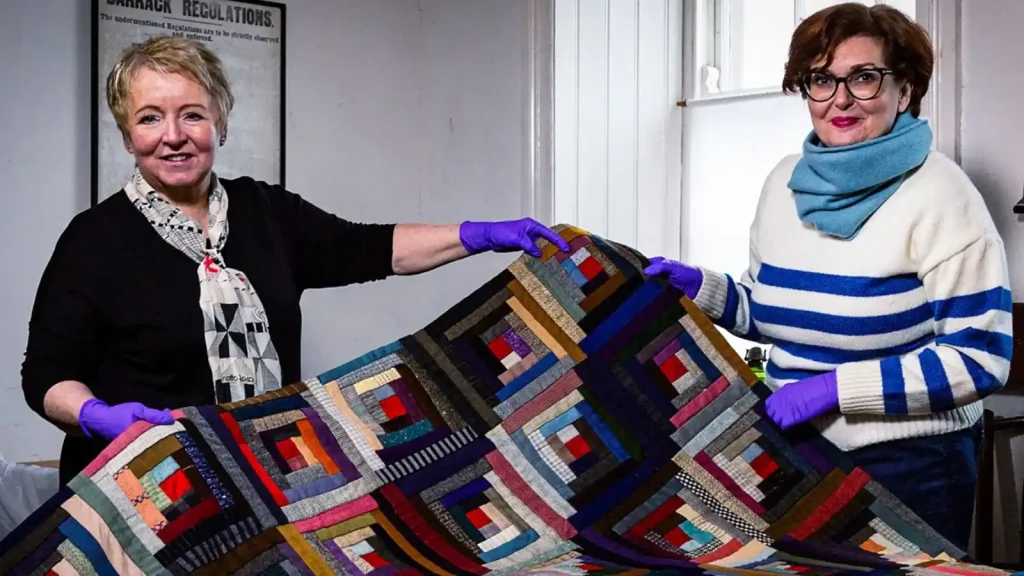
Within the textile collection of the Ulster Folk Museum, one artifact stands out as a singular masterpiece of folk art: the “Crazy Patchwork” or kaleidoscope quilt. Inside Museums Episode 8 presents this object as a “Christmas morning” revelation, a visually stunning piece that dates back to 1916. This quilt is not merely a blanket; it is described as the “quilt that has everything and the kitchen sink,” a complex assemblage of tiny offcuts, scraps, silk panels, and embroidery that forms one of the finest examples of its kind in any British museum.
The construction of the quilt follows a specific tradition where a piece of red flannel is placed in the center of each block. This design choice is deeply symbolic, representing the hearth of the home. In an Ulster farmhouse, the fire was never allowed to go out, and a small ember would always be kept burning. By placing the red flannel at the center, the makers of the quilt were embedding the concept of the eternal hearth into the very fabric of the object.
This specific artifact is known as a “signature quilt,” made to raise funds for a national school in Islandmagee. It contains over 300 signatures, including the names of pupils, parents, local business owners, and community members. However, it is the personal touches added alongside the names that make the quilt a historical document of immense personality. Some contributors chose to stitch small drawings or symbols next to their names, effectively leaving a “marker on history.”
One such detail highlighted in the programme is the signature of Annie Riley, who stitched a small teacup next to her name. When a donor was interviewed decades later about the significance of this symbol, asking if Annie Riley owned a tea room, the response was simply that she was “brave and handy with a cup of tea.” This anecdote underscores the value placed on hospitality in the community. The quilt also functions as a “conversation quilt,” designed to be brought out when conversation lagged during a visit. The host could point to dates, badges, or school samples stitched into the fabric to spark new topics of discussion.
Among the many details is a tiny mouse stitched onto a stalk of wheat, a whimsical addition that suggests the playful nature of the makers. But beyond the whimsy, the quilt reveals the complex identity of the Protestant working-class family that created it. They stitched a “patchwork of identity” into the item, including a Shamrock for Ireland, a Scots Thistle, and the Union flag. Crucially, there is also an American flag, suggesting that migration was a part of their family narrative. This single object captures the multifaceted nature of belonging in Ulster, holding the history of a family and a community in a piece of unique folk art.
Language as a Living Archive
A central theme of Inside Museums Episode 8 is the unique way people in Northern Ireland speak, a legacy created over centuries from the three main languages of the region: Irish, English, and Scots. The Ulster Folk Museum preserves this linguistic heritage not just in written texts but in a vast audio archive. The museum’s collection captures how the “folk communicated,” offering a direct route back to the thoughts and expressions of previous generations.
From the museum’s inception in the early 1960s, language was considered a vital part of its mission. The Ulster Dialect Archive was established to focus on the various strands of speech and how they overlapped and interwove. The programme features recordings of phrases repeated in Gaelic, such as “The priest’s horse is lame” and “The boy’s coat is very big.” These recordings serve as an auditory snapshot of a time when native Irish speakers were more prevalent in certain areas, and they demonstrate the museum’s commitment to saving these voices from oblivion.
The museum’s approach to language is notably inclusive. The curators emphasize that the collection includes manuscript collections of Ulster-Scots writers and poets, such as Robert Huddleston. This inclusivity reflects the founding ethos of the museum, which viewed these different languages, accents, and dialects as fitting together rather than existing in separate silos. While languages have often been used to divide communities in the political sphere of Ulster, the museum has sought to defuse that tension by presenting them as a shared cultural wealth.
The archive reveals that the linguistic landscape was not one of rigid boundaries where “you speak that, you stay there.” Instead, it was a fluid environment where dialects influenced one another. By preserving the recordings of native Irish speakers alongside Ulster-Scots manuscripts, the museum provides a rich source for understanding the region’s identity. It allows visitors to explore their heritage in a non-confrontational way, learning how central language is to both the forefathers of the region and the present day.
The Philosophy of the Ploughed Field
The guiding philosophy of the Ulster Folk Museum, as articulated by Estyn Evans and reiterated throughout Inside Museums Episode 8, is the distinction between the battlefield and the ploughed field. This metaphor is powerful in the context of Northern Ireland’s history. Battlefields are sites of conflict, victory, and defeat—events that often serve to divide populations into winners and losers. In contrast, the ploughed field represents the universal human struggle for survival, the cultivation of the land, and the domestic life that sustains everyone regardless of political allegiance.
The museum explicitly aims to look at the history of the ploughed field. This focus shifts the narrative away from the dates of wars and political upheavals toward the cyclical patterns of rural life. It asks visitors to reflect on the shared heritage of the region, emphasizing that the labor of the land was a common experience for all ancestors in Ulster. The “folk wonders” preserved in the museum—the spades, the looms, the cooking pots—are the tools of this shared survival.
This philosophy transforms the museum from a simple collection of old objects into a space for reconciliation and reflection. By celebrating the skills of the blacksmith, the weaver, and the farmer, the museum elevates the common person to the center of history. It suggests that the true story of the region is found in the everyday resilience of its people rather than in the clash of armies. This perspective is described as a “precious reminder” of lives deeply connected to the land.
The legacy of the pioneering collectors who gathered this folklife collection is a testament to this philosophy. They recognized that the distinctive cultural traditions of Ulster were worth saving not because they supported one political narrative over another, but because they represented the authentic human experience of the place. The “ploughed field” ethos remains the cornerstone of the museum, guiding its mission to help different and often divided communities find a shared heritage.
Reconnecting a New Generation
In contemporary times, the Ulster Folk Museum faces the challenge of remaining relevant to a new generation that is increasingly disconnected from rural traditions. Inside Museums Episode 8 highlights how the museum is reaching out to carry the legacy of Estyn Evans into a new century. The goal is to reconnect young people with the “words, ways, and wisdom” of former days, ensuring that the knowledge preserved in the archives does not become stagnant.
The museum achieves this by allowing visitors to experience the past for themselves. It is not a passive experience; the sensory details—the smell of the turf fires, the sound of the loom, the sight of the reconstructed cottages—create an immersive environment. This experiential learning is crucial for teaching the history of the land. By seeing the “everyday items” that were once considered junk, new generations learn to value the ingenuity and craftsmanship of their ancestors.
The programme suggests that in “our own challenging times,” the lessons of the past have a renewed resonance. The resilience demonstrated by families like the Bairds or individuals like Margaret Clyde offers a perspective on how to endure and find joy in simple things. The “shabby chic” of the past was a necessity, but it was also a life filled with music, storytelling, and community support. By presenting these stories, the museum offers a template for understanding the present through the lens of the past.
Ultimately, the museum serves as a bridge. It links the visionary work of the 1930s and the volunteer efforts of the 1950s with the modern visitor. It ensures that the “crystal” memories of the past are kept safe and accessible. The continued relevance of the museum lies in its ability to teach us all that history is not just about the great events recorded in textbooks, but about the texture of daily life and the shared humanity that underpins it.
Inside Museums Episode 8 concludes by reaffirming the vital importance of the Ulster Folk Museum as a repository of shared identity. The journey through the cottages, the archives, and the collections reveals a Northern Ireland that is defined not by its divisions, but by its commonalities. The mixing and mingling of Irish, English, and Scottish traditions have created a unique culture that is preserved within the museum’s walls and fields.
The programme leaves the viewer with a profound appreciation for the “folk wonders” of Ulster. From the humble Harnen stand to the intricate Crazy Patchwork quilt, each object tells a story of skill, utility, and artistic expression. These artifacts are the physical manifestations of a way of life that prioritized community, hospitality, and a deep connection to the natural world. They are the treasures of the “ploughed field,” standing in quiet contrast to the noise of the “battlefield.”
The vision of Estyn Evans and the dedication of the volunteers who followed him have ensured that this history was not lost. Their “willing hands” gathered the fragments of a disappearing world—the dialects, the drawings, the tools—and created a sanctuary where they could be understood and shared. This legacy is now a permanent part of the cultural landscape, offering a space where the people of Northern Ireland can explore their complex identity in a spirit of inclusivity.
As the museum carries this legacy forward, it continues to ask visitors to reflect on their own place in this story. The preservation of the past is shown to be an active, ongoing process, one that requires the engagement of each new generation. Inside Museums Episode 8 serves as both a tribute to this effort and an invitation to discover the beauty of everyday objects, ensuring that the human stories of the land remain vibrant and alive for the future.
FAQ Inside Museums Episode 8
Q: What is the Ulster Folk Museum and where is it located?
A: The Ulster Folk Museum is an open-air heritage institution located just outside Belfast, Northern Ireland, spanning 180 acres with over 50 historic buildings. It preserves the everyday life and rural traditions of Ulster by showcasing reconstructed cottages, workshops, and authentic artifacts from previous generations. The museum was established following decades of research and opened to the public in 1964, serving as a living archive of how people worked, communicated, and maintained their domestic lives across centuries.
Q: How does Inside Museums Episode 8 explore the Ulster Folk Museum’s collection?
A: Inside Museums Episode 8 takes viewers on a comprehensive journey through the museum’s architectural reconstructions, domestic interiors, textile heritage, and archival collections. The programme reveals both the public displays and the behind-the-scenes collection store, highlighting specific treasures like the Crazy Patchwork quilt, weaver’s cottages, and agricultural tools. Additionally, it emphasizes the museum’s philosophy of focusing on the “ploughed field” rather than the “battlefield,” presenting shared cultural heritage that transcends political divisions in Northern Ireland.
Q: Who was Professor Estyn Evans and why is he significant to the museum?
A: Professor Estyn Evans was a Welsh geographer, writer, and folklorist whose visionary work in the 1930s laid the foundation for the Ulster Folk Museum. He recognized that traditional rural life in Northern Ireland was disappearing due to modernization and mobilized an army of volunteers to document customs, dialects, and material culture before they vanished. Evans famously advocated for celebrating the “ploughed field” over the “battlefield,” shifting historical focus toward shared agricultural heritage and everyday experiences rather than conflict and division.
Q: What makes the Magilligan cottage historically significant?
A: The Magilligan cottage from County Londonderry, dating to the 1750s, was the first building opened to the public when the museum launched in 1964. Margaret Clyde lived in this structure for 90 years without electricity or running water, maintaining a continuous fire that served as the heart of the home for warmth and cooking. Furthermore, the cottage functioned as a “ceilidh house,” where neighbors gathered for music, dancing, and conversation, making it a vibrant social hub that exemplifies community life in rural Ulster.
Q: How were the museum’s buildings reconstructed at their current location?
A: The buildings at the Ulster Folk Museum underwent a meticulous transplantation process where original structures were carefully dismantled at their historical sites throughout Ulster. Each stone was numbered during disassembly, transported to the museum grounds, and then painstakingly rebuilt using the original materials in a process resembling architectural “paint-by-numbers.” This methodology ensured authenticity and historical accuracy, preserving not just replicas but the actual physical fabric of Ulster’s architectural heritage across multiple centuries.
Q: What is the Crazy Patchwork quilt and what does it represent?
A: The Crazy Patchwork quilt, dating to 1916, is a signature quilt created to raise funds for a national school in Islandmagee, containing over 300 signatures from pupils, parents, and community members. Each block features red flannel at its center, symbolizing the eternal hearth fire that was never allowed to extinguish in Ulster farmhouses. The quilt includes personal touches like Annie Riley’s teacup symbol and stitched national emblems representing the complex identity of its Protestant working-class makers, functioning as both folk art and historical document.
Q: How does the museum preserve Ulster’s linguistic heritage?
A: The Ulster Dialect Archive maintains extensive audio recordings capturing how people communicated in Irish, English, and Scots across generations. These recordings include phrases in Gaelic and manuscript collections from Ulster-Scots writers and poets, demonstrating the fluid linguistic landscape where dialects influenced one another. The museum’s inclusive approach presents these languages as shared cultural wealth rather than divisive markers, providing visitors with an auditory route back to the thoughts and expressions of their forebears.
Q: What role did volunteer collectors play in creating the museum’s archive?
A: During the 1950s, volunteers inspired by Estyn Evans conducted crucial fieldwork, interviewing elderly residents about vanishing lifestyles and recording their memories in handwritten notebooks. These collectors, armed only with pens and paper, documented agricultural techniques, domestic practices, and folk customs through detailed notes and illustrative sketches. R.H. Montgomery’s notebooks, for example, contain drawings showing how to plough fields and use tools like the Sky spade, creating an invaluable visual and textual record of manual labor and traditional knowledge.
Q: What is the significance of linen weaving to Ulster’s identity?
A: Linen production formed the economic backbone of Ulster for approximately 250 years, with weaving traditions dating to around 1600 and Irish linen achieving worldwide renown by 1700. The rhythmic sound of hand looms in cottages like the Ballydugan weaver’s cottage represented both skilled craftsmanship and the foundation of an industry that eventually employed hundreds of thousands in mills and factories. Nearly everyone in Northern Ireland has family connections to textile work, making this heritage deeply woven through the region’s collective memory and identity.
Q: How does the museum remain relevant to contemporary audiences?
A: The museum creates immersive, sensory experiences that allow visitors to physically engage with history through reconstructed environments, authentic artifacts, and hands-on demonstrations. By reconnecting people with the “words, ways, and wisdom” of former days, it teaches valuable lessons about resilience, community, and craftsmanship that resonate during challenging modern times. The museum serves as an active bridge between generations, ensuring that preserved knowledge remains vibrant and accessible rather than becoming static archival material disconnected from contemporary life.