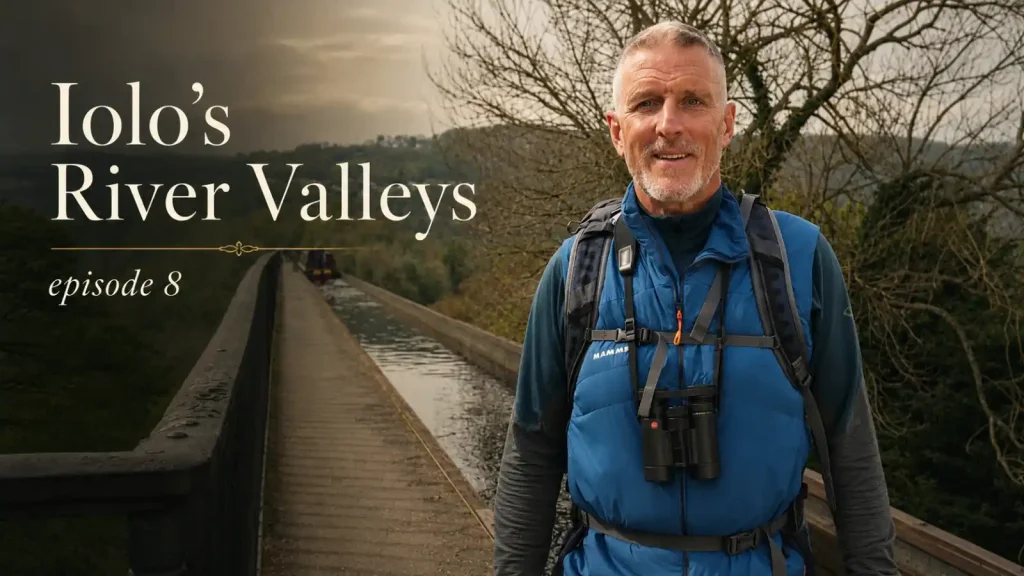
Iolo’s River Valleys episode 8 takes viewers on one of the most geographically and ecologically ambitious journeys in the series, tracing the full length of the River Dee from its wide, tidal estuary on the border of Wales and England to its very origins as a thin trickle of water on the high slopes of Y Dduallt mountain. The Dee is North Wales’ longest river, and across its seventy miles it passes through landscapes of extraordinary variety — saltmarsh, flood meadow, industrial heritage, ancient woodland, upland moorland, and glacial lake. No single journey through Wales compresses such ecological contrast into one continuous corridor of water.
The River Dee holds a particular status among Welsh rivers. It defines boundaries — geographical, political, and ecological — in ways that few other waterways can claim. Along its lower reaches, the river marks the historic frontier between Wales and England, a role it has played for centuries. Yet the boundary it draws is not merely political. The estuary and its surrounding habitats shift gradually from one ecological world to another, from the open, windswept saltmarshes favoured by hunting raptors to the intimate, species-rich meadows that survive in the river’s middle reaches.
Iolo Williams brings his characteristic unhurried curiosity to this journey. A naturalist at home in every habitat the Dee touches, he moves between wading birds and wading rivers with equal ease, spending time with conservation professionals and solitary dawn vigils with equal enthusiasm. What makes this episode especially rewarding is the sheer breadth of species encountered — from microscopic freshwater invertebrates to birds of prey riding the estuary thermals, from ancient mussels clinging to riverbeds to sea trout pushing upstream through autumn darkness.
The Dee Estuary sets the tone immediately. Viewed from the Welsh side at Flint, the estuary reveals itself as one of the most important wader habitats in Britain. The spectacle Iolo witnesses there is remarkable by any measure: thousands of wading birds moving across the mud and shallow water in coordinated masses, their behaviour driven by the rhythm of the tide. The sheer scale of the gathering reinforces just how critical estuarine habitat is to migratory and overwintering bird populations.
Crossing to the English side of the estuary opens a different but equally dramatic perspective. The vast saltmarsh here supports populations of marsh harriers and short-eared owls, both species that rely on open, undisturbed wetland for hunting. Watching these raptors work the marsh is a reminder that the Dee Estuary functions as an ecosystem without regard for the national boundary running through it. The river and its margins create the conditions; the wildlife simply responds.
Travelling inland changes the pace and the mood. The Dee moves away from tidal influence and enters the agricultural lowlands, where an increasingly intensive farming landscape surrounds it on all sides. It is here that the episode’s encounter with one of Wales’ last remaining flood meadows carries particular weight. These habitats — once common along most lowland rivers — have been drained, ploughed, or chemically managed out of existence across most of the country. What survives along the Dee is a rare survivor, and it holds a plant and invertebrate community that speaks directly to what the wider landscape has lost.
Continuing westward, the journey enters the Vale of Llangollen, a valley shaped by geology and transformed by human industry. The Pontcysyllte Aqueduct dominates this section of the Dee corridor — a structure so extraordinary in its engineering ambition that it received UNESCO World Heritage status. Llangollen itself sits beneath the ruins of Castell Dinas Brân, a hilltop fortress whose name translates as Castle of Crows, and whose historical chronicles record one of the last confirmed breeding records of golden eagles in Wales. The eagles are long gone, but the valley continues to hold wildlife surprises.
In the upper reaches, the Dee feeds into Llyn Tegid, Wales’ largest natural lake, before its headwater tributaries reach into the mountains. It is in these remote upper valleys that some of the episode’s most scientifically significant encounters occur — freshwater pearl mussels clinging to life in a clean, cold tributary, bioluminescent fungi glowing in autumn woodland, and sea trout navigating spawning grounds under cover of night. The Dee, in its final miles before Y Dduallt, becomes a place where wildness feels genuinely intact.
Iolo’s River Valleys episode 8
The Dee Estuary and Its Wading Bird Spectacle on Iolo’s River Valleys
The estuary of the River Dee is one of Britain’s most productive intertidal habitats, and the episode makes this clear from the outset. Viewed from Flint on the Welsh side, the mud and shallow water of the estuary hold vast numbers of wading birds during the tidal cycle. The spectacle Iolo witnesses is not simply a gathering of birds; it is a coordinated ecological process, with thousands of individuals responding simultaneously to the movement of water, feeding intensively when the tide drops and lifting into the air in wheeling flocks as the water returns.
The species diversity at the estuary reflects its importance as a stopping and wintering site. Waders of multiple species use the Dee Estuary across the annual cycle, relying on the invertebrate-rich mud that the tidal rhythm replenishes continuously. For many of these birds, the estuary represents a critical link in migration routes stretching from Arctic breeding grounds to West African wintering sites. The Dee’s broad, flat estuary offers exactly the feeding conditions these long-distance travellers require.
Crossing from the Welsh to the English shore reveals the saltmarsh habitats that fringe the outer estuary. Here, marsh harriers quarter low over the vegetation, exploiting the open ground for hunting. Short-eared owls work the same terrain, their buoyant, low flight carrying them systematically over the reed beds and grass. Both species depend on the kind of undisturbed, extensive wetland that the Dee Estuary still provides — a habitat that has disappeared from large areas of lowland Britain. The estuary does not recognise the national boundary that runs through it, and neither do the birds that depend on it.
Flood Meadows and Floral Abundance Along the River Dee
Travelling inland from the estuary, Iolo reaches one of the episode’s most ecologically important sites: a surviving flood meadow, one of the last of its kind in Wales. Flood meadows were once characteristic features of lowland river valleys throughout Britain. Regular winter flooding prevented conversion to arable use, and traditional hay-cutting regimes allowed a rich community of flowering plants to establish and persist. The intensification of agriculture across the twentieth century eliminated most of these habitats, leaving survivors like this Dee valley meadow as isolated relics.
The great burnet is among the flowering plants Iolo finds in the meadow. This tall, distinctive plant with its deep crimson flower heads is now scarce across Wales and Britain more broadly, its populations largely confined to meadows that escaped agricultural improvement. Its presence in the Dee flood meadow is a marker of ecological continuity — evidence that the meadow has remained botanically intact for a considerable period.
The invertebrate community of the meadow is equally impressive. Iolo watches bees working the flowers systematically, their foraging behaviour connecting the meadow’s plant diversity to wider pollination networks. Ladybirds and butterflies are also present, each contributing to a web of ecological interactions that depends on the meadow remaining flower-rich and unimproved. In a landscape dominated by intensive farming on all sides, this small meadow represents something genuinely irreplaceable — a functioning example of a habitat type that Wales has largely lost.
Iolo’s River Valleys and the Engineering Marvel of Pontcysyllte Aqueduct
The Vale of Llangollen announces itself as a landscape shaped by dramatic geological forces, the River Dee cutting through rock to create a valley of considerable scenic power. Towering above all of it — quite literally — is the Pontcysyllte Aqueduct, the structure that Thomas Telford designed and completed in 1805. At 220 years old, the aqueduct spans the Dee valley on eighteen stone piers, carrying a cast-iron trough across a height of 38 metres. It remains the longest and highest navigable aqueduct in Britain.
The aqueduct was built to carry the Ellesmere Canal across the valley, transporting coal, iron, and other industrial goods during a period of rapid industrial expansion in North Wales and the Welsh Marches. Its construction represented a significant engineering achievement for its era — Telford’s decision to use a lightweight iron trough rather than a heavier masonry channel allowed the piers to be built more slender and the whole structure to be more economical. The World Heritage designation the aqueduct received acknowledges both its technical innovation and its historical significance.
Today, the Pontcysyllte Aqueduct carries canal boats along the same iron trough that once moved industrial freight. Walking or boating across it offers an elevated view of the Dee valley below, the river threading through the landscape hundreds of feet beneath the canal. For Iolo’s River Valleys, the aqueduct represents one of the episode’s most vivid illustrations of how human intervention in the Dee corridor has left marks that time has transformed into landmarks. What was built for industrial utility has become, through the passage of time, a structure of remarkable beauty.
Castell Dinas Brân, Golden Eagles, and the Mandarin Duck of Llangollen
Llangollen sits in the shadow of Castell Dinas Brân, the ruined hilltop fortress whose name — Castle of Crows — hints at the avian associations the site has always carried. Historical chronicles record that this valley was once home to breeding golden eagles, making it one of the last confirmed sites in Wales where the species successfully reproduced. The golden eagle’s disappearance from the Welsh landscape reflects a broader pattern of persecution and habitat loss that eliminated the species from most of Britain south of the Scottish Highlands.
The eagles are gone, but the valley they once occupied is far from empty. Iolo finds mandarin ducks on the River Dee near Llangollen, and his reaction to these birds captures something important about the way wildlife can surprise even experienced naturalists. The mandarin duck is an introduced species, originating in East Asia, but its implausibly ornate plumage — the male’s elaborate patterns of chestnut, white, orange, and iridescent green and purple — makes it one of the most visually striking birds in Britain regardless of its origin. Iolo’s visible delight at encountering them is entirely understandable.
The presence of mandarin ducks along this stretch of the Dee is a reminder that rivers are dynamic environments, capable of hosting unexpected residents alongside native species. The Llangollen valley provides the combination of mature riverside trees for nesting and clean, well-oxygenated water for feeding that mandarin ducks require. In the space left by the golden eagle’s extinction, the valley has acquired new wildlife characters of its own — less historically resonant, perhaps, but no less vivid.
Black Grouse Conservation and the Dawn Lek on Iolo’s River Valleys
Above the Llangollen valley, the landscape opens into heather moorland. It is here, in the pre-dawn darkness, that Iolo joins an RSPB conservation officer for one of the episode’s most carefully managed wildlife encounters. The target is the black grouse — specifically, the communal courtship display known as a lek, which the males perform at dawn on traditional display grounds. Black grouse numbers have fallen sharply across Wales and Britain, making any opportunity to observe this behaviour both a privilege and a reminder of how much has been lost.
The logistics of the encounter reflect the sensitivity required when working with threatened species. Iolo and the conservation officer position themselves behind camouflage netting in darkness, well before the birds arrive. The preparation is deliberate and disciplined — any disturbance that causes the males to abandon the lek risks interrupting a behaviour that is fundamental to the species’ reproductive success. The patience required speaks to the kind of commitment that underpins serious conservation fieldwork.
The display itself is extraordinary. Male black grouse — the blackcocks, with their distinctive lyre-shaped tails and vivid red wattles — perform their elaborate ritual of bubbling calls, wing-spreading, and competitive posturing as first light grows across the moor. Females observe from the margins, their choices driving the selection pressure that has shaped the display over evolutionary time. Watching this behaviour in a Welsh upland setting, with the knowledge of how rare such sights have become, gives the encounter a weight that goes beyond simple wildlife observation.
Llyn Tegid, Freshwater Pearl Mussels, and the Upper River Dee
The River Dee’s upper reaches lead eventually to Llyn Tegid — Bala Lake in English — Wales’ largest natural lake. Formed by glacial action and fed by the Dee, Llyn Tegid holds water of exceptional clarity and ecological quality. Iolo visits the lakeside and takes in the view, the stillness of the water contrasting with the active, moving river he has been following throughout the journey. The lake is a natural pause in the landscape, a place where the Dee seems to gather itself before continuing its final push into the mountains.
Nearby, on the Afon Tryweryn — one of the Dee’s upland tributaries — Iolo joins a specialist from Natural Resources Wales holding a licence to search for freshwater pearl mussels. The freshwater pearl mussel is among the most endangered species in Britain and Europe. It requires exceptionally clean, cold, well-oxygenated water with specific substrate conditions, and it has disappeared from the vast majority of rivers where it once occurred. Pollution, habitat modification, and the decline of salmon and trout populations — on which juvenile mussels depend as hosts — have reduced the species to a handful of surviving populations.
Finding mussels on the Tryweryn, even in small numbers, is scientifically significant. These animals can live for over a century, and the oldest individuals in a population may have established themselves in river conditions that no longer exist elsewhere. Their presence on this Dee tributary indicates that the water quality here remains within the narrow tolerances the species requires. Conservation of the freshwater pearl mussel depends entirely on maintaining those conditions — and on ensuring that salmon and trout continue to use the same rivers, providing the larval mussels with the hosts they need to complete their life cycle.
Bioluminescent Fungi, Sea Trout, and the Night Worlds of Iolo’s River Valleys
Autumn brings a different quality of light to the Dee’s woodland reaches. In the damp, shaded conditions of seasonal woodland, fungi emerge in extraordinary variety, and some produce one of nature’s most unusual phenomena: bioluminescence. Iolo explores autumn woodland along the Dee corridor and, using ultraviolet light, reveals fungi that glow in the darkness — their tissues emitting a faint, eerie light that is invisible under normal conditions. The effect, seen in context, is genuinely otherworldly.
Bioluminescence in fungi is not fully understood, but it is thought to involve a chemical reaction between compounds in the fungal tissue. Some species produce light continuously; others glow only at certain stages of their life cycle. The ecological function — if it has one — may relate to attracting invertebrates that help disperse spores, though the evidence for this is still being investigated. What is clear is that the phenomenon is real, reproducible, and visually remarkable. The damp autumn conditions along the Dee create exactly the environment in which these fungi flourish.
The episode’s final nocturnal sequence takes Iolo to a secret spawning ground on one of the Dee’s upper tributaries, where sea trout — known in Welsh as sewin — are making their autumn migration upstream to breed. Sea trout are the sea-run form of brown trout, spending part of their lives feeding in the sea before returning to fresh water to spawn. Their autumn migration is a behaviour of considerable ecological importance, connecting marine nutrient cycles to upland river systems.
To minimise disturbance to this vulnerable behaviour, Iolo and his team use a pole camera and drones rather than direct approach. The footage captured shows the fish moving over the spawning gravel — the redds — with the purposeful, unhurried behaviour of animals engaged in one of nature’s most fundamental acts. The females cut depressions in the gravel with their tails; the males compete and position themselves alongside. The scene plays out in darkness, the water cold and clear, the fish entirely absorbed in the process that defines their annual cycle.
Iolo’s River Valleys Journey Concludes on the Slopes of Y Dduallt
The journey’s final destination is Y Dduallt mountain, where the River Dee begins. Here, on high ground far above the agricultural lowlands and the industrial heritage of the middle valley, the river is not yet a river. It is a trickle — a thin thread of water emerging from saturated ground on the mountain slope — carrying no hint of the estuary it will eventually reach, the lake it will fill, or the aqueduct it will pass beneath. The source of the Dee is quiet, remote, and entirely unspectacular in the best possible sense.
Standing at the source provides a particular kind of perspective. Everything that makes the Dee ecologically significant — the estuarine waders, the flood meadow plants, the freshwater mussels, the spawning sea trout — begins here, with this modest seep of water from moorland ground. The entire seventy-mile journey is implicit in the source, compressed into a few inches of flow. The Dee does not announce its ambitions at the beginning; it simply starts, and the landscape does the rest.
Iolo’s River Valleys episode 8 achieves something that travel and wildlife documentaries often attempt but rarely accomplish: a genuine sense of a landscape understood whole. The River Dee is not presented as a series of disconnected highlights but as a single, continuous system in which each element connects to the others.
The waders of the estuary and the mussels of the Tryweryn are part of the same story; the Pontcysyllte Aqueduct and the black grouse lek are expressions of the same valley seen at different scales and through different eyes. Following the river from its mouth to its source, as Iolo does, is the right way to understand it — because the river itself travels in the opposite direction, gathering everything the landscape offers as it moves toward the sea.
FAQ Iolo’s River Valleys episode 8
Q: What river does Iolo Williams explore in Iolo’s River Valleys episode 8?
A: Iolo Williams explores the River Dee, North Wales’ longest river. His journey covers approximately seventy miles, beginning at the wide tidal estuary on the Wales-England border and concluding at the river’s source on the slopes of Y Dduallt mountain. Along the way, he encounters a remarkable range of habitats, from saltmarsh and flood meadow to upland moorland and glacial lake.
Q: What makes the Dee Estuary significant for wildlife?
A: The Dee Estuary is one of Britain’s most important intertidal habitats for wading birds. Thousands of waders gather there during the tidal cycle, feeding intensively on the invertebrate-rich mud. Additionally, the vast saltmarsh on the English side supports marsh harriers and short-eared owls. The estuary functions as a critical link in migration routes stretching from Arctic breeding grounds to West African wintering sites.
Q: Why are flood meadows along the River Dee considered ecologically important?
A: Flood meadows are among Wales’ rarest surviving habitats. Regular winter flooding historically prevented conversion to arable land, allowing rich communities of flowering plants to thrive. However, twentieth-century agricultural intensification eliminated most of these meadows. The surviving Dee valley example supports scarce species such as the great burnet, alongside bees, butterflies, and ladybirds that depend on flower-rich, unimproved grassland.
Q: What is the Pontcysyllte Aqueduct, and why does it feature in Iolo’s River Valleys episode 8?
A: The Pontcysyllte Aqueduct is a UNESCO World Heritage Site designed by Thomas Telford and completed in 1805. It spans the Dee valley on eighteen stone piers, carrying a cast-iron trough 38 metres above the river. Originally built to transport coal and iron during the industrial revolution, it remains the longest and highest navigable aqueduct in Britain. It represents a defining landmark of the Vale of Llangollen.
Q: What is the historical connection between Castell Dinas Brân and golden eagles in Wales?
A: Castell Dinas Brân, meaning Castle of Crows, overlooks Llangollen in the Dee valley. Historical chronicles record it as one of the last confirmed breeding sites of golden eagles in Wales. Persecution and habitat loss eventually eliminated the species from the Welsh landscape. Furthermore, the valley now hosts mandarin ducks — an introduced species from East Asia whose elaborate plumage makes them among the most visually striking birds found along the River Dee today.
Q: What is a black grouse lek, and why is observing one in Wales significant?
A: A lek is the communal dawn courtship display performed by male black grouse on traditional display grounds. Males, known as blackcocks, produce bubbling calls and spread their distinctive lyre-shaped tails to attract watching females. Black grouse numbers have declined sharply across Wales and Britain, making any active lek a conservation priority. In Iolo’s River Valleys episode 8, Iolo observes the display from behind camouflage netting alongside an RSPB conservation officer to avoid disturbing the birds.
Q: What is Llyn Tegid, and how does it connect to the River Dee?
A: Llyn Tegid, known in English as Bala Lake, is Wales’ largest natural lake. It was formed by glacial action and receives water directly from the upper River Dee. The lake holds water of exceptional clarity and ecological quality. Iolo visits the lakeside in Iolo’s River Valleys episode 8, describing it as a natural pause in the landscape where the Dee gathers itself before continuing its final ascent into the mountains toward its source on Y Dduallt.
Q: Why is the freshwater pearl mussel so rare, and where does Iolo find one along the River Dee?
A: The freshwater pearl mussel is one of Britain’s most endangered species. It requires exceptionally clean, cold, well-oxygenated water and depends on healthy salmon and trout populations as hosts for its larvae. Pollution and habitat modification have eliminated it from most rivers. In Iolo’s River Valleys episode 8, Iolo joins a Natural Resources Wales licence holder on the Afon Tryweryn — a Dee tributary — where a surviving population indicates that water quality remains within the species’ narrow tolerances.
Q: What are sea trout, and why does Iolo observe them at night in Iolo’s River Valleys?
A: Sea trout, known in Welsh as sewin, are the sea-run form of brown trout. They spend part of their lives feeding at sea before returning to fresh water each autumn to spawn. Their migration connects marine nutrient cycles to upland river systems. To minimise disturbance at a secret spawning ground on a Dee tributary, Iolo’s team uses a pole camera and drones. The footage reveals females cutting nests in riverbed gravel while males compete for position alongside them.
Q: What bioluminescent phenomenon does Iolo discover in the Dee’s woodland during autumn?
A: In the damp autumn woodlands along the River Dee corridor, Iolo discovers fungi that produce bioluminescence — a faint glow visible under ultraviolet light but invisible under normal conditions. This phenomenon involves a chemical reaction within the fungal tissue. Scientists believe it may attract invertebrates that help disperse spores, though research into its ecological function continues. The cool, shaded conditions of the Dee’s seasonal woodland create exactly the environment in which these remarkable organisms flourish.