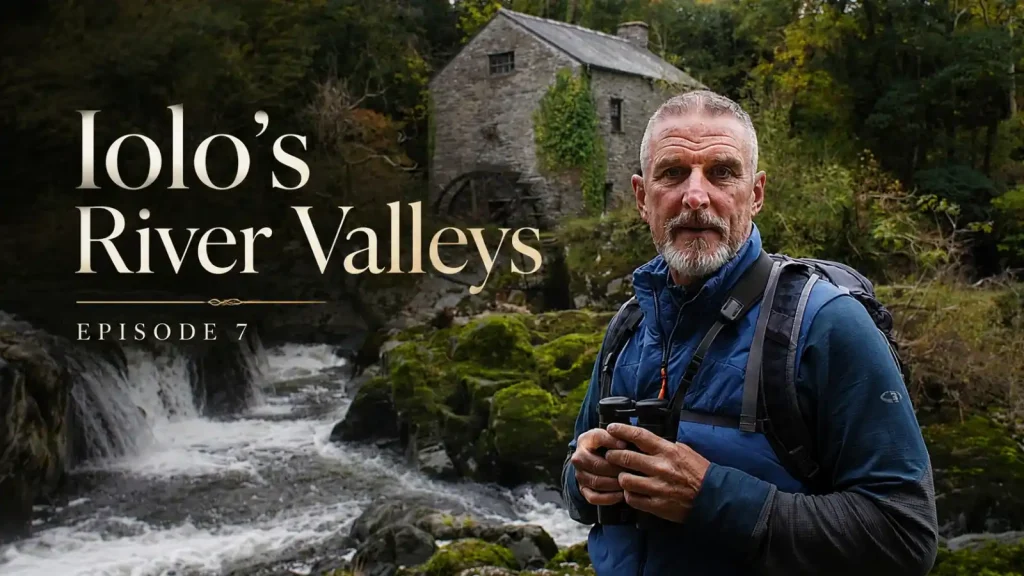
Iolo’s River Valleys episode 7 takes viewers on a 76-mile journey along the River Teifi, widely celebrated as the queen of Welsh rivers, tracing its path from the estuary at Cardigan Bay all the way to its remote mountain source in the Cambrian Mountains. This is not a gentle scenic tour. It is an investigation into the ecological state of one of Wales’s most storied waterways, revealing a river that sustains extraordinary wildlife while facing serious and growing threats from pollution, habitat loss, and the collapse of its most iconic fish populations.
The Teifi has inspired poets, sustained communities for millennia, and shaped a distinctive cultural landscape. What naturalist Iolo Williams finds along its banks in a single journey captures both its enduring brilliance and its fragility.
The River Teifi has long occupied a special place in Welsh consciousness. It flows through Ceredigion and Pembrokeshire, draining an ancient landscape shaped by glaciers, peatlands, and centuries of human settlement. For wildlife, it offers a remarkable range of habitats compressed into a relatively short distance: coastal estuary, tidal marshes, flooded slate quarries, wooded gorges, pastoral valleys, and finally the vast upland blanket bog of Cors Caron National Nature Reserve before reaching the high moorland of the Cambrian Mountains. Each habitat brings its own cast of species, and together they make the Teifi one of the richest wildlife corridors in Wales.
The journey begins in May, a month that amplifies everything alive along the river. Breeding season is underway, migrants are moving, and the landscape hums with biological urgency. Yet May also exposes contradictions. Birds that should be nesting further north appear on the estuary, suggesting failed breeding attempts elsewhere. Butterflies arrive from north Africa, carried by southerly winds across the continent. The season’s energy makes the river feel productive and hopeful, but the closer attention reveals a system under strain. Salmon and sea trout, once synonymous with the Teifi, are now so scarce that the coraclemen who have fished this river for two thousand years struggle to justify casting their boats.
Iolo Williams brings a quality of attention to this journey that goes beyond casual birdwatching. He reads the landscape in layers, understanding that a mixed flock of waders on the estuary tells a story about distant breeding grounds, that a slow worm basking on slate spoil reflects the particular microclimate of an old quarry, and that a kingfisher successfully raising a third brood in a single season speaks to the resilience possible when conditions align. His approach frames the Teifi not merely as a beautiful river but as a system with logic, history, and vulnerability. Iolo’s River Valleys episode 7 builds this reading steadily, from the tidal flats of Patch Beach to the windswept plateau of Llyn Teifi.
The structural journey of the episode also carries thematic weight. Moving upstream means moving back in time, from the modern pressures of the estuary and the intensively farmed valleys toward older, wilder landscapes. Cors Caron feels like a place that has resisted change precisely because it is difficult to exploit. The Cambrian Mountains source is harsher still, a high, exposed, treeless environment where the river is little more than a trickle draining off blanket peat. This progression from tidal mudflats to mountain peatland captures the full ecological range of the Teifi, and it gives the journey a satisfying logic that rewards sustained attention.
What makes the Teifi distinctive among Welsh rivers is the density of specialist species that depend on it. Otters require rivers with clean water, sufficient fish, and undisturbed bankside cover. Kingfishers need steep earthen banks and reliable fish stocks. Dippers navigate the fast, oxygenated stretches of the gorge. Each of these species acts as an indicator of river health, and each features in this journey. Their presence is genuinely reassuring, but it does not cancel out the evidence of decline elsewhere. The tension between abundance and loss runs through the entire 76-mile traverse.
The cultural dimension of the Teifi matters as much as the ecological one. Coracle fishing, practised here for around two thousand years, represents one of Britain’s oldest continuous fishing traditions. The Teifi’s slate quarries at Cilgerran shaped the industrial history of this corner of Wales and then fell silent, leaving behind flooded pits and spoil heaps that nature has steadily colonised. The waterfalls at Cennarth were once celebrated as a spectacle of leaping salmon, drawing visitors from across the country. Each of these features carries a memory of what the river once supported, and each now tells a story of change.
By the time Iolo Williams reaches the source, the journey has accumulated enough evidence to understand the Teifi as both extraordinary and embattled. The river still delivers encounters of genuine wonder: an otter hunting an eel at close range, a kingfisher returning with a fish for hungry chicks, a whinchat singing from a rush clump in one of its last lowland strongholds. These moments matter. They demonstrate what the river is capable of when given space and protection. They also make the failures of stewardship in the farmed and developed valleys all the more striking.
Iolo’s River Valleys episode 7 review
Iolo’s River Valleys Episode 7 Begins at the Estuary: Patch Beach and Cardigan Bay
The journey opens at Patch Beach, the point where the River Teifi finally releases into Cardigan Bay. In May, this coastal margin is already busy with life. Iolo Williams notices a mixed flock of dunlin and ringed plovers working the tideline, and their presence here surprises him. These are not birds that should be loitering on a Welsh estuary in May. They are almost certainly failed breeders, birds whose nesting attempts further north have come to nothing, drifting south earlier than expected and beginning to gather before the main southward movement of late summer. Their early arrival on the Teifi estuary is a small but telling sign of disrupted breeding cycles elsewhere.
Alongside the waders, painted lady butterflies are moving through. These are migrants in the fullest sense, having flown from north Africa on southerly winds before making landfall on the Welsh coast. On Patch Beach, they stop to feed on the nectar-rich flowers growing among the sea defences, restoring energy before continuing their journey inland.
The painted lady is one of the great migratory insects of the world, capable of multi-generational journeys spanning continents, and seeing them pause on a Welsh estuary in May makes the global scale of insect migration suddenly concrete. For Iolo Williams, their presence is a reminder that the Teifi is not an isolated ecosystem but a node in a much wider network of movement and migration.
Cardigan Bay itself provides the backdrop to this opening section, its broad curve visible beyond the estuary mouth. The bay is one of Wales’s most important marine habitats, supporting bottlenose dolphins, harbour porpoises, and a rich intertidal community. The Teifi flows into it having drained a catchment of hundreds of square kilometres, and whatever enters that catchment eventually reaches the bay. This hydrological connection makes the health of the river directly relevant to the health of the wider coastal environment, a link that becomes more significant as the journey progresses upstream into the agricultural heartland.
The Teifi Marshes and Cilgerran: Industrial Ruins and Wildlife Recovery
Moving upstream from the estuary, the journey enters the Teifi Marshes, a reserve that sits adjacent to the old slate quarries near Cilgerran. These flooded quarry pits represent one of the more unexpected wildlife habitats along the river. When slate extraction ended, the pits filled with water and the surrounding spoil heaps were gradually colonised by scrub, grassland, and reptile-friendly open ground. Nature did not wait for permission to move in.
On the quarry spoil, Iolo Williams finds a slow worm hunting in the open. The slow worm is not a worm and not a snake but a legless lizard, a distinction that matters biologically even if it goes unnoticed by most observers. What matters here is that the slate spoil provides exactly what a slow worm needs: warm, loose substrate that heats quickly in sunlight, invertebrate prey in the leaf litter, and enough structural complexity to provide refuge. The quarry’s legacy of industrial disturbance has accidentally created conditions that a managed nature reserve might struggle to replicate.
Among the invertebrates on the quarry vegetation, swollen-thighed beetles go about their business. These distinctive beetles, whose males carry noticeably enlarged hind femurs, are pollen-feeders associated with open flower-rich habitats. Their presence confirms the botanical richness of the quarry margins. More dramatic still is the discovery of a single tree being used simultaneously by great spotted woodpeckers and great tits, both species nesting in the same trunk. The woodpeckers excavate their own cavity. The great tits, opportunistic and adaptable, have moved into a separate hole in the same tree. Two species, one trunk, both successfully raising young, a genuine two-for-one nesting arrangement.
The Ancient Fishing Tradition Documented in Iolo’s River Valleys Episode 7
At the Teifi marshes, Iolo Williams meets Rod Bowen, one of the last active coraclemen on the river. The coracle is a small, bowl-shaped boat made from a wooden frame covered in hide or canvas, light enough for a single person to carry on their back between the river and the road. The design is ancient, essentially unchanged for around two thousand years, and the Teifi has been one of the last rivers in Wales where coracle fishing has survived as a living tradition rather than a historical recreation.
Rod Bowen’s account of the current state of coracle fishing is sobering. The tradition that has persisted through the Roman period, the Norman conquest, industrialisation, and two world wars is now under genuine threat, not from cultural indifference but from the collapse of the fish populations that sustain it. Salmon and sea trout, the primary targets of coracle fishermen, have declined so dramatically on the Teifi that the whole practice has become economically and ecologically unjustifiable for many who might otherwise continue it. The coracle survives, but the fishing that gives it purpose is disappearing.
This decline sits at the heart of the episode’s environmental argument. The Teifi was once famous for its salmon and sea trout runs, drawing anglers and coracle fishermen alike, generating local identity and local income. The loss of those runs is not a minor ecological footnote. It represents the unravelling of a relationship between a river and its human community that stretches back further than written records. Rod Bowen’s testimony gives that loss a human face and a specific, irreplaceable cultural context.
Cennarth Falls and the Pollution Challenge Along the Welsh Rivers
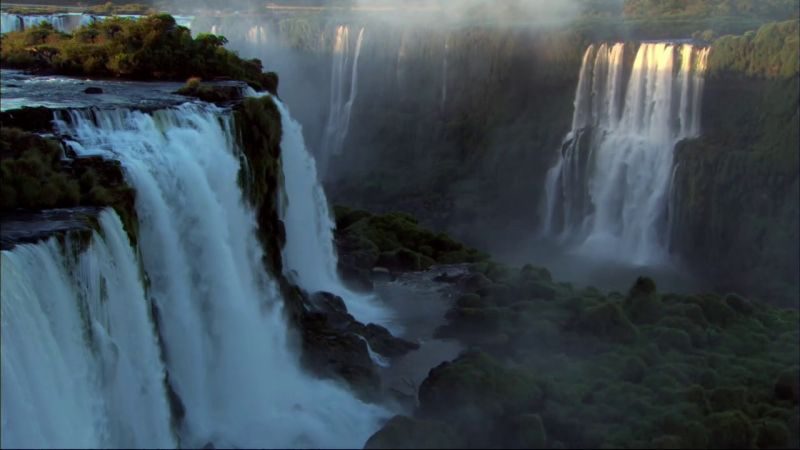
Cennarth Falls ranks among the most celebrated spots on the entire River Teifi. The waterfall drops over a series of rock ledges in a gorge setting of considerable drama, and historically it was a reliable location to watch salmon and sea trout leaping as they migrated upstream to their spawning grounds. Visitors would gather at the falls specifically to witness this spectacle. That spectacle is now largely absent.
Iolo Williams addresses the cause directly and without euphemism. He identifies pollution as the elephant in the room, an uncomfortable truth that underlies the fish decline across the Teifi and, by extension, across many Welsh rivers. The pollution comes from two primary sources: agricultural runoff, which introduces nitrates, phosphates, and sediment from intensively managed farmland, and urban sources, which contribute treated and sometimes undertreated sewage effluent. Together, these inputs degrade water quality, reduce oxygen levels, disrupt spawning gravels, and compromise the food chains on which juvenile fish depend.
The falls themselves remain visually spectacular, and the gorge still supports wildlife. However, the absence of leaping fish at Cennarth is a diagnostic symptom of a river system in distress. Iolo Williams does not labour the point melodramatically, but he does not soften it either. The Teifi Gorge, which should be one of the great salmon rivers of western Britain, is functioning at a fraction of its historical capacity because the water quality required to sustain migratory fish has not been adequately protected.
Himalayan Balsam, Kingfishers, and Resilience in the Teifi Gorge
Travelling through the gorge, Iolo Williams highlights the spread of Himalayan balsam along the riverbanks. This invasive plant, originally from the western Himalayas, was introduced to British gardens in the nineteenth century and has since spread aggressively along waterways across the country. It grows tall, shades out native bankside vegetation, and dies back completely in winter, leaving bare soil that is vulnerable to erosion. On rivers already suffering from elevated sediment loads, the additional erosion contributed by Himalayan balsam is a significant problem. Its presence along the Teifi confirms that the pressures on this river are multiple and interconnected.
In contrast to these depressing indicators, a kingfisher nest near Henllan provides one of the episode’s most uplifting moments. Iolo Williams watches a female kingfisher return repeatedly to her nest burrow in an earthen bank, each time carrying a small fish for her chicks. What makes this particular kingfisher exceptional is the information that she is already on her third brood of the season. Kingfishers can raise multiple broods in a single year, but three broods requires sustained good conditions: clean, clear water with sufficient small fish, an undisturbed nesting bank, and enough time within the breeding season to complete each cycle. This female has found all of those conditions near Henllan.
The kingfisher encounter illustrates a principle that runs throughout Iolo’s River Valleys episode 7: even a river under pressure can harbour pockets of genuine ecological health. The kingfisher does not read environmental reports or know about the pollution further downstream. She has found what she needs in her specific stretch of the river and is responding with maximum reproductive effort. Her three broods represent the river at its best, demonstrating what clean water and good habitat can still deliver.
An Extraordinary Otter Encounter at Maes y Crugiau
The single most vivid wildlife encounter of the entire journey occurs at Maes y Crugiau, where Iolo Williams watches an otter hunt and consume an eel at close range. Otters are not uncommon on the Teifi, but the opportunity to observe one feeding in unhurried detail is genuinely rare. The otter locates an eel, secures it, and eats it on a riverbank, apparently unconcerned by the observer’s presence. For Iolo Williams, the encounter is clearly a highlight of the whole 76-mile traverse.
The otter’s choice of prey is itself ecologically informative. Eels, specifically European eels, are one of the most extraordinary animals in British freshwater. They spawn in the Sargasso Sea, cross the Atlantic as larvae, migrate up rivers like the Teifi as juvenile elvers, spend years or decades growing in freshwater, and then return to the Sargasso to breed and die. The European eel is now classified as critically endangered, its populations having collapsed across its entire range due to barriers to migration, overfishing, habitat loss, and parasitic infection. An otter eating an eel on the Teifi is therefore a complex ecological moment: a predator exploiting a prey species that is itself in serious difficulty.
The otter’s broader presence on the Teifi is a marker of river quality. Otters disappeared from most English rivers during the twentieth century due to pesticide contamination and persecution, and their recovery since the 1980s has tracked improvements in water quality and legal protection. The Teifi has maintained an otter population throughout, partly because its catchment remained relatively less contaminated than lowland English rivers, and partly because the river’s structure of pools, riffles, and bankside cover provides excellent otter habitat. Seeing one at close range, fishing confidently in daylight, confirms that the Teifi still functions as otter country in the fullest sense.
Cors Caron National Nature Reserve and the Whinchat’s Last Lowland Stronghold
The journey reaches Cors Caron National Nature Reserve, an ancient raised peat bog of national and international importance stretching across the upper Teifi valley. Cors Caron is one of the largest and best-preserved raised bogs in Wales, a landscape shaped by thousands of years of peat accumulation in the shallow basin left by a post-glacial lake. Its surface is a mosaic of sphagnum moss, cotton grass, sedge pools, and scrub margins, threaded by boardwalks that allow visitors to traverse the bog without damaging its fragile surface.
On the boardwalks at Cors Caron National Nature Reserve, Iolo Williams finds a whinchat, a small migratory bird that has undergone severe population declines across lowland Britain over recent decades. The whinchat winters in sub-Saharan Africa and returns each spring to breed in open, rough grassland and upland habitats. Changes in agricultural practice, specifically the improvement of rough grassland and the loss of traditional hay meadows, have removed much of its lowland breeding habitat. Cors Caron represents one of the few remaining places in Wales where the whinchat still breeds reliably in a lowland setting, its population sustained by the reserve’s unimproved, structurally complex vegetation.
The whinchat’s presence here is therefore significant beyond the immediate pleasure of the sighting. It marks Cors Caron as a genuine refugium, a place where species that have been squeezed out of the wider landscape can maintain a population while the surrounding countryside becomes steadily less hospitable. The National Nature Reserve designation provides the legal and management framework to maintain the conditions the whinchat requires, but the broader lesson is that such reserves carry disproportionate conservation responsibility precisely because the habitat around them has been so thoroughly modified.
Iolo’s River Valleys Episode 7 Explores Wildlife-Friendly Farming on the Upper Teifi
Near Cors Caron, the journey visits a farm operating on conservation-first principles, offering a deliberate contrast to the intensively managed land responsible for much of the river’s pollution load. On this farm, the results of sympathetic management are immediately visible. Golden-ringed dragonflies patrol the watercourses, their distinctive banded bodies and powerful flight marking them as apex predators of the invertebrate world. Ringlet butterflies drift through the rough grassland margins, indicating the presence of unimproved sward with sufficient grass diversity to support their caterpillars.
Most significantly, a pair of kestrels is successfully raising chicks in a nest box provided by the farmer. Kestrels have declined markedly across much of Britain as agricultural intensification has reduced the small mammal populations on which they depend. A kestrel hunting over a field needs to be able to see and catch voles and mice in the vegetation below. Heavily grazed improved pasture offers very little cover for small mammals and therefore very little food for kestrels. This farm’s retention of rougher grassland and field margins has created the conditions that support both the prey and the predator.
The contrast between this farm and the intensively managed land downstream is pointed but not preachy. The evidence is visible in the species present. Conservation-first agriculture does not mean abandoning productive farming. It means managing land in ways that allow wildlife to coexist with food production, maintaining margins, water features, rough areas, and structural diversity that benefit a wide range of species. The kestrel chicks in the nest box, fed on voles caught in ungrazed grassland, represent the practical outcome of that approach.
Iolo’s River Valleys Episode 7 Concludes at Llyn Teifi in the Cambrian Mountains
The journey ends at Llyn Teifi, the remote mountain lake in the Cambrian Mountains from which the River Teifi begins its 76-mile descent to the sea. The Cambrian Mountains are a high, exposed plateau of blanket peat and moorland, one of the least visited and least populated landscapes in Wales. Llyn Teifi sits in this plateau, a cold, dark, wind-raked lake that seems an unlikely origin for a river as rich and varied as the Teifi.
In winter conditions, which the summit environment imposes even in late spring, the landscape is stripped to its essentials: bog cotton, heather, dark water, grey sky. The contrast with the estuary’s painted lady butterflies and mixed wader flocks could hardly be more complete. Yet this harsh, unproductive-looking landscape is precisely what sustains the Teifi. The blanket peat of the Cambrian Mountains acts as a vast sponge, absorbing winter rain and releasing it slowly through spring and summer, maintaining river flow during drought periods that would otherwise leave downstream habitats parched and lifeless.
The source landscape also represents one of the last genuinely wild places in Wales, a place where human influence has been relatively light precisely because the land offers so little to intensive agriculture or development. The Cambrian Mountains Wildlife Conservation programme has focused attention on this upland landscape, recognising that protecting the source of rivers like the Teifi protects everything downstream.
The river begins here as a trickle in the peat, and what happens in this plateau determines the volume, timing, and quality of water flowing past Cors Caron, through the Teifi Gorge, past Cennarth Falls, through the Teifi Marshes, and finally out across Patch Beach into Cardigan Bay. The whole 76-mile journey is contained in the water leaving this windswept lake, carrying with it the character of a landscape and the future of a river.
FAQ Iolo’s River Valleys episode 7
Q: What is Iolo’s River Valleys Episode 7 about, and which river does it follow?
A: Iolo’s River Valleys Episode 7 follows naturalist Iolo Williams on a 76-mile journey along the River Teifi, widely regarded as the queen of Welsh rivers. The journey begins at Patch Beach on Cardigan Bay and ends at the remote mountain source, Llyn Teifi, in the Cambrian Mountains. Along the way, it documents an exceptional range of wildlife, habitats, and conservation challenges.
Q: Why does Iolo Williams find dunlin and ringed plovers on the Teifi estuary in May?
A: Their presence in May is unusual. Iolo Williams identifies them as likely failed breeders — birds whose nesting attempts further north came to nothing — drifting south earlier than expected. Their early arrival on the Teifi estuary signals disrupted breeding cycles in distant northern habitats. Additionally, painted lady butterflies from north Africa are feeding on flowers among the sea defences at the same location.
Q: What wildlife has colonised the old slate quarries near Cilgerran on the River Teifi?
A: Nature has reclaimed the Cilgerran quarries impressively. Iolo Williams discovers a slow worm hunting across quarry spoil, taking advantage of the warm slate substrate. Swollen-thighed beetles feed on pollen-rich flowers on the quarry margins. Furthermore, a single tree hosts both great spotted woodpeckers and great tits nesting simultaneously in separate cavities — a remarkable two-for-one nesting arrangement demonstrating how industrial ruins can become unexpected wildlife havens.
Q: Why is coracle fishing on the River Teifi now under threat?
A: Rod Bowen, a local coracleman, explains that coracle fishing on the Teifi has continued for approximately 2,000 years. However, the dramatic decline of salmon and sea trout populations now threatens its survival. The collapse stems not from cultural disinterest but from deteriorating water quality and habitat loss. Without sufficient fish, a tradition that survived Roman occupation, industrialisation, and two world wars faces an uncertain future.
Q: What does Iolo Williams identify as the main cause of fish decline on the Teifi?
A: Iolo Williams addresses this directly at Cennarth Falls, where salmon once leapt spectacularly during migration. He identifies pollution as the elephant in the room. Agricultural runoff introduces nitrates, phosphates, and sediment, while urban sources contribute sewage effluent. Together, these inputs degrade water quality, reduce oxygen levels, and destroy spawning gravels. The falls remain visually dramatic, but the absence of leaping fish marks a river functioning far below its historical capacity.
Q: How does Himalayan balsam affect the River Teifi and its banks?
A: Himalayan balsam, introduced to Britain in the nineteenth century, has spread aggressively along the Teifi’s banks. It grows tall, outcompeting native bankside plants, and dies back completely each winter. This leaves bare soil highly vulnerable to erosion. On a river already suffering elevated sediment loads from agricultural runoff, the additional erosion caused by this invasive species compounds existing pressures significantly.
Q: What makes the kingfisher sighting near Henllan particularly significant in Iolo’s River Valleys Episode 7?
A: A female kingfisher near Henllan is already raising her third brood of the season when Iolo Williams observes her returning with fish for her chicks. Three successful broods require sustained clean water, reliable fish stocks, and an undisturbed nesting bank throughout the season. This remarkable achievement demonstrates that even a river under environmental pressure can sustain pockets of genuine ecological health when local conditions remain favourable.
Q: What happens during Iolo Williams’s otter encounter at Maes y Crugiau?
A: At Maes y Crugiau, Iolo Williams watches an otter hunt and consume an eel at close range. The otter feeds confidently on the riverbank, apparently undisturbed by his presence. The encounter is notable for two reasons. First, otters serve as key indicators of river health, and their continued presence on the Teifi confirms acceptable water quality. Second, the European eel the otter eats is itself a critically endangered species, adding ecological complexity to this remarkable sighting.
Q: Why is Cors Caron National Nature Reserve so important for the whinchat?
A: The whinchat has declined severely across lowland Britain as agricultural improvement has destroyed its rough grassland breeding habitat. Cors Caron National Nature Reserve, with its ancient raised peatland and structurally complex vegetation, remains one of the few lowland sites in Wales where the whinchat still breeds reliably. Iolo Williams finds one on the reserve’s boardwalks. Cors Caron therefore functions as a genuine refugium, carrying disproportionate conservation responsibility for this increasingly scarce migrant.
Q: How does Iolo’s River Valleys Episode 7 end, and what does Llyn Teifi represent?
A: The journey concludes at Llyn Teifi, a cold, remote mountain lake on the Cambrian Mountains plateau. In near-wintry conditions, the landscape is stripped to blanket peat, heather, and dark water. However, this harsh environment is ecologically essential. The upland peatland acts as a vast natural sponge, absorbing rainfall and releasing it steadily to sustain river flow throughout the year. Everything encountered across the 76-mile journey downstream ultimately depends on what begins here.