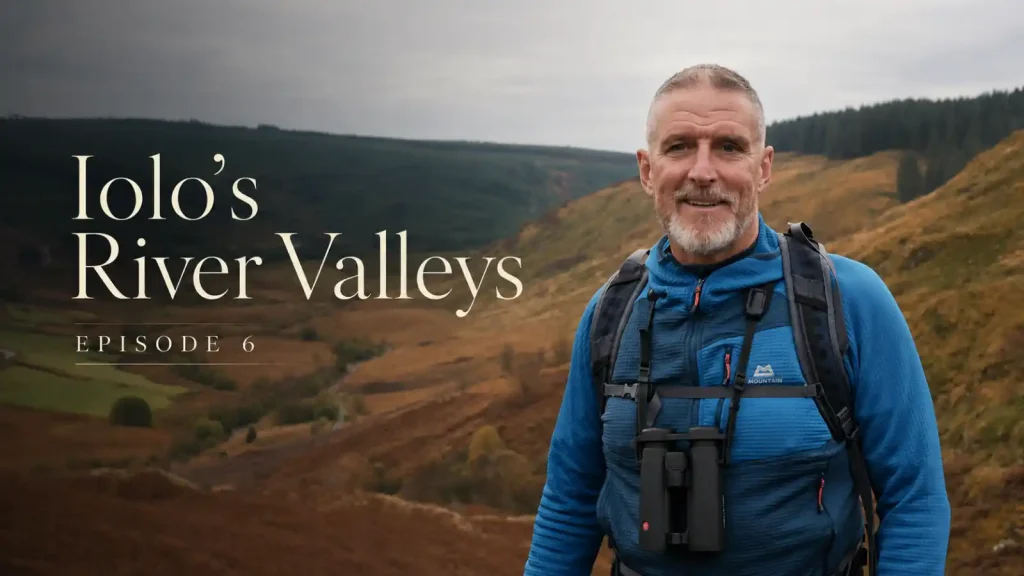
Iolo’s River Valleys episode 6 opens on the wide, tidal mouth of the Tywi, where the river surrenders itself to the sea at the coastal village of Llansteffan, and a 75-mile journey into the heart of Wales begins. The Tywi is one of the longest rivers flowing entirely within Wales, and this episode traces its full length from the shoreline all the way into the remote uplands of the Cambrian Mountains, where the water begins as little more than a trickle among the high moorland grasses. Few rivers in Wales carry such ecological, historical, and cultural weight, and this journey makes the case for why the Tywi deserves close attention.
The river’s estuary sets the tone immediately. Llansteffan Castle, a Norman fortification dating to the 12th century, gazes down from its hillside position over the point where the Tywi meets the sea. That juxtaposition of ancient human construction and constant natural movement defines much of what follows. The castle has watched the river shift and meander for centuries, and it continues to preside over a landscape that is simultaneously wild and deeply shaped by human hands.
The Tywi valley is a place of striking contrasts. Fertile lowlands give way to forested uplands; tranquil oxbow lakes sit within reach of fast-flowing salmon rivers; grand parkland estates border working farms whose runoff threatens the very water that sustains them. Iolo Williams, the Welsh naturalist and broadcaster, serves as guide throughout, and his knowledge of the valley’s wildlife is matched by his clear affection for the landscape through which he travels. His expertise with birds is evident from the very first stop, but his curiosity extends to insects, mammals, fish, and the plants that hold wetland habitats together.
River Tywi is not in perfect health. Like the overwhelming majority of rivers across the United Kingdom, it carries the burden of water quality problems that have accumulated over decades of agricultural intensification and inadequate sewage treatment. Those problems become visible early in the journey, well before the river reaches its upper catchment. Yet the episode is not a simple story of environmental decline. Alongside the evidence of stress, Iolo finds pockets of genuine resilience: populations of fish thriving in clean-gravel tributaries, ancient woodland hosting increasingly rare species, and habitats like Bishop’s Pond quietly doing what wetlands do best.
The route Iolo follows is upstream, moving from the coast through the Carmarthen lowlands, past Llandeilo and the great parkland of Dinefwr, into the foothills and then the mountains. Each stage of the journey brings a different character of landscape and a different set of species. The estuary gives way to managed farmland, then to the intimate patchwork of fields and hedgerows around Abergwili, then to the broad-leaved woodland of the RSPB Gwenffrwd-Dinas reserve, and finally to the open, wind-exposed peatland near the river’s source. Tracing the Tywi from salt water to mountain stream in a single journey is an exercise in understanding how a single watershed can contain a world.
The human history embedded in the valley adds another dimension. The 12th-century castle at Llansteffan stands at one end of the timeline; a drystone wall at Taliaris being carefully rebuilt to its original 18th-century specification stands somewhere in the middle; and the Iron Age hillfort at Garn Goch, occupying a commanding position above the valley floor, reaches back two thousand years. The Welsh countryside is rarely simply countryside. It is a layered archive, and Iolo’s journey reads each of those layers in turn.
Throughout the episode, Iolo engages not just with what is present but with what has been lost. The wood warbler, a bird now almost absent from much of the Welsh uplands, still sings in the sessile oak woods above the Tywi. The cockchafer beetle, once common enough to be unremarkable, has become scarce across Britain. The return or continued presence of these species in specific locations points both to what has gone wrong elsewhere and to what good habitat management can preserve. The valley, in this sense, functions as a measure of what Welsh wildlife looks like when the conditions are right.
By the time the journey reaches the Cambrian Mountains and the Tywi’s remote source, the episode has built a complete picture of a river system carrying its history, its problems, and its possibilities all at once. What begins at Llansteffan as a tidal estuary watched over by a Norman castle ends as a quiet hillside spring, and the distance between those two points is measured not just in miles but in habitat types, species counts, and centuries of human interaction with the land.
Iolo’s River Valleys episode 6 review
Iolo’s River Valleys Episode 6 and the Coastal Beginning at Llansteffan
The journey begins in the dune system between the beach and the village of Llansteffan, and the first significant encounter is with a stonechat. This small, compact bird is a specialist of rough, open ground — heathland, clifftops, and coastal scrub — and the dunes at Llansteffan provide exactly the kind of exposed, shrubby terrain it favours. The stonechat’s name describes its call with unusual precision: two small stones clicking sharply together, a sound that carries clearly across open ground and serves as an efficient territorial signal.
Stonechats are notably pugnacious for their size. The male in particular defends its territory with vigour disproportionate to its body, and Iolo observes this behaviour directly at the start of the walk. That territorial confidence makes the stonechat a fitting introduction to a river valley that, for all its ecological pressures, still holds a remarkable number of species in strong local populations.
Llansteffan Castle dominates the view from the dunes. The 12th-century Norman structure occupies the high ground above the estuary, and its presence immediately connects the natural environment to the deep history of human settlement in the valley. The Tywi estuary has been a strategic location for as long as people have lived in south-west Wales, and the castle’s position — commanding the point where river and sea meet — reflects that strategic value. The combination of wildlife-rich dunes, tidal estuary, and medieval fortification at the very outset of the journey establishes the tone for everything that follows.
Water Quality Problems on the River Tywi Near Carmarthen
Moving inland through the lowlands toward Carmarthen, Iolo encounters one of the most visible signs of the Tywi’s ecological problems. A significant algae bloom coats the river’s surface near the town, a dense growth of cyanobacteria driven by excessive nutrients in the water. The cause is the combination of two pollution streams: sewage effluent containing elevated levels of phosphates and nitrates, and agricultural runoff carrying fertiliser residues from surrounding farmland into the river system.
Algae blooms are not simply an aesthetic problem. When nutrient levels rise high enough to trigger rapid algal growth, the ecological consequences cascade through the entire river system. As the bloom dies back, the decomposition process consumes dissolved oxygen, dropping levels low enough to kill fish and invertebrates. The organisms that form the base of the river food chain — the invertebrates that juvenile fish depend on — are particularly vulnerable.
The Tywi suffers from the same pressures that affect the vast majority of rivers across the United Kingdom. Decades of agricultural intensification have increased the volume of nutrients entering river catchments, and sewage infrastructure in many areas has not kept pace with population growth or with the increasing intensity of rainfall events linked to climate change. The bloom near Carmarthen makes an abstract environmental problem concrete and immediate. Iolo pauses to observe it carefully, and the visual impact of green-coated water in what should be a clean lowland river is striking.
Bishop’s Pond and the Tywi Valley’s Oxbow Wetlands Near Abergwili
A short distance from the main river, near the village of Abergwili, lies Bishop’s Pond. This tranquil body of water is an oxbow lake — a meander that the Tywi gradually cut off from its main channel as the river shifted its course across the floodplain. Oxbow lakes form when a river erodes through the narrow neck of a pronounced meander, leaving the old loop isolated. Over time, the isolated water body becomes a distinct wetland habitat, developing its own ecology independent of the main river.
Bishop’s Pond has matured into a thriving wetland. The standing water and surrounding marginal vegetation create conditions that support a rich community of invertebrates, and on the day Iolo visits, damselflies and dragonflies are patrolling the water’s edge in number. These insects are among the most visually dramatic of Britain’s invertebrates. The iridescent blues, greens, and purples of the damselflies catch the light with every movement, and the larger dragonflies hold their territories with the aggressive aerial precision that has made them effective predators for hundreds of millions of years.
The difference between the algae-heavy main river and the clean, invertebrate-rich oxbow is instructive. Isolated from the main channel’s pollution load, Bishop’s Pond demonstrates what Tywi Valley wetlands are capable of supporting when nutrient levels are not elevated. The presence of large dragonfly populations in particular indicates good water quality and a well-functioning aquatic food web, since dragonfly larvae spend years as aquatic predators before emerging as adults.
Iolo’s River Valleys Episode 6 at Dinefwr Park and the Fallow Deer Rut
Dinefwr Park near Llandeilo is one of the most significant landscapes on the entire Tywi journey. The parkland has its roots in a medieval deer park, and it retains a large population of fallow deer to this day. Iolo visits during the autumn rutting season, when the dynamics of the herd shift dramatically and the landscape itself seems to change character.
The fallow buck that Iolo observes is in full rut, and its behaviour is a masterclass in competitive signalling. The dominant buck uses a deep, repetitive belching groan to assert its status and hold its group of does together. This vocalisation is not aggression directed at rivals but a constant broadcast of presence and dominance — a sound designed to travel across open parkland and remind both competing males and receptive females where the dominant animal is. The combination of deep calls, the visual display of the buck’s broad, palmate antlers, and the animal’s deliberate movement through its group creates an impressive display.
Fallow deer are not native to Britain in the wild sense. They were introduced during the Norman period, almost certainly as managed parkland animals. Dinefwr’s herd therefore connects directly to the same era as Llansteffan Castle, and both the castle and the deer park are expressions of the same Norman impulse to organise and control the Welsh landscape. Watching the rut at Dinefwr is simultaneously a natural history experience and a glimpse into a medieval management system that has been running, more or less continuously, for nearly a thousand years.
Drystone Walling at Taliaris and the Craftsmanship of the Valley’s History
Above the valley floor at Taliaris, Iolo meets a craftsman engaged in the painstaking work of rebuilding a section of drystone wall. The wall dates to the 1700s, and the rebuilding follows the original construction methods precisely: no mortar, no modern fixings, each stone selected and placed so that the wall locks together through weight, friction, and the careful distribution of load.
Drystone walling is a skill that demands deep familiarity with stone. Every piece of rock is different in weight, shape, and fracture pattern, and a skilled waller reads each stone before placing it, understanding instinctively how it will sit and how it will interact with the stones around it. The rebuilt section at Taliaris is not simply a repair job; it is a reinstatement of an 18th-century agricultural boundary that has defined the shape of this hillside for three centuries.
The persistence of traditional craftsmanship in the Tywi Valley reflects a broader relationship between the landscape and its people. Farming in the valley’s upland margins has always required knowledge accumulated over generations — knowledge of soils, of weather patterns, of how to build structures that will last. The drystone wall at Taliaris is a physical record of that knowledge, and the craftsman rebuilding it is preserving not just stone but technique and understanding.
Garn Goch Iron Age Hillfort and the Wildlife of the Valley’s High Ground
On the opposite side of the valley from Taliaris stands Garn Goch, one of the largest Iron Age hillforts in Wales. The site occupies a commanding position above the Tywi, and its scale is immediately apparent. The ramparts enclose a substantial area, and the views across the valley floor make the strategic logic of the location obvious. Iron Age communities built hillforts as defended settlements and as statements of territorial control, and Garn Goch does both effectively.
The hillfort’s high, undisturbed ground also supports wildlife that has retreated from much of the wider Welsh countryside. Iolo finds birds at Garn Goch that are now absent from most farmland and managed landscapes across Wales. The rough, unimproved vegetation on and around the hillfort’s ramparts provides habitat that intensive agriculture has eliminated from the valley floor. In this sense, the Iron Age monument functions as an inadvertent nature reserve, preserving conditions on its steep, unploughed slopes that once existed across much of the surrounding landscape.
The connection between human history and ecological value at Garn Goch is a recurring feature of ancient monuments across Britain. Sites that escaped agricultural improvement often did so because their terrain was too steep or too rocky to cultivate efficiently, and those same qualities preserved habitat for species that need rough, undisturbed ground. The hillfort at Garn Goch holds both two thousand years of human history and a fragment of the wildlife community that once characterised the wider Tywi Valley.
Iolo’s River Valleys Episode 6 on the River Sawdde and the Salmon Survey
Leaving the main valley, Iolo follows a quiet tributary, the River Sawdde, into the uplands. Here he encounters officers from Natural Resources Wales conducting a fish survey. The survey method involves electrofishing — passing a controlled electrical current through a section of river to temporarily stun fish, allowing them to be collected, counted, identified, and returned unharmed. It is a standard technique for assessing the health of a river’s fish population.
The results of the survey on the Sawdde are genuinely encouraging. The gravel beds of the tributary support a healthy population of juvenile salmon, known as parr, along with other fish species. The presence of young salmon in good numbers indicates that adults are successfully spawning in the river and that the conditions for juvenile survival — clean, oxygenated water, sheltering gravel, and sufficient invertebrate prey — are present. For a catchment that faces real water quality pressures lower down, this is significant.
The oxygen-rich gravels of the Sawdde represent the conditions that salmon rivers need to sustain themselves. Salmon lay their eggs in carefully chosen gravel beds, burying the eggs deep enough to receive a constant flow of clean, oxygenated water. Any silt contamination from agricultural runoff smothers the gravel, reducing oxygen flow and killing eggs and larvae. The fact that the Sawdde’s gravels remain clean and productive offers a genuine glimmer of hope, as Iolo acknowledges, for the long-term future of salmon in the Tywi catchment.
Ancient Oak Woodland and Rare Species at RSPB Gwenffrwd-Dinas
The journey continues into the Cambrian Mountains at the RSPB Gwenffrwd-Dinas reserve, a landscape of ancient sessile oak woodland covering steep valley sides above fast-flowing streams. This is one of the finest examples of temperate rainforest in Wales — a habitat defined not by tropical conditions but by the consistently high rainfall of the Welsh uplands, which sustains a dense, moss-covered woodland that feels ancient in a way that managed forests do not. The trees here are gnarled, lichen-draped, and widely spaced, their canopy open enough to allow light to filter through in shifting patterns.
In this woodland, Iolo handles a cockchafer beetle, also known as a maybug. The cockchafer is a large, impressive insect — significantly bigger than most beetles encountered in everyday British life — with distinctive fan-like antennae and a heavy, buzzing flight. It has become genuinely scarce in recent decades. Agricultural changes, particularly the widespread use of soil pesticides, have reduced its populations substantially. The larvae live underground for several years, feeding on plant roots, before emerging as adults in late spring. That long subterranean phase makes the species particularly vulnerable to soil disturbance and chemical treatment.
The cockchafer’s scarcity is notable not only as an ecological loss in itself but because the insect is a significant food source for bats. Iolo describes it as a three-course meal for bats, and the phrase captures the energetic value of a large, fat-rich insect to an animal that must fuel itself entirely through aerial hunting. Bat populations are sensitive to declines in large insect prey, and the cockchafer’s disappearance from much of the British countryside is likely one of several factors affecting bat numbers and distribution.
The wood warbler is the other key species at Gwenffrwd-Dinas, and its song is one of the characteristic sounds of these Welsh oak woods. The warbler produces a shivering, accelerating trill — a sound that Iolo describes in terms that convey both its quality and its rarity. Wood warblers are summer visitors to Britain, arriving from their African wintering grounds to breed in upland sessile oak woodland. They have declined significantly across their British range, and the Welsh uplands now hold a disproportionately large share of the remaining population.
The preference of wood warblers for sessile oak woodland links the species directly to the type of forest that survives at Gwenffrwd-Dinas. Sessile oak woodland differs from the pedunculate oak woods of lowland Britain in character and in the community of species it supports. The steeply sloping, high-rainfall environment of the Welsh uplands suits the sessile oak perfectly, and the resulting woodland — open-canopied, rich in lichen and bryophyte, underlain by deep moss — is the habitat that wood warblers have evolved to exploit. Its continued presence at the RSPB reserve explains why the bird still breeds there when it has gone from so many other Welsh sites.
Iolo’s River Valleys Episode 6 Enters the Tywi Forest and the Upper Catchment
Above Gwenffrwd-Dinas, the Tywi enters a different landscape. The Tywi Forest covers a vast area of the upper catchment, a large-scale conifer plantation established in the mid-20th century on land that was previously open moorland. Conifer plantations of this type — dense, dark, and ecologically simplified — were planted across huge areas of Welsh upland during the decades following the Second World War as part of a national timber production programme.
The Tywi Forest represents a significant intervention in the landscape of the upper catchment. The planting of closely spaced Sitka spruce and other conifers transformed open moorland habitat into closed-canopy forest, eliminating the ground-nesting birds, upland invertebrates, and moorland plants that had occupied the site. The forest also affects the river itself: conifer plantations can acidify stream water as rainwater passing through the dense needle litter picks up acids before reaching the watercourse.
Moving through this section of the catchment, Iolo reflects on the scale of the forest and what it replaced. The contrast between the ancient oak woodland of Gwenffrwd-Dinas and the 20th-century spruce forest of the upper Tywi is stark. One is a habitat shaped over thousands of years by the interaction of climate, geology, and biological processes; the other is an industrial landscape managed for timber yield. Both are products of human decision-making, but the decisions that created them reflect entirely different relationships with the land.
The Tywi’s Remote Source in the Cambrian Mountains
The journey’s final stage carries Iolo to the river’s source in the Cambrian Mountains. Here the Tywi begins as a small stream emerging from the high moorland, its water the colour of weak tea from the peat through which it drains. The moorland landscape at this altitude is open, windswept, and spare — a world away from the lush, green lowlands of the Carmarthen plain or the sheltered oak woods of the mid-valley.
The source of a river is both a geographical fact and an ecological one. At the Tywi’s beginning, the water is clean and cold, carrying minimal sediment and virtually no agricultural nutrient load. The organisms that live here — upland specialists adapted to fast-flowing, oxygen-rich, nutrient-poor water — are entirely different from those inhabiting the slower, warmer stretches near Carmarthen. The 75-mile length of the river is therefore not just a distance but a gradient, along which water chemistry, flow rate, temperature, and habitat structure all change continuously.
Standing at the source, Iolo reflects on the journey from Llansteffan. The 12th-century castle at the river’s mouth, the algae bloom near Carmarthen, the damselflies at Bishop’s Pond, the rutting fallow deer at Dinefwr Park, the salmon parr in the Sawdde’s clean gravels, the wood warbler’s shivering song in the ancient oaks of Gwenffrwd-Dinas — all of these moments belong to a single river system, connected by the water that began at this quiet hillside spring. The source of the Tywi is the logical endpoint of the journey, and arriving here reinforces how much a single river valley can contain.
The Ecological Significance of the River Tywi as a Complete System
The Tywi’s value as a wildlife habitat cannot be fully understood by examining any single stretch of the river in isolation. The river functions as a connected system, and the health of each section depends on what happens upstream and downstream. Clean gravel beds in the upper tributaries like the Sawdde support salmon reproduction that contributes to fish populations throughout the lower river. Wetland habitats like Bishop’s Pond filter nutrients and support invertebrate communities that feed birds and bats along the whole valley corridor. The ancient woodland at Gwenffrwd-Dinas stabilises the upper catchment’s hydrology and provides habitat for species that require large, undisturbed forest blocks.
Conversely, failures in one part of the system affect the whole. The nutrient pollution visible near Carmarthen originates partly from agricultural land in the mid-catchment and from sewage infrastructure throughout the valley. The algae bloom does not stay in one place; its effects on dissolved oxygen levels extend downstream, and the nutrient load it reflects drains from a catchment that spans the river’s entire length. Addressing the Tywi’s water quality problems requires action across the full extent of the watershed, not just at the visible pollution sites.
The work of Natural Resources Wales surveyors on the Sawdde, the RSPB’s management of Gwenffrwd-Dinas, the drystone waller preserving the 18th-century agricultural landscape at Taliaris — all of these activities contribute to the Tywi Valley’s ecological resilience in different ways. No single intervention will restore the river to full health, but the accumulation of good management decisions across the catchment creates the conditions in which recovery is possible.
Iolo’s River Valleys Episode 6 and What the Tywi Journey Reveals About Welsh Wildlife
Welsh wildlife is not uniformly in decline. The Tywi journey makes this point clearly, without minimising the real problems the river faces. The stonechat vigorously defending its dune territory at Llansteffan is thriving in a habitat that suits it. The dragonflies at Bishop’s Pond indicate a functional aquatic ecosystem within the broader catchment. The salmon parr in the Sawdde suggest that the upper river retains the clean water quality that one of Britain’s most demanding fish species requires. The wood warbler at Gwenffrwd-Dinas is living proof that ancient oak woodland, when it survives, continues to support the specialised species that evolved alongside it.
These positive signals are not grounds for complacency. The cockchafer’s scarcity is a warning about what happens when soil invertebrates lose the habitat and the chemical-free conditions they need to complete their life cycles. The disappearance of the species that Iolo finds at Garn Goch from most of the Welsh countryside marks a real impoverishment of the landscape. The algae bloom near Carmarthen is not an isolated incident but a symptom of systemic pressure on the river.
The Tywi Valley, viewed from Llansteffan to the Cambrian Mountains, is a landscape where the history of human interaction with the natural world is still being written. The Norman castle and the Iron Age hillfort record earlier chapters; the 18th-century drystone wall and the Victorian deer park record others. The current chapter involves agricultural intensification, sewage infrastructure, the legacy of 20th-century forestry, and the beginning of efforts to understand and reverse the damage done. Iolo’s 75-mile journey along the River Tywi does not resolve that story, but it maps its terrain with precision, affection, and considerable scientific clarity.
FAQ Iolo’s River Valleys episode 6
Q: What is Iolo’s River Valleys episode 6 about?
A: Iolo’s River Valleys episode 6 follows Welsh naturalist Iolo Williams on a 75-mile journey along the River Tywi. The route begins at the coastal village of Llansteffan, where the river meets the sea, and concludes at the river’s remote source in the Cambrian Mountains. Along the way, Iolo explores wildlife, history, and the ecological challenges facing one of Wales’s most significant rivers.
Q: Where does Iolo’s River Valleys episode 6 begin, and what wildlife appears first?
A: The episode begins at Llansteffan, where a 12th-century Norman castle overlooks the Tywi estuary. Iolo’s first significant wildlife encounter is with a stonechat on the coastal dune system. This small, territorial bird produces a call that resembles two stones clicking together. Additionally, the dunes provide ideal habitat for this hardy species, which vigorously defends its patch of rough, open ground.
Q: What water quality problems does the River Tywi face?
A: The River Tywi suffers from elevated nutrient levels caused by sewage effluent and agricultural runoff. Near Carmarthen, Iolo observes a visible algae bloom on the river’s surface. This bloom depletes dissolved oxygen as it decomposes, threatening fish and invertebrates. Furthermore, these conditions reflect pressures affecting the vast majority of UK rivers, where farming intensification and ageing sewage infrastructure combine to degrade water quality.
Q: What is Bishop’s Pond, and why is it ecologically significant?
A: Bishop’s Pond, near Abergwili, is an oxbow lake formed when the Tywi cut off one of its own meanders. Isolated from the main channel, it has developed into a thriving wetland. Iolo finds damselflies and dragonflies patrolling its edges, indicating clean water and a healthy food web. In contrast to the nutrient-polluted main river, this oxbow demonstrates the ecological richness that Tywi Valley wetlands can sustain.
Q: What happens during the fallow deer rut at Dinefwr Park?
A: During autumn, Iolo visits Dinefwr Park near Llandeilo to observe the fallow deer rutting season. A dominant buck uses deep, repetitive belching groans to hold his group of does together and assert status over rival males. Fallow deer were introduced to Britain during the Norman period, so Dinefwr’s herd connects directly to the same era as Llansteffan Castle. The rut is simultaneously a wildlife spectacle and a glimpse into medieval parkland management.
Q: What traditional craft does Iolo encounter at Taliaris?
A: At Taliaris, above the valley floor, Iolo meets a skilled craftsman rebuilding a drystone wall dating to the 1700s. The work uses no mortar; instead, each stone is selected and placed using weight, friction, and careful load distribution. This technique demands deep familiarity with individual stones and accumulated generational knowledge. The wall has defined this hillside for three centuries, and its reconstruction preserves both physical structure and irreplaceable traditional expertise.
Q: What is the wildlife significance of Garn Goch Iron Age hillfort?
A: Garn Goch is one of the largest Iron Age hillforts in Wales, occupying a commanding position above the Tywi Valley. Its steep, unploughed slopes have inadvertently preserved habitat that agricultural improvement eliminated from the valley floor. Iolo finds bird species at Garn Goch that have disappeared from most of the Welsh countryside. However, the site’s rough, undisturbed vegetation continues to support these species precisely because its terrain resisted cultivation throughout centuries of farming change.
Q: What did the fish survey on the River Sawdde reveal?
A: Natural Resources Wales officers surveying the River Sawdde, a Tywi tributary, found a healthy population of juvenile salmon alongside other fish species. The clean, oxygen-rich gravel beds of the Sawdde support successful salmon spawning and juvenile survival. This result offers genuine hope for the catchment’s future, since salmon are highly sensitive to water quality. Furthermore, the presence of salmon parr in good numbers indicates that at least the upper river retains the conditions this demanding species requires.
Q: What rare species does Iolo find at RSPB Gwenffrwd-Dinas?
A: At the RSPB Gwenffrwd-Dinas reserve, Iolo encounters two increasingly scarce species. The cockchafer beetle, also known as a maybug, has declined significantly due to soil pesticides and agricultural change. Additionally, the wood warbler, a summer visitor to Wales, still breeds in the reserve’s ancient sessile oak woodland. Its shivering, accelerating trill is one of the characteristic sounds of Welsh temperate rainforest. Both species depend on habitat conditions that this well-managed reserve continues to provide.
Q: What does the source of the River Tywi look like, and what does the full journey reveal?
A: The Tywi begins as a small, peat-stained stream emerging from open Cambrian Mountains moorland. The water at the source is cold, clean, and entirely free of the nutrient pressures visible lower in the valley. Iolo’s 75-mile journey reveals the River Tywi as a complete, connected system carrying history, ecological stress, and genuine resilience simultaneously. From Llansteffan Castle to the mountain source, the Tywi Valley contains wildlife, craft, ancient monuments, and a river still capable of recovery with sustained, catchment-wide care.