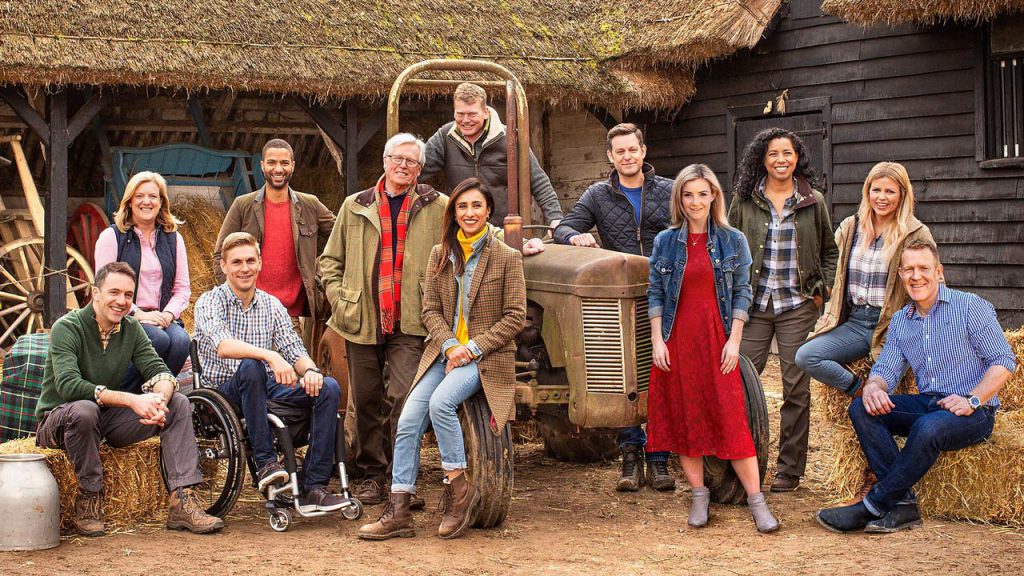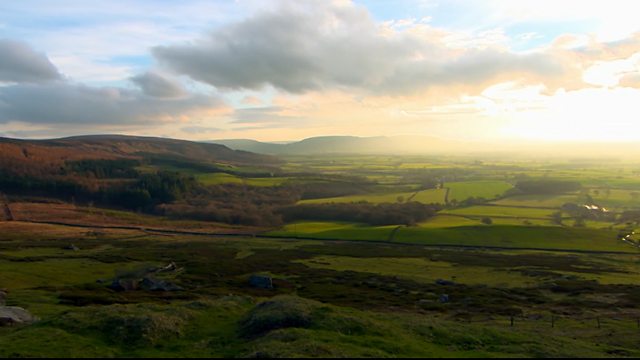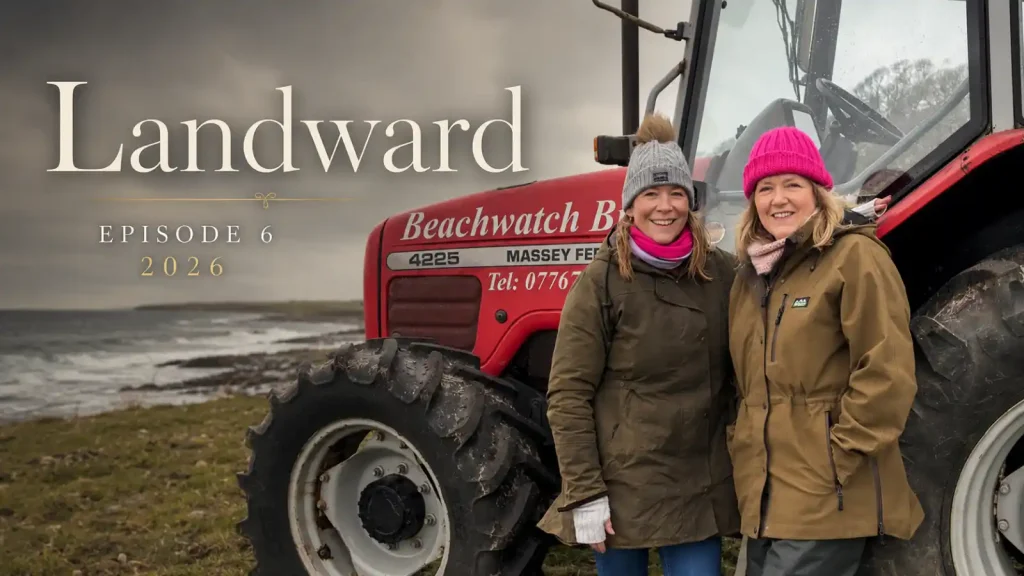
In Landward episode 6 2026, the team trades the Scottish mainland for something altogether more enchanting. Dougie, Arlene, and Shahbaz make their way to the Isle of Bute, a small but remarkable island cradled in the Firth of Clyde. Bute has long been called the jewel of those famous waters, and it is easy to understand why. Its landscapes shift from rugged coastline to gentle farmland almost without warning. Consequently, it offers a richness of story that few places in Scotland can match.
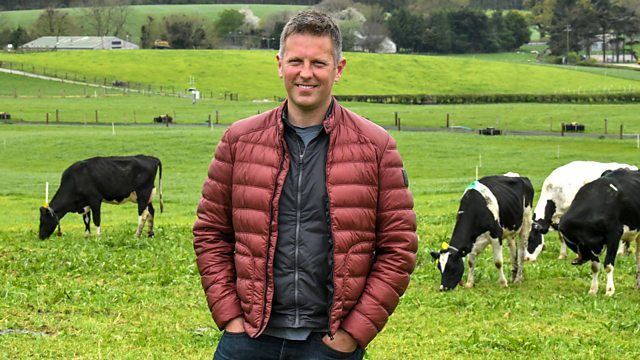
Dougie’s first port of call takes him deep into the world of island dairy farming. Like so many corners of Scottish agriculture, Bute’s farming community finds itself navigating uncertain waters. Another milk pricing crisis is casting a long shadow, and the farmers Dougie meets are digging in, staying resilient against pressures that feel relentless. Their story is one of quiet determination. Specifically, it speaks to a wider truth about agricultural life across Scotland — that the people who tend the land and the livestock do so out of deep commitment, not just economic calculation.
From the farmyard, Dougie moves to somewhere altogether more mysterious. The grounds of Mount Stuart House hold one of Bute’s most intriguing wildlife puzzles, and he arrives ready to investigate. Mount Stuart is a breathtaking Gothic mansion, a place where history and nature have intertwined for centuries. In other words, it is exactly the kind of setting where secrets feel at home. Whatever Bute’s wildlife mystery turns out to be, the grounds of this extraordinary house seem like the perfect place to unravel it.
Meanwhile, Arlene heads to Scalpsie Bay, where she joins someone locals might quite reasonably describe as a superhero. A dedicated beach ranger works tirelessly here, monitoring what the tides deliver to Bute’s shores. Country life along Scotland’s coast is never simple. The sea gives generously, but it also tells uncomfortable stories about pollution, marine debris, and the creeping consequences of climate change. Consequently, understanding what washes ashore has become genuinely important conservation work. Arlene rolls up her sleeves and dives in alongside this unsung guardian of the coastline.
Arlene’s day on Bute takes a warmer, more tender turn after the beach. She discovers a charming initiative connecting preschool children with the rhythms of farming life. These tiny visitors are getting their first real taste of agriculture — touching soil, meeting animals, learning where food comes from. It is a simple idea, but its importance runs deep. After all, a child who understands farming grows into an adult who values it. In many ways, moments like these are the seeds of Scotland’s agricultural future.
Shahbaz brings the episode’s most profoundly human story. He sits down with a Syrian family who fled the devastation of war and eventually found their footing on the Isle of Bute. Their journey from conflict to this quiet island in the Firth of Clyde is, frankly, extraordinary. Bute offered them something they desperately needed — welcome, stability, and the chance to build something new. Their story adds a layer of emotional depth to this episode that lingers long after the credits roll.
The farming threads running through this episode reflect a national conversation. Across Scotland, livestock farmers and dairy producers face a grinding combination of rising costs, volatile markets, and unpredictable weather patterns linked to climate change. Dougie’s visit to Bute’s dairy farmers puts a human face on those pressures. These are real people, not statistics. They wake before dawn, they worry about prices they cannot control, and they carry on regardless. Their resilience is, in truth, the backbone of Scottish country life.
The preschool farming initiative Arlene encounters speaks to a growing recognition within the agriculture sector. Connecting young children to farming early builds lasting respect for the land. Specifically, programmes like these help ensure that future generations understand where their food originates and why it matters. Furthermore, they remind rural communities that agricultural life is something worth celebrating and preserving. In Landward 2026, that message comes through clearly and warmly.
Landward episode 6 2026
The wildlife mystery at Mount Stuart House adds a satisfying layer of intrigue to this episode of Landward. Scotland’s natural environments are endlessly complex, and Bute is no exception. Its mix of woodland, farmland, and coastline supports a remarkable variety of species. Consequently, when something unusual occurs in that ecosystem, it deserves serious attention. Dougie’s investigation feels like a reminder that Scotland’s countryside rewards those who look closely.
Arlene’s work at Scalpsie Bay underlines just how much the coastline has to tell us. Beach rangers perform unglamorous but vital work, cataloguing what arrives on shore and reporting their findings to researchers and conservation bodies. Climate change is reshaping ocean patterns in ways that are only beginning to be fully understood. The shores of Bute, therefore, serve as a kind of living ledger — recording shifts that matter far beyond the island itself.
Landward episode 6 2026 is a love letter to the Isle of Bute and to the people who call it home. From dairy farmers steadying themselves against economic headwinds to a refugee family finding peace on a Scottish island, every story here is rooted in real human experience. The episode captures what Landward does best — celebrating Scotland’s agricultural heartland, its wild edges, and the extraordinary lives lived quietly within both.
Landward episode 6 2026 takes viewers to one of Scotland’s most quietly remarkable islands, a place where ancient woodland meets working farmland, where seals haul out on sandy bays, and where families from opposite ends of the world have found common ground. The Isle of Bute, sitting in the sheltered waters of the Firth of Clyde, is the destination for Dougie, Arlene, and Shahbaz as they fan out across the island to uncover stories of resilience, community, and the constant negotiation between nature and agriculture that defines country life in Scotland.
Bute is not a large island, but it carries an outsized significance in the story of Scottish farming and landscape. Its mild, oceanic climate has made it productive dairy country for generations, its coastline supports rich marine ecosystems, and its estates shelter some of the rarest wildlife found anywhere in the country. Yet the island, like so many rural Scottish communities, faces pressures that are neither simple nor easily resolved. Milk pricing volatility threatens the livelihoods of the farmers who have kept Bute’s agricultural tradition alive, while climate change is reshaping the ecological rhythms that residents and visitors have long taken for granted.
Landward episode 6 2026 review
The episode arrives at a moment when the relationship between rural communities and the wider economy is under particular scrutiny. Across Scotland, livestock farmers and dairy producers have been forced to adapt at speed, absorbing market shocks that originate far from their fields. Meanwhile, questions about what washes ashore on island coastlines, what wildlife inhabits island estates, and how island communities absorb and integrate newcomers are all live and urgent. Landward 2026 has consistently brought these themes into focus, and this episode continues that work with characteristic thoroughness.
Dougie Vipond anchors the farming content, visiting a dairy operation that is navigating the latest round of milk price instability with a combination of practical adjustment and hard-won stoicism. He also turns wildlife detective at the grounds of Mount Stuart House, where a mystery concerning one of Scotland’s most distinctive animals has been simmering for years.
Arlene Stewart, meanwhile, works the coastline, joining a beach ranger whose knowledge of what the sea deposits on Bute’s shores is both encyclopaedic and alarming. She also visits a project connecting preschool children to the rhythms of agricultural life. Shahbaz Hussain brings the episode’s most affecting strand, meeting a Syrian family who have made Bute their home after escaping conflict, and whose story speaks to the island’s capacity for welcome.
Together these strands build a portrait of Bute that is specific in its detail and broad in its resonance. The island becomes, across the course of the episode, a kind of lens through which larger questions about farming, ecology, community, and belonging can be examined without abstraction. These are not theoretical concerns but lived realities, felt in the price received for a tanker of milk, in the objects found at the tide line, in the laughter of children meeting farm animals for the first time, and in the quiet pride of a family that has rebuilt its life on a Scottish island far from the country it was forced to leave.
Landward episode 6 2026 is, in this sense, an episode about what islands make possible. Insularity is often framed as a limitation, but Bute’s story suggests something more complicated. The island’s relative self-containment has preserved farming practices, landscapes, and communities that might not have survived the homogenising pressures of mainland development. At the same time, its openness to the sea and to the people who arrive by ferry has kept it porous, alive to change, and capable of absorbing new perspectives without losing its essential character.
The episode moves with assurance between its different registers. Agriculture dominates the first movement, with Dougie’s dairy farm visit establishing the economic stakes clearly and without sentimentality. The wildlife strand at Mount Stuart adds a dimension of ecological inquiry. Arlene’s beach work introduces environmental concern and educational hope in roughly equal measure, and Shahbaz’s time with the Syrian family brings a human depth that lifts the whole episode beyond the merely pastoral. Scotland, country life, farming, and community are not just backdrop here; they are the actual subject.
What follows is a detailed account of everything Landward episode 6 2026 covers across its three strands, moving from the realities of dairy farming under pressure, through the mysteries of the island’s wildlife, the ecology of its shoreline, the education of its youngest residents, and the remarkable journey of a family that found a new life on a small island in the Clyde.
Landward Episode 6 2026 and the Reality of Dairy Farming on the Isle of Bute
Dougie’s first port of call on Bute is a dairy farm where the rhythms of agriculture continue regardless of what the milk market is doing. The farm runs a milking herd of around 120 cows, and the operation is firmly embedded in the practical traditions of Scottish livestock farming. Cows are milked twice daily, the land is managed for silage and grazing, and the entire enterprise depends on a price per litre that the farmer has no power to set.
The timing of Dougie’s visit is pointed. Another milk pricing crisis is developing, and the farmer explains the structural vulnerability that makes dairy particularly exposed. The price paid to producers bears little relationship to the cost of production, and when processors or retailers apply downward pressure, farmers absorb the loss with no mechanism for passing it on. The farmer describes the margin as wafer thin even in good times, and in bad times it disappears entirely.
Despite this, the farm continues. The farmer’s commitment to the land and the herd is evident, and there is no romantic gloss applied to it. This is work that demands early mornings, constant physical effort, and a tolerance for uncertainty that most occupations do not require. Dougie observes the milking process directly, and the conversation that accompanies it covers the practicalities of feed costs, veterinary expenses, and the logistics of getting milk off an island and into a supply chain that was not designed with island producers in mind.
The Structural Pressures Facing Island Agriculture in Scotland
The island dimension of Bute’s farming adds a layer of difficulty that mainland producers do not face. Transport costs are a constant overhead. Getting inputs to the island and outputs from it involves ferry crossings that add expense and logistical complexity. When milk prices fall, those transport costs become proportionally more damaging, because they represent a fixed burden that cannot be reduced through economies of scale.
The farmer on Bute is not alone in facing these pressures. The episode makes clear that this is a systemic issue affecting dairy farmers across Scotland, but the island context sharpens it. There is no easy pivot available. The land is suited to livestock farming, the infrastructure is built around it, and the alternative land uses available to a mainland farmer with proximity to urban markets simply do not exist in the same way on Bute. Agriculture here is both more exposed and more constrained.
Dougie’s conversation with the farmer touches on what resilience actually looks like in practice. It is not a grand gesture or a dramatic transformation of the business model. It is, instead, a patient and incremental set of adjustments: watching feed costs, timing purchases, managing the herd’s condition carefully, and maintaining the relationships with processors and co-operatives that provide at least some negotiating leverage. Country life in farming communities is often characterised by this kind of unglamorous persistence, and the Bute dairy farm illustrates it clearly.
The emotional weight of the farming strand comes not from crisis but from continuity. The farmer has kept the operation going through previous downturns, and the expectation is that this one will also be navigated. But the cumulative toll of repeated cycles of pressure is visible, and Dougie’s questions draw it out without sensationalism. Landward 2026 handles this with the respect it deserves.
Mount Stuart and the Wildlife Mystery at the Heart of Landward Episode 6 2026
The grounds of Mount Stuart House provide the setting for one of the most intriguing segments in Landward episode 6 2026. Mount Stuart is a Victorian Gothic mansion of extraordinary ambition, set within extensive grounds that include ancient woodland, formal gardens, and wilder areas of scrub and grassland. It is one of the most architecturally significant buildings in Scotland, but Dougie is not here for the architecture. He is here for a wildlife mystery.
The mystery centres on red squirrels. Bute is unusual in Scotland in that it has a red squirrel population without the grey squirrel invasion that has devastated reds across most of the country. Grey squirrels, introduced from North America, carry a poxvirus that is fatal to reds but causes them no harm, and they also outcompete reds for food resources. On mainland Scotland this dynamic has pushed red squirrels into a contracting range in the north and west. But on Bute, greys have never established, and reds have survived.
The mystery is not simply that the reds are there, but concerns the specifics of their population dynamics, distribution, and the pressures they face on an island where their usual enemy is absent. Dougie meets with someone closely involved in monitoring the squirrel population, and the conversation covers the methods used to track the animals, the challenges of surveying woodland habitat, and what the data reveals about the health of the Bute population. The Mount Stuart grounds, with their mature woodland, provide exactly the kind of habitat that red squirrels require, and the estate has been an important refuge.
Squirrel Conservation and the Significance of Island Populations
The absence of grey squirrels on Bute is not simply good fortune; it is the result of geographic isolation and active vigilance. The island’s separation from the mainland means that natural colonisation by greys is unlikely, but the risk of accidental introduction remains real. A single grey squirrel arriving on the island could, if it established and bred, begin a process that has proved irreversible elsewhere in Scotland. The monitoring work at Mount Stuart and across the island is therefore preventive as much as it is scientific.
The red squirrel population on Bute represents something significant in the broader context of Scottish wildlife conservation. Island populations of species that are under pressure on the mainland serve as reservoirs of genetic diversity and as potential sources for reintroduction programmes if mainland recovery ever becomes feasible at scale. Protecting the Bute population is not simply about one island’s ecology; it connects to the long-term prospects for the species in Scotland.
Dougie’s engagement with this subject is characteristically enthusiastic. He climbs, crouches, and peers into woodland with evident enjoyment, and his genuine interest in the conservation context gives the segment a warmth that goes beyond the informational. Landward 2026 has consistently found ways to make wildlife science accessible without oversimplifying it, and the Mount Stuart segment is a good example of that approach. The mystery of the squirrels, once unpacked, reveals a story about island ecology, conservation strategy, and the fragile relationship between species and landscape.
Arlene Stewart’s Work with the Scalpsie Bay Beach Ranger
Arlene’s contribution to Landward episode 6 2026 begins at Scalpsie Bay on the western side of Bute, a bay known for its seal colony and its views across the Firth of Clyde towards the Kintyre peninsula. She is joined by a beach ranger who has been given the informal but telling title of superhero by the local community, a designation that reflects both the breadth of the ranger’s responsibilities and the affection in which the role is held.
The beach ranger’s work covers everything that arrives on the shore. Some of it is welcome: the natural detritus of the sea, the stranded organisms that tell stories about ocean currents and seasonal patterns, the occasional remarkable find that adds to the scientific understanding of what lives in the Clyde. Much of it is not welcome at all. Plastic pollution arrives on Bute’s beaches in quantities that the ranger catalogues with careful attention, and the data gathered from this monitoring work feeds into wider efforts to understand how marine debris moves through Scottish coastal systems.
Arlene’s participation in the beach survey is practical and engaged. She walks the tideline with the ranger, examines what has been deposited, and asks questions that draw out the ranger’s expertise. The range of materials found is striking. Alongside the expected plastic bottles and fishing gear, the survey turns up items whose origins are genuinely puzzling, objects that have travelled distances difficult to comprehend and that arrive on this Scottish island shore having passed through multiple ocean systems.
The Environmental Significance of Bute’s Coastline and Marine Ecology
Scalpsie Bay is not simply a picturesque location; it is an ecologically significant site within the broader context of Firth of Clyde marine conservation. The seals that haul out on its rocks are common seals, and their presence is an indicator of the bay’s productivity and relative freedom from disturbance. The beach ranger’s work protects this environment directly, by managing human access, removing debris, and monitoring the condition of both the physical beach and its wildlife.
The Firth of Clyde has a complex environmental history. Once among the most productive sea lochs in Europe, its fish stocks collapsed in the twentieth century due to a combination of overfishing and habitat degradation. Recovery has been slow and uneven. The marine environment around Bute reflects this history, and the work done by rangers and conservation organisations on the island sits within a broader story of attempted restoration and management.
Climate change is altering the conditions of the Clyde in ways that are still being understood. Water temperatures are rising, which affects the species composition of the inshore environment and the timing of seasonal events. Arlene’s conversation with the ranger touches on these changes, and the ranger’s long experience of the bay provides a perspective that goes beyond the purely scientific. The ranger has watched the beach change over years, and the changes observed are consistent with the trends that researchers are documenting across Scottish coastal systems.
The plastic pollution dimension of the beach survey connects Bute’s local experience to a global problem. Scotland, farming, livestock management, and agricultural runoff all contribute to the coastal pollution picture, but the marine plastic arriving on Bute’s beaches comes from sources far beyond Scotland’s borders. The ranger’s work is therefore both local in its execution and global in its context, a combination that Arlene captures effectively in her reporting.
Preschool Children and Their First Experience of Agricultural Life
The second strand of Arlene’s episode takes her inland to a project that is introducing preschool children to farming and agriculture. The project works with very young children, bringing them into contact with farm animals and the basic rhythms of agricultural life in a structured but playful way. The aim is to give children who might otherwise have no connection to farming an early and positive experience of it.
The children’s responses are captured with evident delight. Encountering animals at close quarters for the first time produces reactions ranging from cautious fascination to outright joy, and the educational value of the experience is framed not in terms of formal learning but in terms of sensory engagement and the development of confidence. Children who touch, feed, and observe farm animals are engaging with country life in a direct and embodied way that no classroom equivalent can replicate.
The project connects to wider concerns about the disconnection between the food that people eat and the agricultural systems that produce it. Children growing up in urban or suburban environments may have little or no awareness of where their food comes from or what farming involves. Early experiences of this kind are intended to begin building that understanding at an age when curiosity is at its most open and impressions are at their most lasting.
The farmers and educators involved in the project speak about it with obvious commitment. They see the work as both practically valuable, in building appreciation for agriculture and the people who practice it, and socially important, in fostering a relationship between the next generation and the land. In the context of Landward episode 6 2026’s broader themes, this segment provides a note of hope: the children encountering Bute’s farming life today may be its most important advocates in twenty years.
Landward Episode 6 2026 and the Story of a Syrian Family’s New Life on Bute
Shahbaz’s contribution to Landward episode 6 2026 is the episode’s most emotionally resonant strand. He meets a Syrian family who fled the conflict in their home country and were resettled on the Isle of Bute through Scotland’s refugee support programmes. Their experience of the island, the welcome they received, and the life they have built there is told with candour and warmth.
The family’s journey to Bute was not, by any straightforward logic, an obvious destination. A small island in the Firth of Clyde, with a population of around six thousand people, is a long way in every sense from urban Syria. Yet the family describe their arrival and reception in terms that make the connection feel both surprising and entirely natural. The community on Bute extended a welcome that was practical, sustained, and genuine, and the family found in island life a stability and safety that they had not experienced for years.
Shahbaz’s conversation with the family covers the practicalities of daily life on Bute: the work they have found, the businesses some have started, the education their children are receiving, and the social connections they have built with islanders who were initially strangers. The island’s scale, which might seem limiting, has in practice been an advantage. A small community means that faces become familiar quickly, that help is offered and received without formality, and that belonging can be established at a human pace.
Community, Belonging, and Opportunity on the Isle of Bute
The Syrian family’s story raises questions about what makes integration successful and what island communities can offer that larger, more anonymous environments cannot. On Bute, the family have found that their presence is noticed and valued. They have become part of the community’s fabric in ways that reflect both their own effort and the island’s genuine openness.
One family member has established a business that brings elements of Syrian food culture to Bute, an enterprise that has been received with enthusiasm by islanders. This is not simply a commercial venture; it is an act of cultural sharing that has enriched the island’s life while providing the family with both income and a sense of purpose. The business has become a meeting point where Syrian and Scottish food traditions intersect, and where the family’s identity is expressed and celebrated rather than suppressed or marginalised.
Shahbaz handles this material with sensitivity and without condescension. He is interested in the family’s experience as they describe it, not as it might be expected to be. The result is a portrait of integration that is honest about its difficulties while affirming its possibilities. Country life on a Scottish island, it turns out, can accommodate and be enriched by people whose backgrounds could not be more different from the island’s own traditions.
The family’s relationship to Scotland and to Bute is still being formed. They carry the memory of Syria with them, and they speak about their home country with love and grief in equal measure. But they have also built something new, and their children, growing up on Bute, are developing identities that are rooted in the island even as they remain connected to a heritage that the island itself has had to learn about. Landward episode 6 2026 gives this complexity its proper weight.
Landward Episode 6 2026 as a Portrait of Island Resilience and Rural Scotland
The Isle of Bute that emerges from Landward episode 6 2026 is neither a postcard nor a problem. It is a working landscape, inhabited by people who are navigating real pressures with practical intelligence and community support. The dairy farmers facing another milk pricing crisis, the conservationists protecting red squirrels, the beach ranger cataloguing what the sea deposits, the educators connecting children to agricultural life, and the Syrian family building their future on an island shore: all of these stories share a common thread of resilience without romanticism.
Scotland’s rural communities face challenges that are structural, environmental, and demographic. Farming margins are thin, young people are drawn to cities, climate change is altering the physical landscape, and the skills and knowledge that make rural life work are always at risk of being lost. Landward 2026 has, across its run, documented these challenges honestly while also attending to the creativity and determination with which communities respond to them.
Bute, specifically, illustrates something important about the relationship between insularity and resilience. The island’s separation from the mainland has preserved things that might otherwise have been lost: red squirrels, a distinctive farming culture, a community small enough to know itself. At the same time, that separation has created vulnerabilities, in the form of transport costs and limited economic diversification, that make every external shock more damaging. The episode holds both of these truths simultaneously, which is precisely what good reporting about country life in Scotland requires.
Livestock farming, agriculture, and the communities that sustain them are not relics; they are living systems that require active support, intelligent policy, and public understanding. The children meeting farm animals at a Bute preschool project are being given the beginning of that understanding, and the Syrian family running a food business on the island are demonstrating that rural Scotland’s future can be built by people who came to it from elsewhere. Landward episode 6 2026 makes the case, through specific and grounded storytelling, that the Isle of Bute and places like it are worth understanding, worth supporting, and worth celebrating without sentimentality.
FAQ Landward episode 6 2026
Q: What does Landward episode 6 2026 cover on the Isle of Bute?
A: Landward episode 6 2026 explores life on the Isle of Bute in the Firth of Clyde. Presenters Dougie, Arlene, and Shahbaz investigate dairy farming pressures, red squirrel conservation at Mount Stuart, coastal pollution at Scalpsie Bay, preschool farming education, and the story of a Syrian family who rebuilt their life on the island.
Q: What challenges do dairy farmers on the Isle of Bute face?
A: Bute’s dairy farmers face a difficult combination of low milk prices and high island transport costs. Farmers operating herds of around 120 cows receive a price per litre they cannot control. Furthermore, ferry costs for moving inputs onto the island and products off it add a fixed financial burden that squeezes already thin margins during pricing downturns.
Q: Why are red squirrels significant on the Isle of Bute?
A: Bute is one of the few places in Scotland where red squirrels survive without pressure from grey squirrels. Grey squirrels, introduced from North America, carry a poxvirus fatal to reds and outcompete them for food. However, Bute’s island isolation has prevented grey squirrel colonisation, making its red squirrel population a vital conservation reservoir for the species.
Q: What wildlife mystery does Dougie investigate at Mount Stuart House?
A: Dougie examines the population dynamics of red squirrels in the mature woodland surrounding Mount Stuart House. Conservationists monitor the squirrels’ distribution and health using survey techniques suited to dense woodland habitat. Additionally, the investigation considers the ongoing risk of accidental grey squirrel introduction to the island, which remains the greatest threat to Bute’s red squirrel population.
Q: What does the Scalpsie Bay beach ranger do on the Isle of Bute?
A: The Scalpsie Bay beach ranger monitors and manages one of Bute’s most ecologically important coastlines. Responsibilities include cataloguing marine plastic pollution, protecting the local common seal colony, and recording natural material deposited by tides. The ranger’s data contributes to broader understanding of how debris moves through Scottish coastal systems. Arlene joins a hands-on tideline survey during her visit.
Q: How does plastic pollution affect Bute’s beaches?
A: Marine plastic arrives on Bute’s shores from sources far beyond Scotland’s borders, carried by ocean currents through multiple sea systems. Items found include fishing gear, bottles, and objects of puzzling distant origin. The beach ranger systematically records these finds, building a picture of pollution patterns that connects local environmental conditions to global marine debris problems affecting coastlines worldwide.
Q: What is the preschool farming project featured in Landward episode 6 2026?
A: The project introduces very young children to farm animals and basic agricultural rhythms through structured, playful sessions. Children with no prior connection to farming engage directly with livestock, building sensory confidence and early awareness of where food originates. Organisers view these experiences as essential for fostering long-term appreciation of agriculture among generations growing up increasingly disconnected from rural and country life.
Q: How did the Syrian family featured in Landward 2026 come to live on Bute?
A: The family fled conflict in Syria and were resettled on the Isle of Bute through Scotland’s refugee support programmes. Despite the island’s small scale seeming an unlikely destination, the community’s sustained and practical welcome helped the family establish stability quickly. Shahbaz speaks with them about work, education, and the social connections they have built with islanders since their arrival.
Q: What business has the Syrian family established on the Isle of Bute?
A: A family member has launched a food business bringing Syrian culinary traditions to Bute, which islanders have received with genuine enthusiasm. The enterprise creates income and a meaningful sense of purpose. Furthermore, it functions as a cultural meeting point where Syrian and Scottish food traditions intersect, enriching island life while allowing the family to express and share their identity with the wider community.
Q: What broader themes does Landward episode 6 2026 explore through the Isle of Bute?
A: The episode examines resilience, community, and the pressures shaping rural Scotland today. Through dairy farming instability, wildlife conservation, coastal ecology, and refugee integration, Bute becomes a lens for understanding how island communities absorb external shocks while preserving distinctive landscapes and traditions. Landward episode 6 2026 demonstrates that Scotland’s agricultural and rural communities require active public understanding and sustained policy support to thrive.