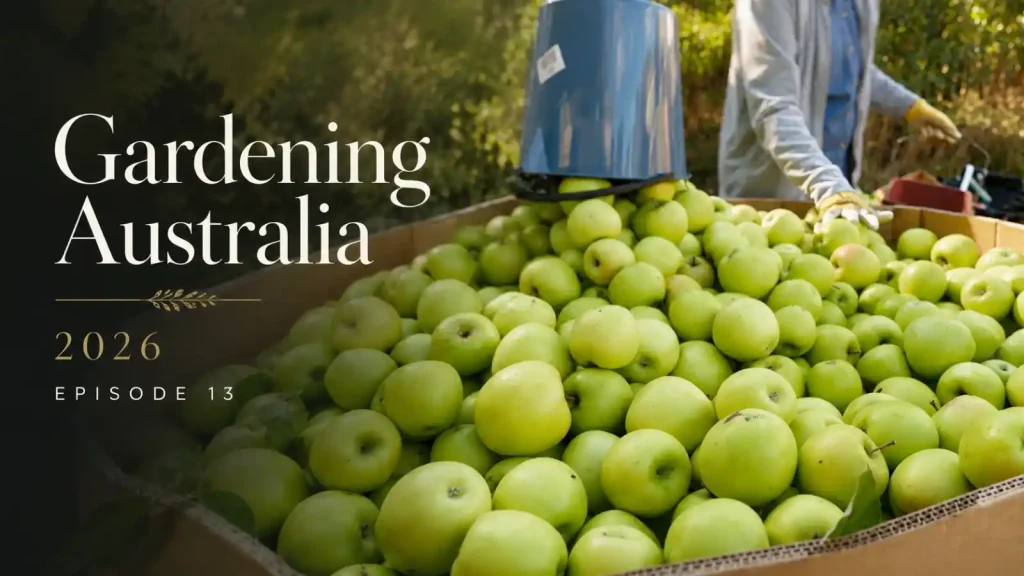
Gardening Australia 2026 Episode 13: autumn transforms the garden from a place of summer productivity into something altogether more contemplative, more richly coloured, and more instructive about the cycles that underpin all living things. This episode moves across an extraordinary range of subjects and locations, from a century-old garden in regional Victoria dripping with history and rare trees, to a grassland restoration project in Tasmania’s Midlands that challenges conventional thinking about what a healed landscape should look like.
Along the way, viewers encounter the precision of begonia cultivation, the communal energy of fruit rescue volunteering, and the meditative craft of building a miniature crevice garden from scratch. Together, these stories form a portrait of Australian gardening in its most expansive and generous sense.
Autumn is, in many ways, the season that most rewards the attentive gardener. The rush of planting and harvesting that defines spring and summer gives way to something slower and more considered. Foliage colours deepen, seed heads harden, and the structure of a garden becomes visible in ways that dense summer growth obscures. For practitioners of gardening Australia-wide, this is also a period of reflection, of asking which plants have earned their place and which approaches deserve to continue into the following year. This episode captures that reflective quality beautifully, moving between subjects that each, in different ways, ask what it means to tend a living system with genuine care.
The episode opens in the garden of Cloudehill in the Dandenong Ranges, a place that Costa visits with unmistakeable reverence. Cloudehill is not merely a garden but a living document of design philosophy, horticultural ambition, and generational continuity. Its iconic foliage, displayed in extraordinary autumn colour at the time of filming, frames a broader conversation about what enduring gardens require and what they ultimately offer to those who tend them and those who visit. The garden draws together garden design at its most considered and diy gardening impulses that any home grower might recognise, even within a setting of considerable scale and sophistication.
From that foundation, the episode branches outward into community action, scientific restoration, horticultural education, and hands-on construction. Sophie Thomson visits a fruit rescue operation in South Australia, joining a team of volunteers who harvest fruit that would otherwise be wasted and redirect it toward people who need it most. Jerry Coleby-Williams delivers a masterclass in begonia cultivation that is simultaneously practical and taxonomically rich.
Millie Ross constructs a crevice garden in a small courtyard, demonstrating that garden design need not require large space or large budgets. And in Tasmania, an ecologist works to restore the Midlands’ native grasslands to something approaching their pre-European condition. These threads are distinct but they share a common undertone: that Australian gardening, at its best, is an act of relationship with place, community, and ecological responsibility.
The breadth of this episode reflects a long-standing strength of the programme, which has always treated gardening not as a narrow domestic pursuit but as a window onto ecology, food systems, cultural history, and human creativity. Native plants appear not as a category of specialist interest but as the foundation of entire restoration efforts. Garden hacks and practical technique sit comfortably alongside deeper discussions of soil biology and landscape history. For viewers across the country, the episode offers both inspiration and instruction in equal measure.
What makes this particular episode of gardening Australia especially compelling is the way each segment draws out a different timescale. The begonia grower measures success in weeks and seasons. The Cloudehill garden carries the decisions of gardeners who worked there a century ago. The Tasmanian grassland restoration operates on an ecological timescale that stretches back before European settlement and forward toward a future that may take decades to fully materialise. Against all of these, the fruit rescue volunteers work on the most immediate of timescales, responding to abundance before it becomes waste. The interplay of these different rhythms gives the episode unusual depth and range.
Gardening Australia 2026 Episode 13 is also, in practical terms, one of the more instructionally dense episodes of the current series. Jerry’s begonia segment alone covers taxonomy, soil preparation, potting mix composition, propagation technique, and pest management. Millie’s crevice garden tutorial walks through stone selection, placement logic, soil preparation, and plant choice with a level of detail that viewers can readily apply at home. The fruit rescue segment raises questions about garden surplus and food sharing that many home growers find immediately relevant. Across all of these, the episode treats its audience as capable, curious, and ready to learn.
As autumn deepens across Australia and gardeners turn their attention to what the cooler months demand and offer, this episode functions as both a guide and a provocation. It asks viewers to look at their own gardens with fresh eyes, to consider what is wasted and what might be shared, to think about the ecological history beneath their feet, and to attend to the specific needs of the plants in their care. With those themes in mind, it is worth moving through each major segment in detail.
Gardening Australia 2026 Episode 13
Cloudehill and the Gardening Australia 2026 Episode 13 Visit to an Iconic Autumn Garden
Cloudehill, set in the Dandenong Ranges outside Melbourne, is one of the most significant private gardens open to the public in Australia. Costa’s visit reveals a garden of exceptional character, shaped by decades of committed planting and a design philosophy that prizes structure, seasonal change, and horticultural depth. The garden was originally established by the Woolrich family, who operated a nursery on the site for much of the twentieth century. Its current form reflects layers of influence and intention that no single season can fully reveal, but autumn comes closest to exposing its full complexity.
The foliage colour at Cloudehill in autumn is remarkable. Maples, liquidambars, cherries, and a range of other deciduous trees create a shifting spectrum of amber, crimson, gold, and rust that moves through different areas of the garden at different rates. Costa notes that the timing of colour in each tree depends on species, microclimate, and the specific conditions of that particular growing season. This variability is not a flaw in the design but a feature, ensuring that the garden rewards repeated visits and that no two autumns look identical.
Costa speaks with the garden’s current steward about the challenges and rewards of maintaining a garden at this scale. The conversation touches on the labour required to manage large deciduous trees responsibly, the way leaf fall must be managed without stripping the garden of the organic matter it needs, and the ongoing decisions about which plants to retain, which to remove, and which new introductions might serve the garden’s long-term vision. These are fundamentally the same questions any diy gardening practitioner faces, scaled up but not categorically different in nature.
The garden design at Cloudehill relies heavily on structural planting, with hedges, topiary, and defined garden rooms creating a framework within which seasonal colour and texture operate. In autumn, when deciduous trees shed their leaves, this underlying architecture becomes clearly visible. The bones of the garden — its paths, walls, levels, and permanent plantings — reveal themselves as the ornamental layers fall away. Costa uses this moment to reflect on the value of structural thinking in any garden, regardless of size or style.
Fruit Rescue Volunteering and Community Gardening in Gardening Australia 2026 Episode 13
Sophie Thomson joins Sustainable Communities in South Australia for a morning of fruit rescue, a practice that involves harvesting fruit from trees whose owners either cannot or do not wish to pick the crop themselves. The fruit is then distributed to community organisations, food banks, and individuals who need it. The operation Sophie visits is well-organised, with regular volunteer teams working through neighbourhoods systematically, contacting homeowners, harvesting at the right moment, and ensuring nothing goes to waste.
The scale of surplus that urban fruit trees generate is striking. A single mature lemon tree, Sophie learns, can produce far more fruit than any household can use. Across a suburb full of lemon trees, stone fruit trees, citrus of various kinds, and backyard fig trees, the collective surplus runs to tonnes of fresh produce each year. Much of this has historically gone unpicked and eventually to waste. The fruit rescue model interrupts that cycle, treating the backyard garden not as a private resource but as a potential contributor to a broader food network.
For many participants, fruit rescue is also an introduction to the productive potential of Australian gardening. Volunteers who may not garden themselves learn to identify fruit at peak ripeness, to handle it carefully during harvest, and to appreciate the seasonal rhythms that determine when different varieties are ready. Sophie picks alongside volunteers of various ages and backgrounds, all of whom express a sense of purpose and connection that extends well beyond the physical act of picking fruit.
The segment raises an important point about garden surplus more broadly. Many home gardeners in Australia grow more than they can consume, particularly in seasons of abundance. The impulse to share that surplus — with neighbours, local organisations, or community food networks — is a natural extension of the generosity that characterises much of gardening culture. Fruit rescue formalises and scales that impulse, connecting individual garden productivity to genuine community need.
Jerry Coleby-Williams on Begonias: Taxonomy, Cultivation, and Garden Hacks
Jerry Coleby-Williams is one of the most knowledgeable horticultural communicators in Australia, and his begonia segment in Gardening Australia 2026 Episode 13 is among his most detailed and instructive contributions to the programme. Jerry approaches begonias with the enthusiasm of a genuine collector and the rigour of a trained botanist, making his explanations both accessible and substantially more precise than most popular coverage of this plant family.
Begonias constitute an enormous genus, with well over two thousand recognised species and thousands more cultivars. Jerry organises this complexity by drawing attention to the three main groups that gardeners in Australia are most likely to encounter: fibrous-rooted begonias, rhizomatous begonias, and tuberous begonias. Each group has distinct cultural requirements, different seasonal behaviour, and different strengths as garden or container plants. Understanding which group a particular begonia belongs to is, Jerry argues, the single most useful piece of knowledge a grower can have.
Tuberous begonias, the focus of much of Jerry’s discussion, are particularly relevant to autumn. As temperatures begin to drop, tuberous types signal the end of their growing season through changes in their foliage and stem condition. Jerry describes the signs to watch for and explains the process of lifting tubers after the first cold snap reduces the plant’s vigour. The tubers must then be dried carefully, inspected for rot or damage, and stored in a cool, dry, frost-free location until they are ready to be started again in spring.
Propagation is an area where Jerry offers particularly practical advice. Stem cuttings are the simplest method for most begonia types, and Jerry walks through the process in detail: selecting a healthy stem with at least two nodes, cutting cleanly below a node, removing lower leaves, and placing the cutting into a well-drained propagating mix. He recommends keeping cuttings in warm, humid conditions out of direct sun until rooting occurs. Leaf cuttings work for rhizomatous types, with entire leaves pinned to a propagating medium or wedged vertically into it, eventually producing plantlets at the base of the leaf stalk. These garden hacks give viewers concrete, tested methods they can apply immediately.
Jerry also addresses common problems that begonia growers encounter. Powdery mildew is one of the most frequent issues, favoured by warm days, cool nights, and still air — conditions common across much of Australia in autumn. He recommends improving air circulation as the primary preventive measure, choosing resistant varieties where possible, and using approved organic fungicide sprays if the problem persists. Overwatering is another significant risk, particularly for tuberous types in containers. Jerry’s advice is direct: allow the growing medium to dry slightly between waterings, and always use containers with adequate drainage.
Millie’s Crevice Garden: Garden Design at a Miniature Scale
Millie Ross’s crevice garden segment is one of the most practically instructive portions of Gardening Australia 2026 Episode 13. Working in a small courtyard space, Millie builds a crevice garden from the ground up, demonstrating at each stage what decisions are being made and why. The result is a compact, visually striking planting that draws on alpine garden traditions but adapts them to an Australian setting and scale that most urban gardeners will find entirely achievable.
A crevice garden is fundamentally a constructed rock feature in which plants grow in the narrow gaps between stones rather than in conventional open soil. The aesthetic draws on natural rocky outcrops and cliff faces where specialist plants colonise the smallest available pockets of growing medium. In garden design terms, it offers excellent drainage, effective use of vertical space, and an opportunity to grow plants that would struggle in richer, moister soil conditions. Native plants from rocky or exposed habitats are particularly well-suited to this environment.
Millie begins by selecting her stones, explaining that irregular, flat-sided rocks work best because they can be placed on edge to create the deep, narrow crevices that the chosen plants will occupy. The stones need not be matching in colour or type, but consistency of scale helps produce a coherent visual result. She embeds each stone firmly into a base layer of gritty soil, angling them slightly so that rainwater is directed inward toward the root zones rather than running off the surface. This detail is crucial to the long-term success of the planting.
The growing medium Millie prepares for the crevices is intentionally lean: a mix of coarse sand, fine gravel, and a small proportion of good quality potting mix. This composition ensures drainage is never compromised while still providing sufficient nutrient and moisture retention for small, adapted plants. She notes that the common error in crevice gardening is making the mix too rich, which encourages soft growth that is vulnerable to rot and disease. Restraint in soil preparation is, counterintuitively, what allows the plants to thrive.
Plant selection for the finished crevice garden includes a range of low-growing natives, small sedums, and alpine-type plants suited to sharp drainage and bright light. Millie chooses species that contrast in texture and form, placing fine-leafed or grass-like plants beside rosette-forming types to create visual interest at very close range. This is diy gardening at its most deliberate and precise, and the result demonstrates convincingly that even a very small outdoor space can support genuinely sophisticated garden design.
Ecological Restoration in Tasmania’s Midlands: Native Plants and Landscape Recovery
The Tasmanian segment of Gardening Australia 2026 Episode 13 takes the programme into territory that is less immediately practical for home gardeners but perhaps more intellectually arresting than anything else in the episode. An ecologist working in the Tasmanian Midlands describes a long-term project to restore native grassland vegetation to an area that has been significantly altered by European agricultural practice over the past two centuries. The project is patient, methodical, and guided by a detailed understanding of what the Midlands landscape looked like before colonial settlement.
The Tasmanian Midlands occupy a dry, relatively low-rainfall corridor in the interior of the island. Before European settlement, this region supported distinctive native grassland communities dominated by kangaroo grass and a rich diversity of associated forbs, sedges, and geophytes. These grasslands were maintained partly by Indigenous burning practices and partly by the grazing of native herbivores, particularly wallabies and kangaroos. European agriculture disrupted both of these dynamics, replacing native vegetation with introduced pasture species and eliminating the fire regime that had shaped the landscape for millennia.
The restoration work described in the segment involves removing introduced pasture grasses, reintroducing native seed collected from local remnant populations, and managing grazing pressure carefully while the native vegetation reestablishes. This is painstaking work, requiring years of commitment before results become clearly visible. The ecologist is clear that there is no shortcut: native plants from appropriate local provenance must be used, and the conditions that allowed them to thrive originally must be at least partially reinstated.
One of the most striking aspects of this project is the emphasis on local genetic provenance. Native plants used in restoration work should ideally come from seed collected within the same region, because local populations are genetically adapted to local conditions of soil, climate, and seasonal pattern. Using plants from distant populations, even of the same species, risks introducing genetic material that is not locally adapted and may reduce the resilience of the restored community. This principle has significant implications for Australian gardening more broadly, wherever native plants are used in garden or landscape settings.
The ecological work also highlights the role that private landholders play in landscape-scale restoration. Many of the most significant remnant grassland patches in the Midlands survive on private farmland, protected by the stewardship of individual farmers who recognise their value. Connecting these remnants through restored corridors is a central goal of the project, and it depends entirely on voluntary cooperation from landholders across the region. The ecologist describes this collaborative dimension of the work as both its greatest challenge and its greatest source of optimism.
Autumn Planting and Soil Preparation Across Gardening Australia 2026 Episode 13
Throughout the episode, advice about autumn practice recurs in multiple segments and from multiple presenters, collectively forming a coherent picture of what this season demands from Australian gardeners. Autumn is, in climatic terms, one of the most variable seasons across the continent, ranging from the mild, dry conditions of coastal southern Australia to the still-warm, humid air of subtropical Queensland. Gardening Australia has always been alert to this regional diversity, and this episode reflects it in the range of plants and techniques covered.
Soil preparation is a recurring theme. In the crevice garden segment, Millie emphasises the importance of a well-drained, lean growing medium. In the begonia segment, Jerry discusses appropriate potting mixes for container-grown plants and the risks of poorly draining soil in cool weather. In the Cloudehill visit, the management of leaf fall as an organic resource reflects a broader principle: autumn is the season to invest in soil organic matter, adding compost, leaf mould, and mulch while soil temperatures are still warm enough to support the microbial activity that converts these materials into plant-available nutrients.
Planting in autumn offers substantial advantages over spring planting for many garden types. Trees and shrubs planted in autumn have the entire cool season to establish root systems without the stress of summer heat. Perennials planted now will settle in, develop root structure, and be ready to grow vigorously from the first warm days of spring. Bulbs planted in autumn — a category that includes many of the most rewarding spring-flowering plants — need the cold period ahead to trigger their flowering mechanism. Gardening Australia 2026 Episode 13 implicitly endorses autumn planting at every turn, not through direct exhortation but through the practical choices its presenters make and describe.
Garden hacks appropriate to the season appear in various forms throughout the episode. Jerry’s advice on begonia propagation is immediately actionable for anyone with a plant ready to divide. Millie’s crevice garden tutorial offers a technique that transforms an underused corner of a courtyard into a productive and beautiful space at relatively modest cost. The fruit rescue segment provides a model for thinking about surplus produce that any gardener with a productive tree or vegetable plot can adapt at the scale of their own neighbourhood.
Costa’s Reflections and the Broader Philosophy of Gardening Australia 2026 Episode 13
Costa Georgiadis brings to Cloudehill not just his characteristic enthusiasm but a genuine appreciation for what a mature, historically layered garden reveals about the long game of horticulture. His visit is as much philosophical meditation as practical tour. He returns repeatedly to the idea that a great garden is a conversation between present stewards and past gardeners, an ongoing negotiation between vision and reality, ambition and constraint.
The iconic foliage of Cloudehill in autumn prompts a reflection on impermanence that runs quietly through the whole episode. Autumn colour is by definition transient — it is most vivid in the moment before it is lost. The leaf that blazes crimson today will fall and decay, becoming the soil amendment that feeds next year’s growth. This cycle is not merely poetic; it is the biological engine of the deciduous garden, and Costa treats it with the seriousness it deserves.
The diversity of this episode of Gardening Australia 2026 is itself a form of argument, suggesting that the healthiest relationship with gardening is a broad one. Knowing how to propagate a begonia, how to build a crevice garden, how to think about grassland ecology, and how to connect one’s own garden surplus to community food systems are not competing preoccupations but complementary dimensions of a single engaged practice. Costa’s visit to Cloudehill anchors all of this, offering a reminder that the deepest rewards of Australian gardening are reserved for those who commit to the long view.
The episode ends, as the best episodes of this programme do, with the viewer left not with a checklist but with a changed perspective. The native plants being coaxed back into the Tasmanian Midlands, the begonia tubers being carefully dried and stored for spring, the fruit moving from backyard tree to community table, and the stones being embedded one by one into Millie’s courtyard crevice garden are all expressions of the same patient, generous, ecologically literate sensibility that has always defined Gardening Australia at its finest. In episode 13, that sensibility finds its most articulate autumn expression.
FAQ Gardening Australia 2026 Episode 13
Q: What iconic garden does Costa visit in Gardening Australia 2026 Episode 13?
A: Costa visits Cloudehill in the Dandenong Ranges, one of Australia’s most significant historic gardens. Originally established by the Woolrich family as a nursery, the garden features extraordinary autumn foliage from maples, liquidambars, and cherries. Its structured design uses hedges, topiary, and defined garden rooms to create a framework that becomes especially visible as deciduous leaves fall in autumn.
Q: What is fruit rescue, and how does Sophie Thomson get involved in Gardening Australia 2026 Episode 13?
A: Fruit rescue involves harvesting surplus fruit from private trees that owners cannot pick themselves, then redirecting it to food banks and community organisations. Sophie joins Sustainable Communities in South Australia, working alongside volunteers of various ages and backgrounds. A single mature lemon tree can produce far more fruit than one household uses, so the programme channels that abundance toward genuine community need rather than letting it go to waste.
Q: What are the three main begonia groups Jerry Coleby-Williams explains in Gardening Australia 2026 Episode 13?
A: Jerry identifies fibrous-rooted, rhizomatous, and tuberous begonias as the three primary groups Australian gardeners encounter. Each group has distinct cultural requirements and seasonal behaviour. Understanding which group a plant belongs to is, according to Jerry, the single most useful piece of knowledge a grower can possess, as it determines watering habits, propagation method, and how the plant should be managed as temperatures drop in autumn.
Q: How should tuberous begonias be stored over winter after their growing season ends?
A: Jerry advises watching for reduced vigour and foliage changes as autumn cooling signals the end of the growing season. Once the first cold snap reduces plant energy, lift the tubers carefully from the soil or container. Dry them thoroughly, inspect each one for rot or damage, and then store them in a cool, dry, frost-free location. They can be restarted in spring when temperatures begin to rise again.
Q: What propagation techniques for begonias does Jerry recommend in this episode?
A: Jerry recommends stem cuttings as the simplest method for most begonia types. Select a healthy stem with at least two nodes, cut cleanly below a node, remove lower leaves, and place the cutting into well-drained propagating mix. Keep cuttings in warm, humid conditions away from direct sun until rooting occurs. Additionally, rhizomatous begonias respond well to leaf cuttings, where an entire leaf pinned to propagating medium eventually produces plantlets at the base of the leaf stalk.
Q: How does Millie Ross build a crevice garden in Gardening Australia 2026 Episode 13?
A: Millie constructs her crevice garden in a small courtyard using irregular, flat-sided rocks placed on edge to create deep, narrow planting gaps. She angles each stone slightly inward so rainfall is directed toward root zones rather than running off the surface. The growing medium is deliberately lean — a mix of coarse sand, fine gravel, and a small proportion of potting mix — ensuring sharp drainage that prevents rot in the low-growing alpine and native plants she selects.
Q: What plants suit a crevice garden, and what mistakes should gardeners avoid?
A: Millie selects low-growing natives, small sedums, and alpine-adapted species that thrive in sharp drainage and bright light. She contrasts fine-leafed or grass-like plants with rosette-forming types to create visual interest at close range. However, the most common mistake is making the growing medium too rich. Overly fertile soil encourages soft, lush growth that is highly vulnerable to rot and disease. Restraint in soil preparation is, counterintuitively, the key to long-term plant success in a crevice setting.
Q: What restoration work is taking place in Tasmania’s Midlands in Gardening Australia 2026 Episode 13?
A: An ecologist describes a long-term project to restore native grassland communities dominated by kangaroo grass and associated native forbs and geophytes. European agriculture replaced these grasslands with introduced pasture species and eliminated the Indigenous burning regime that maintained them for millennia. The restoration involves removing introduced grasses, reseeding with locally sourced native plants, and carefully managing grazing pressure. Furthermore, the project connects remnant grassland patches on private farmland through restored corridors, relying on voluntary landholder cooperation.
Q: Why does local genetic provenance matter when using native plants in restoration or garden projects?
A: Local populations of native plants are genetically adapted to the specific soil, climate, and seasonal patterns of their region. Using seed or plants collected from distant populations — even of the same species — risks introducing genetic material that is not locally adapted. This can reduce the resilience and long-term survival of the planted community. The Tasmanian restoration project therefore uses seed collected exclusively from remnant populations within the Midlands region, applying this principle as a non-negotiable foundation of their ecological approach.
Q: What are the key advantages of planting trees, shrubs, and bulbs in autumn rather than spring?
A: Autumn planting allows trees and shrubs to establish root systems through the entire cool season without the stress of summer heat. Perennials planted in autumn develop strong root structure and respond with vigorous growth from the first warm days of spring. Bulbs require the cold period ahead to trigger their flowering mechanism, making autumn the essential planting window. Additionally, soil temperatures remain warm enough in early autumn to support the microbial activity that breaks down compost and mulch into plant-available nutrients.