MasterChef The Professionals 2026 episode 3 marks the arrival of the competition’s first true inflection point, the moment where the pressure shifts from impressive to essential. The quarter-finals have begun, and with them comes the unmistakable sense that culinary talent alone is no longer sufficient. Consistency, creativity under duress, and the ability to perform at the highest level in front of some of Britain’s most exacting food critics — these are the qualities that will separate those who advance from those who go home. The stakes have never felt higher, and the chefs competing this week have already proven themselves capable of brilliance. Now they must prove they are capable of sustaining it.
The quarter-final format amplifies every flaw and every flash of genius alike. Chefs who sailed through earlier rounds on confident technique now face a gauntlet structured to expose the limits of their adaptability. The competition is not simply about cooking well; it is about cooking well when the ingredient you are handed is not one you chose, when the clock is working against you, and when the dish you produce must justify your presence at this stage of the contest. That combination of constraints produces cooking of genuine drama, and this episode delivers precisely that.
King prawns form the centrepiece of the episode’s invention test, and their selection is far from arbitrary. Prawns occupy a peculiar position in professional cookery — widely familiar, technically demanding, and almost punishingly unforgiving when handled without precision. Overcook them and their delicate sweetness collapses into a rubbery disappointment. Undercook them and the entire dish becomes a health risk as well as a culinary failure. The chefs competing in this quarter-final all have professional kitchen experience, but experience does not guarantee composure, and composure is exactly what king prawns require.
The larder stocked for the invention test reflects a deliberate generosity designed to test decision-making as much as technical skill. Fruits, vegetables, bacon, pancetta, a range of spices, and different types of pastry sit alongside the prawns, each offering a different route toward a successful dish. The abundance of options is itself a challenge. In a professional kitchen with a known menu, chefs operate within defined parameters. Here, they must construct those parameters themselves, in real time, while executing the cooking. The best performers understand that restraint is often more impressive than ambition when the primary ingredient demands to be heard.
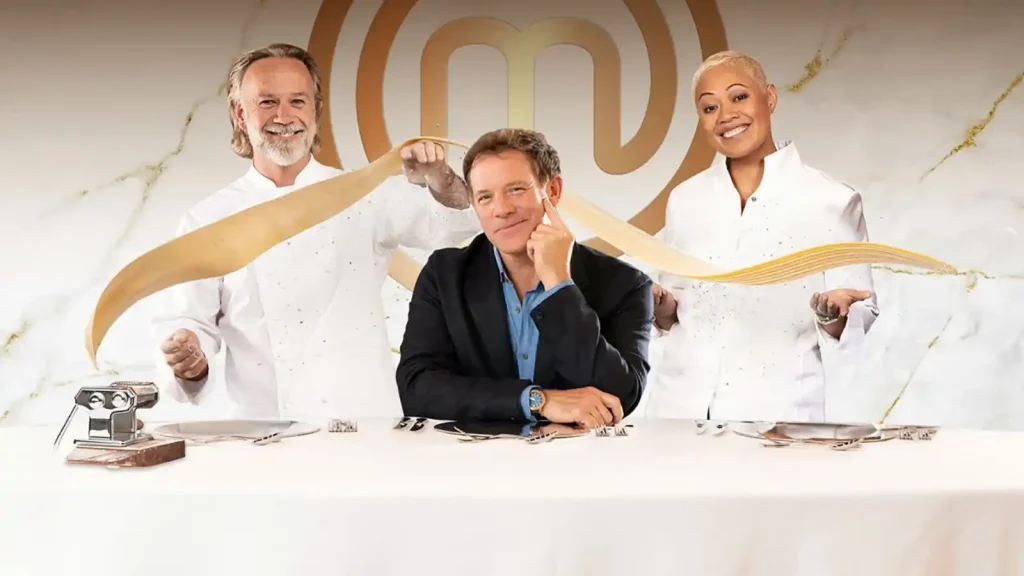
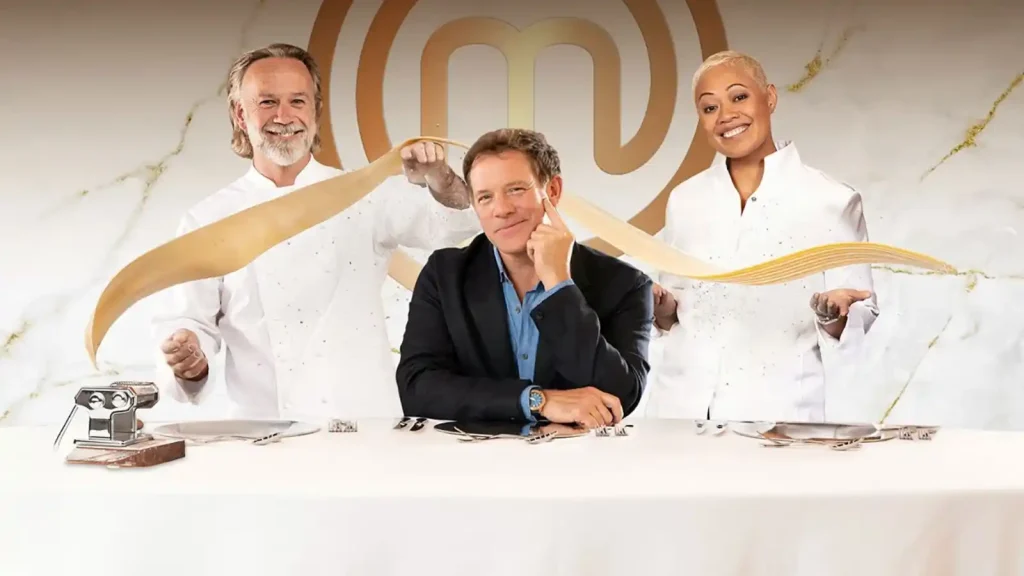
Gregg Wallace and Marcus Wareing anchor the judging panel with their now-established dynamic — Wallace bringing emotional immediacy and appetite-driven enthusiasm, Wareing applying the cool, technical scrutiny of a Michelin-starred chef who has seen everything the professional kitchen can produce. Together they function as a pressure system of their own, and the chefs know it. Marcus Wareing, in particular, operates with a precision of expectation that leaves no room for excuses. When he tastes something extraordinary, his approval carries enormous weight. When he is underwhelmed, the silence around that assessment is its own kind of verdict.
The episode builds systematically through two distinct phases, each demanding something different from the competing chefs. The invention test isolates individual creativity and technical control under timed conditions. The critics’ round then layers social performance onto culinary execution — these chefs must not only cook a two-course meal of the highest standard, but do so knowing that Tom Parker Bowles, Leyla Kazim, and Jimi Famurewa are sitting in the dining room with the refined palates and the professional vocabulary to dismantle a dish in a sentence. It is a transition from solo performance to public theatre, and not every chef makes it comfortably.
What makes this episode particularly compelling is the range of responses to identical constraints. Every chef receives king prawns. Every chef has access to the same larder. Yet the dishes that emerge vary dramatically in concept, technique, and ambition. Some chefs reach for classical combinations and execute them with precision. Others push into more experimental territory and either produce something genuinely original or reveal the gap between ambition and execution. That gap, when it appears, is exactly what the judges are watching for — not because failure is entertaining, but because how a professional handles difficulty under pressure tells you almost everything you need to know about their future in the industry.
The food critics’ arrival in episode three carries its own weight of expectation. Tom Parker Bowles, Leyla Kazim, and Jimi Famurewa are familiar presences in the MasterChef kitchen, but familiarity has not softened their standards. These are professional critics who eat at restaurants of every tier, who understand what excellence looks like at the top of the culinary profession, and who have no incentive to be generous about food that does not meet the standard the competition demands. Their verdicts form a critical layer of assessment between the chefs’ own intentions and the judges’ final decisions, and in this episode, those verdicts carry genuine consequence.
MasterChef The Professionals 2026 episode 3
The Invention Test: MasterChef The Professionals 2026 Sets the Quarter-Final Bar
The invention test in MasterChef The Professionals 2026 episode 3 arrives as the competition’s clearest measure of independent culinary thinking. Each chef receives king prawns as their mandatory centrepiece and is given access to a fully stocked larder. The instruction is deceptively simple: make the prawn the hero of the dish. The difficulty lies in the execution, because making any single ingredient the unambiguous focal point of a plate requires not only technical competence but also the kind of editorial discipline that separates accomplished professionals from genuinely exceptional ones.
The time pressure of the invention test is not merely a logistical constraint — it functions as a diagnostic tool. Chefs who have spent years developing their instincts know how to prioritise, how to plan a dish structure in seconds, and how to move through a kitchen economy of motion. Those who are less assured reveal themselves in the early minutes, reaching for too many components or changing direction partway through the cook. The judges watch those opening moments closely, because the chef’s relationship with uncertainty tells them a great deal about how that chef will perform in a professional kitchen when something goes wrong at service.
King prawns are particularly revealing as an invention test ingredient precisely because they are so familiar. Every professional chef has cooked with them. The danger is complacency — defaulting to a well-worn combination rather than engaging creatively with the ingredient in its specific context. The chefs who perform best in this round are those who treat the prawn as a genuine culinary problem to solve rather than a prompt to execute a memorised recipe. The larder’s inclusion of pastry options, fruit, and pancetta creates multiple possible flavour directions, and the choices each chef makes reveal their instinctive culinary personality.
Culinary Decision-Making Under Pressure in the Quarter-Final Competition
The invention test produces a vivid range of approaches, and the diversity of those approaches is itself one of the episode’s most instructive dimensions. Some chefs anchor their prawns in classical European frameworks, using butter, garlic, and aromatics to create dishes that honour the ingredient without attempting to transform it. Others experiment with spice combinations, drawing on Asian or North African influences to push the flavour profile in more unexpected directions. The quality of the results depends heavily on the chef’s ability to commit to a direction and execute it without hesitation.
Marcus Wareing’s assessments of the invention test dishes are characteristically precise. He evaluates not just the taste of a dish but the thinking behind it — whether the components on the plate are there for a reason, whether the seasoning reflects genuine attention, and whether the prawn is truly at the centre of the eating experience or has been overwhelmed by surrounding elements. When a dish fails to honour the key ingredient, his critique is direct. When a dish succeeds in elevating the prawn while demonstrating original thinking, his approval is equally unambiguous.
Gregg Wallace brings a different but complementary perspective to the invention test judging. Where Wareing analyses technique and culinary logic, Wallace responds to the visceral experience of eating — whether a dish delivers pleasure, whether it surprises, whether it makes him want another bite. The pairing of their judgement styles means that a dish must succeed on multiple levels simultaneously to earn genuine praise. Technical precision without sensory impact fails as surely as crowd-pleasing approachability without underlying craft. The best dishes in this quarter-final manage to satisfy both men, and those are the dishes that propel their creators forward in the competition.
MasterChef The Professionals 2026 Episode 3 and the Critics’ Crucible
The transition from the invention test to the critics’ round represents a significant shift in what the competition is testing. The invention test measures a chef’s ability to cook instinctively and efficiently under constraint. The critics’ round measures something different and in some respects more demanding — the ability to produce a complete, polished, two-course meal that would hold its own in a serious restaurant. The chefs who succeed in the invention test are not guaranteed to succeed in the critics’ round. The skills required, while related, are not identical.
Tom Parker Bowles brings to the dining room a combination of personal enthusiasm for food and critical rigour developed through years of professional writing about restaurants and cookery. Leyla Kazim approaches food with a strong sense of cultural context and flavour intelligence, alert to whether a dish is using its influences respectfully and effectively or reaching for them superficially. Jimi Famurewa, as a working restaurant critic, evaluates food in terms of its broader restaurant context — whether a dish represents value in experience terms, whether it demonstrates a point of view, whether it communicates something specific and memorable. Together, these three bring a breadth of evaluative perspective that is genuinely challenging for the competing chefs to satisfy simultaneously.
The two-course meal format of the critics’ round introduces strategic complexity that the invention test does not require. Chefs must think not only about individual dishes but about the relationship between them — whether the courses complement each other in flavour and texture, whether the progression makes sense as a dining experience, and whether the overall meal tells a coherent story about the chef’s culinary identity. A strong starter followed by a weaker main undermines the impression more than either dish might individually, and the critics notice when a pairing feels unconsidered.
Prawn Cookery and Professional Standards in MasterChef The Professionals 2026
The choice of king prawns as the invention test ingredient speaks directly to the challenge of professional precision. Prawns are among the most time-sensitive proteins a chef can work with. Their cooking window is measured in minutes, sometimes seconds, and the difference between perfectly cooked and overdone is often invisible to the eye but immediately apparent on the palate. In a competition kitchen, where stress naturally elevates the risk of timing errors, prawns function as a kind of truth serum for technical discipline.
The larder available to the chefs offers multiple potential flavour companions for the prawns. Pancetta and bacon suggest smoky, savoury directions that can ground the sweetness of the prawn in something more robust. Fresh fruits open the possibility of acidity and brightness, which can lift prawn dishes out of heaviness and create more elegant eating. The range of pastry options hints at more structured approaches — whether wrapping, encasing, or using pastry as a textural contrast rather than a structural base. Each of these directions is valid; the execution determines whether the vision is realised.
The quality of seasoning is a recurring emphasis in the episode’s judging commentary. Prawns carry their own natural seasoning from their marine environment, and overdoing salt or spice can strip away the very flavour that makes them worth eating. The most accomplished chefs in this quarter-final demonstrate an understanding of this balance — using their other ingredients to enhance the prawn rather than compete with it. Where that balance is lost, the judges identify it immediately, and the chef’s path to knockout week becomes considerably more difficult.
The Critics Deliver Their Verdicts on the Cooking Competition
Tom Parker Bowles, Leyla Kazim, and Jimi Famurewa approach the critics’ round meals with the same level of attention they would bring to a professional restaurant review. They discuss each dish among themselves, sharing immediate reactions and then refining those reactions through conversation. Their dialogue is revealing not just as assessment but as a demonstration of how experienced food thinkers engage with a plate — what they notice first, what lingers, and what they find themselves returning to. The episode captures this dynamic with sufficient detail to make the critiques genuinely informative.
The critics are particularly alert to the difference between competent execution and genuine culinary voice. In a competition at quarter-final level, competence is assumed. What the critics are looking for is evidence that the chef has something to say — a perspective on food that goes beyond technical accomplishment and expresses genuine creativity or cultural specificity. Dishes that impress on technical grounds but feel impersonal register differently from dishes that may have minor technical flaws but carry a clear and compelling identity. Both the judges and the critics navigate this tension when forming their assessments.
Several dishes in the critics’ round generate particularly enthusiastic responses, and the language the critics use in those moments is precise and evocative. When food genuinely excites these critics, they articulate exactly why — identifying the specific combination of flavours, textures, or structural choices that elevate the dish above the expected. That specificity is itself a standard, because it demonstrates that the praise is earned through genuine analysis rather than general enthusiasm. The chefs who receive that kind of detailed, affirmative critique know they have cooked something that justifies their presence at this stage of the competition.
MasterChef The Professionals 2026 and the Path Through to Knockout Week
The judging deliberations that follow the critics’ round combine two streams of evidence — the judges’ own assessments from the invention test and their observation of the critics’ round, alongside the critics’ direct feedback from the dining room. Marcus Wareing and Gregg Wallace weigh these inputs carefully, because the competition at this stage is not simply about which chefs had the best individual dishes. It is about which chefs have demonstrated the range, consistency, and potential that justify a place in knockout week.
The chefs who progress through the quarter-final in MasterChef The Professionals 2026 do so on the strength of performances across both rounds. A chef who excels in the invention test but struggles in the critics’ round faces a difficult argument for advancement, just as a chef who impresses the critics but showed weakness under invention test conditions must hope that the overall picture is convincing enough. The judges’ decision-making process reflects the complexity of evaluating professional talent — single moments of brilliance matter, but so does the pattern of performance across the entire episode.
The chefs who do not advance leave the competition having demonstrated genuine ability. The quarter-final does not eliminate the undeserving — at this stage, every chef still competing has earned their place through earlier rounds. What the quarter-final determines is not who is good enough to be here, but who is good enough to go further. That distinction is important, and the judges handle the eliminations with the directness and respect that professional chefs deserve. The season’s search for the 2026 champion continues, and the competition has made clear that the remaining contestants will need to summon everything they have.
Flavour, Technique, and Culinary Identity in MasterChef The Professionals 2026 Episode 3
Beyond the mechanics of the competition format, episode three of MasterChef The Professionals 2026 illuminates something broader about the state of professional cooking in Britain. The range of culinary influences visible in the chefs’ dishes reflects the genuinely international composition of the country’s restaurant industry. Classical French technique sits alongside South Asian spicing, East Asian flavour principles, and contemporary British cooking that draws on all of these traditions simultaneously. The competition kitchen becomes, in this context, a kind of cross-section of the contemporary food world.
The food produced in this quarter-final reflects a generation of professional chefs who trained across multiple culinary traditions and have developed highly personal approaches to cooking. That personalisation is evident in the invention test in particular, where the freedom to interpret the brief allows each chef’s instincts to surface more fully than a prescribed challenge might permit. The larder functions as an expressive resource, and the choices each chef makes within it constitute a kind of culinary autobiography written in a single dish.
Marcus Wareing’s emphasis throughout the episode on the importance of balance — between flavours, between components, between ambition and execution — reflects a philosophy of cooking that prioritises the eating experience above the visual impression. In a professional kitchen, a dish must be reproducible, consistent, and genuinely satisfying to eat across multiple services. The invention test dishes are one-offs, but they are evaluated with that broader professional standard in mind. Wareing is asking, in every critique, whether this chef’s instincts are reliable enough to translate into a sustainable professional identity.
The Competition’s Broader Stakes and What the Quarter-Final Reveals
The quarter-final episode of MasterChef The Professionals 2026 does more than advance some chefs and eliminate others. It establishes the emotional and culinary register of the competition’s final phase. The chefs who pass through this episode carry with them the confidence of having succeeded at the highest level of scrutiny the competition has yet applied. They know they can perform under pressure, cook for critics without flinching, and produce food that satisfies both the technical standards of a former Michelin-starred head chef and the appetite-driven enthusiasm of one of food television’s most engaged personalities.
The critics’ involvement in the quarter-final is not merely structural — it is calibrating. Tom Parker Bowles, Leyla Kazim, and Jimi Famurewa bring an external reference point that the competition’s internal judging cannot fully replicate. They represent the audience these chefs will ultimately cook for throughout their careers: informed, demanding, and genuinely passionate about exceptional food. When those critics are moved by a dish, it means something beyond the competition. It means the chef is cooking at a level that matters in the real world of professional food culture.
What the quarter-final of MasterChef The Professionals 2026 ultimately demonstrates is that the competition has arrived at its most revealing phase. The chefs who remain are not simply talented — they are talented and tested, ambitious and self-aware, technically accomplished and creatively driven. The hunt for the 2026 champion is entering its final chapters, and the episode makes unmistakably clear that whoever wins this competition will have earned that title through a gauntlet designed to find not just a good chef, but an exceptional one.
FAQ MasterChef The Professionals 2026 episode 3
Q: What format does MasterChef The Professionals 2026 Episode 3 follow, and what are the two main challenges?
A: MasterChef The Professionals 2026 Episode 3 is structured as a quarter-final featuring two distinct challenges. First, the chefs face an Invention Test, where they receive a mystery key ingredient and must create a standout dish using a fully stocked larder. They have ten minutes to select their ingredients and 70 minutes to cook and serve. Following the Invention Test, the same chefs cook a two-course meal for three of the country’s leading food critics. Only the strongest performers across both rounds progress to Knockout Week.
Q: What was the key ingredient for the Invention Test in Episode 3, and why did the judges choose it?
A: The key ingredient revealed in the Invention Test was king prawns. Judge Marcus Wareing noted that king prawns are an ingredient every professional chef has encountered, making them familiar enough to inspire confidence. However, he also stressed that prawns are very easy to get wrong. Their delicate flavour and short cooking window mean even experienced professionals can overcook them, turning them floury and tough. Additionally, the larder included fruit, vegetables, bacon, pancetta, spices, different types of pastry, and alcohol to complement the prawns.
Q: Which four chefs competed in the MasterChef The Professionals 2026 quarter-final, and what are their backgrounds?
A: Four chefs competed in this quarter-final. Sel is a Guatemala-born private chef who has worked in kitchens across 27 different countries, known for his inventive fusion style. Luke is a head chef at a gastro pub in Winchester and a father of four, praised previously for big, bold flavours. Mario is a 38-year-old head chef from Seville with 15 years of professional cooking experience, celebrated for his Spanish-inspired signature dishes. Ismail is a Bangladesh-born head chef of a London gastro pub, previously praised by the judges for his exceptional use of spices.
Q: How did each chef approach the king prawn Invention Test, and what dishes did they produce?
A: Each chef took a distinctly different approach. Sel served pan-seared prawns alongside a prawn ceviche with mango and pineapple, finished with a pale ale and mango skin sauce. Luke made prawn tortellini in prawn butter and a pan-roasted prawn with sourdough croutons, compressed tomatoes, and a prawn bisque with gochujang. Mario prepared blanched and tempura prawns with dashi broth, rainbow chard, courgette, a rice cracker, confit egg yolk, and prawn oil. Ismail cooked a Bangladeshi-inspired king prawn curry with heritage tomato and tempura broccoli, served on naan bread with garlic rice.
Q: How did the judges assess the Invention Test dishes, and who performed strongest?
A: Luke’s prawn tortellini and bisque received the strongest praise. Marcus Wareing described the bisque as lighting up the plate and called the overall dish delicious, highlighting the velvety sauce and beautifully seasoned prawn. Ismail’s curry earned acclaim for its depth of prawn head flavour and excellent spicing, though his plating on top of the naan bread made it difficult to eat. Sel’s pale ale sauce was noted as lingering too strongly, preventing the prawn’s natural flavour from coming through. Mario’s dish had highlight moments in the dashi broth and prawn oil, but the tempura batter and confit egg yolk execution fell short of expectations.
Q: Who were the food critics in the MasterChef The Professionals 2026 critics’ round, and what did they expect from the chefs?
A: The three food critics were Leyla Kazim, Jimi Famurewa, and Tom Parker Bowles, all regular guests of the show. The judges made clear they expected exceptional cooking, not merely competent cooking. Specifically, the critics wanted to see and taste the character and personal background of each chef in their food. The restaurant industry is highly competitive, and standing out requires something special. The critics assessed both courses together, evaluating creativity, technique, flavour balance, and how well each chef’s cultural identity came through on the plate.
Q: What two-course meals did the chefs cook for the critics, and which dishes stood out?
A: Sel served a Guatemalan-inspired esquites starter of blackened sweetcorn, chipotle cream, langoustines, pan-fried scallops, and langoustine oil, followed by fillet of beef with pepian sauce, mushrooms two ways, grelot onions, and veal sauce. Luke cooked duck fat confit halibut with caviar hollandaise and a charred gem lettuce ballotine for his starter, then a salted caramel chocolate cremeux with toasted hazelnuts, bourbon oranges, and wasabi rocket. Ismail presented a spiced lamb chop with a lamb Scotch egg, tamarind sauce, and asparagus, followed by mango, passion fruit, and coconut cheesecake. Mario offered a deconstructed serranito of Iberico pork tenderloin with wild garlic, piperade, and whiskey sauce, finished with a torrija and bay leaf ice cream.
Q: How did the food critics respond to the dishes served in the MasterChef The Professionals 2026 quarter-final critics’ round?
A: The critics responded with exceptional enthusiasm across the board. Sel’s esquites starter was described as mesmerising, perfectly balanced in heat, smokiness, and flavour, with his beef main called technically brilliant and full of soul. Luke’s halibut was praised as sublime, with the caviar hollandaise likened to a blanket wrapping around beautifully confit fish, and his cremeux dessert described as clean, precise, and executed to perfection. Ismail’s lamb course was called full-bore flavour with foot-down enthusiasm, and his cheesecake was described as fresh and zingy. Mario’s deconstructed serranito impressed with its beautifully cooked pork, while his torrija and bay leaf ice cream was called a subtle, elegant, and impressive dessert.
Q: What was the final outcome of MasterChef The Professionals 2026 Episode 3, and did anyone get eliminated?
A: In an exceptional and rare outcome, all four chefs progressed to Knockout Week. The judges announced their decision after the critics’ round, with Gregg Wallace calling it probably the strongest food critics round he had ever judged. Rather than eliminating one chef, they recognised that the quality across all four menus was simply too high to send anyone home. This result surprised the chefs themselves, with at least one having jokingly predicted the outcome moments before the announcement. All four — Sel, Luke, Mario, and Ismail — advanced, continuing the search for the 2026 MasterChef The Professionals champion.
Q: What culinary techniques and cooking principles were highlighted throughout MasterChef The Professionals 2026 Episode 3?
A: Several key professional techniques featured prominently. Correct prawn cookery was emphasised repeatedly — pan-frying takes only seconds, and overcooked prawns become floury and chewy. Ceviche requires precise timing, as curing acids begin cooking the prawn immediately. Confit cookery demands low, slow temperature control; Mario’s attempt at boiling eggs as a confit method was corrected by judges as technically wrong. Tempura batter requires the right temperature for aeration and crispness. Duck fat confit for fish must be kept at low temperature to prevent curling. Additionally, the judges consistently stressed that a great sauce, proper seasoning, and respecting the hero ingredient are the cornerstones of elite professional cooking.