My Garden of a Thousand Bees reveals a world most people walk past without a second glance — a Bristol back garden teeming with more than sixty species of wild bee, each one living out a compressed and urgent life among the flower beds and fence posts. Wildlife film-maker Martin Dohrn has spent years pointing his cameras at this small patch of ground, and what he has captured challenges every assumption about where nature lives and how close it already is. The garden is not a nature reserve or a managed habitat. It is an ordinary urban plot, and that is precisely the point.
Dohrn’s obsession with bees did not arrive quietly. It built over decades of professional wildlife film-making, sharpened by proximity and patience, until the garden itself became his primary subject. He can identify individual bees by sight — not species alone, but specific insects returning day after day to the same flower, the same nest hole, the same patch of warm brick. That level of familiarity transforms observation into something closer to relationship, and it sits at the heart of everything My Garden of a Thousand Bees communicates about the natural world.
The significance of this work extends well beyond one man’s enthusiasm. Bee populations across Britain and much of the world have declined sharply, and the consequences ripple through ecosystems and food systems alike. Understanding what bees do — how they find food, build nests, compete, reproduce, and die — requires watching them closely over time. Dohrn’s garden provides exactly that laboratory, and his footage provides evidence that wild bees are far more diverse, far more specialised, and far more fascinating than popular awareness tends to acknowledge.
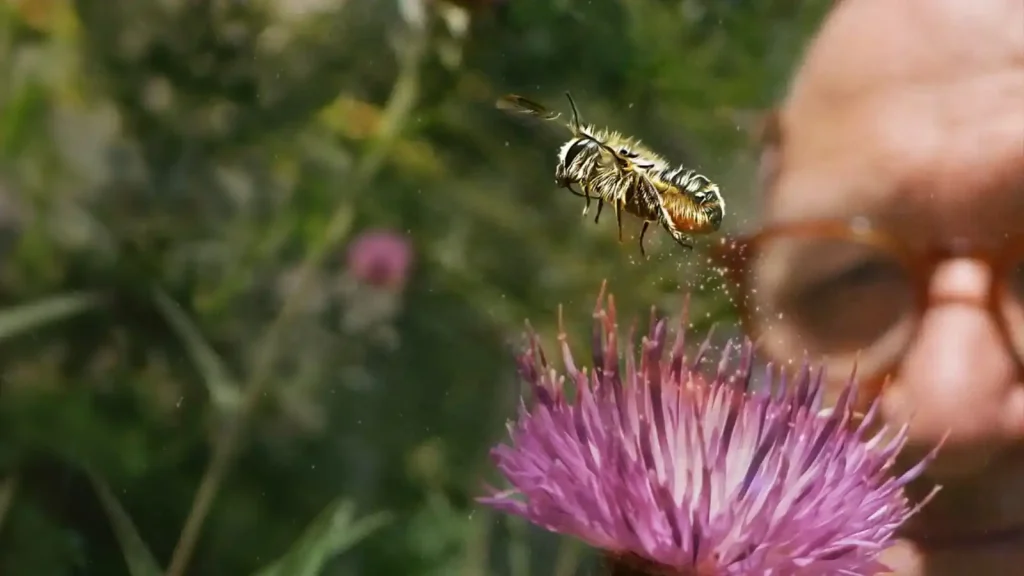
The bumblebee is the bee most people picture when the word is spoken: large, furry, audibly present. But the garden holds far more than bumblebees. Scissor bees the size of a mosquito navigate the same airspace. Wool carder bees patrol territories with aggressive precision. Leafcutter bees carry fragments of leaf overhead like tiny green sails. Mining bees excavate tunnels in bare soil with focused, methodical effort. Each species occupies a distinct ecological niche, and Dohrn’s cameras reach into those niches with technology developed specifically for this kind of extreme close-up work.
The equipment itself reflects the ambition of the project. Dohrn builds and adapts much of his own filming kit, including macro lenses and lighting rigs capable of capturing insects in flight at frame rates that allow slow-motion playback revealing details invisible to the naked eye. He has filmed inside nest chambers, tracked bees through flight paths measured in centimetres, and followed the complete lifecycle of individual insects from egg to death. The results are not merely beautiful — they are scientifically informative, showing behaviour that even specialists have rarely seen in such detail.
Patience is the quality the project demands above all others. Dohrn describes waiting hours for a particular bee to return, sitting motionless beside a nest entrance, camera already focused on the spot where the insect will land. The waiting is not passive. He is reading the garden constantly, tracking which plants are flowering, which nest sites are active, which species are at peak foraging season. This accumulated knowledge allows him to anticipate behaviour rather than simply react to it, and that anticipation produces footage that feels intimate rather than opportunistic.
The emotional dimension of the project is inseparable from the scientific one. Dohrn speaks with evident feeling about individual bees he has followed, particularly a leafcutter bee he tracked through her entire adult life. She became a known individual to him — recognisable, predictable, and eventually mourned. That attachment is not sentimental self-indulgence. It reflects the depth of observation required to film a single insect across weeks, and it underlines a broader truth: that nature becomes more meaningful the more closely it is known.
My Garden of a Thousand Bees is ultimately a study in scale. The garden is small. The bees are smaller still. But the world they inhabit — measured in flowers and milliseconds and wingbeat frequencies — is vast and intricate, and Dohrn’s cameras make it accessible in ways that shift perspective permanently. What follows is a closer examination of the species, behaviours, technologies, and insights that make this project one of the most remarkable pieces of wildlife film-making produced in an urban setting.
My Garden of a Thousand Bees
My Garden of a Thousand Bees and the Diversity Hidden in Plain Sight
The sixty-plus bee species Dohrn has recorded in his Bristol garden represent a range of size, behaviour, and biology that most people would associate with an entire nature reserve rather than a domestic plot. The smallest insects in the garden are the scissor bees, which reach roughly the dimensions of a mosquito. The largest are the bumblebees, whose size and sound make them the most immediately recognisable. Between those extremes lies a spectrum of specialists, each adapted to particular flowers, particular nesting materials, or particular times of year.
Mining bees are among the most numerous and varied. These solitary insects excavate nest tunnels in bare or sparsely vegetated soil, creating small spoil heaps at the entrance that can make a lawn or path look pockmarked to an inattentive eye. Each female mines her own tunnel, provisions it with pollen and nectar, lays her eggs, and seals the cell. There is no colony, no queen, no shared labour. Every female is reproductively independent, and every tunnel represents one individual’s entire reproductive investment.
Leafcutter bees operate differently. Rather than digging into soil, they use sections of leaf — cut with their mandibles into precise oval shapes — to line nest chambers in pre-existing cavities: hollow stems, old beetle holes in dead wood, gaps in masonry. The leaf sections arrive carried beneath the bee’s body, visible from below as she approaches the nest. Dohrn’s cameras capture this behaviour in extraordinary detail, showing the bee manoeuvring the leaf fragment through a hole barely wider than her own body.
Filming the Invisible: Camera Technology in My Garden of a Thousand Bees
The technical challenge of filming bees at the scale Dohrn works is substantial. A bee in flight moves faster than a human eye can track precisely. The depth of field at macro distances is measured in millimetres. Light levels inside nest chambers are essentially zero. Each of these constraints requires a different technical solution, and Dohrn has spent years developing approaches that address them without disturbing the insects or their environment.
High-speed cameras allow him to record wing movements that are completely invisible at normal frame rates. A bumblebee beats its wings hundreds of times per second, and the patterns of those beats — how they change during hovering, during landing, during flight through turbulence — can only be studied in slow motion. The footage reveals a level of aerodynamic control that is genuinely surprising, showing bees making fine adjustments to their flight path in response to wind shifts and flower movement with reactions faster than conscious thought.
Miniaturised lighting is equally critical. Dohrn uses small, controllable light sources positioned at nest entrances and inside artificial observation chambers to illuminate spaces that would otherwise be too dark to film. The chambers are constructed to give the bee natural nesting conditions on one side and a glass viewing panel on the other, allowing the camera to see inside without the bee being aware of the intrusion. The footage from inside these chambers shows provisioning, egg-laying, and larval development at a level of detail that most entomologists have never directly observed.
The Leafcutter Bee: My Garden of a Thousand Bees and One Remarkable Life
Of all the insects Dohrn has filmed, the leafcutter bee he followed through her complete adult life stands out as the emotional and scientific centrepiece of the project. He first identified her as an individual — distinguished from other leafcutters by minor physical characteristics and by her consistent return to the same nest site. From that point, he documented every stage of her adult life: foraging, nest building, provisioning, egg-laying, and finally the cessation of activity that marked the end.
Leafcutter bees are solitary in the strict biological sense — no worker caste, no cooperative colony — but they often nest in loose aggregations where multiple females use nearby sites. Dohrn’s bee chose a cavity in his garden structure, and her repeated returns to this site over several weeks gave him the opportunity to film a complete reproductive cycle. Each visit brought a leaf section or a load of pollen, and the camera recorded the precise mechanics of both activities.
Cutting leaf sections requires both strength and accuracy. The bee positions herself on the leaf surface, grips the edge with her legs, and rotates her body while her mandibles work through the leaf material in a smooth arc. The resulting oval or circular section is then carried in flight to the nest. The precision of the cut — consistent in shape across dozens of sections — suggests a degree of motor control and spatial memory that goes far beyond simple instinct. Dohrn’s footage makes this visible in a way that description alone cannot convey.
The provisioning of the nest cell is equally precise. The bee deposits pollen mixed with nectar — a food mass called bee bread — into the leaf-lined chamber, then lays a single egg on the surface of this provision. She seals the cell with additional leaf sections and begins work on the next one. By the end of her active season, she has created a sequence of sealed cells, each containing one egg surrounded by enough food to sustain development through larva and pupa to adult. She will not live to see any of them emerge.
Bumblebees and Colony Life in My Garden of a Thousand Bees
Bumblebees operate on a fundamentally different social model from the solitary species that make up most of the garden’s bee diversity. A bumblebee colony begins in spring when a mated queen, having overwintered underground, emerges and searches for a nest site. In Dohrn’s garden, queens investigate potential cavities — compost heaps, dense grass clumps, gaps under paving — with obvious purpose. The choice of site is critical, because everything that follows depends on it.
Once established, the queen begins producing worker daughters. These workers, all female and reproductively suppressed, take over foraging duties as the colony grows. The queen shifts her role toward egg-laying, and the colony expands through the spring and summer. At peak size, a bumblebee colony might hold several hundred individuals — far fewer than a honeybee hive, but still a complex social organisation with division of labour, communication about food sources, and collective regulation of nest temperature.
Dohrn’s cameras capture bumblebee foraging in detail that reveals both the efficiency and the physicality of the process. A foraging bumblebee can visit hundreds of flowers in a single trip, using a combination of learned route memory and real-time assessment of nectar and pollen availability. The pollen is packed into specialised structures on the hind legs — corbiculae, or pollen baskets — that can carry loads large enough to be clearly visible as orange or yellow masses. The weight of a full pollen load is substantial relative to the bee’s body mass, and the effort required to fly it back to the nest is considerable.
Wool Carder Bees, Territorial Behaviour, and Competition in the Garden
Among the most behaviourally striking species Dohrn has filmed is the wool carder bee, a medium-sized solitary bee with a particular relationship to plants with hairy or woolly leaves and stems. The female collects fibres from these plants — lamb’s ear is a favourite — and uses them to construct nest cells in pre-existing cavities. The fibres are scraped from the plant surface and carried to the nest in a bundle held beneath the body, giving the bee in flight a distinctive fluffy appearance.
The male wool carder bee is territorial to a degree that sets him apart from most other bee species in the garden. He establishes a territory around the plants that females visit for fibre and nectar, and he defends it aggressively against competitors. Dohrn has filmed these territorial disputes in detail, showing males pursuing and physically grappling with intruders — including other bee species, hoverflies, and insects considerably larger than themselves. The aggression is not posturing. Males make contact, and the encounters can result in injury.
The territorial strategy makes evolutionary sense. A male who controls access to the plants females need for nesting materials controls a resource that directly influences female reproductive success. Females are therefore more likely to encounter and mate with the territorial male than with competitors excluded from the area. The behaviour is a form of resource defence mating, and it produces some of the most dramatic footage in the garden — small insects fighting with genuine commitment over a patch of hairy-leafed plants beside a garden path.
My Garden of a Thousand Bees and the Science of Individual Recognition
One of the most striking aspects of Dohrn’s work is his ability to recognise individual bees. This is not a capacity most people associate with insects, and it raises questions about what individual recognition actually means when applied to animals with nervous systems radically different from our own. For Dohrn, the recognition is primarily visual and behavioural — particular physical markings, worn wing edges, unusual colouration — combined with knowledge of where a particular bee nests and forages.
The practical value of individual recognition is significant. Following one bee across multiple days and multiple foraging trips allows Dohrn to document a complete behavioural sequence that would otherwise have to be reconstructed from observations of many different individuals. It also reveals variation between individuals of the same species — differences in foraging efficiency, in nest architecture, in activity timing — that population-level observation tends to obscure.
The leafcutter bee he followed most closely demonstrated this individual variation clearly. Her nest construction choices, her preferred foraging plants, the timing of her daily activity — all of these were consistent enough across weeks to be genuinely characteristic of her as an individual. Whether this constitutes individuality in any philosophically meaningful sense is a separate question, but at the practical level of wildlife observation, it is a real and documentable phenomenon that Dohrn’s filming method brings into focus.
The Garden as Ecosystem: How My Garden of a Thousand Bees Maps Wild Complexity
The Bristol garden Dohrn films is not managed as a wildlife habitat in any formal sense, yet it supports a bee diversity comparable to many deliberately managed conservation sites. The reasons for this are embedded in decades of accumulated garden structure: mature plants, varied surfaces, bare soil patches, old wood, and the kind of structural complexity that develops when a garden is tended but not over-tidied. Each of these features offers resources to different bee species, and together they create an ecosystem of considerable richness.
Plants are the foundation. Different bee species show pronounced preferences for particular flower types, driven by the match between flower morphology and bee body shape. Long-tongued bumblebees can access tubular flowers that short-tongued species cannot reach. Solitary mining bees often show extreme floral fidelity, visiting only one or two plant species even when others are flowering nearby. Dohrn’s garden contains a wide range of flowering plants, and this variety underpins the species richness he has documented.
Nesting habitat is equally important and more easily overlooked. Bare soil supports mining bees. Dead wood and hollow stems provide cavities for leafcutter and mason bees. Old walls and mortar gaps offer additional nest sites. The wool carder bee requires plants with harvestable fibres. Without this structural diversity, many species would be present as foragers but unable to reproduce — visitors rather than residents. Dohrn’s garden provides both foraging and nesting resources, and that combination is what sustains sixty-plus species across a full season.
Bee Behaviour Across the Season: Patterns Revealed in My Garden of a Thousand Bees
The garden’s bee community is not static across the year. Different species are active at different times, and the composition of the visible bee fauna shifts week by week as the season progresses. Early spring brings the emergence of overwintered bumblebee queens, large and conspicuous as they search for nest sites and early flowering plants. Mining bees emerge shortly after, often timed precisely to the flowering of specific plant species with which they have co-evolved.
Summer brings peak diversity, with leafcutter bees, wool carder bees, and a range of smaller solitary species all active simultaneously. The competition for nesting sites and floral resources is most intense during this period, and the behaviours Dohrn has filmed — territorial defence, foraging competition, parasitism — are most visible then. The parasitic cuckoo bees, which lay their eggs in the nest cells of other species rather than provisioning their own, are particularly active during the peak of their hosts’ nesting season.
By late summer, activity begins to decline. Queen bumblebees that will overwinter — the only colony members to survive the coming months — begin to emerge and feed intensively before seeking hibernation sites. Solitary bees complete their final nest cells and die, leaving behind sealed chambers whose contents will not emerge until the following spring. The garden empties slowly, and the visible signs of bee activity fade. But underground, in hollow stems and wall cavities, the next generation is already developing, invisible and patient.
My Garden of a Thousand Bees and the Question of Urban Wildlife
The implications of Dohrn’s work extend well beyond entomology. His garden demonstrates that urban environments are not simply degraded versions of natural habitats — they are habitats in their own right, capable of supporting biological communities of real significance. Gardens collectively constitute a substantial area of land in Britain, and their management choices have measurable consequences for wildlife populations.
The features that benefit bees in Dohrn’s garden are not expensive or technically demanding. Bare soil patches, tolerated rather than covered. Dead wood left in place rather than cleared. A diversity of flowering plants chosen for ecological value alongside aesthetic appeal. Reduced pesticide use. These are decisions available to most garden owners, and Dohrn’s documentation of their effects makes the case for them more vividly than any written recommendation could.
The garden also challenges the assumption that meaningful wildlife observation requires travel to remote or managed natural sites. Dohrn has spent years filming extraordinary behaviour within metres of his back door. The insects were always there. The cameras, the patience, and the willingness to look closely are what made them visible. That insight has implications not just for conservation but for the relationship between people and the natural world more broadly — a relationship that urban living tends to attenuate but does not have to sever.
The Physics of Bee Flight and What the Cameras Reveal
Bee flight has attracted serious scientific attention for decades, partly because early aerodynamic models suggested it should not work. Those models were wrong — they failed to account for the unsteady aerodynamics of small, rapidly beating wings — but the question of precisely how bees fly with such agility remains active. Dohrn’s high-speed footage contributes to this understanding by making flight mechanics visible in everyday contexts rather than laboratory conditions.
A bumblebee approaching a flower does not simply fly straight and land. It adjusts its trajectory continuously in response to the flower’s position, the wind, and its own momentum, making corrections in fractions of a second. The wings do not beat symmetrically when turning — differential wing stroke amplitudes allow the bee to rotate and translate simultaneously, giving it manoeuvrability that outperforms most engineered flying machines at equivalent scales. Slow-motion footage makes these adjustments visible and countable.
The process of landing is particularly complex. The bee must reduce speed while maintaining control, extend its legs to contact the landing surface, and grip it securely — all while carrying a load of pollen that shifts the centre of gravity relative to an unladen bee. Dohrn’s cameras capture landings frame by frame, revealing the sequence of adjustments that make a smooth arrival possible. The footage is scientifically useful precisely because it shows real bees landing on real flowers under real conditions, not individuals constrained in a wind tunnel.
Dohrn’s Method: Observation, Patience, and the Making of My Garden of a Thousand Bees
The working method behind My Garden of a Thousand Bees is inseparable from the content it produces. Dohrn does not film opportunistically, arriving with a camera when something interesting happens to present itself. He manages his presence in the garden as a form of long-term fieldwork, building knowledge of individual insects and site-specific behaviour that allows him to position himself and his equipment where and when the most significant activity will occur.
This requires a kind of discipline that professional wildlife film-making does not always demand. Much broadcast natural history work involves finding spectacular subjects in remote locations and filming them efficiently over a limited period. Dohrn’s approach inverts this model. The subject is unremarkable — a domestic garden. The time commitment is extraordinary. The intimacy of the resulting footage reflects that investment directly.
He speaks about the garden in terms that suggest it functions as a kind of extended research site, one where he has accumulated years of observational data that inform each new filming session. Knowing that a particular bee returns to a particular nest hole within a predictable time window allows him to set up his camera and wait with confidence rather than uncertainty. That confidence produces steadier footage, better composition, and more complete behavioural sequences than reactive filming could achieve.
Loss, Endings, and the Emotional Truth of My Garden of a Thousand Bees
The death of the leafcutter bee Dohrn had followed through her adult life is not dramatised or sentimentalised in his account of it. He notes it factually: she stopped returning. Her nest was complete, her eggs laid, her season finished. The emotional weight of that ending comes from the accumulation of weeks of observation, from the knowledge of how hard she had worked and how much she had accomplished in the compressed timeframe of a solitary bee’s adult life.
That response — genuine grief at the death of an insect — is unusual enough to be worth examining. Dohrn’s feeling is not projected anthropomorphism; it is the natural consequence of extended, close observation of any living organism with consistent individual behaviour. The bee had become known to him in a real sense. Her death was therefore a real loss, even if the category of loss involved is different from anything in ordinary human experience.
This emotional dimension is part of what makes My Garden of a Thousand Bees more than a technical achievement. The footage is extraordinary, and the species documented are genuinely remarkable. But the project also makes a case for attention itself — for the idea that sustained, careful observation of the non-human world produces not just knowledge but connection, and that connection has value independent of its scientific content.
What My Garden of a Thousand Bees Ultimately Demonstrates
The accumulated evidence of Dohrn’s years of filming in his Bristol garden points in one direction: wild nature is not somewhere else. It is present, active, and complex in the spaces most people occupy daily, if those spaces offer even minimal habitat resources and are observed with any consistency. Sixty species of wild bee in one domestic garden is not an exceptional result produced by exceptional management. It is the result of a garden that has accumulated structure and plant diversity over time, combined with an observer willing to look closely enough to count.
The bees themselves — from giant bumblebees navigating the airspace above the flower beds to scissor bees threading through spaces almost too small to see — are not there because Dohrn invited them. They are there because the resources they need are present, and because wild bees are extraordinarily good at finding and exploiting those resources in whatever landscape they inhabit. His cameras have made their presence legible, but the presence preceded the filming by years.
My Garden of a Thousand Bees stands as both a scientific document and an argument. The science is in the behaviour, the species records, and the flight mechanics made visible by high-speed cameras. The argument is simpler: look more carefully. The garden holds more than most of us realise, and the effort required to discover that is not technical or financial. It is primarily a matter of attention — of slowing down enough to see what is already there, working urgently and precisely in the space between one flower and the next.
FAQ My Garden of a Thousand Bees
Q: What is My Garden of a Thousand Bees about?
A: My Garden of a Thousand Bees follows wildlife film-maker Martin Dohrn as he documents over sixty species of wild bee living in his ordinary Bristol back garden. Using specialist macro cameras and high-speed equipment, Dohrn films extraordinary bee behaviour — from giant bumblebees to scissor bees the size of a mosquito — and forms a remarkable bond with one leafcutter bee he tracks through her entire adult life.
Q: Who is Martin Dohrn and why does he film bees in his garden?
A: Martin Dohrn is a professional wildlife film-maker who has developed a deep specialism in bee behaviour. Rather than travelling to remote locations, he turned his Bristol garden into a long-term field site. Over years of patient observation, he learned to identify individual insects by sight. This sustained, close-range approach produces footage of exceptional intimacy and scientific detail that conventional wildlife filming rarely achieves.
Q: How many bee species can be found in a typical urban garden?
A: Dohrn has recorded more than sixty bee species in his single Bristol garden alone. This figure rivals the diversity found on many managed nature reserves. The key factors are structural variety — bare soil, dead wood, hollow stems, and old masonry — combined with a wide range of flowering plants. Gardens that provide both foraging and nesting resources can support far greater wild bee diversity than most owners realise.
Q: What is the difference between bumblebees and solitary bees?
A: Bumblebees are social insects that form colonies headed by a queen, with worker daughters sharing foraging duties. Solitary bees, by contrast, have no colony or worker caste. Each female mines her own nest, collects her own provisions, and lays her own eggs entirely independently. Leafcutter bees, mining bees, and wool carder bees are all solitary. Additionally, solitary bees make up the vast majority of wild bee species in Britain.
Q: How do leafcutter bees build their nests?
A: Leafcutter bees cut precise oval sections from leaves using their mandibles, then carry the fragments to pre-existing cavities such as hollow stems, beetle holes in dead wood, or gaps in old masonry. They line each nest cell with these sections, provision it with a pollen and nectar mixture called bee bread, lay a single egg, and seal the cell. Furthermore, the female repeats this process across multiple cells before her season ends.
Q: What makes wool carder bees unusual compared to other garden bees?
A: Wool carder bees stand out for two reasons. Females harvest fibres from woolly-leaved plants such as lamb’s ear to construct soft nest cells. Males, however, are fiercely territorial — they defend patches of fibre-producing plants against all intruders, including insects larger than themselves. This resource-defence behaviour is rare among bees. Dohrn has filmed these territorial disputes in detail, capturing genuine physical contact between competing males.
Q: What specialist camera equipment does Martin Dohrn use to film bees?
A: Dohrn builds and adapts much of his own equipment, including macro lenses, miniaturised lighting rigs, and high-speed cameras capable of recording hundreds of frames per second. This allows slow-motion playback that reveals wing mechanics invisible to the naked eye. He also constructs observation chambers with glass viewing panels to film inside nests without disturbing the bees. The resulting footage captures provisioning, egg-laying, and larval development in unprecedented detail.
Q: Can bees really be identified as individuals, and why does it matter?
A: Dohrn identifies individual bees through subtle physical markers — worn wing edges, minor colour variations — combined with consistent behavioural patterns such as nest site fidelity. This individual recognition matters scientifically because it allows a complete behavioural sequence to be documented for one insect rather than reconstructed from observations of many. It also reveals genuine variation between individuals of the same species in foraging efficiency, timing, and nest construction choices.
Q: How can gardeners attract more wild bees to their outdoor spaces?
A: Dohrn’s garden demonstrates that relatively simple choices make a substantial difference. Leaving bare soil patches supports mining bees. Retaining dead wood and hollow stems provides nesting cavities for leafcutter and mason bees. Planting a diverse range of flowering species extends the foraging season across spring, summer, and autumn. Reducing pesticide use protects foraging insects directly. Together, these measures can transform a standard garden into a habitat supporting dozens of wild bee species.
Q: What broader lesson does My Garden of a Thousand Bees offer about urban wildlife?
A: My Garden of a Thousand Bees demonstrates that meaningful wildlife exists in everyday urban spaces, not only in remote or managed reserves. Dohrn’s Bristol garden was not designed as a conservation site, yet it sustains extraordinary bee diversity. The project makes a compelling case that sustained, close observation of familiar surroundings reveals complexity most people overlook. Ultimately, wild nature is not somewhere else — it is already present, active, and waiting to be seen.