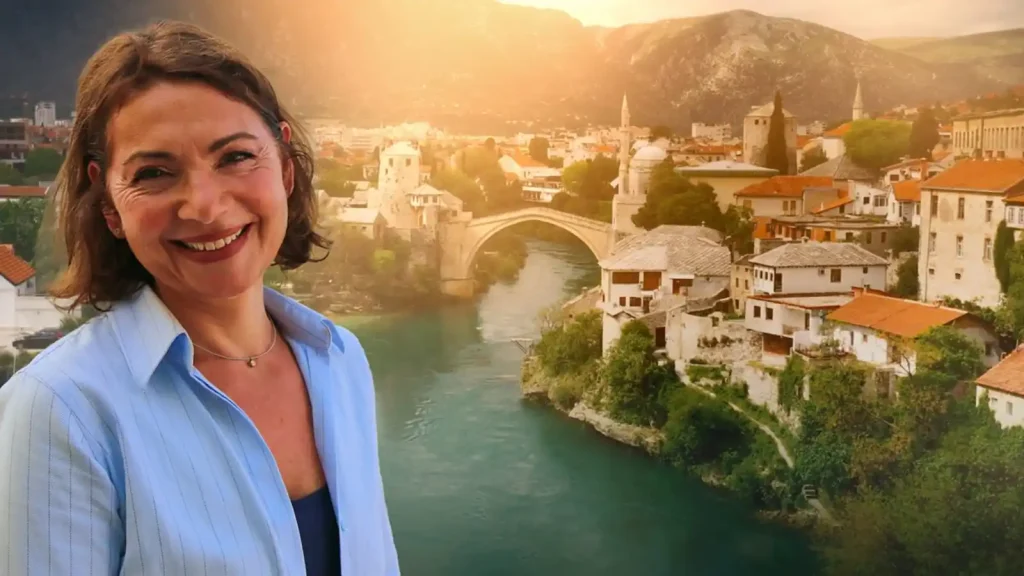
The Balkans episode 1: Europe’s Forgotten Frontier
For centuries, the Balkans have been Europe’s crossroads—a place where cultures, empires, and ideologies have collided, merged, and reshaped the region’s identity. Today, this complex and historically rich territory remains a geopolitical battleground, where global powers maneuver for influence. In the first episode of Europe’s Forgotten Frontier, BBC’s Europe editor, Katya Adler, takes us on a journey through Croatia, Bosnia, and Albania. Her mission: to explore how this often-overlooked corner of Europe is evolving in the wake of its turbulent past.
Katya Adler first set foot in the Balkans over three decades ago, during the violent breakup of Yugoslavia. The echoes of war still linger, though the region has transformed in ways both hopeful and unsettling. As she revisits these lands, she finds a place of breathtaking beauty—rugged mountains, sun-drenched coastlines, and medieval towns seemingly frozen in time. Yet beneath the surface, tension simmers.
Despite its natural allure, the Balkans remain a fragile link in Europe’s geopolitical chain. The scars of war, economic hardship, and political instability continue to shape its destiny. More than ever, global powers—including Russia, China, and the Islamic world—are vying for influence, challenging the European Union’s hold on the region.
Croatia, the first stop on Adler’s journey, has managed to distance itself from much of the turmoil that still grips its neighbors. Now a proud member of both the EU and NATO, the country enjoys economic growth, thriving tourism, and political stability. Cities like Dubrovnik and Split welcome millions of visitors every year, their medieval walls standing as testaments to a rich past.
Yet not all is as it seems. While Croatia has successfully integrated into the European framework, remnants of its past haunt the present. The divisions between ethnic Croats and Serbs, though less visible, have not entirely disappeared. Political corruption, economic disparities, and the struggle to retain its young workforce threaten the country’s stability. The shadow of the past still stretches over Croatia’s future, a reminder that peace is often more fragile than it appears.
Traveling east, Adler arrives in Bosnia and Herzegovina—a country still struggling to define its identity. The Dayton Agreement, which ended the Bosnian War in 1995, stitched together a nation out of warring factions. But nearly three decades later, the political system remains paralyzed, with deep ethnic divisions holding Bosnia back from true progress.
Sarajevo, once the beating heart of a multicultural Yugoslavia, retains its resilience. Minarets, Orthodox churches, and Catholic cathedrals stand side by side, reflecting a history of coexistence and conflict. Yet, the tensions between Bosniaks, Croats, and Serbs persist. While young people look toward a future within the European Union, political leaders often pull in different directions—some toward the West, others toward Russia.
Economic hardship compounds the problem. High unemployment drives many Bosnians to seek opportunities abroad, further weakening the country’s ability to build a stable future. With Russia seeking to extend its influence in the region and the EU struggling to maintain its role as a guiding force, Bosnia remains precariously balanced between progress and stagnation.
The Balkans episode 1: Europe’s Forgotten Frontier
In contrast, Albania presents a different story. Once an isolated communist state, it has transformed into one of Europe’s most dynamic economies. The capital, Tirana, is a vibrant city bursting with color, energy, and ambition. Skyscrapers rise alongside Ottoman-era mosques, and trendy cafes buzz with youthful optimism.
But Albania is also a country of contradictions. While it has made significant strides in economic development, corruption remains a major challenge. Organized crime networks still wield influence, and the country’s aspirations for EU membership are frequently met with skepticism from Brussels.
Despite these hurdles, Albania is emerging as a key player in the Balkans. The country has strengthened ties with NATO, positioned itself as an attractive investment hub, and sought to redefine its international reputation. As China increases its investments and the Middle East extends its cultural and economic reach, Albania finds itself at a crossroads—one that will determine its trajectory for decades to come.
The Balkans: A Battleground for Global Influence
The struggle for control in the Balkans is nothing new. For centuries, empires—Ottoman, Austro-Hungarian, Soviet—have sought to impose their will on this land. Today, a new power struggle unfolds. The European Union, once the region’s primary hope for stability and prosperity, faces mounting challenges in keeping the Balkans aligned with Western ideals.
Russia, eager to counter EU expansion, nurtures political alliances in Serbia and Bosnia’s Republika Srpska, leveraging historic ties to maintain influence. China, with its Belt and Road Initiative, pours billions into infrastructure projects, securing economic footholds. Meanwhile, Turkey and Gulf states extend their reach through religious and cultural investments, appealing to the region’s Muslim populations.
For the people of the Balkans, these competing forces create both opportunities and anxieties. While foreign investments bring economic benefits, they also raise questions about sovereignty and political independence. Will the Balkans fully integrate into the European vision, or will external powers pull them in different directions?
A Future Yet to Be Written
As Katya Adler’s journey through the Balkans unfolds, one thing becomes clear: this region is far from forgotten. It stands at the heart of a global tug-of-war, its future shaped by the choices of its people and the ambitions of powerful outsiders.
The Balkans are changing. But whether that change leads to unity and prosperity or division and conflict remains an open question. One thing is certain—this beautiful, complex, and often misunderstood region will continue to captivate, challenge, and shape the future of Europe.
Conclusion The Balkans episode 1: The Balkans at a Crossroads
The Balkans remain a land of contrasts—where past and future collide, and where hope and hardship intertwine. This region, long considered Europe’s forgotten frontier, is anything but forgotten. It is a chessboard where global powers make their moves, a bridge between East and West, and a place where history refuses to stay buried.
At every turn, the scars of conflict linger. In Bosnia, ethnic divisions still dictate political realities. In Croatia, echoes of the past complicate its European ambitions. In Albania, economic dynamism battles deep-rooted corruption. Each country walks a tightrope, balancing between opportunity and instability, between integration and isolation.
Yet, despite the weight of history, the Balkans are not trapped in their past. They are evolving, reshaping their identities, and striving for a future beyond the struggles that once defined them. Young people, armed with ambition and resilience, dream of a Balkan region that is prosperous, peaceful, and fully woven into the European fabric. They are the architects of a new era—one where the ghosts of war no longer dictate the future.
But external forces complicate the road ahead. The European Union, once the region’s north star, now struggles to keep its grip. Russia’s influence grows in certain corners, while China’s economic ambitions extend deeper. Turkey and the Gulf states find new ways to shape the region’s cultural and political landscape. The Balkans stand at a crossroads, facing a question as old as the land itself: Who will shape their destiny—their people or foreign powers?
Ultimately, the fate of the Balkans lies in its own hands. Its people, shaped by centuries of struggle, have always found ways to endure, adapt, and rebuild. Their resilience is their greatest weapon. Their determination, their greatest hope. As the world watches, the Balkans must choose—will they be a battleground for outside forces or a beacon of stability and progress?
The answer is still unwritten, but one thing is certain: the Balkans are no longer just Europe’s forgotten frontier. They are its proving ground—a mirror reflecting the continent’s struggles, its ambitions, and its future.
FAQ The Balkans episode 1: Europe’s Forgotten Frontier
Q: Why is the Balkans considered Europe’s forgotten frontier?
A: The Balkans has long been a crossroads of empires and cultures, yet it remains overshadowed by Western Europe. Political instability and economic challenges contribute to its overlooked status.
Q: What historical conflicts have shaped the Balkans?
A: The Balkans has witnessed Ottoman rule, Austro-Hungarian influence, and the Yugoslav Wars. These conflicts have deeply influenced national identities and modern political tensions.
Q: How does global influence affect the Balkans today?
A: Global powers, including the EU, Russia, China, and Turkey, compete for influence through investments, political alliances, and cultural connections, shaping the region’s future trajectory.
Q: Why is Bosnia and Herzegovina politically unstable?
A: Bosnia remains divided along ethnic lines. The 1995 Dayton Agreement ended war but created a complex political system that often leads to gridlock and nationalist tensions.
Q: How has Croatia integrated into the European Union?
A: Croatia joined the EU in 2013 and NATO in 2009. While its economy and tourism sector have benefited, challenges like political corruption and emigration persist.
Q: What are Albania’s biggest economic challenges?
A: Albania has seen economic growth, but corruption, organized crime, and skepticism from the EU regarding its membership bid hinder full economic integration.
Q: How do young people in the Balkans view their future?
A: Many young people seek opportunities abroad due to economic hardship. However, there is also a growing movement to modernize and integrate into the European Union.
Q: What role does tourism play in the Balkans’ economy?
A: Tourism is a major economic driver, particularly in Croatia and Albania. Stunning coastlines, historical sites, and unique cultures attract millions of visitors annually.