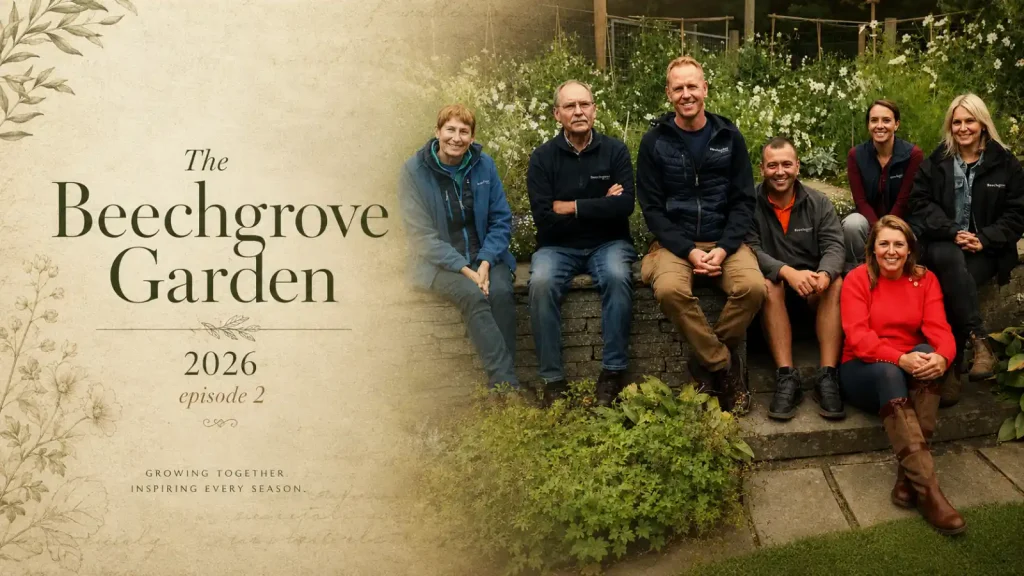
The Beechgrove Garden 2026 episode 12 lands at the precise turning point every northern gardener waits for, the moment in late June when the threat of frost finally lifts and tender plants can go out with confidence. This instalment moves through cut-flower planting, surprising new science on tree pruning, a hands-on veg masterclass packed with pest defences, and a thoughtful look at building gardens that welcome everyone. It is practical, seasonal, and rooted entirely in the cooler Scottish climate that shapes everything Beechgrove does.
What gives the programme its weight is the breadth of expertise on show. Half-hardy annuals get planted out at exactly the right week, a seasoned plantsman rethinks decades of pruning habits, and a beginner-friendly veg guide confronts its first serious pest invasion of the year. Each segment carries genuine stakes for the home grower.
The themes that thread through The Beechgrove Garden 2026 episode 12 are timing, protection, and accessibility. When to plant, how to defend young crops, and how to make the act of gardening reachable for people facing physical and cognitive barriers. These are not abstract ideas. They are decisions every gardener makes, framed here with clarity and real-world consequence.
The episode opens with a clear seasonal signal. By the end of June, the danger of frost has passed across most of Scotland, and that makes it the ideal time to plant out half-hardy annuals. The definition matters here. A half-hardy annual completes its entire life cycle in a single growing season, sown in spring, flowering through summer, then dying off in autumn without returning.
Three plants anchor the segment, each chosen for the cut-flower garden. The first is a Cosmos called Cupcakes, prized for pink and white blooms whose petals fuse at the base. That fusion creates a distinctive bowl shape with a frilly rim, looking remarkably like a paper cupcake case. It is a small botanical detail with a big visual payoff.
The second plant, Ammi visnaga ‘Green Mist’, carries a useful lesson in flexibility. It can be grown either as a half-hardy annual or as a hardy one. Sowing it the previous season, through late summer and autumn, produces stronger young plants ready to go out in early spring. Consequently, the cut-flower garden delivers blooms far sooner the following year.
The third, a Gypsophila called Single Alba, breaks the annual pattern entirely. Although sown this spring, it is actually a perennial. Once it finishes flowering, a simple cutting back ensures it returns year after year. That makes it outstanding value, and a smart choice for any gardener building a productive cutting patch on a budget.
The Beechgrove Garden 2026 episode 12
Colin Crosbie’s Surprising Advice on When to Prune Young Trees
One of the most striking moments in The Beechgrove Garden 2026 episode 12 comes from Colin Crosbie in his garden just outside Dumfries, where he challenges long-held assumptions about tree pruning. Gardening has changed enormously, he explains, and pruning more than most. What he was taught at college as a young gardener differs sharply from what he practises now, with much of that shift driven by new scientific research.
The headline revelation is counterintuitive. One of the best times to prune young trees is actually now, while they are in active growth. Pruning during this period lets the wound heal over faster and reduces the chance of infection taking hold. The difference to the tree’s long-term health is significant.
The old principles still hold, however. Dead, damaged, or diseased branches must come off, and anything crossing or rubbing needs removing too. Good tools make this safe and clean. Sharp secateurs handle anything up to finger thickness, while a small saw deals with larger branches. Attempting a thick branch with secateurs risks injuring your hand and tearing the tree.
Crosbie’s technique inside a Sorbus needhamii, a type of whitebeam, demonstrates the craft. Dead inner branches starved of light come out first, opening the canopy so sunlight can reach the centre. He never cuts flush against the stem. Instead, he leaves the wrinkled ridge and the collar above it, because that tissue is what allows the tree to heal. For heavier limbs he uses an undercut first, then a cut from above, preventing a falling branch from tearing bark down the trunk.
Fasciation, Bird Nests, and the Care Pruning Demands at This Time of Year
Crosbie’s pruning walk produces a genuine oddity on one of his favourite cherries, Prunus x yedoensis. A dense, tangled mass of growth appears among the branches, a condition called fasciation. It can be triggered by pests, disease, or physical damage, and its sheer weight threatens to rip the limb if left in place. Removing the affected branch protects the whole tree.
The growth, once cut, looks almost like a bird’s nest, and that image leads to a crucial seasonal warning. Pruning in summer carries a responsibility many gardeners overlook. Active nests sit hidden in trees and shrubs at this time of year, and the rule is absolute. If you spot a nest, stay away from it.
Scaring nesting birds is not an option. Protecting wildlife takes priority over any tidying job, and the work can simply wait. It is a reminder that the garden is a shared habitat, and good practice means reading the living context before reaching for the saw. That ethic runs quietly through the whole episode.
Back to Basics Tackles Its First Pest Battle in the Veg Plot
The Back to Basics strand offers a beginner’s guide to growing veg, and this week it confronts the season’s first real pest problem. The Scottish spring has been punishing, swinging from cold and wet to dry and cold, then turning wet again as summer arrived. Despite that, the veg plot is thriving, with potatoes, carrots, onions, lettuce, and spring onions all coming along well.
The potatoes tell a story of resilience. First earlies planted on programme one are growing strongly and sit about a couple of weeks from maturity, signalled by the appearance of flowers. A touch of frost browned the foliage earlier, setting them back slightly, but the plants should recover fully. Second earlies, planted later, are already starting to flower.
Carrots showcase successional sowing, with batches sown weeks apart so the harvest arrives gradually rather than all at once. Crucially, they sit under a fine mesh barrier. This guards against carrot root fly, a pest that lays eggs in the soil around the roots. The resulting maggots feed on the fleshy roots unseen, and the damage only becomes obvious at harvest. The mesh works because the fly cannot clear its height.
The episode’s first major pest discovery comes in the brassica cage. Cauliflowers, cabbages, kale, and Brussels sprouts look thirsty, but the soil is plainly wet enough, which points to something worse below ground. Lifting a plant reveals the culprit, a brassica root fly maggot feeding on the roots and killing young plants. The advice is direct. Ditch badly affected plants, replant healthy spares, and fit protective collars around the stems to stop the fly laying eggs in the first place.
Beetroot Thinning and Courgette Planting Done the Right Way
Beyond pest control, the veg segment delivers two textbook techniques. The beetroot row needs thinning, because seedlings sown too close together cannot swell into proper roots. Shop-bought beetroot reaches roughly tennis-ball size, and crammed seedlings will never get there without intervention.
The method is gentle and precise. Firming the soil with one hand, then easing out the surplus root with finger and thumb, protects the neighbours that remain. Thinning to about five centimetres apart gives each plant room. The thinnings are not wasted either. Once one swells to golf-ball size it can be picked and eaten, freeing the rest to reach full tennis-ball maturity.
Timing and moisture matter enormously here. Wet soil offers perfect conditions for thinning, but dry soil should be watered the night before, never minutes ahead. Watering too late loosens everything and risks disturbing and damaging the roots of surrounding plants. It is a small detail that separates a clean job from a clumsy one.
Courgettes round off the practical work, with green-skinned ‘Midnight’ and yellow-skinned ‘Sebring’ going in. As hungry feeders, they need a generous planting hole a spade deep and wide, enriched with a couple of spadefuls of manure. The standout tip is restraint. Courgettes crop so heavily that two plants are plenty, however many seedlings germinate from the packet.
The Sensory Touch Garden and the Power of Texture in Planting Design
A recurring feature in The Beechgrove Garden 2026 episode 12 is the presenter challenge, where each plot is designed to appeal to a different sense, with Carole judging all four in September. This segment belongs to the sense of touch, and the goal is a garden that not only looks good but feels good too.
The design begins with structure and texture. Hand-woven willow globes, made from willow harvested in the garden back in March, give the plot sculptural form. Soft, frothy fennel and ornamental grasses sit alongside the smooth, rubbery foliage of sedums, building a deliberate contrast of surfaces that invites touching as much as looking.
The plant choices are inspired. Stachys, known as lamb’s-ear, is so soft and fluffy it creates a living carpet between stepping stones, and its pink-purple flower spires draw bees. One visitor, the wool carder bee, gathers the fluffy down from its leaves and stems to line its nest. Echinacea adds rough, spiky seed heads, while the bristly stems of Verbena bonariensis, a two-metre giant that needs no staking, complement that texture and feed bees and butterflies.
Personal touches complete the picture. A piece of gnarled driftwood, found on a walk and kept for its beautiful weathered texture, makes the garden unique. The lesson reaches beyond this single plot. A garden gains character when it reflects its maker, and texture turns out to be one of the most underused tools in any planting scheme.
Smart Choices Around Deadheading, Peonies, and the Apple June Drop
The episode rethinks one of gardening’s most automatic habits. Deadheading is usually praised for producing more flowers and better blooms, yet there are real benefits to leaving some seed heads alone. An allium with its purple fading and seed heads emerging is left in place, adding structure and interest, or cut for a vase indoors.
Calendula illustrates a season-long strategy. Early spent blooms get deadheaded, but at the back end of the season the plant is left to set seed. Those seeds scatter naturally and self-sow with extraordinary generosity. Six plants left to their own devices multiplied into close to 600, more than enough to dig up, share with friends, or simply hoe out where they are not wanted.
Peony harvesting gets a tactile test. Once a bud shows colour, a gentle squeeze tells you everything. A soft, marshmallowy feel means it is ready for cutting, while a hard bud needs another week or two. When cutting, leave at least three to four sets of leaves below the cut, allowing the plant to recharge for even better peonies next year.
The apple trees reward earlier effort. With few pollinators about earlier in the season, the trees were hand-pollinated with a paintbrush, and the result is a heavy crop. Rather than thinning now, the advice is to wait for the June drop, a natural process in late June or early July where weaker fruits fall away. This natural prune helps the tree produce bigger, better apples, leaving roughly a hand’s width between the fruits that remain.
Designing the Accessible Garden for Mobility, Sight, and Dementia
Perhaps the most quietly powerful part of The Beechgrove Garden 2026 episode 12 is the focus on accessibility. Gardeners know the wellbeing the outdoors offers, yet that experience is more straightforward for some than others. Adaptive changes can remove physical, psychological, and social barriers, making the hobby reachable for everyone.
The practical adaptations are simple but transformative. Removing lawns eliminates the weekly maintenance burden. Raised beds with level tops let people with mobility issues work without stooping, and even sit down comfortably while gardening. Specialist tools help further, including a trowel with an extra-long handle and bright red and yellow colouring, so visually impaired gardeners can locate tools easily and grip them despite hand difficulties.
The segment then turns to dementia, a brain syndrome affecting nearly 90,000 people in Scotland. The garden can play a genuine therapeutic role here. Multisensory stimulation from flowers, foliage textures, and the sounds of wildlife helps create positive mood changes and can ease the tension, frustration, and aggression that the condition sometimes brings.
Safety shapes the design. An enclosed space helps prevent wandering, and while a fence or wall is the quickest solution, plants soften the boundary so it feels natural rather than confining. Ivy ‘Little Diamond’ clothes a wall fast, climbing hydrangea suits a north-facing aspect, and the ornamental vine Vitis vinifera purpurea delivers large foliage that turns rich purple in autumn. A Californian ceanothus called Silver Surprise adds a calculated risk, planted in a free-draining raised bed facing west to give it the best possible chance.
What This Episode Reveals About Gardening in a Cooler Climate
Taken as a whole, the strongest message of The Beechgrove Garden 2026 episode 12 is that great gardening is a response to constraint. The cooler northern climate dictates the timing of everything, from the late-June planting window for tender annuals to the end-of-June apple drop that other regions see far earlier. Working with that reality, rather than against it, is the foundation of success.
Protection emerges as the second great theme. Mesh against carrot root fly, collars against brassica root fly, gloves and vigilance around toxic laburnum seed pods, and careful pruning that shields trees from infection all point the same way. Defending plants at the right moment prevents far bigger problems later, whether that is a ruined crop or an expensive tree-surgery bill.
Ultimately, the episode argues that gardening should be open to all. The accessible garden’s raised beds, adaptive tools, and dementia-friendly planting carry the same care and expertise as any showpiece border. By pairing seasonal know-how with genuine inclusivity, The Beechgrove Garden 2026 episode 12 makes a compelling case that the best gardens are the ones designed for the people who use them.
FAQ The Beechgrove Garden 2026 episode 12
Q: When is the best time to plant out half-hardy annuals in Scotland?
A: Late June is ideal, once the danger of frost has passed across most of Scotland. Half-hardy annuals complete their whole life cycle in one season, sown in spring and flowering through summer. Planting them out now, after the cold nights ease, gives tender varieties like Cosmos the warmth they need to thrive.
Q: Why is summer a good time to prune young trees?
A: Pruning young trees during active growth lets the wound heal over faster and reduces the chance of infection taking hold. This advice reflects newer scientific research and overturns older habits. The difference to the tree’s long-term health is significant, making now one of the best moments to make those cuts cleanly.
Q: Should you use secateurs or a saw for pruning branches?
A: Use sharp secateurs for anything up to finger thickness, and a saw for larger branches. Forcing thick branches with secateurs risks injuring your hand and damaging the tree. For heavier limbs, make an undercut first, then cut from above. This prevents a falling branch from tearing bark down the trunk.
Q: How do you stop carrot root fly from damaging carrots?
A: A fine mesh barrier is the most effective defence. Carrot root fly lays eggs in the soil around the roots, and the resulting maggots feed on the fleshy roots unseen. The damage only becomes obvious at harvest. The mesh works because the fly cannot clear its height, keeping the crop protected throughout the season.
Q: What causes brassicas to wilt even when the soil is wet?
A: Wilting brassicas in damp soil usually point to brassica root fly maggots feeding below ground. They kill young plants quickly. The best response is to ditch badly affected plants and replant healthy spares. Fitting a protective collar around each stem stops the fly laying eggs near the plant in the first place.
Q: How do you thin beetroot seedlings correctly?
A: Thin beetroot to about five centimetres apart so each root can swell properly. Firm the soil with one hand, then ease out the surplus seedling with finger and thumb to protect its neighbours. Always thin into wet soil, or water the night before. Watering minutes ahead loosens everything and risks damaging surrounding roots.
Q: How many courgette plants should you actually grow?
A: Two plants are usually plenty, however many seedlings germinate. Courgettes crop so heavily that more will overwhelm most households. As hungry feeders, they need a generous planting hole a spade deep and wide, enriched with a couple of spadefuls of manure. That extra feeding keeps them growing strongly through the summer months.
Q: What are the benefits of not deadheading every flower?
A: Leaving some seed heads adds structure and interest, and lets plants self-sow generously. Alliums left uncut provide form, while calendula left at the end of the season scatters seed freely. Six calendula plants left alone multiplied into close to 600. The surplus can be dug up, shared with friends, or hoed out.
Q: What is the June drop and should you thin apples before it?
A: The June drop is a natural process, in late June or early July in Scotland, where weaker fruits fall away on their own. Wait for it before thinning by hand. This natural prune helps the tree produce bigger, better apples. Afterwards, leave roughly a hand’s width between the fruits that remain.
Q: How can a garden be made more dementia-friendly?
A: Multisensory stimulation from flowers, foliage textures, and wildlife sounds helps create positive mood changes and ease tension. An enclosed space, softened with plants rather than bare walls, helps prevent wandering without feeling confining. Climbers like ivy, climbing hydrangea, and ornamental vine clothe boundaries naturally, supporting nearly 90,000 people living with dementia in Scotland.