The Marvellous Miniature Workshop Episode 1 opens with a deceptively simple premise that carries extraordinary emotional weight: a retired social worker named Leah wants to revisit the place where she fell in love as a teenager, but that place no longer exists in any liveable form. Crumpsall Library in Manchester, once a grand Edwardian civic building, now stands derelict and boarded up, its parquet floors buckled, its stained-glass windows dark.
The building shaped Leah’s entire life. She met her future husband Neil there when they were both young, and the library became the foundation stone of a love story that lasted decades. Neil has since passed away, and Leah cannot simply walk through those doors again. What she can do, however, is hold that memory in her hands — literally — through the intricate craft of professional model making at 1:24 scale.
This is the central promise of the series. Sara Cox hosts a craft show unlike anything currently on British daytime TV, one that merges artisan skills with deeply personal memories to produce miniature recreations of places that matter profoundly to real people. The format is straightforward yet deeply affecting. Ordinary individuals bring stories of cherished memories tied to specific locations, and a team of professional miniaturists builds those locations in painstaking detail, small enough to sit on a tabletop yet rich enough to unlock a lifetime of emotion.
The Marvellous Miniature Workshop Episode 1 establishes the emotional and creative template for the entire series. It introduces the workshop itself, the makers who operate within it, and the philosophy that drives every tiny build. The programme does not treat miniature models as mere decoration or hobbyist craft. Instead, it positions them as vessels of social history, nostalgia, and human connection. Every piece of parquet flooring, every miniature book spine, every hand-painted stained-glass panel serves a purpose beyond aesthetics. These detailed miniatures carry the weight of real lives.
Sara Cox anchors the show with warmth and genuine curiosity, guiding viewers through both the technical process and the emotional journey. She visits Leah at home, walks through the derelict library, and sits alongside the makers as they problem-solve and create. Cox functions not as a distant presenter but as an active participant, someone visibly moved by the stories and fascinated by the craftsmanship. Her presence gives the programme its heartwarming TV quality without ever tipping into sentimentality.
The team of magnificent makers assembled for this documentary series brings a remarkable range of specialist skills. Hannah Lemon leads the build for Leah’s library, but the workshop also includes Abi Trotman, Lee Robinson, and Ethan Goodbody, each contributing distinct expertise. Together, they demonstrate that professional miniaturists operate at the intersection of engineering, artistry, fine detail work, and emotional storytelling. The Marvellous Miniature Workshop Episode 1 makes clear from the outset that these are not casual hobbyists. They are highly trained artisans whose work demands patience measured in hours per square centimetre.
What elevates this opening episode beyond a simple making miniatures demonstration is its commitment to human stories. Leah’s connection to Crumpsall Library is not abstract. She describes arriving there as a teenager, walking through its imposing entrance, and encountering Neil for the first time. The library was their meeting place, their courtship ground, and a symbol of everything their relationship would become. When Leah speaks about Neil, the depth of loss is palpable, but so is the joy. The library represents not grief but celebration — a place where something beautiful began.
The programme also touches on broader themes of community and civic loss. Crumpsall Library was not just significant to Leah. It served an entire neighbourhood as a place of learning, gathering, and aspiration. Its current derelict state reflects a pattern familiar across Britain, where once-proud public buildings fall into disrepair. By recreating the library in miniature, the show performs an act of restoration that goes beyond one woman’s memories. It preserves a piece of social history that might otherwise vanish entirely.
The transition from Leah’s story to the workshop floor reveals the sheer ambition of the project. Hannah Lemon must recreate not just the general impression of a library but its specific architectural character, right down to the herringbone pattern of the parquet floor, the precise colour of the woodwork, and the design of the stained-glass windows. This is where the programme’s fascination with fine detail becomes most apparent, and where viewers begin to understand why scale models at this level require weeks of concentrated effort.
The Marvellous Miniature Workshop Episode 1
The Story Behind Crumpsall Library and a Lifetime of Love
Leah’s connection to Crumpsall Library begins in her teenage years. She describes the building as a place of genuine civic pride, an Edwardian structure with high ceilings, elegant woodwork, and an atmosphere that made young visitors feel the seriousness and beauty of learning. Libraries in that era functioned as more than book repositories. They served as social spaces, community anchors, and places where young people from ordinary backgrounds could access knowledge and culture.
It was in this setting that Leah first encountered Neil. The meeting was not dramatic or cinematic. It was quiet, natural, and rooted in the everyday reality of two teenagers frequenting the same local institution. Yet from that modest beginning grew a partnership that defined Leah’s adult life. She and Neil married, built a family, and carried the library with them as a shared reference point — the place where everything started.
Neil’s death left Leah with an enormous absence and an equally enormous archive of memories. The library, already closed and deteriorating, became a symbol of what she had lost on two levels: her husband and the physical place that connected them. When she describes her wish to see the library recreated, she is not simply requesting a model. She is asking for something far more profound — a tangible, holdable piece of the past that she can keep close. This is the emotional core that drives the entire episode and gives the miniature artistry its purpose.
How Sara Cox and the Makers Approach Emotional Storytelling Through Miniatures
Sara Cox’s role in the programme extends well beyond traditional presenting. She meets Leah before the build begins, listening carefully to the specific memories that matter most. This research phase proves essential. The makers cannot recreate a generic library. They must recreate Leah’s library — the version that lives in her memory, complete with the details that trigger recognition and emotion.
Cox also visits the actual Crumpsall Library building, now in a state of severe disrepair. The footage of the real location serves a powerful function. Viewers see the crumbling plaster, the boarded windows, and the general air of abandonment. This visual contrast — between what the building has become and what it once was — amplifies the significance of the miniature recreation. The model will restore what time and neglect have taken away.
Back in the workshop, Cox engages with the makers as they plan and execute the build. She asks questions that viewers would naturally want answered, drawing out explanations of technique and material choice without interrupting the creative flow. Her interactions with Hannah Lemon in particular reveal the depth of thought behind every decision, from the type of wood used for the flooring to the method for replicating stained glass at 1:24 scale. This collaborative dynamic makes the creative workshops feel genuinely alive rather than staged.
Hannah Lemon and the Art of Recreating Parquet Floors at 1:24 Scale
Hannah Lemon takes the lead on Leah’s library build, and her approach reveals the extraordinary precision that professional miniaturists bring to their work. The parquet floor alone presents a formidable challenge. The original Crumpsall Library featured herringbone parquet — a pattern that requires each individual piece of wood to be cut, stained, and laid at precisely the correct angle. At 1:24 scale, these pieces become almost impossibly small, yet the pattern must remain recognisable and accurate.
Lemon’s method involves cutting tiny strips of real wood, staining them to match the tonal variations found in aged parquet, and then laying them by hand in the herringbone arrangement. The process is painstaking. A single section of floor can take hours, and any misalignment becomes glaringly obvious at close range, particularly under the microscopic cameras the programme uses to capture fine detail. These extreme close-up shots give viewers an appreciation for the work that would be invisible to the naked eye.
Beyond the floor, Lemon must address the library’s architectural features — the shelving, the woodwork, the proportions of the space. Each element requires its own research, its own materials, and its own technique. The result is not a rough approximation but a realistic replica that captures the character of the original building. Lemon’s work demonstrates why handmade miniatures at this level occupy a different category entirely from mass-produced collectible models. Every component carries the mark of individual craftsmanship.
The Challenge of Miniature Stained Glass and Architectural Detail
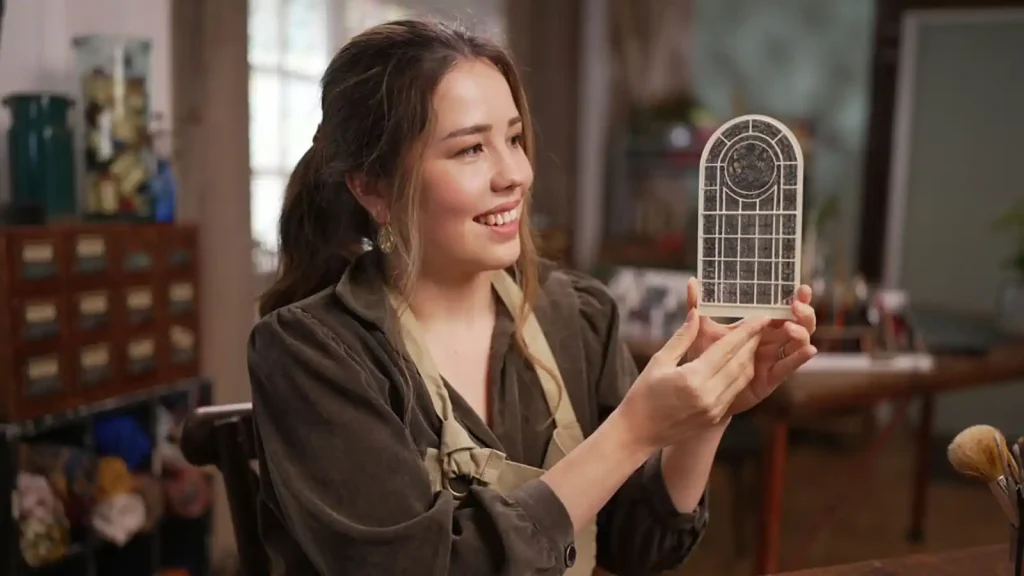
One of the most visually striking elements of Crumpsall Library was its stained-glass windows. These decorative features gave the building much of its character, filtering light through coloured panels and lending the interior a sense of warmth and grandeur. Recreating stained glass at miniature scale presents unique technical difficulties, and the programme devotes considerable attention to how the makers solve them.
The challenge lies not just in colour accuracy but in translucency. Real stained glass transmits light. A painted replica, however detailed, will look flat and lifeless if it does not also allow light to pass through. The makers experiment with materials and techniques to achieve this effect, testing different approaches until they find one that captures the glow of the original windows. The process illustrates a broader truth about intricate craft at this level: every element that seems simple in full scale becomes a complex engineering problem in miniature.
The stained-glass work also highlights the collaborative nature of the model workshop. While Hannah Lemon leads the build, the other makers contribute expertise and problem-solving throughout. Abi Trotman, Lee Robinson, and Ethan Goodbody each bring different perspectives and skills, and the programme shows them consulting, advising, and supporting one another. This team dynamic reinforces the idea that professional model making at the highest level is rarely a solo pursuit. It requires a community of artisan skills working toward a shared vision.
The Personal Touches That Transform a Miniature Model Into a Memory
What separates this build from a purely architectural exercise is the inclusion of deeply personal elements. The makers do not stop at recreating the library’s structure. They add specific items drawn directly from Leah’s memories and from Neil’s life. Most notably, the finished model includes a miniature version of Neil’s school cap — a detail so specific and so intimate that it transforms the diorama from a building into a love letter.
These personal touches represent the heart of what The Marvellous Miniature Workshop Episode 1 seeks to achieve. A technically perfect model of a library would impress viewers with its craftsmanship. A model that includes a dead man’s school cap, placed where his teenage self might have left it, does something far more powerful. It collapses the distance between past and present, between memory and physical object. For Leah, seeing that cap inside the miniature library does not simply remind her of Neil. It places him back inside the space where she first knew him.
The programme handles these moments with considerable sensitivity. Sara Cox and the makers understand that the reveal — the moment when Leah first sees the completed model — carries enormous emotional stakes. They prepare for it carefully, ensuring that every special memory Leah has shared finds expression somewhere in the finished piece. The dioramas produced by this series are not generic displays. They are bespoke creations, built around the specific experiences of specific people, and their power comes from that specificity.
Microscopic Cameras and the Viewer’s Experience of Fine Detail
The Marvellous Miniature Workshop Episode 1 employs microscopic cameras to remarkable effect, allowing viewers to experience the miniature models at a level of detail invisible to the unaided eye. These extreme close-ups reveal textures, imperfections, and subtleties that demonstrate the extraordinary quality of the craftsmanship. A bookshelf that looks convincing from arm’s length becomes astonishing when the camera pushes in to show individually titled spines, realistic wood grain, and carefully applied dust effects.
This cinematographic choice serves both entertainment and educational purposes. For viewers interested in hobbyist craft or scale models, the close-up footage provides genuine insight into techniques and materials. For general audiences, it creates a sense of wonder — a recognition that human hands produced something this small and this detailed. The cameras essentially invite viewers inside the miniature world, turning a tabletop object into an immersive environment.
The programme also uses these shots to build anticipation before the reveal. By showing the model in extreme close-up throughout the construction process, viewers develop their own relationship with the emerging miniature. They notice new details with each sequence, building a cumulative appreciation that mirrors the makers’ own growing investment in the project. By the time Leah sees the finished library, the audience already understands what they are looking at and why it matters.
The Reveal and Its Emotional Impact on Leah
The climactic moment of The Marvellous Miniature Workshop Episode 1 arrives when Leah sees the completed miniature of Crumpsall Library for the first time. The programme builds toward this reveal with careful pacing, allowing tension and anticipation to accumulate naturally. Sara Cox accompanies Leah, providing gentle support while allowing the emotion to unfold without interference.
Leah’s reaction validates everything the programme has been building toward. She recognises the parquet floor, the stained-glass windows, the shelving, and the proportions of the space. She sees the specific personal items the makers included — Neil’s school cap among them — and the recognition triggers a response that transcends simple pleasure. This is not a woman admiring a well-made model. This is someone encountering a lost world restored in miniature, a place she can now hold, examine, and keep.
The reveal also demonstrates the therapeutic potential of miniature recreations. For Leah, the model does not replace what she has lost. Nothing could. However, it provides a physical anchor for memories that might otherwise grow vague over time. The library in her hands will not deteriorate further. The parquet will not buckle. The stained glass will not shatter. In miniature, the building achieves a permanence that the real structure could not maintain, and Leah’s memories gain a tangible home.
Craftsmanship as Preservation of Social History
The Marvellous Miniature Workshop Episode 1 raises important questions about how communities preserve their shared past. Crumpsall Library once served as a cornerstone of its neighbourhood, a public building that represented collective investment in education and culture. Its decline mirrors that of countless similar institutions across Britain, places that once anchored communities now standing empty or demolished.
By recreating the library in miniature form, the programme performs an act of cultural preservation as much as personal commemoration. The finished model captures architectural details, design choices, and spatial qualities that no photograph could fully convey. Future viewers of this model — whether Leah’s family or audiences watching the programme — gain access to a piece of social history that would otherwise exist only in fading memory. The tiny builds produced by the workshop carry historical as well as emotional significance.
This preservation function adds depth to the programme’s appeal. Viewers interested in storytelling through miniatures find technical fascination in the construction process. Those drawn to human interest stories connect with Leah’s journey. Meanwhile, audiences with an interest in heritage and architecture discover a programme that documents vanishing buildings with remarkable fidelity. The 2025 TV shows landscape includes many craft-focused programmes, but few combine technical skill, personal emotion, and historical preservation with such effectiveness.
What The Marvellous Miniature Workshop Reveals About the Power of Small Things
The programme’s title contains its thesis. The workshop is marvellous not because of the scale of what it produces but because of the disproportionate impact those small creations have on real people. Leah’s miniature library weighs almost nothing. It occupies a fraction of a shelf. Yet it contains an entire relationship, an entire building, an entire chapter of a woman’s life. The gap between physical size and emotional magnitude is precisely what makes the concept so compelling.
Sara Cox captures this idea succinctly throughout the episode: it truly is the little things that mean the most. The programme does not need to argue this point. It simply demonstrates it, over and over, through the care the makers invest and the responses their work provokes. Each tiny book, each miniature floorboard, each carefully painted window frame carries meaning because someone chose to make it with intention and precision.
The Marvellous Miniature Workshop Episode 1 establishes a model-making TV series that operates on multiple levels simultaneously. It entertains through the fascination of watching skilled hands create impossibly small objects. It educates through its transparent exploration of materials, techniques, and problem-solving. Most importantly, it moves viewers by connecting all that craftsmanship to real human stories of love, loss, and remembrance. The miniature models may be tiny, but the joy and meaning they deliver prove genuinely immense.
FAQ The Marvellous Miniature Workshop Episode 1
Q: What is The Marvellous Miniature Workshop Episode 1 about?
A: The Marvellous Miniature Workshop Episode 1 follows Sara Cox and miniaturist Hannah Lemon as they recreate Manchester’s Crumpsall Library for a retired social worker named Leah. Leah met her late husband Neil at the library as a teenager. Although the building now stands derelict, Hannah’s intricate 1:24 scale model restores its former splendour. Additionally, the miniature includes deeply personal touches like Neil’s school cap, transforming the piece into a powerful vessel of cherished memories.
Q: Who hosts The Marvellous Miniature Workshop and what is the format?
A: Sara Cox hosts this heartwarming TV craft show on BBC One. In each episode, ordinary people share special memories tied to specific places. A team of professional miniaturists then recreates those locations as detailed miniatures. Furthermore, Sara actively participates by visiting contributors at home, exploring original locations, and engaging with the makers throughout the build process.
Q: Who are the professional miniaturists featured in the workshop?
A: The model workshop features four skilled makers. Hannah Lemon leads the Crumpsall Library build. Meanwhile, Abi Trotman, Lee Robinson, and Ethan Goodbody each contribute specialist artisan skills. Together, they collaborate on problem-solving, material selection, and fine detail work. Consequently, their combined expertise produces realistic replicas that far exceed what any single maker could achieve alone.
Q: Why is Crumpsall Library significant to Leah in this episode?
A: Crumpsall Library holds irreplaceable meaning for Leah because she first met her husband Neil there as a teenager. The library served as their meeting place and courtship ground. However, Neil has since passed away and the building now lies boarded up and derelict. Therefore, the miniature recreation gives Leah a tangible, lasting connection to both the place and the love story it represents.
Q: What scale are the miniature models built at in the series?
A: The makers build all miniature models at 1:24 scale. This precise ratio allows extraordinary fine detail while keeping the finished dioramas small enough to hold. Specifically, features like herringbone parquet floors, stained-glass windows, and individual book spines remain recognisable at this scale. Microscopic cameras then capture these details for viewers, revealing craftsmanship invisible to the naked eye.
Q: How does Hannah Lemon recreate the parquet floor in miniature?
A: Hannah cuts tiny strips of real wood, stains them to match aged tonal variations, and lays each piece by hand in a herringbone pattern. This painstaking process can take hours for a single section. Moreover, any misalignment becomes glaringly obvious under microscopic cameras. The result showcases why handmade miniatures occupy a completely different category from mass-produced scale models.
Q: How do the makers handle the challenge of miniature stained glass?
A: Recreating stained glass at miniature scale requires solving both colour accuracy and translucency challenges. A simply painted replica would look flat and lifeless. Consequently, the makers experiment with various materials and techniques until they achieve panels that genuinely transmit light. This intricate craft process illustrates how every full-scale architectural element becomes a complex engineering problem when reduced to 1:24 scale.
Q: What personal items are included in Leah’s miniature library?
A: Beyond the architectural details, the makers include deeply personal elements drawn from Leah’s memories. Most notably, the finished model features a miniature version of Neil’s school cap. This specific, intimate addition transforms the diorama from a building replica into an emotional storytelling piece. In essence, it places Neil back inside the space where Leah first knew him.
Q: How does the programme use microscopic cameras to enhance the viewing experience?
A: The Marvellous Miniature Workshop uses microscopic cameras to show viewers extraordinary fine detail invisible to the naked eye. These extreme close-ups reveal individually titled book spines, realistic wood grain, and carefully applied textures. As a result, audiences develop a deeper appreciation for the craftsmanship. The technique effectively invites viewers inside the miniature world before the emotional reveal.
Q: What broader themes does The Marvellous Miniature Workshop Episode 1 explore?
A: Beyond personal nostalgia, the episode addresses social history and community heritage. Crumpsall Library once served an entire neighbourhood as a place of learning and aspiration. Its derelict state reflects a wider pattern of civic decline across Britain. Accordingly, the miniature recreation preserves architectural and cultural details that might otherwise vanish entirely. The programme ultimately demonstrates that storytelling through miniatures can honour both individual lives and shared heritage.