Treasures of Ancient Egypt episode 2: Embark on a captivating journey into the heart of Ancient Egypt, where art, history, and human ingenuity converge to tell stories of power, beauty, and transformation. In the second episode of Treasures of Ancient Egypt, Alastair Sooke serves as your expert guide, navigating through an era of unparalleled opulence and cultural innovation. This mesmerizing exploration begins with the compelling, almost haunting, psychological portraits of the tyrant king Senwosret III and culminates in the resplendent golden mask of the boy king Tutankhamun. Along the way, viewers are treated to a kaleidoscope of architectural marvels, exquisite tombs, and a city that witnessed one of the most revolutionary shifts in artistic expression in Egypt’s history.
The episode opens with the enigmatic figure of Senwosret III, a pharaoh whose reign was marked by power and ambition. His portraits, carved with an intensity that reveals both strength and vulnerability, provide a rare glimpse into the psyche of a ruler who sought to dominate not just his kingdom but also the sands of time. These sculptures, with their furrowed brows and downturned mouths, are more than artistic achievements—they are windows into a complex and multifaceted humanity often hidden behind the grandeur of kingship.
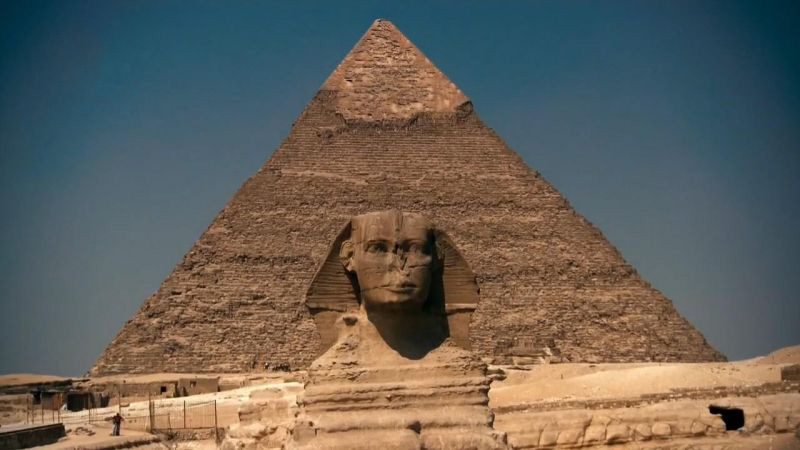
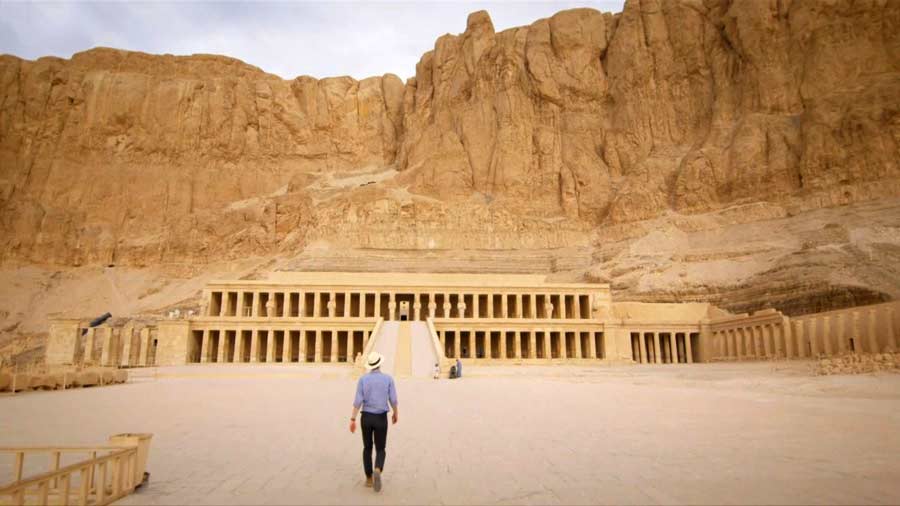
As the journey progresses, Sooke leads us into the golden age of Egyptian art, where intricate craftsmanship and grandiose visions defined the era. One cannot help but marvel at the towering obelisks and the colossal statues that stand as enduring symbols of ancient ingenuity. These architectural wonders, bathed in the desert sun, evoke a sense of awe that transcends millennia. Among these, the tombs of the pharaohs offer a glimpse into a world where death was not an end but a gateway to eternity. The walls of these tombs, adorned with vibrant frescoes and hieroglyphs, tell tales of gods and mortals, weaving a narrative that is as timeless as it is profound.
No exploration of Ancient Egypt’s artistic treasures would be complete without a visit to the city of Amarna, the site of one of the most significant artistic revolutions in history. Under the reign of King Akhenaten and Queen Nefertiti, a new artistic style emerged, characterized by sinuous forms and unprecedented naturalism. This shift broke away from the rigid conventions of earlier periods, introducing a fluidity and emotional depth that captured the essence of life itself. The art of Amarna, with its tender family scenes and expressive depictions of the royal couple, speaks of a humanity that feels strikingly modern.
The episode reaches its dazzling conclusion with the golden mask of Tutankhamun, a masterpiece that epitomizes the splendor of Ancient Egyptian artistry. Crafted with exquisite detail, the mask is more than a symbol of wealth; it is a testament to the enduring legacy of a civilization that revered beauty and craftsmanship. As Sooke examines the intricate patterns and radiant gold, he reveals the layers of meaning embedded in this iconic artifact. The mask, like the culture it represents, is both a celebration of life and a poignant reminder of its fragility.
Interwoven throughout the episode are insights from leading Egyptologists and contemporary artists, who shed light on the enduring relevance of Ancient Egyptian art. They remind us that beneath the glittering veneer lies a deeply human story—one of love, ambition, and the eternal quest for meaning. These experts help bridge the gap between past and present, showing how the art of Ancient Egypt continues to inspire and resonate in the modern world.
What makes this exploration truly compelling is its ability to connect the viewer emotionally to a civilization that, despite the passage of thousands of years, feels remarkably familiar. Through Sooke’s narrative and the vivid imagery of these treasures, we are reminded of the universal truths that bind humanity across time. The grandeur of the pharaohs, the devotion to the gods, and the artistic expressions of love and power all echo the fundamental aspects of the human experience.
As the credits roll, one cannot help but reflect on the enduring allure of Ancient Egypt. Its treasures are not merely relics of the past; they are vibrant testaments to a culture that valued creativity, innovation, and the pursuit of immortality. In Treasures of Ancient Egypt, Alastair Sooke invites us to see beyond the gold and grandeur, uncovering the humanity that lies at the heart of these ancient masterpieces. This journey through time is not just a lesson in history but a celebration of the timeless connection between art and the human spirit.
Treasures of Ancient Egypt episode 2 – The Golden Age
Nefertiti
Neferneferuaten Nefertiti (c. 1370 – c. 1330 BC) was an Egyptian queen and the Great Royal Wife of Akhenaten, an Egyptian Pharaoh. Nefertiti and her husband were known for a religious revolution, in which they worshipped one god only, Aten, or the sun disc. With her husband, she reigned at what was arguably the wealthiest period of Ancient Egyptian history. Some scholars believe that Nefertiti ruled briefly as Neferneferuaten after her husband’s death and before the accession of Tutankhamun, although this identification is a matter of ongoing debate. If Nefertiti did rule as Pharaoh, her reign was marked by the fall of Amarna and relocation of the capital back to the traditional city of Thebes.
Nefertiti had many titles including Hereditary Princess; Great of Praises; Lady of Grace, Sweet of Love; Lady of The Two Lands; Main King’s Wife, his beloved; Great King’s Wife, his beloved, Lady of All Women; and Mistress of Upper and Lower Egypt. While modern Egyptological pronunciation renders her name as Nefertiti, her name was probably contemporaneously pronounced as Nafertyiti.
Akhenaten
Akhenaten, known before the fifth year of his reign as Amenhotep IV (sometimes given its Greek form, Amenophis IV, and meaning “Amun Is Satisfied”), was an ancient Egyptian pharaoh of the 18th Dynasty, who ruled for 17 years and died perhaps in 1336 BC or 1334 BC.
He is noted for abandoning traditional Egyptian polytheism and introducing worship centered on the Aten (notably instead of Amun, the temples of which he destroyed, the name of whom he rubbed off and the priests of whom he left without resources), which is sometimes described as monolatristic, henotheistic, or even quasi-monotheistic. An early inscription likens the Aten to the sun as compared to stars, and later official language avoids calling the Aten a god, giving the solar deity a status above mere gods.
Senusret III
Khakaure Senusret III (also written as Senwosret III or the hellenised form, Sesostris III) was a pharaoh of Egypt. He ruled from 1878 BC to 1839 BC during a time of great power and prosperity, and was the fifth king of the Twelfth Dynasty of the Middle Kingdom. He was a great pharaoh of the Twelfth Dynasty and is considered to be, perhaps, the most powerful Egyptian ruler of the dynasty.
Consequently, he is regarded as one of the sources for the legend about Sesostris. His military campaigns gave rise to an era of peace and economic prosperity that reduced the power of regional rulers and led to a revival in craftwork, trade, and urban development. Senusret III was among the few Egyptian kings who were deified and honored with a cult during their own lifetime.