The documentary Treasures of Ancient Greece episode 1 reveals that the journey to artistic perfection, long defined by the West, began not with the familiar white marble temples of Athens, but in a far older, stranger world of myth and monsters. While we often credit the ancient Greeks with inventing realistic art, the roots of this tradition are deeper and more complex than previously understood. Understanding the origins of Greek art offers insight into the very foundation of Western aesthetic values. It connects us to a continuous story of human creativity that spans millennia, influencing everything from Renaissance masterpieces to modern design.
This exploration delves into the surprising beginnings of Greek artistic expression. The narrative pieces together the earliest influences, separating historical fact from enduring myth. It draws upon both epic poetry and modern archaeology to reveal how the miracle of Greek art came into being. The scope of Treasures of Ancient Greece episode 1 covers a thousand-year period, tracing art’s instrumental role in unifying a scattered collection of kingdoms into the civilization we now call ancient Greece. This evolution showcases a dynamic progression of artistic focus.
The quest begins on the island of Crete, within the legendary palace of Knossos. Here, we encounter the vibrant, nature-inspired works of the Minoan civilization. From Crete, the story moves to the volcanic island of Santorini and the remarkably preserved settlement of Akrotiri, a ‘Greek Pompeii’. The journey then shifts to the Greek mainland, exploring the fabled, fortified palace of Mycenae. Finally, it navigates the enigmatic period known as the Greek Dark Ages, uncovering dazzling remains that challenge long-held assumptions about this era.
The story of this discovery starts just over a century ago. In 1900, an English archaeologist named Arthur Evans arrived on Crete. Guided by the words of the ancient poet Homer, who wrote of a great city called Knossos ruled by King Minos, Evans began to dig. He was driven by the myth of the Labyrinth and its monstrous inhabitant, the Minotaur. Evans was convinced that the legends held a kernel of historical truth, a belief that would lead to one of the most significant archaeological finds in history.
His excavation unearthed the sprawling, unfortified palace of Knossos, dating back to between 1700 and 1400 BC. Evans believed he had found the court of King Minos and named the civilization he uncovered the Minoans. The art he found was a revelation. It depicted a world seemingly at peace, filled with images drawn from nature. This discovery proved that Greek art had richer, deeper roots than anyone had imagined, predating the glories of Classical Greece by more than a thousand years. A new chapter in the history of art had begun.
Treasures of Ancient Greece episode 1
The Minoan Vision and the Specter of Mycenae
The art of the Minoan civilization, as unearthed by Arthur Evans, presented a vision of a people deeply connected to the natural world. Their fascination with its curves, shapes, and rhythms dominated their artistic output. A standout example is the famous bull-leaping fresco from Knossos. This dynamic wall painting depicts a dangerous spectacle of acrobats somersaulting over a charging bull. The composition is fluid and full of life, capturing a sense of joyful, buoyant movement. According to Alastair Sooke, the work’s “audacity of simplicity” shares an artistic spirit with works created thousands of years later.
This connection to nature was a recurring theme. The Minoan goddess holding two snakes aloft shows defiance and power, while other frescoes celebrate the landscape itself. Further evidence of this sophisticated culture emerged on Santorini. The settlement of Akrotiri, preserved by a colossal volcanic eruption around 1600 BC, offers a remarkable time capsule. Its exquisite frescoes share the Minoan love of nature seen on Crete. Paintings of cavorting swallows and clambering blue monkeys demonstrate a keen observation of the animal world and a delight in capturing fleeting moments of life.
However, a fresco found at Akrotiri also provides evidence of a new, formidable power. It depicts warriors marching up a hill, their armor and weapons identifying them not as Minoans but as Mycenaeans from mainland Greece. This artwork signals a dramatic shift. Just as the Minoans had once colonized Santorini, the formidable Mycenaeans would eventually take over Knossos on Crete. The art of these warrior kings would offer a stark, martial contrast to the pastoral paradise imagined by the Minoans, heralding a new era for the region.
Homeric Riches and the Age of Heroes in the Treasures of Ancient Greece episode 1
In 1876, another explorer driven by Homeric tales arrived on the Greek mainland. The German adventurer Heinrich Schliemann came to the Peloponnese in search of the grave of Agamemnon, the legendary king who led the Greeks in the Trojan War. His destination was Mycenae, a huge fortified palace that had lain in ruins for three millennia. Approaching the citadel, one is struck by its imposing, warlike character. The thick, intimidating walls, which later Greeks called cyclopean walls because they believed only a giant Cyclops could have moved the stones, speak of a society built for conflict.
To enter Mycenae, one must pass through the iconic Lion Gate, a relief sculpture signaling the power of the city’s rulers. Inside the walls, Schliemann made a spectacular discovery: a circle of shaft graves. Within these deep trenches, he unearthed a hoard of golden objects that exceeded even his wildest dreams of Homeric riches. He found hundreds of luxurious items, justifying Homer’s description of Mycenae as “rich in gold.” The most famous of these is the so-called Mask of Agamemnon, a golden death mask of a bearded man. Schliemann excitedly telegraphed, “I have gazed upon the face of Agamemnon.”
Although later analysis revealed the artifacts predated the era of a historical Agamemnon by several centuries, the find was monumental. Schliemann had uncovered the treasures of a powerful and sophisticated Mycenaean civilization. Among the treasures were two golden cups, which beautifully merge Minoan and Mycenaean artistry. They depict scenes of wild bull-hunting with extraordinary detail, showcasing both peaceful capture and fierce conflict. These objects can be read as a metaphor for the shifting political landscape, with the fierce bulls perhaps symbolizing the aggressive Mycenaean way of life supplanting the more serene Minoan world. This period, with its warrior kings and grand citadels, would become the Age of Heroes for later Greeks.
The Greek Dark Ages and the Rebirth of Form
By the 11th century BC, the great Mycenaean strongholds lay abandoned. This collapse ushered in a period that historians have termed the Greek Dark Ages, an era lasting roughly 300 years. The population plummeted, and the causes of the catastrophe—whether war, environmental disaster, or internal strife—remain a mystery. For a long time, it was believed that the visual arts almost completely disappeared during this interval. The human figure, a central subject of both Minoan and Mycenaean art, vanished from the artistic record for several centuries.
However, recent archaeological finds have challenged the idea that this period was entirely devoid of cultural development. On the island of Euboea, at a site now known as Lefkandi, evidence has emerged of a surprisingly sophisticated society. Excavators uncovered the remains of a vast building from the 10th century BC, a structure that preceded the architecture of Greek temples by at least two centuries. Inside, they found the graves of a man and woman buried with fine grave goods, including a Babylonian necklace that was already a thousand years old at the time of its burial.
Among these items was a remarkable object that pointed the way toward a new vision for Greek art: the Lefkandi Centaur. This ceramic figure of a half-man, half-horse creature is the first known depiction of mythology in Greek sculpture. While small and seemingly simple, this centaur offers a blueprint for future artistic development. As Alastair Sooke explains, it combines a love of geometric pattern with a burgeoning passion for mythology. It was this renewed interest in geometric design and storytelling that would ultimately lead Greek art out of the Dark Ages and set the stage for its next evolution.
The Rise of Geometric Design and Eastern Influence in the Treasures of Ancient Greece episode 1
Following the Greek Dark Ages, a distinct artistic style emerged, characterized by its fascination with pattern. For centuries, Greek pots were not decorated with human scenes but with swathes of intricate geometric designs. Around 750 BC, a pivotal moment occurred, witnessed on large geometric pots used as tomb markers. Amid the relentless rows of triangles, zigzags, and meanders, the human figure made its return. These stickmen, with their triangular torsos and shapely legs, depict funerary scenes, such as the lying in state of the deceased, surrounded by mourners tearing their hair in grief. These rudimentary figures mark the start of the enduring Greek obsession with the human form.
Soon, the decoration on these vases acquired a new narrative power. By the 7th century BC, the dense patterning gave way to larger, more dynamic figures depicting myths and monsters. A famous example shows the blinding of the Cyclops Polyphemus by Odysseus, a story related in Homer’s The Odyssey. Artists also began depicting Gorgons, terrifying creatures with snake hair that could turn a man to stone. This shift was accelerated by the adoption of the black-figure technique, a style learned from Middle Eastern metalworkers. This method, which involved painting figures in silhouette and then incising details with a sharp point, allowed for bold, graphic storytelling that spread across the Greek world.
This growing sense of a shared Greek identity, or Hellas, was paradoxically stimulated by foreign contact. The island of Samos, a frontier territory where West met East, became a crucial hub. Here, treasures retrieved from the sanctuary known as the Heraion show clear Eastern influence. Bronze griffin heads, originally a Middle Eastern motif, were produced in Samian workshops.
Most striking is the influence of Egypt. A giant statue from the 6th century BC, known as a kouros, stands in a stiff, frontal pose with clenched fists, echoing Egyptian statuary. Yet, as Sooke points out, a Greek spirit is visible in the softening of the flesh and the figure’s nudity, anticipating later developments in Greek art. These kouroi, found all over Greece, reveal a deep fascination with symmetry and pattern, melded with an emerging naturalism.
Competition and the Animation of Form at Panhellenic Sanctuaries
As wealth and power grew, a number of thriving city-states, such as Athens, Corinth, and Sparta, began to emerge. These ambitious rivals fought frequently but also needed places to convene in peacetime. Sanctuaries like Delphi became vital spiritual centers where Greeks from every city-state could gather to share their common culture and compete in athletics. The oracle of Apollo at Delphi became a way for warring states to settle disputes, and once there, they sought to leave their mark. These sanctuaries became showcases for artistic achievement and conspicuous expenditure.
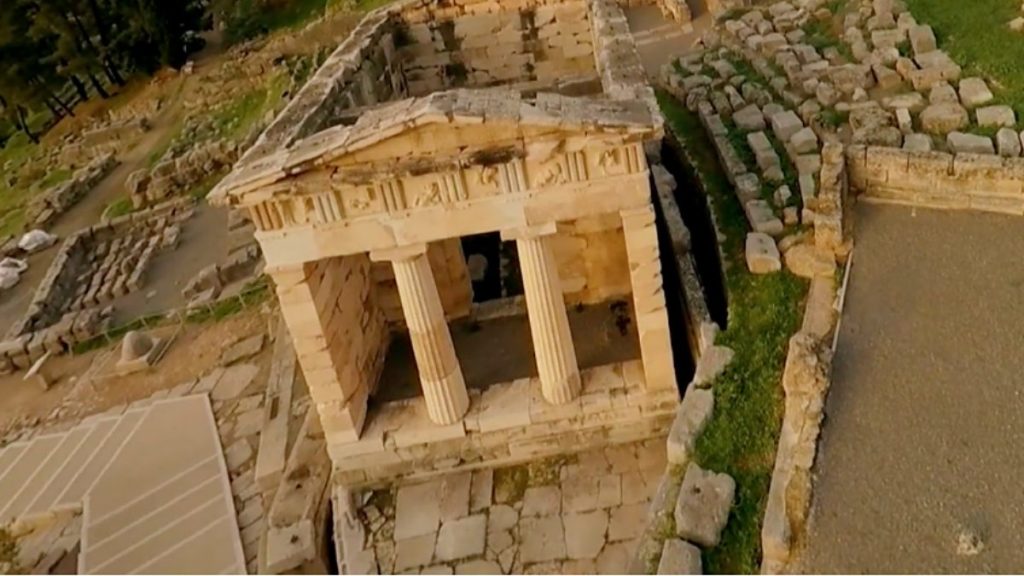
Delphi became a cornucopia of imagery, crammed with statues of gods, triumphant athletes, and elaborate sculpted friezes decorating treasuries built to honor military victories. Art became a medium for political competition. The Siphnian Treasury, for instance, featured an elaborate frieze that dramatizes the mythological battle of gods and giants. The carving shows a new dynamism; the figures are not isolated but part of a surging, pulsing rhythm of battle. There is an unprecedented sense of depth and overlapping form. This new vigor was a radical departure from the static forms of the past.
This spirit of competition spurred a new energy and creativity in Greek art. Artists began to compete among themselves, like athletes, to scale new creative heights. This creative ferment invigorated even the stiff, formal kouroi. While still owing a debt to the Egyptian model, they began to relax into something unmistakably Greek. A kouros found in a cemetery shows this evolution.
Although he retains the frontal pose and rigid arms, there is a new poise and presence of a real person. The muscles, while exaggerated, represent an expressive attempt to understand how human anatomy works. Slowly, Greek sculpture was softening up, moving toward a new era of realism and self-confidence, culminating in dynamic works like the Tyrant Slayers statues in Athens.
The Eternal Thread: How Ancient Discoveries Continue to Shape Our Creative DNA
The remarkable journey through ancient Greece’s artistic evolution reveals something profound about human creativity itself—it’s never truly created in isolation, but rather emerges from a rich tapestry of cultural collision, competition, and continuous reinvention. From Arthur Evans kneeling in the Cretan soil to uncover Minoan frescoes to Heinrich Schliemann telegraphing his discovery of golden treasures, these archaeological revelations didn’t just unearth ancient artifacts; they uncovered the very blueprint of how Western civilization learned to see beauty.
What strikes most powerfully about this thousand-year artistic odyssey is how each civilization built upon its predecessors while adding something distinctly their own. The Minoans gave us nature’s fluid grace—those bulls leaping across palace walls still pulse with an energy that modern artists recognize. The Mycenaeans introduced the drama of human conflict and power, their golden death masks staring across millennia with an intensity that Hollywood directors would envy. Even during the supposed “Dark Ages,” when the great palaces lay abandoned, creativity didn’t die—it retreated, regrouped, and emerged transformed in the geometric patterns and mythological centaurs that would eventually bloom into classical perfection.
This pattern of cultural cross-pollination feels remarkably contemporary. Just as ancient Greek artists absorbed Egyptian techniques, Eastern motifs, and Babylonian craftsmanship to create something uniquely Hellenic, today’s creators continue to remix, reimagine, and synthesize influences from across time and geography. The competitive spirit that drove city-states to outdo each other with increasingly spectacular temple sculptures mirrors the creative rivalry that pushes modern artists, designers, and innovators to break new ground.
Perhaps most fascinating is how the human figure—that central obsession of Greek art—vanished completely during the Dark Ages only to return stronger than ever. Those stick-figure mourners on geometric pottery represent more than artistic recovery; they embody humanity’s irrepressible need to see ourselves reflected in our creations. Every time we’re moved by a Renaissance painting, captivated by a modern sculpture, or even touched by a simple photograph capturing human emotion, we’re experiencing echoes of that same impulse that drove anonymous Greek artists to scratch human forms into clay three thousand years ago.
The discoveries at Knossos, Mycenae, and Lefkandi remind us that creativity is archaeology in reverse—each generation builds new layers of meaning on ancient foundations. Understanding these roots doesn’t just satisfy academic curiosity; it helps us recognize the continuous thread connecting past and present, revealing that our modern aesthetic sensibilities aren’t arbitrary preferences but part of an unbroken conversation spanning millennia.
For anyone who creates, appreciates art, or simply wonders why certain images move us so deeply, this ancient Greek journey offers both inspiration and perspective. We’re not starting from scratch—we’re part of a creative lineage that survived dark ages, absorbed foreign influences, and transformed competition into innovation. The next time you’re struck by a piece of art that seems to speak directly to you, remember: you’re hearing echoes of conversations that began in Minoan palaces, continued through Mycenaean citadels, and refuse to end.
FAQ Treasures of Ancient Greece episode 1
Q: Where did ancient Greek art actually originate?
A: Contrary to popular belief, ancient Greek art didn’t begin with the white marble temples of Athens. Archaeological evidence reveals that Greek artistic traditions originated over a thousand years earlier in the Minoan civilization on Crete (1700-1400 BC). These early artists created vibrant, nature-inspired frescoes that predate Classical Greece significantly. Additionally, the Mycenaean warrior culture on mainland Greece contributed martial themes and golden treasures that influenced later artistic development.
Q: Who discovered the Minoan civilization and why was it significant?
A: English archaeologist Arthur Evans discovered the Minoan civilization in 1900 while excavating the palace of Knossos on Crete. Guided by Homer’s references to King Minos, Evans uncovered a sophisticated culture that revolutionized understanding of Greek art’s origins. Furthermore, the Minoan artworks depicted a peaceful, nature-connected society with fluid, dynamic compositions like the famous bull-leaping fresco, proving Greek artistic traditions were far older and more complex than previously imagined.
Q: How did Mycenaean art differ from Minoan artistic traditions?
A: Mycenaean art marked a dramatic shift from Minoan peaceful naturalism to martial themes reflecting their warrior culture. While Minoans celebrated nature with flowing frescoes of animals and landscapes, Mycenaeans emphasized power through fortified palaces, golden death masks, and military imagery. However, objects like the golden bull-hunting cups beautifully merged both traditions, symbolizing the transition from Minoan serenity to Mycenaean aggression and creating a bridge between these distinct artistic philosophies.
Q: What happened to Greek art during the Dark Ages?
A: Traditionally, historians believed Greek art nearly disappeared during the Dark Ages (11th-8th centuries BC), with the human figure vanishing completely from artistic records. However, recent archaeological discoveries at Lefkandi challenge this assumption. Excavators found sophisticated burials with precious grave goods and the remarkable Lefkandi Centaur—the first mythological sculpture in Greek art. Consequently, this period wasn’t entirely devoid of creativity but represented a transformation period where geometric patterns and mythological storytelling emerged.
Q: How did Heinrich Schliemann’s discoveries change our understanding of ancient Greece?
A: Heinrich Schliemann’s 1876 excavation at Mycenae, inspired by Homer’s descriptions, uncovered spectacular golden treasures including the famous “Mask of Agamemnon.” Although later analysis revealed these artifacts predated the historical Agamemnon by centuries, Schliemann’s discoveries proved Homer’s descriptions of “gold-rich Mycenae” had historical basis. Moreover, his finds demonstrated the sophistication of Mycenaean civilization and validated using literary sources as archaeological guides, revolutionizing approaches to ancient history research.
Q: How did Eastern cultures influence early Greek artistic development?
A: Eastern influence profoundly shaped Greek art through trade and cultural exchange, particularly on frontier islands like Samos. Greek artists adopted the black-figure technique from Middle Eastern metalworkers, enabling bold graphic storytelling on pottery. Additionally, Egyptian sculptural traditions inspired the rigid, frontal poses of early Greek kouroi statues. However, Greeks transformed these foreign influences by adding distinctly Hellenic elements like naturalistic flesh modeling and nudity, creating uniquely Greek artistic expressions from international sources.
Q: How did Greek pottery evolve from geometric patterns to narrative scenes?
A: Greek pottery underwent dramatic transformation from abstract geometric designs to complex narrative art over several centuries. Initially, post-Dark Age pottery featured intricate patterns—triangles, zigzags, and meanders—without human figures. Around 750 BC, stick-figure humans reappeared in funerary scenes on tomb markers. Subsequently, by the 7th century BC, artists created larger, more dynamic figures depicting mythological stories like Odysseus blinding Polyphemus, marking the beginning of Greek narrative art and storytelling traditions.
Q: What role did competition play in advancing Greek artistic achievement?
A: Competition became a crucial catalyst for Greek artistic innovation, particularly at Panhellenic sanctuaries like Delphi. City-states competed to create the most impressive artistic displays—elaborate treasuries, sculpted friezes, and monumental statues—to demonstrate their wealth and power. Furthermore, artists themselves began competing like athletes, pushing creative boundaries and technical excellence. This competitive spirit transformed static Egyptian-influenced kouroi into dynamic, naturalistic sculptures, ultimately leading to the unprecedented realism of classical Greek art.
Q: Why was the human figure so important in Greek art?
A: The human figure represented the core of Greek artistic philosophy and cultural identity. After disappearing during the Dark Ages, its return marked renewed confidence and cultural renaissance. Greek artists became obsessed with understanding human anatomy, proportion, and movement, viewing the human body as the perfect expression of divine harmony. Additionally, this focus reflected Greek humanistic values—placing humans at the center of their worldview rather than gods or abstract concepts, establishing foundations for Western artistic traditions.
Q: How do ancient Greek artistic discoveries continue influencing modern creativity?
A: Ancient Greek artistic discoveries provide a continuous thread connecting past and present creative expression. Modern artists still recognize the energy in Minoan bull-leaping frescoes and the power of Mycenaean golden masks. Furthermore, the Greek pattern of cultural cross-pollination—absorbing foreign influences while creating something uniquely their own—mirrors contemporary creative processes. Consequently, understanding these ancient foundations helps modern creators recognize they’re part of an unbroken artistic lineage that transforms competition into innovation and survives through continuous reinvention.