The Great Pottery Throw Down 2026 episode 9 arrives at its most demanding juncture yet, with the semi-final placing four remaining potters under extraordinary pressure inside the Gladstone Museum. This is the week where technical mastery, creative ambition, and emotional resilience converge — and only the strongest will earn a place in the final. The stakes have never been higher, and the challenges set before the contestants reflect that gravity with unflinching precision.
Ceramics, as a craft, demands patience and discipline in equal measure. Yet this semi-final episode pushes far beyond those fundamentals, asking potters to engage with two distinct disciplines in a single day: the intricate, painstaking art of mosaic-making and the technically complex engineering of a working water fountain. Both challenges draw inspiration from one of the world’s most iconic landmarks — Rome’s Trevi Fountain — a structure that has stood as a symbol of ambition, beauty, and craftsmanship for centuries.
The Great Pottery Throw Down 2026 has consistently raised its expectations as the series has progressed, but episode 9 represents a genuine step change. The combination of mosaic work and fountain construction tests not only skill but also the ability to conceive and execute a cohesive aesthetic vision. These are not standalone exercises. They are two halves of a unified artistic statement, and the judges evaluate them accordingly.
Keith Brymer Jones, the series’ beloved judge whose emotional investment in ceramics is well-documented across the show’s history, brings his characteristic blend of warmth and rigorous critical assessment to these semi-final challenges. Alongside him, the judging panel holds the potters to the highest standards the competition has yet demanded. For the contestants, this is the culmination of weeks of development, risk-taking, and refinement within the walls of the Gladstone Museum.
The Gladstone Museum itself functions as more than a backdrop. Its Victorian industrial architecture — the bottle kilns, the cobbled yard, the workshop interiors saturated with clay dust and history — sets a tone that amplifies the seriousness of what unfolds. Pottery has been made in spaces like this for generations, and the potters working here are acutely aware of that lineage. It lends their efforts a weight that extends beyond the competition itself.
The Trevi Fountain inspiration is not decorative window-dressing. It is a deliberate conceptual framework that asks potters to think about water, movement, mythology, and monumental scale — and to translate those ideas into functional, beautiful ceramic objects. Rome’s great fountain was itself a feat of engineering and artistry working in tandem, and that dual demand echoes precisely through the semi-final’s twin challenges.
What separates this episode from earlier rounds is the sheer integration required. Mosaics demand a fundamentally different skill set from throwing or hand-building. They require an eye for colour, a feel for texture at the tile level, and the spatial intelligence to compose an image or pattern across a fragmented surface. Fountains, meanwhile, require structural integrity, understanding of water flow, and the confidence to build forms that will actually function under pressure.
The Great Pottery Throw Down 2026 episode 9 therefore asks its potters to be, simultaneously, painters, engineers, sculptors, and designers. The four remaining contestants step into that challenge carrying the accumulated knowledge and pressure of an entire competition series — and what they produce in this semi-final defines not only who reaches the final, but who they are as ceramic artists.
The Great Pottery Throw Down 2026 episode 9
The Semi-Final Setting and What It Demands of The Great Pottery Throw Down 2026 Contestants
Entering the semi-final, the four remaining potters bring with them distinct creative identities developed over the course of the competition. Each has demonstrated specific strengths, and those strengths are tested in specific ways by the structure of episode 9. The mosaic challenge arrives first, establishing the visual and thematic foundation. The fountain challenge follows, demanding that everything learned in the morning session feed into a larger, more technically demanding creation.
The Gladstone Museum provides kilns, tools, and the atmospheric weight of its industrial heritage, but it cannot provide certainty. Ceramics remains an unpredictable medium. Glazes behave differently than expected. Structures crack under stress. Time — always a pressure in the Throw Down — accelerates its demands when the complexity of the work increases. Semi-final conditions strip away any margin for error that earlier rounds may have permitted.
Keith Brymer Jones has spoken throughout the series about the qualities he values most in ceramic artists: technical honesty, creative courage, and the ability to solve problems without compromising the integrity of the work. The semi-final is precisely the stage where those qualities are most visibly tested, and where the distance between strong competitors and truly exceptional ones becomes apparent.
Mosaic Making in The Great Pottery Throw Down 2026: Technique, Colour, and Ceramic Precision
The mosaic challenge draws on one of the oldest decorative traditions in Mediterranean craft history. Roman mosaic work — the tradition that directly inspired the Trevi Fountain’s broader aesthetic context — involved thousands of individually placed tesserae, each contributing to a composition only fully visible from a distance. Potters in the Great Pottery Throw Down 2026 semi-final face a compressed version of that same challenge, with the added complexity of working in ceramic rather than stone or glass.
Creating ceramic mosaic pieces requires the potter to think at two scales simultaneously. At the macro level, the overall composition — its colours, shapes, and thematic coherence — must read clearly and confidently. At the micro level, each individual tile or fragment must be cut, shaped, and placed with precision. A single misjudged tile can disrupt the visual rhythm of an entire section. There is no room for approximation in work of this kind.
The potters approach their mosaics with varying strategies. Some work from detailed preparatory sketches, mapping the composition before a single tile is cut. Others develop their designs more intuitively, allowing the material to guide their decisions as they go. Both approaches carry risks. The planned approach can become rigid under the pressure of time; the intuitive approach can lose coherence without a strong underlying structure. The most successful work in this challenge comes from potters who find the balance between preparation and responsiveness.
Colour management in ceramic mosaic work presents its own distinct challenges. Glazes shift during firing, and what appears as a harmonious palette in the unfired state can resolve very differently after the kiln. Experienced potters anticipate this shift, adjusting their colour choices accordingly. For those less familiar with the mosaic form, the kiln can deliver unwelcome surprises. Ceramics as a discipline rewards those who understand the chemistry of their materials, and the mosaic challenge makes that requirement explicit.
The Trevi Fountain as Creative Framework and Its Influence on Pottery Design
Rome’s Trevi Fountain has endured as one of the world’s most recognisable monuments for good reason. Its design integrates architecture, sculpture, and hydraulic engineering into a single overwhelming spectacle. Neptune commands the central arch, flanked by allegorical figures, while water cascades in multiple directions across a vast basin. The fountain is not merely decorative — it is a complete artistic and functional system.
For the potters of the Great Pottery Throw Down 2026, this source material offers both inspiration and challenge. The Trevi Fountain’s aesthetic is explicitly grand, mythological, and theatrical. Translating that sensibility into ceramic objects requires either committing to that grandeur or finding a personal interpretation that remains authentically connected to the source. Neither approach is easy. Imitation without understanding produces empty pastiche; reinterpretation without visual connection loses the brief entirely.
The most compelling responses to the Trevi Fountain brief in this semi-final are those that identify a specific quality of the original — its relationship to water movement, its use of figure in relief, its layering of forms at different depths — and develop that quality within a ceramic vocabulary. Keith Brymer Jones and his fellow judges look for exactly this kind of purposeful engagement with the source material, and their assessments reflect the degree to which each potter achieves it.
Water as a design element presents particular challenges in ceramic work. The material itself is static; it is the form that must imply movement. Curves that suggest flow, textures that evoke turbulence, openings calibrated to direct water in specific directions — these are the design tools available to the potter. Those who use them with confidence produce fountains that feel genuinely alive. Those who underestimate the challenge produce objects that, while potentially beautiful in a static sense, fail to convincingly embody their function.
The Water Fountain Challenge: Engineering and Artistry in The Great Pottery Throw Down 2026
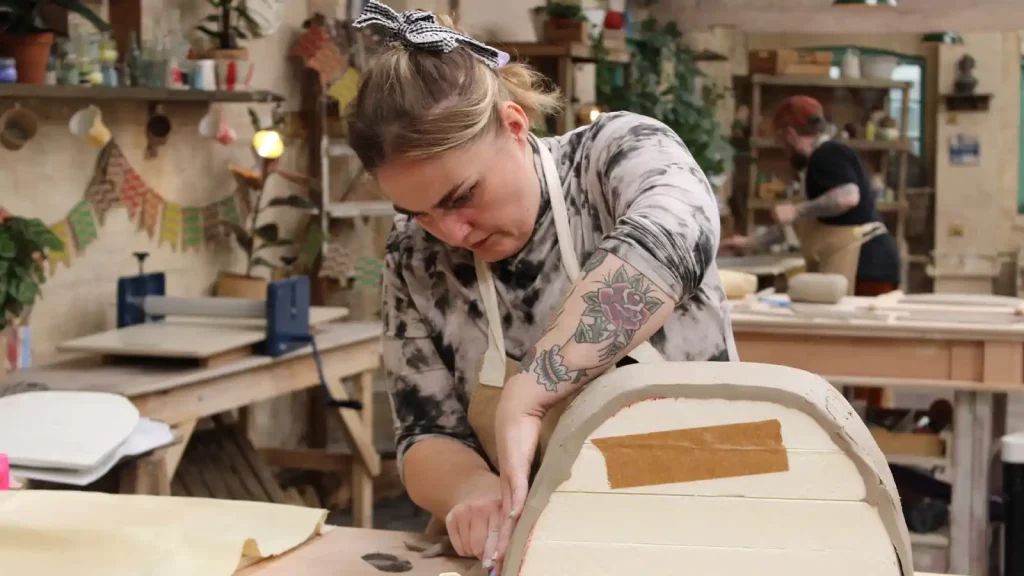
Building a working water fountain in ceramics is among the most technically demanding challenges the Great Pottery Throw Down has ever set. The form must be structurally sound enough to withstand the continuous flow of water, aesthetically coherent with the Trevi Fountain brief, and practically functional — meaning water must enter, move through, and exit the structure in a controlled and visually pleasing manner.
The engineering dimension of this challenge separates it clearly from most ceramic work. A pot or a sculptural piece can fail in purely aesthetic terms and still exist as a physical object. A fountain that does not function has failed at the most fundamental level, regardless of how beautiful its surface treatment may be. This absolute criterion concentrates the mind powerfully, and the potters must resolve the structural and hydraulic logic of their designs before they can devote full attention to the decorative elements.
Wall thickness is a critical variable in fountain construction. Too thin, and the structure risks cracking under the weight of water and its own fired mass. Too thick, and the piece becomes unwieldy, heavy, and potentially unstable. The potter must judge this balance by feel and experience, drawing on their understanding of clay’s behaviour through the drying and firing process. Those who have built confidently across earlier rounds of the competition have the advantage of accumulated physical knowledge; for those whose technical confidence is less established, the fountain challenge exposes that gap directly.
The connection points where water enters and exits the fountain require particular attention. These joints must be sealed completely to prevent leakage while remaining visually integrated into the overall design. A poorly resolved pipe connection can undermine the entire aesthetic of an otherwise strong piece. The judges at the Gladstone Museum are unsparing in their scrutiny of such details, understanding that craft at the highest level tolerates no separation between technical and aesthetic quality.
Keith Brymer Jones and the Judging Standards of The Great Pottery Throw Down 2026
Keith Brymer Jones is one of British ceramics’ most recognisable figures, and his presence as lead judge on the Great Pottery Throw Down has defined the show’s critical register from its earliest series. His approach to judging combines deep technical knowledge with genuine emotional engagement. He is not interested in work that plays it safe. He responds most powerfully to pottery that takes risks, that reveals something about the maker, that pushes against the boundaries of what the medium is expected to do.
In the context of the semi-final, those values become directly relevant to the judging outcomes. The potters who reach the final are not necessarily those who produce the technically cleanest work. They are those who demonstrate, through their mosaic and fountain creations, that they are capable of working at a genuinely ambitious level — and that their creative vision is coherent, purposeful, and distinctly their own.
The Gladstone Museum’s judging process in this episode is thorough and detailed. Each piece is assessed both as a standalone object and in relation to the brief. Keith Brymer Jones examines surface quality, structural integrity, colour harmony, and the degree to which the functional requirements of the fountain have been met. His co-judge brings complementary perspectives, ensuring that no significant dimension of the work escapes scrutiny.
What the judges ultimately seek in a semi-final performance is evidence of a complete ceramic artist — someone who can conceive, plan, execute, and problem-solve across the full arc of a complex challenge. The potters who demonstrate that completeness move forward. Those who reveal significant gaps in any of these areas face elimination, regardless of how impressive their work may be in partial terms.
Competitor Performances and the Pressure of Elimination
The four remaining potters arrive at the semi-final as well-matched competitors who have all demonstrated compelling strengths in earlier episodes. What distinguishes their performances in episode 9 is not a simple hierarchy of skill but rather how each potter responds to the specific demands of mosaic work and fountain construction when combined in a single high-pressure day.
The mosaic challenge reveals aspects of each competitor’s creative personality that may not have been fully visible in earlier rounds. Those with a strong graphic sensibility — an instinct for composition and colour — find their confidence here. Those whose strengths lie primarily in three-dimensional form must adapt their thinking to a fundamentally different set of spatial demands. The ability to make that adaptation quickly, without losing creative momentum, is itself a key indicator of semi-final readiness.
As the day progresses toward the fountain challenge, the cumulative pressure of the competition becomes increasingly visible. Decisions that would feel manageable in an earlier round carry greater weight here. A structural choice that proves problematic cannot simply be revisited; time has become too compressed, the stakes too high. The potters must back their instincts and commit fully to their approaches, trusting that the foundations of their ceramic knowledge will carry them through.
Ceramics does not always reward the most confident or the most technically advanced competitor in the short term. The kiln, the most unpredictable element in any potter’s working life, has its own agenda. Work that appears strong before firing can emerge transformed — for better or for worse. In the semi-final of the Great Pottery Throw Down 2026, those transformations carry consequences that reach directly into the competition’s final chapter.
The Role of the Gladstone Museum in Shaping The Great Pottery Throw Down 2026
The Gladstone Museum in Stoke-on-Trent occupies a unique position in British ceramic heritage. As one of the last surviving Victorian pottery factories in the country, it functions as both a working creative space and a living monument to the industrial history of British ceramics. The bottle kilns that dominate its skyline are among the most distinctive architectural features in the Potteries, and their presence gives the Throw Down a rootedness in craft tradition that no purpose-built television studio could replicate.
For the potters competing in episode 9, working within the Gladstone Museum is not merely logistically convenient. It is symbolically significant. They are making pottery in a place where pottery has been made for generations, where the craft was industrialised and elevated simultaneously, where skill and production intersected at scale. That history is present in the fabric of the building, and it asks something of everyone who works within it.
The practical facilities of the Gladstone Museum — its kilns, its workshop spaces, its access to a range of ceramic tools and materials — support the complexity of the semi-final challenges. The mosaic work benefits from the museum’s available tile-cutting equipment and glaze resources. The fountain challenge draws on the structural workshops where larger-scale ceramic forms have been built throughout the series. The environment shapes the work, and the work, in turn, speaks back to the environment.
Keith Brymer Jones has expressed throughout the series a deep personal connection to the Gladstone Museum and to the broader ceramic tradition it represents. For him, the semi-final is not simply a television competition reaching its penultimate stage. It is a moment where the craft itself is being honoured and tested, where the values of careful, committed, skilled ceramic making are placed front and centre. That perspective infuses the judging of episode 9 with a gravity that elevates it beyond straightforward competitive assessment.
What the Semi-Final Reveals About the Future of The Great Pottery Throw Down 2026
The semi-final of the Great Pottery Throw Down 2026 functions as more than an elimination round. It is a statement about what the competition values, what ceramics demands at its highest level, and what kind of artists the series has developed across its run. The Trevi Fountain brief is not arbitrary. It places the potters in direct conversation with one of human civilisation’s great achievements in decorative and functional design, asking them to measure their own ambitions against a monumental standard.
The potters who advance to the final carry with them the evidence of their semi-final performance. Their mosaics and fountains have revealed their creative priorities, their problem-solving approaches, and their capacity to work under conditions of extreme pressure. Those qualities do not disappear when the semi-final ends. They define the competitive landscape of the final itself.
The Great Pottery Throw Down 2026 has, across its nine episodes, established a clear argument: that pottery at its best is a discipline of total engagement, where technical mastery, creative vision, and emotional commitment operate as an integrated whole. The semi-final makes that argument with particular force. The Gladstone Museum bears witness. Keith Brymer Jones bears witness. And the ceramics themselves — these mosaics and fountains, flawed and beautiful and genuinely made — bear the most compelling witness of all.
FAQ The Great Pottery Throw Down 2026 episode 9
Q: What happens in The Great Pottery Throw Down 2026 episode 9?
A: Episode 9 is the semi-final, set at the Gladstone Museum. Four remaining potters tackle two major challenges: creating ceramic mosaics and building working water fountains. Both challenges draw inspiration from Rome’s iconic Trevi Fountain. Only the strongest performers earn a place in the final.
Q: What are the two main challenges in The Great Pottery Throw Down 2026 semi-final?
A: The semi-final features a mosaic-making challenge followed by a working water fountain challenge. Both are inspired by the Trevi Fountain in Rome. Together, they test colour composition, structural engineering, and creative vision. Potters must treat them as two halves of one unified artistic statement.
Q: Why is Rome’s Trevi Fountain the inspiration for The Great Pottery Throw Down 2026 episode 9?
A: The Trevi Fountain represents centuries of ambition, artistry, and hydraulic engineering working together. It integrates architecture, sculpture, and water movement into one monumental design. This makes it an ideal brief for potters, since it demands both decorative skill and functional problem-solving simultaneously. Furthermore, its mythological scale challenges competitors to think beyond their comfort zones.
Q: What skills does ceramic mosaic making require in The Great Pottery Throw Down 2026?
A: Ceramic mosaic making demands precision at two distinct scales. Potters must compose a coherent overall design while cutting and placing each individual tile with accuracy. Additionally, they must anticipate how glazes shift during kiln firing, since colours change significantly after heat. Strong graphic instincts, spatial intelligence, and material knowledge all combine to determine the outcome.
Q: How does Keith Brymer Jones judge the semi-final performances?
A: Keith Brymer Jones assesses each piece across multiple criteria, including structural integrity, surface quality, colour harmony, and functional success. However, technical cleanliness alone does not guarantee progression. He values creative courage, personal artistic vision, and the ability to take purposeful risks. Potters who demonstrate a complete, coherent ceramic identity consistently earn his strongest praise.
Q: What makes building a working water fountain so technically challenging in ceramics?
A: A ceramic fountain must satisfy both aesthetic and engineering demands simultaneously. Wall thickness requires precise judgement, since forms that are too thin crack, while overly thick walls become unstable. Furthermore, all water entry and exit points must seal completely without disrupting the visual design. Unlike purely decorative pottery, a fountain that fails to function has failed entirely, regardless of its appearance.
Q: What is the significance of the Gladstone Museum as the setting for The Great Pottery Throw Down 2026?
A: The Gladstone Museum in Stoke-on-Trent is one of Britain’s last surviving Victorian pottery factories. Its bottle kilns and industrial workshops connect potters directly to centuries of ceramic heritage. Working within its walls adds symbolic weight to every piece produced. Additionally, the museum provides kilns, specialist tools, and workshop spaces that support the complexity of semi-final challenges.
Q: How do potters approach the Trevi Fountain brief without producing simple imitation?
A: The strongest competitors identify a specific quality of the Trevi Fountain, such as its water movement, layered relief work, or mythological figures, and develop that quality within their own ceramic vocabulary. Direct imitation without understanding produces empty pastiche. Conversely, reinterpretation without clear visual connection loses the brief. The judges reward potters who engage purposefully and personally with the source material.
Q: How many potters compete in The Great Pottery Throw Down 2026 episode 9, and what is at stake?
A: Four potters compete in the semi-final, with a place in the series final at stake. Each competitor brings a distinct creative identity developed across previous episodes. However, individual strengths are tested differently by mosaic and fountain work. The semi-final reveals not only technical ability but also how each potter responds to compounding pressure as the competition reaches its final stages.
Q: What does The Great Pottery Throw Down 2026 semi-final reveal about ceramics as a discipline?
A: The semi-final demonstrates that ceramics at its highest level demands total integration of skill, vision, and resilience. Technical mastery, creative ambition, and emotional commitment must operate together, not separately. Furthermore, the kiln remains unpredictable, reminding every potter that the material retains its own agency. Episode 9 ultimately argues that the finest ceramic artists are those who embrace that uncertainty with confidence and purpose.