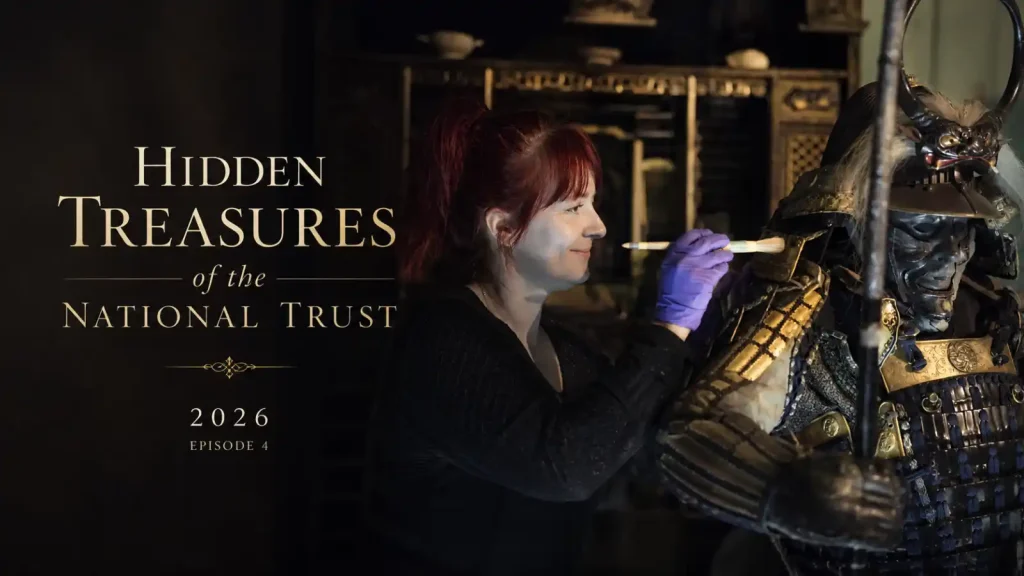
Hidden Treasures of the National Trust 2026 episode 4 turns its attention to two of Britain’s most obsessive collectors and the specialists racing to save what they left behind. Inside Snowshill Manor, a Cotswold house packed with more than 22,000 curiosities, conservators prepare a rare suit of boy’s samurai armour for the British Museum. Sixty miles away at Derbyshire’s Calke Abbey, the Harpur Crewe family’s vast natural history hoard, Georgian diamond brooches and a flock of rare Portland sheep all demand attention. This is collecting on a monumental scale, told through the people who protect it.
The episode, subtitled “Collectomania,” sets two very different visions of accumulation side by side. Charles Paget Wade filled Snowshill with man-made wonders he rescued from a mechanising world. The Harpur Crewes spent a fortune imposing order on the natural one. Both left behind legacies so large and so fragile that entire teams now work to keep them alive.
What unites Snowshill and Calke Abbey is a question that runs beneath every story in Hidden Treasures of the National Trust 2026 episode 4: what do we owe the things people leave behind? The answer plays out in workshops, galleries, lambing pens and a model village, where dedicated experts fight deadlines, decay and the occasional badger to keep these collections breathing.
From the outside, Snowshill looks like the quintessential English manor house, tucked into a quiet Cotswold village. Step through the door, and the illusion shatters. Collections and House Manager Jennifer looks after more than 22,000 objects here, in one of the National Trust’s most eccentric collections. Boats, sextants, a pocket planetarium, a flying fish, ageing anatomy, buckets, bicycles and battle-scarred blades all jostle for space.
The man behind it was Charles Paget Wade, born in Kent in 1883. He was no ordinary Victorian collector. Wade liked to wear his enormous costume collection, appearing in giant boots that reached his thighs or in naval dress. He was once arrested in London for walking the streets in a full suit of armour, reasoning that wearing it beat carrying it. He delighted in jumping out at visitors from hidden doors he had built into the house.
Wade had a serious purpose beneath the theatre. He collected things other people found dull or unfashionable, driven by a passion for preserving craft objects that were vanishing fast as mechanisation swept Britain. Because of his enthusiasm, Snowshill now holds treasures that survive nowhere else. When he gave the house to the Trust, it was even more crammed than it is today, and staff still wage a never-ending battle to fit everything in.
Hidden Treasures of the National Trust 2026 episode 4
The Rare Boy’s Samurai Armour Bound for the British Museum
Snowshill’s Samurai Room is one of its most atmospheric spaces, and the story of how it came to exist is pure Wade. Hunting for a tap washer in a Cheltenham shop, he spotted a full suit of armour and fell for it instantly. The owner mentioned he had six more out the back, unwelcome in his own home because his wife disliked them. Wade went home that day with seven suits. His collection eventually grew to roughly 30 sets.
Collections Assistant Natalie now keeps this army of ancient warriors in condition, cleaning them week in and week out. She has named them to tell them apart, working her way through Gary and his mate Barry, brushing the metal of the do, the breastplate, and the little demon masks called oni that she clearly adores. Her love of swords and samurai stretches back to her schooldays, and she felt an instant kinship with Wade’s compulsion to collect.
One treasure stands apart. A boy’s samurai armour, dating from the early to mid 18th-century Edo period, has been chosen for a groundbreaking British Museum exhibition. Boys’ armour this old and this complete is extraordinarily rare. Built for a child of perhaps four, decorated with a dragon on the breastplate, it would have featured in ceremonial parades that signalled a family’s wealth and status during a long era of peace, when samurai turned from war toward governance, philosophy and the arts.
The Race to Conserve Fragile Silk and Gilded Leather
Nearly 300 years old and made of dozens of hand-crafted pieces, the boy’s armour arrives at the National Trust’s Royal Oak Foundation Conservation Studio in Sevenoaks in worrying shape. Studio Lead Emma admires its decoration, but the problems are immediate. The lacing is light-damaged and desperately fragile, the armour is heavy and dirty, and one section hangs on by a few strands, ready to fall away at a touch.
The job demands a small army of its own. Conservator Felicity tackles the gilded shoulder guards, the sode, built from iron, deer skin and gold leaf. Pests have feasted on the leather beneath the gilding, hungry for the hide rather than the gold, leaving the surface ready to surrender. With only about three weeks before the deadline, Felicity knows the schedule is tighter than usual, and that failure means the piece simply will not appear.
At the Textile Conservation Studio in Norfolk, Conservator Terri faces the most delicate work of all. The chest plate, or cuirass, joins its lacquered metal plates with silk braids, and a large area of loss in the middle threatens to let the plates’ weight pull everything apart. Working on samurai armour for the first time, Terri inserts dyed silk for support, anchors the broken ends beneath fine netting, and pins it with insect pins so slender they barely pierce the original textile. Once stabilised, she finally lets herself breathe. The deadline, however, is unforgiving: the armour cannot fail to reach the exhibition.
Calke Abbey, the Unstately Home That Time Nearly Lost
Sixty miles from Snowshill, Calke Abbey tells a darker, stranger story of collecting. Set in over 2,000 acres of rolling Derbyshire countryside, this 58-room Baroque mansion is filled with geology, shells, a herbarium, taxidermy and birds’ eggs. Almost anything imaginable has a specimen here. Yet the staff cheerfully call it the unstately home, because much of it is deliberately preserved in a state of decline.
The reason is history. By the 1980s, the Harpur Crewe family had lived at Calke for nearly 400 years, but the crushing cost of upkeep had pushed the house to the brink. When the National Trust took it on in 1985, much of it had fallen into disrepair. Rather than restore it to gleaming perfection, the Trust chose to capture that precise moment of near-loss, with peeling wallpaper, ghostly marks where paintings once hung, and objects left unrestored.
Property Curator Julie now works to preserve this snapshot in time, fighting stiff shutters each morning and treating the dishevelment itself as a precious exhibit. Calke stands as a testament to the hundreds of country houses demolished across the 20th century. Some visitors are shocked; it is not what they expect from a grand estate. But that very near loss is the point, and the scars are part of the meaning.
Sir Vauncey Harpur Crewe and the Trust’s Largest Natural History Collection
Calke’s obsession had a chief architect. In 1886, the Victorian Sir Vauncey Harpur Crewe inherited both the estate and his family’s weakness for accumulating. His boyhood bedroom, presented as it was found in the 1980s, already hints at what was coming, with deer antlers, rocks and shells scattered across the bed, the earliest seeds of a lifelong fixation.
Sir Vauncey built on collections begun by his forebears to create what is now the Trust’s largest assembly of natural history specimens. His collection effectively overtook the house, turning Calke into a private museum of the natural world. He spent a phenomenal sum on it, some single purchases costing more than a servant’s annual wage, and much of the family fortune likely vanished into glass cases and specimen drawers.
Despite the eccentricity, he cared deeply for his specimens. He banned open fires in certain rooms to prevent heat damage, behaving, as staff note, much like a modern natural science curator. Taxidermist Sarah, who works on the collection, marvels that birds well over 160 years old survive in such condition, precisely because Sir Vauncey cased and protected them. Today she defies the lone-old-man stereotype of her trade, neatening feathers with an eyeshadow brush, coaxing the barbs to hook back together in a process she finds therapeutic and occasionally maddening.
Saving the Rare Portland Sheep, a Living Conservation Project
Not every treasure at Calke sits behind glass. In the grounds, a living conservation project has been producing results for over 250 years: a flock of rare Portland sheep, tended by ranger Emily and her team. By the mid-1970s, the breed was almost extinct, down to 86 breeding ewes and just three bloodlines, one of which was Calke’s. The stakes for keeping it flourishing could hardly be higher.
The most important day of the year arrives when the rams, or tups, are introduced to the ewes. Emily judges which animals best show the Portland traits, tan faces and legs, pale muzzles, clean legs free of wool, and good horns. Her favourite ram, a friendly, slightly chunky favourite who needs the exercise, wins the day, with a final nod of approval from Hayley, the keen if imperfect in-house sheepdog. A raddle harness fitted with coloured chalk will mark which ewes he has covered.
The payoff comes months later, in spring. Returning to the flock, Emily finds the ewes heavy with milk and, soon enough, the first lamb born overnight, its umbilical cord sprayed with iodine to prevent infection. Lambing is her favourite time of year, and she admits it is impossible not to grow attached. Tagged, logged and led out to the kitchen garden with their mothers, the new arrivals become the latest additions to a centuries-old flock that nearly disappeared entirely.
Charles Wade’s Doorbell Automaton Brought Back to Life
Among Snowshill’s tens of thousands of objects, some of the most intriguing are those Wade made himself. Chief among them is his doorbell, an elaborate automaton that once moved tiny figures, opened and closed doors and played music when a visitor pulled a cord. An inscription inside confirms Wade built it, echoing a Victorian fashion for moving automata and cuckoo clocks. For years, though, it had not budged.
Jennifer calls in Dynamic Objects Conservator Mike, who takes the piece back to his workshop for a full diagnosis. He faces a genuine puzzle: a one-off mechanism with no comparable example anywhere, whose workings he must reverse-engineer before he can mend it. Using a probe camera to peer inside the turret, he discovers a broken little figure wedged in the works, jamming a shaft, and then a deeper problem with the timing between the doors and the figures running on the belt.
Mike, who traces his love of automata to the Meccano his father gave him as a child, eventually reseats a misplaced soldier and re-times the mechanism. Back at Snowshill, an audience gathers to watch the doorbell perform for the first time in years. The doors swing, the figures parade, a small hatted figure pops out, and the music box tinkles to life. The crowd cheers and calls for more, and the team agrees that Wade, the great showman, would have been thrilled.
Calke Abbey’s Hidden Georgian Diamonds Make Their London Debut
Sir Vauncey’s natural world was not the only treasure at Calke. Stored out of sight sat jewellery worn by at least seven generations of the family: earrings, brooches, bracelets, everyday pieces and sentimental ones, never closely examined. The National Trust’s major project to assess its jewellery collections, aided by Honorary Jewellery Adviser John Benjamin, finally brings them into the light.
One set carries a remarkable story. Vauncey collected the agate beads himself while travelling in 1869, his mother designed the necklace, and a famous jeweller set it, a true family project assembled piece by piece. But it is a group of diamond brooches that leaves John dry-mouthed. Set with large rose-cut diamonds from around 1750, backed with tinfoil to throw light back and make them sparkle, they survive at a size almost never seen, because such stones were usually broken up and recycled into newer fashions.
Jewellery conservator Joanna gives the Georgian pieces their careful preparation, lifting tarnish from the silver settings with a fine silicone abrasive and a strictly dry method, since any moisture behind a stone could cloud it. For her, the appeal runs far beyond bling into social history, including lockets unopened for centuries holding personal locks of hair. The brooches then travel to St James’s jewellers Wartski, where curator Katherine Purcell places them alongside designs by Picasso and Dalí. Seeing their scale in person astonishes everyone, and after decades hidden in storage, Calke’s diamonds finally dazzle the public again.
A Complicated Legacy Behind the Collector’s Fortune
Behind Snowshill’s wonder lies an uncomfortable truth that the episode does not avoid. Visitors most often ask how Wade afforded 22,000 objects. The answer is that his collecting took off after a substantial inheritance at the age of 28, money that, as staff put it, lets imagination run unlimited. But that fortune came at a human cost.
The wealth flowed from sugar plantations the family had inherited in Saint Kitts, then a British colony in the Caribbean. Wade’s ancestors had enslaved people in their household, and after the abolition of slavery his grandfather bought plantations that brought the family great wealth. The riches that filled Snowshill were rooted in that history of exploitation, a fact the Trust now tells openly rather than quietly.
Wade’s own position was more complicated still. He was of dual heritage, spending considerable time with his Afro-Caribbean grandmother, Mary Wade, and so was very clearly aware of his mixed ancestry and the enslaved people somewhere in his line of descent. In later life he wrote of the abhorrence of the transatlantic slave trade and the horror of people sold as property. Staff suspect that only with age did he truly grapple with the paradox of a life of curiosities funded by such a past.
Why Collecting Still Speaks Through the National Trust’s Hidden Treasures
The National Trust cares for more than a million objects across over 200 historic houses, an inheritance that offers rare insight into the minds of the nation’s most committed collectors. As one curator reflects in Hidden Treasures of the National Trust 2026 episode 4, the urge to collect lives in most of us to some degree. It is a way of imposing order, of chasing the rare object or the specimen that tells an intriguing story, of building something greater than its individual parts.
Snowshill and Calke Abbey embody two faces of that impulse. Wade gathered the handmade and the eccentric to save craft from extinction, even building a model village so beloved that gardener James confesses to sneaking in to rearrange its tiny tableaux. The Harpur Crewes pursued the natural world with equal intensity, leaving behind taxidermy, jewels and a near-extinct breed of sheep that survives because someone refused to let it go. Both estates show collecting as an act of love, control and self-expression all at once.
What the conservators, rangers, taxidermists and curators share is a refusal to let these legacies fade quietly. From a boy’s samurai armour stitched back together for the British Museum, to Georgian diamonds blinking awake in a London gallery, to a doorbell singing again after decades of silence, the work on display in Hidden Treasures of the National Trust 2026 episode 4 proves a simple idea voiced in its opening moments. These objects still speak, if you listen hard enough, and the people who care for them are determined that we keep hearing them.
FAQ Hidden Treasures of the National Trust 2026 episode 4
Q: How many objects are in the Snowshill Manor collection?
A: Snowshill Manor holds more than 22,000 curiosities, making it one of the National Trust’s most eccentric collections. Charles Paget Wade gathered everything from boats, sextants and a pocket planetarium to ageing anatomy, buckets, bicycles and battle-scarred blades. When he first gave the house to the Trust, it was even more tightly packed than visitors see today.
Q: How did Charles Paget Wade afford his collection?
A: Wade’s collecting took off after he came into a substantial inheritance at the age of 28. That fortune flowed from sugar plantations his family had inherited in Saint Kitts, then a British colony in the Caribbean. His ancestors had enslaved people, and after abolition his grandfather bought plantations that brought the family great wealth.
Q: Why is the boy’s samurai armour so rare?
A: Surviving boy’s samurai armour this old and this complete is extraordinarily uncommon. The Snowshill piece dates from the early to mid 18th-century Edo period and was built for a child of perhaps four. Its rarity earned it a place in a groundbreaking British Museum exhibition, where most surviving examples are far larger adult male suits.
Q: Why was Edo period samurai armour so decorative?
A: The Edo period, beginning in 1603, brought over 250 years of peace to Japan. With no wars to fight, the samurai class turned toward governance, philosophy and the arts. Armour became highly ornamental, worn in ceremonial parades to the capital that signalled a family’s wealth, status and allegiance to their Tokugawa rulers.
Q: What damage did the samurai armour need repaired?
A: The armour arrived heavy, dirty and dangerously fragile. Its lacing was light-damaged, with one section held on by just a few strands. Pests had eaten the deer-skin leather beneath the gilded shoulder guards, while a large area of loss in the silk braids risked letting the chest plate’s weight pull everything apart.
Q: Why is Calke Abbey called the unstately home?
A: Staff use the nickname because much of Calke is deliberately preserved in decline rather than restored. When the National Trust took it on in 1985, the house had fallen into disrepair after nearly 400 years of Harpur Crewe ownership. The Trust kept peeling wallpaper, faded marks and unrestored objects to capture that exact moment of near-loss.
Q: What makes Sir Vauncey Harpur Crewe’s collection significant?
A: Sir Vauncey built the National Trust’s largest assembly of natural history specimens, effectively turning Calke into a private museum. He spent a phenomenal sum, with single purchases sometimes costing more than a servant’s annual wage. Importantly, he cared for the specimens carefully, banning open fires in certain rooms to prevent heat damage.
Q: Why are Calke Abbey’s Portland sheep so important?
A: Calke’s flock is a living conservation project running over 250 years. By the mid-1970s, Portland sheep were almost extinct, reduced to 86 breeding ewes and just three bloodlines, one of which was Calke’s. Ranger Emily carefully selects rams and ewes by breed traits each year to keep the rare breed flourishing.
Q: How was Charles Wade’s doorbell automaton restored?
A: Dynamic Objects Conservator Mike reverse-engineered the one-off mechanism, since no comparable example exists. Using a probe camera inside the turret, he found a broken figure jamming a shaft and a timing fault between the doors and the figures on the belt. After reseating a soldier and re-timing it, the doorbell moved, opened doors and played music again.
Q: What is special about Calke Abbey’s diamond brooches?
A: The brooches feature large rose-cut diamonds from around 1750, backed with tinfoil to reflect light and make them sparkle. Diamonds of this size rarely survive, because such stones were usually broken up and recycled into newer fashions. After a careful conservation clean, they joined designs by Picasso and Dalí at London jewellers Wartski.