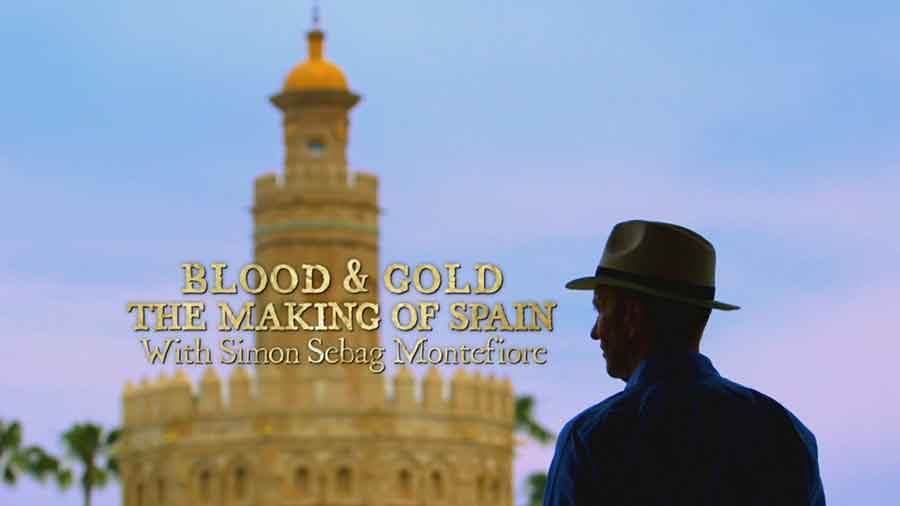
Blood and Gold – The Making of Spain episode 1: Spain. The name itself echoes with passion, drama, and intense history. It conjures images of flamenco dancers, grand cathedrals, and sun-drenched plazas. However, beneath this vibrant surface lies a story of profound complexity. This is the story of The Making of Spain. It’s a narrative etched in centuries of conflict and brilliance. Indeed, it is a history defined by “Blood and Gold.” Host Simon Sebag Montefiore invites us on this epic journey. He acts as our guide through 2,000 years of turbulent, fascinating history. The grand adventure begins with Blood and Gold – The Making of Spain episode 1. This first chapter sets a magnificent and dramatic stage.
The first episode immediately dives deep into Spain’s chaotic early years. This was a time of foundations. Spain, as we know it, did not exist. Instead, the Iberian Peninsula was a prize. It was a coveted piece of land. Great empires saw it as the battleground of the known world. Romans came and built cities, roads, and aqueducts. Then, Visigoths swept in, bringing a different rule. Each group left an indelible mark. They forged the peninsula’s early, fragmented identity. Simon explores how this land became a crossroads of civilization. It was a brutal and formative period. This chaos set the scene for an incredible transformation.
Then, a dramatic shift changed the course of history forever. In 711, armies crossed the straits from North Africa. This marked the beginning of Islamic Iberia. We know this legendary period as Al-Andalus. But this was not just a simple conquest. It was also a remarkable story of survival. A few decades later, in 756, a fugitive prince arrived. Abd ar-Rahman I was a member of the Umayyad dynasty. He had escaped a bloody massacre in Damascus. He saw Spain as his last refuge. Here, he established the independent Umayyad Emirate of Córdoba. This single act was the seed of something spectacular.
Cordoba. Today, it’s a beautiful, peaceful Andalusian city. But in the 8th and 9th centuries, it became the heart of Al-Andalus. The new Emirs began to build their legacy. They started construction on the Great Mosque. This structure would eventually become one of the wonders of the world. It was, of course, a statement of power and faith. Yet, it was also a symbol of the new, blended culture. It famously blended old Roman columns with new Islamic arches. This era was defined by this powerful synthesis. The Emirate was carefully laying the groundwork for an unparalleled golden age.
In Blood and Gold – The Making of Spain episode 1, the focus sharpens. We witness the dawn of this truly golden age. In the year 929, a descendant named Abd ar-Rahman III made a bold move. He was no longer content with the title of Emir. He proclaimed himself “Caliph.” This title was a huge declaration. It meant he was the true spiritual leader of the faithful. It was also a direct challenge to rival Caliphs in Baghdad and North Africa. This new state was the powerful Caliphate of Córdoba. It quickly became the most dazzling and advanced state in all of Europe.
This new Caliphate was not just about military power. It was a beacon of civilization. While much of Europe languished in the “Dark Ages,” Cordoba was a metropolis. It was a glittering city of lights, paved streets, and vast libraries. Scholars from all faiths gathered there. Muslims, Jews, and Christians worked side-by-side. They translated Greek philosophy. They made huge leaps in science, medicine, and mathematics. This period saw a stunning expansion of trade and culture. Cordoba grew into a city of half a million people. It was, without doubt, the jewel of the 10th century.
Simon Sebag Montefiore doesn’t just tell us this history. He takes us there. We walk with him through the mesmerizing, whispering arches of the Great Mosque. He explores the evocative ruins of the spectacular palace-city, Medina Azahara. This fabled city was built from scratch by Abd ar-Rahman III. It was a breathtaking testament to his power and wealth. It was said to be built of marble, gold, and ivory. Simon shows us how this “golden age” wasn’t just rhetoric. It was real. He connects the past to the present. He makes this vital piece of Spain’s history feel alive.
But Blood and Gold is a fitting title for this series. The gold was brilliant. The blood, however, was always close. The Caliphate’s incredible success held the seeds of its own destruction. After the great and powerful Caliphs, real power fell to a single, ruthless court official. This was the hayib, Al-Mansur. Al-Mansur, or “The Victorious,” was a brilliant general. He waged brutal campaigns against the Christian kingdoms of the north. He held Al-Andalus together with an iron fist. But he ruled in the Caliph’s name, not his own. This created a fragile system based on one man’s strength.
Blood and Gold – The Making of Spain episode 1
When Al-Mansur finally died, the center could not hold. The Caliphate began to disintegrate. A terrible and bloody civil war erupted. This period is known as the Fitna of al-Andalus. It was a bitter, confusing conflict. Descendants of the last true Caliph, Hisham II, fought for the throne. They battled the ambitious successors of Al-Mansur. Brother turned against brother. Warlords saw their chance. They carved out their own territories. The unity of Al-Andalus was completely shattered. The golden age was burning.
Finally, in 1031, the Caliphate was officially abolished. The dream of a unified Al-Andalus was over. After years of this brutal infighting, the great state fractured. It shattered like a mirror into dozens of pieces. These pieces were small, independent Muslim kingdoms. They were known as the taifas. Each taifa competed fiercely with the others. Some, like Seville, produced beautiful art and culture. But they were small. They were divided. And they were weak. This fragmentation opened the door for the Christian kingdoms of the north. The Reconquista would soon gain new, unstoppable momentum.
Blood and Gold – The Making of Spain episode 1 covers this incredible, dramatic arc. It shows us the rise and fall of a great civilization. We see how Spain was forged in the fires of empire. We witness the unmatched brilliance of Cordoba. We also witness its tragic and bloody collapse. This episode perfectly captures the dual nature of Spain’s history. It is a story of dazzling achievement and brutal, constant conflict. Simon Sebag Montefiore masterfully sets the stage. He leaves us captivated and ready for the next chapter of The Making of Spain.
Blood and Gold – The Making of Spain episode 1 with Simon Sebag Montefiore
Blood and Gold – The Making of Spain episode 1 with Simon Sebag Montefiore explores the complex origins of a nation forged by conflict, faith, and empire. The country known as Spain has had many names, including Al-Andalus, Iberia, and Hispania. It is a peninsula almost entirely surrounded by water, a geographic fact that has been both its blessing and its curse. Its position has made it European, yet it looks toward Africa, separated by only 14 kilometers of sea.
This unique geography made its history profoundly complex. The road to Spain has always been the sea, especially from the South. This accessibility made the peninsula the borderland and the battlefield of the continent’s many different influences. From 3000 BC, the great traders of the Mediterranean, the Greeks and Phoenicians, came here. They were attracted by the land’s fertile plains and its rich mines, which brought forth gold, silver, tin, and copper.
This story, explored in Blood and Gold – The Making of Spain episode 1 with Simon Sebag Montefiore, is not a simple linear narrative. It is a story of diversity and more manifestations than any other country in Western Europe. The nation’s identity is defined by its unique meshing of Jewish, Muslim, and Christian cultures. This blending of peoples and faiths makes Spain unique among Western nations.
The early history of Spain begins with the sea and the resources that drew outsiders. This wealth made the peninsula a coveted prize for rising empires. This was a land forged by rulers, armies, peoples, and faiths more exotic than elsewhere in the West. This chaotic and foundational period set the stage for centuries of conflict and cultural fusion.
Host Simon Sebag Montefiore begins this epic journey in the south, the gateway to the peninsula. He explores key locations that hold the secrets of this turbulent past. These include Cadiz, Spain’s oldest living city, and Seville, Andalusia’s Catholic capital. The journey also visits Gibraltar, the nation’s gateway, and the great city of Cordoba, the capital of the Islamic Caliphate.
This early history was a time of titans, caliphs, and kings. For centuries, this land was Europe’s “Wild West.” Palaces and cities rose while wars of annihilation were fought. This foundation of conflict, persecution, and tolerance defines the entire story. It is a narrative built equally on blood and gold.
Rome, Carthage, and the Battle for Hispania
The story of imperial Spain begins in Cadiz. More than 2,000 years ago, this was a colony of the Phoenician city of Carthage. In 237 BC, one of history’s most famous figures, the young Hannibal, was brought here as a ten-year-old boy. From here, his father, Hamilcar, would conquer most of Spain as a new Carthaginian empire. This conquest set the stage for one of the great imperial rivalries of the ancient world. Spain became the battlefield between the established power of Carthage and the rising power of Rome.
Hannibal, born into the Barca family whose name meant “thunderbolt,” eventually assumed command. Before launching his legendary campaign, he sought a divine blessing. He traveled to the temple of Melqart, the God of Tyre and the mother city of the Carthaginians. Melqart, who appears in the Jewish Bible as Baal, was a symbol of power and virility. At the temple shrine on the Island of Sancti Petri, Hannibal consulted the oracle in 218 BC. There, he famously swore an oath to destroy Rome, vowing to arrest its destiny with “fire and steel.”
Hannibal’s plan was astonishingly audacious. He mustered a huge army of 60,000 in Cadiz. This force included Spanish spearmen, African cavalry, and 40 war elephants, the ultimate prestige weapon. In 217 BC, he marched this entire army from Spain, across the south of France, and over the Alps into Italy. This campaign brought Rome to the very edge of defeat, most notably at the Battle of Cannae. Yet, even as Hannibal closed in, Rome did not fall. The Romans rallied, led by statesmen like Cato the Elder, who repeatedly declared, “Carthago delenda est”—Carthage must be annihilated. They found a general almost as sublime a strategist as Hannibal himself: Publius Cornelius Scipio.
Scipio took the war to Hannibal’s base in Spain. The decisive battle occurred in 206 BC at Ilipa, a few miles north of Seville. The winners would rule Europe for the next 700 years. Scipio’s motivation was personal; Hannibal’s family had killed both his father and his uncle. Though outnumbered, with 50,000 Romans against 75,000 Carthaginians, Scipio used brilliant and deceptive tactics.
Military historian Saul David explains that Scipio changed his formation at the last minute. He moved his elite Roman legions from the center to the flanks. He then advanced in a concave formation, enveloping the enemy. This maneuver ensured the weaker Carthaginian allies fought Scipio’s best troops, while the elite Carthaginian center was neutralized. The Carthaginian war elephants, stung by javelins, panicked and became an “own goal,” trampling friend and foe alike.
Scipio was victorious. This battle determined that Spain would become a province of Rome, not of Africa. Scipio built the city of Italica near the battlefield for his veterans. He then used Spain as a springboard to attack North Africa in 204 BC. This invasion forced Carthage to recall Hannibal from Italy. Scipio defeated Hannibal, earning the title “Africanus.” Hannibal, pursued by Roman agents, eventually committed suicide. Rome ultimately wiped Carthage off the map.
The Spanish Emperors and the Romanization of Spain
The Romans loved their new province, Hispania. They found it almost “more Italian than Italy.” For them, life was good. They could make great fortunes from fish paste, olive oil, and wine. Hispania quickly became the food bowl and the winery of the empire. This prosperity and integration produced remarkable leaders. Ironically, the three greatest Roman emperors at the empire’s zenith came from Roman Spain. In 98 AD, Trajan, who was from Italica, became emperor. He was a formidable soldier and an outstanding ruler, so respected that he was voted the title “Optimus,” or “the best.”
Trajan’s successor, Hadrian, also hailed from Italica. Hadrian was probably the most accomplished man ever to rule the Roman Empire. He created the Pantheon in Rome and enormously improved his home city of Italica. Later, the philosopher-emperor Marcus Aurelius also came from a Spanish Roman family. These emperors oversaw a vast trade network that powered the empire.
Spanish olive oil and wine were shipped across the Mediterranean in large pottery jars called amphorae. However, these jars had a flaw: they could only be used once before the pottery became tainted. At its height, as many as 54 million amphorae were exported to Rome. Their discarded debris formed a heap that became a mountain, Mount Testaccio, which is still there to this day.
Roman life in Hispania centered on the amphitheater. Italica’s amphitheater was one of the largest in the empire, seating 25,000 people. Around 50 AD, a moment of imperial whimsy changed Spanish culture forever. The Emperor Claudius banned all gladiatorial fights in Spain. These were replaced with contests of exotic beasts. Lions and tigers were kept in pits beneath the arena. Among these beasts were the local Spanish bulls, which were then sent up into the amphitheater to be viciously slaughtered to the crowd’s delight. This, the program suggests, was the beginning of Spanish bullfighting.
From Pagan Gods to Christian Martyrs
Rome’s traditional gods often fused with foreign deities. One popular blood-saturated fertility cult, the cult of Attis, echoed the old Phoenician myth of Melqart. Attis was a shepherd boy who was castrated and bled to death but was miraculously brought back to life. He became the ultimate symbol of virility for his frenzied followers. They would cavort, splattering themselves with blood, flagellating themselves, and, as the ultimate gesture, castrating themselves. These traditions, it is suggested, may be echoed today in the self-flagellating Catholic brotherhoods still found in Spain.
The Spanish-born emperor Hadrian unwittingly changed Spain’s religious landscape in another way. In 132 AD, his persecution of the Jews in Jerusalem provoked a major revolt. After crushing the rebellion, Hadrian had 500,000 Jews slaughtered and banned them in perpetuity from their beloved Jerusalem. Many of these exiles came to settle here in Spain. They founded a community named Saffarad, the Hebrew word for Spain. They thus became the Sephadic Jews.
Out of this Jewish disaster, a new religion emerged and spread fast: Christianity. Its inevitable confrontation with Roman paganism is illustrated by the story of Justa and Rufina in Seville, then called Hispalis. Around 287 AD, these two devout Christian sisters, who were admired for their work as potters, refused to let their pottery be used in a pagan festival for the goddess Venus.
This was part of Emperor Diocletian’s policy to reinvigorate Roman religion. The sisters refused and smashed a statue of Venus. This was nothing less than a “brazen bid for martyrdom,” and their prayers were indeed answered. They were horribly tortured. Justa was thrown down a 100-foot well, where she perished. Rufina was saved for the lions, but a miracle occurred: instead of eating her, the lions licked her wounds. The prefect, unimpressed, had her strangled, beheaded, and burned. The Christians had their first martyrs.
Within just 30 years, the Roman Empire itself had converted to Christianity, yet it was already disintegrating. When Rome fell in 476 AD, Spain was at the mercy of invading “Barbarian” tribes. The Vandals came first but failed to hold the peninsula. They left only one real legacy: their name. The Arabic Al-Andalus, which later became Andalusia, probably means “The land of the Vandals.” Next, the Visigoths overran the peninsula. Though often depicted as raping and pillaging axe-men, the Visigoths were creative in peace, producing sages and scholars. St. Isidore, the Visigothic Bishop of Seville, refined and adapted Roman law to create a united, Christian Spain. Their kingdom became the prototype for Catholic monarchy, ruling for two centuries.
The Arrival of Islam and the Umayyad Exile
The Visigoths lost Spain as dramatically as they won it. The end came at the “River of the Dead,” near the port of Santa Maria. It all started with a legend of a beautiful naked girl. King Roderick, the last Visigothic king, spied upon Florinda, the daughter of his nobleman Julian, while she was bathing. He then ravished her. In revenge, Julian rebelled, met the king’s forces at the river, and killed him. Crucially, Julian did not just rebel; he looked across the sea to North Africa for help. He “summoned Islam.”
A new faith had arisen in the deserts of Arabia under the Prophet Mohammed. By 711, Arab armies, ruled by the Umayyad Caliphs from Damascus, had conquered a vast empire stretching from Iran to Morocco, just 14km from Spain. Julian’s call for help was irresistible. The Governor of Tangiers, Tariq Bin-Ziyad, raised an army of 7,000 Arabs and Berbers. In April 711, they embarked on rafts and crossed the straits to land in Europe. Gibraltar’s name commemorates this very moment; it derives from the Arabic “Jabal Al-Tariq,” the Mountain of Tariq. The divided Visigoths were overwhelmed. Islam had arrived.
This new power, Al-Andalus, would build a culture that outshone its European neighbors in wealth and magnificence. Its legacy infuses everything in Southern Spain. Modern Spanish is still full of Arab words; for example, aceite (oil) comes from the Arabic al-zayt (olive juice). The great river al-wadi al-kabir (the great river) became the Guadalquivir. The Arabs even solved the Roman amphorae problem with their cultural sophistication. They glazed the inside of their vases, allowing them to be used again and again—an early case of domestic recycling.
The Muslim conquerors of Al-Andalus soon faced their own crisis. In 750 AD, back in Damascus, the Umayyad Caliphs were overthrown by the more rigorous Abbasids. The Abbasids invited the Umayyads to a dinner and massacred the entire family. Only one prince escaped: Abd Al-Rahman. He was 19, tall, red-haired, and suddenly the most wanted man in the Islamic world.
He fled across North Africa for six years, hunted by Abbasid assassins. In 755, he landed near Malaga with just 300 followers. He swept north to Cordoba, the old Roman capital, and smashed the forces of his enemies. He then devised a special gift for the Abbasid Caliph in Baghdad who had murdered his family: a basket of severed heads.
Blood and Gold – The Making of Spain episode 1 with Simon Sebag Montefiore: Cordoba’s Zenith
Abd Al-Rahman I was a tolerant Muslim and a magnificent builder. He made Cordoba his capital, creating a paradise in Spain. He built a great city with noble buildings and lush gardens to remind him of his lost home in Damascus. His masterpiece was the Great Mosque, or Mezquita, which he started building in 786. This architectural wonder features 850 columns of granite and marble. It uses a unique system of two-tiered pillars, cleverly repurposing older Visigothic columns from Roman ruins. Its famous horseshoe arches may also have been of Visigothic design.
Under Umayyad rule, Cordoba became a cosmopolitan metropolis. Arab scientists, the true heirs to the Ancient Greeks, made astounding advances unknown in the brutish West. The glittering court gathered scholars, architects, poets, and astrologers. One man stood out: Ali Ibn Nafi, known as “The Blackbird.” He was a superstar singer-songwriter, an international trendsetter, and a dandy—a “cross between Beau Brummell and Mick Jagger.” He came from Baghdad, promoted asparagus from a weed to a delicacy, and invented the modern three-course meal. Everyone wanted to be like him. This “most Spanish” of art forms, flamenco, can trace its musical roots back to Ibn Nafi’s musical vision and his influence on the guitar.
This cosmopolitan tolerance, however, had its limits. Islamic tolerance can be exaggerated. Islam was supreme. Jews and Christians were only free to worship if they paid a special tax and always recognized Muslim mastery. Some, like Eulogius of Cordoba, resented this supremacy. He led a movement of radical Christians who sought martyrdom by publicly insulting the Prophet Mohammed. He was duly arrested, tried, and beheaded. His body was tossed onto the river bank.
The dynasty’s greatest ruler was Abd Al-Rahman III, who succeeded to the throne in 912. He created paved streets, public lighting, and collected a library of half a million books. Cordoba became one of the biggest and richest cities in Europe, with a population of several hundred thousand. In contrast, London and Paris at the time were just “glorified villages” with 10-15,000 inhabitants. In 929, he declared himself “Caliph,” the commander of the faithful. To project this new authority, he built the Medinat Al-Zahara, the “dazzling palace,” just outside the city. It was a political headquarters, military command center, spectacular showpiece, and pleasure palace.
This palace, which lay hidden for 900 years, revealed advanced Arab technology, including one of Europe’s first flushing lavatories. Courtiers of the Caliph lived here in comfort and hygiene at a time when Londoners and Parisians were mired in stinking filth. But the Caliph himself was a “ferocious and thin-skinned tyrant.” He kept two harems, one of boys and one of girls. He had a girl’s face burnt off when she resisted his advances and had a boy (Pelagius of Cordoba, later canonized) dismembered for the same offense. He even kept a menagerie of lions to feed people to.
Historian Simon Barton explains the Umayyad preference for blonde concubines, who were sourced from Northern France by Muslim and Jewish slave merchants. In fact, all the Umayyad emirs and caliphs were born to slave concubines. This, Barton notes, was a “dynastic defence mechanism.” A slave concubine, uprooted from her homeland, had no powerful family to interfere in the politics of the dynasty, unlike a noble wife. The system was ultimately more about power than sex.
Blood and Gold – The Making of Spain episode 1 with Simon Sebag Montefiore: Fracture and Fall
This powerful system required a strong Caliph at the top. When the rules were broken, the Caliphate fell apart. In 976, the succession of a child, Caliph Hisham II, revealed the system’s fragility. His mother, Subh, a former concubine, opened the doors of power to outsiders. She appointed her new lover, Al-Mansur (“The Victorious”), as Grand Vizier. Al-Mansur was one of the most brilliant and ruthless characters of the entire Caliphate.
He launched 57 raids of “holy war” against the Christian North, burning and pillaging. He even burned the civilized, cultured libraries of the Umayyad Caliphs before him. In 997, his raids reached their climax when he sacked Santiago de Compostela. The doors and bells of its churches were brought back in triumph to Cordoba on the backs of Christian slaves.
Ironically, Al-Mansur was too successful. His triumphs hollowed out and undermined the Caliphate. He promoted himself as a quasi-Caliph and founded his own semi-royal dynasty. His sons, however, lacked his talent and restraint. One son, the “preposterous popinjay” Sanchuelo, tried to make himself Caliph. The entire kingdom fell apart. “There died the glory of Al-Andalus.” In 1031, just 30 years after Al-Mansur’s death, the Caliphate collapsed. Al-Andalus broke down into little city-states, ruled by princes like medieval barons in the West.
The Jewish Vizier and the 1066 Pogrom
The episode of The Making of Spain then travels to Granada. The city’s name itself reflects its Jewish (“City of Pomegranates”) and Muslim (gr’nata) roots. Three hundred years before the famous Alhambra Palace was built, this was the site of the palace of Samuel Ibn Naghrillah. He was one of the most extraordinary Jewish leaders in 11th-century Islamic Spain. He started as a spice merchant in Cordoba, moved to Granada, and became the advisor to its Berber rulers. When he backed the right candidate for the throne, Samuel became not only the leader of the Jewish Community but the Grand Vizier and the Commander in Chief of the Granadan army.
Naghrillah was a true renaissance man. He commanded armies and won victories in war. In peace, he was a rabbi, a writer of Jewish philosophy, and above all, a poet. He wrote astonishing poetry in both Hebrew and Arabic. He wrote love poems to beautiful girls, to wine, to boys, and to the excitement of victory in war. When Samuel died in 1056, he was succeeded by his son Joseph as Grand Vizier of Granada. Joseph was only 20 but ruled for ten years. While it was traditional for Grand Viziers to be succeeded by their sons, there was a problem. The Naghrillahs were Jews. This Jewish potentate seemed like an enemy within, from a dynasty of interlopers.
In 1066, a date as resonant for the Jews of Granada as it was for the Saxon King of England, “something snapped.” A mob came to Joseph’s palace, dragged him out, and chased him through the streets. When the mob finally caught up with Joseph Naghrillah, they lynched him. They then went on a killing spree, massacring 4,000 Jews. As for Joseph, they crucified him right beside the magnificent city gate.
The crucifixion of Joseph Naghrillah in Granada marked the beginning of the end of religious pluralism in Muslim Spain. The confidence of the Caliphate, which was necessary for such broad-mindedness, was past. As the analysis by Simon Sebag Montefiore shows, over the next 400 years, Spain would tear itself apart. The Making of Spain was entering a new, brutal chapter. This set the stage for the Christian Kings of the North to strike back, conquering all of Spain for the cross.
The Enduring Legacy: When Civilizations Rise and Fall on the Edge of Two Worlds
Spain’s story, as revealed in this remarkable first episode, isn’t just ancient history gathering dust in textbooks—it’s a living testament to how diversity can forge brilliance, and how fragmentation inevitably breeds vulnerability. Standing at the crossroads where Europe meets Africa, where Christianity encounters Islam, where Roman order dissolved into medieval chaos, the Iberian Peninsula became humanity’s grand experiment in cultural collision and synthesis.
What makes the rise and fall of the Caliphate of Córdoba so captivating isn’t merely its opulence—those half-million books, those paved streets glowing with public lighting while London wallowed in darkness, or that extraordinary toilet technology centuries ahead of its time. Rather, it’s the haunting recognition that golden ages are inherently fragile.
Córdoba’s brilliance burned brightest precisely because it managed what seems almost impossibly difficult: creating space where Muslim scholars, Jewish viziers, and Christian craftsmen could collaborate, compete, and create together. The Great Mosque itself, with its recycled Roman columns supporting revolutionary Islamic arches, stands as stone poetry about the power of building upon rather than merely replacing what came before.
Yet Blood and Gold reminds us that tolerance and pluralism require constant cultivation. They demand strong, confident leadership willing to embrace complexity rather than retreat into simplicity. When Abd ar-Rahman III’s successors weakened, when Al-Mansur prioritized military glory over institutional stability, when mob violence could crucify a Jewish vizier simply for being too successful—these weren’t random accidents. They were symptoms of a society losing faith in the very diversity that made it extraordinary. The 1066 Granada pogrom and the subsequent splintering into petty taifas revealed an uncomfortable truth: cosmopolitanism is a luxury that crumbles when fear and insecurity take hold.
Simon Sebag Montefiore’s journey through Andalusia offers more than medieval drama. It provides a mirror for our own age, when societies worldwide grapple with questions of identity, belonging, and coexistence. How do we balance multiple faiths and cultures? What happens when the center cannot hold? Can brilliance survive fragmentation? These aren’t just questions for 11th-century Granada—they resonate across centuries.
As this first episode closes with Christian kingdoms poised to strike southward, we’re left contemplating an ironic reversal. The very tolerance and sophistication that elevated Islamic Spain also contained the seeds of its vulnerability. Those divided taifas, squabbling over poetry and power while their enemies united under the cross, remind us that internal cohesion matters as much as external brilliance.
The making of Spain—forged in blood, gilded in gold—continues in episodes to come. But already we understand that this isn’t simply a national origin story. It’s an epic meditation on how civilizations rise when they embrace complexity and fall when they can no longer sustain it. The ruins of Medina Azahara, silent for nine centuries beneath Andalusian soil, whisper a question worth pondering: What are we building today that future generations will unearth and wonder at—or weep over?
FAQ Blood and Gold – The Making of Spain episode 1
Q: What is Blood and Gold – The Making of Spain episode 1 about?
A: This documentary episode explores Spain’s foundational history through 2,000 years of conquest and cultural fusion. Host Simon Sebag Montefiore guides viewers from the Roman conquest through the Islamic golden age of Córdoba. The narrative focuses particularly on the rise and fall of the Caliphate of Córdoba, examining how diverse civilizations shaped the Iberian Peninsula. Additionally, the episode reveals how blood and gold—conflict and prosperity—have defined Spanish identity throughout centuries.
Q: Why was Córdoba so important during the Islamic period?
A: Córdoba became Europe’s most advanced city during the 10th century under the Umayyad Caliphate. While London and Paris remained small villages with 10-15,000 inhabitants, Córdoba flourished with several hundred thousand residents. The city boasted paved streets, public lighting, and a library containing half a million books. Furthermore, scholars from Muslim, Jewish, and Christian backgrounds collaborated there, advancing science, medicine, and mathematics. This cosmopolitan atmosphere made Córdoba the jewel of medieval Europe and a beacon of civilization.
Q: How did Abd ar-Rahman I establish the Emirate of Córdoba?
A: Abd ar-Rahman I was the sole Umayyad prince to escape the Abbasid massacre in Damascus in 750 AD. He fled across North Africa for six years while hunted by assassins before landing near Malaga in 755 with just 300 followers. Subsequently, he swept north to Córdoba and defeated his enemies decisively. His greeting to the Abbasid Caliph who murdered his family was characteristically brutal: a basket of severed heads. Nevertheless, he proved a tolerant ruler and magnificent builder, establishing the independent Umayyad Emirate that would eventually become a Caliphate.
Q: What caused the collapse of the Caliphate of Córdoba?
A: The Caliphate’s fragility emerged when child Caliph Hisham II succeeded in 976, allowing power to shift to Al-Mansur, a ruthless Grand Vizier. Although Al-Mansur held the state together through military campaigns, he ruled in the Caliph’s name while founding his own semi-royal dynasty. When he died, his sons lacked his talent, and the system collapsed into civil war known as the Fitna of al-Andalus. By 1031, the unified Caliphate shattered into dozens of small taifa kingdoms, each weak and divided. This fragmentation ultimately opened the door for Christian reconquest from the north.
Q: What was the significance of the 1066 Granada pogrom?
A: The 1066 massacre marked the beginning of the end for religious pluralism in Islamic Spain. Joseph Naghrillah, a Jewish Grand Vizier of Granada, was lynched by a mob that subsequently massacred 4,000 Jews. His crucifixion beside the city gate symbolized the collapse of the cosmopolitan tolerance that characterized earlier Córdoba. Consequently, the confidence necessary for multi-faith coexistence had evaporated as the Caliphate fractured. This tragedy demonstrated how quickly diversity transforms into vulnerability when central authority weakens and fear replaces confidence in society.
Q: How did Roman conquest shape Spain’s early identity?
A: Rome’s victory over Carthage at the Battle of Ilipa in 206 BC determined that Spain would become European rather than African. General Scipio’s brilliant tactics defeated Hannibal’s 75,000-strong army despite being outnumbered. Hispania subsequently became Rome’s food bowl and winery, producing three of Rome’s greatest emperors: Trajan, Hadrian, and Marcus Aurelius. Roman infrastructure, law, language, and culture created foundations that persist today. Moreover, Emperor Claudius’s ban on gladiatorial combat inadvertently birthed Spanish bullfighting by substituting beast contests featuring local bulls.
Q: What architectural marvels did the Umayyads create in Spain?
A: The Great Mosque of Córdoba, begun in 786 by Abd ar-Rahman I, stands as the Umayyads’ architectural masterpiece. This stunning structure features 850 columns of granite and marble with distinctive two-tiered horseshoe arches, cleverly repurposing Roman and Visigothic elements. Abd ar-Rahman III later constructed Medinat Al-Zahara, a spectacular palace-city built from marble, gold, and ivory. Hidden for 900 years, it revealed advanced technology including Europe’s first flushing lavatories. These monuments weren’t merely displays of power; they embodied the cultural synthesis that made Al-Andalus extraordinary.
Q: Who was Simon Sebag Montefiore and what is his role in the series?
A: Simon Sebag Montefiore serves as the host and guide throughout Blood and Gold – The Making of Spain. He takes viewers through key locations including Cadiz, Seville, Gibraltar, and Córdoba, connecting past to present through evocative storytelling. Rather than simply narrating history, Montefiore walks through the Great Mosque’s whispering arches and explores Medina Azahara’s ruins. His approach makes 2,000 years of turbulent Spanish history feel immediate and alive. Through his perspective, viewers experience how conflict, faith, and empire forged modern Spain’s complex identity.
Q: How did religious tolerance function in Islamic Spain?
A: Islamic tolerance in Al-Andalus was real but limited compared to modern standards. Muslims, Jews, and Christians could coexist and collaborate, creating unprecedented intellectual achievements. However, Islam remained supreme, and non-Muslims paid special taxes while acknowledging Muslim authority. Some Christians like Eulogius of Córdoba resented this hierarchy and deliberately sought martyrdom by insulting the Prophet Mohammed. The system worked brilliantly when caliphs were strong and confident, enabling remarkable cultural flowering. Nevertheless, when central authority weakened, as demonstrated by the 1066 pogrom, tolerance quickly evaporated into violence.
Q: What lessons does episode 1 offer about civilization and diversity?
A: The episode demonstrates that multicultural brilliance requires strong, confident leadership committed to embracing complexity. Córdoba’s golden age flourished because diverse faiths and peoples collaborated, advancing knowledge while Europe languished in darkness. However, this cosmopolitanism proved fragile when succession crises, military strongmen, and internal divisions shattered unity. The transformation from unified Caliphate to fractured taifas reveals how quickly sophistication yields to vulnerability without cohesion. These historical patterns resonate today, suggesting that managing diversity demands continuous cultivation rather than passive acceptance. Spain’s story ultimately teaches that civilizations rise through synthesis but fall through fragmentation.