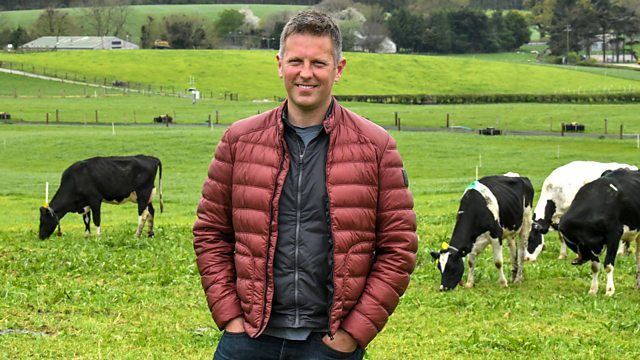
Countryfile: The Sweet Story of Britain’s Sugar Beet Harvest
There’s something quietly remarkable about the British countryside in autumn. The fields turn amber and rust, the air sharpens, and across the flatlands of eastern England, a very particular harvest is in full swing. This is the sugar beet harvest — and this week on Countryfile, Charlotte Smith and Vick Hope head east to tell its story.
It’s a story worth telling. One hundred years ago, Britain produced its first batch of home-grown sugar from sugar beet. Before that, the country depended almost entirely on imported cane sugar. Today, that same crop still sweetens millions of cups of tea every single day.
Vick Hope heads straight into the thick of it. She joins Norfolk farmers during the most intense period of their agricultural year — the final push to lift the last of the season’s beet before winter tightens its grip.
Sugar beet harvesting is not a leisurely affair. The crop must come out of the ground within a narrow seasonal window. Miss it, and the consequences can be serious. Frost, waterlogged fields, and deteriorating roots can all reduce the sugar content dramatically. So farmers work long hours, often in cold and muddy conditions, to get every last root lifted and on its way to the processing plant.
Vick captures all of this brilliantly. Watching her wade through the mud alongside the farmers, you feel the urgency and the effort involved. Country life, as Countryfile always reminds us, is not a postcard. It is hard, physical, and deeply seasonal work.
Furthermore, the landscape itself is extraordinary. The flat, wide skies of Norfolk stretch out like a painting. Nature and agricultural life exist side by side here in a way that feels ancient and important. Even the wildlife adapts to harvest season — gulls wheel and dive behind the machinery, picking off disturbed invertebrates from the freshly turned soil.
Meanwhile, Charlotte Smith takes a different route. She heads inside one of Britain’s largest sugar beet processing plants to follow those muddy roots on their transformation into refined sugar.
The scale is breathtaking. These facilities run twenty-four hours a day during the campaign season, processing thousands of tonnes of beet every single day. Charlotte walks us through the journey step by step, and it’s genuinely fascinating. The beet arrives caked in soil, looking utterly unpromising. Yet within hours, it becomes the white granules we spoon into our morning coffee.
The process is surprisingly clean and efficient. The beet is washed, sliced, and soaked in hot water to extract the sugar. Then the liquid is filtered, concentrated, and crystallised. Remarkably, very little goes to waste. The pulp becomes animal feed. The molasses becomes a fermentation ingredient. Even the extracted soil goes back onto the land.
This is Countryfile 2025 at its best — taking something we take completely for granted and revealing the extraordinary effort and ingenuity behind it. Sugar doesn’t just appear on supermarket shelves. It has a long, muddy, fascinating journey to get there.
It’s worth pausing to appreciate the history here. A hundred years ago, Britain had virtually no domestic sugar production. The First World War had exposed how dangerously dependent the country was on imported goods. Sugar was rationed. Prices soared.
Countryfile – Sugar Beet Harvest
As a direct result, the British government invested in the sugar beet industry. The first factories opened in the early 1920s. By the mid-twentieth century, sugar beet had transformed huge swathes of eastern England’s agricultural life. Fields that once grew only cereals now rotated through beet as well. Rural communities grew up around the processing plants. An entire economy took root — quite literally — in the soil.
Today, British sugar beet provides around half of the country’s sugar needs. It’s a quiet success story that rarely makes headlines. But Countryfile is here to change that this week, and rightly so.
Also this week, Tom Heap turns his attention to a rather less appetising subject. He investigates what is actually contained in the sewage sludge that gets spread as fertiliser on British farmland.
Sewage sludge — sometimes called biosolids — is a by-product of wastewater treatment. It contains nitrogen and phosphorus, which are useful for crops. As a result, farmers have used it on their fields for decades. However, concerns are growing about what else it might contain.
Tom’s investigation comes at a significant moment. The government has just launched a consultation on reforming how sewage sludge is used in British farming. The timing is telling. Recent research has raised serious questions about so-called “forever chemicals” — synthetic compounds that do not break down naturally and can accumulate in soil, water, and the food chain.
These are not abstract concerns. Nature and wildlife can be affected when harmful compounds enter ecosystems through agricultural soil. Moreover, questions are emerging about long-term impacts on human health and on the very farmland that feeds us.
Tom handles this with his characteristic rigour. He speaks to farmers, scientists, and regulators. He presents the evidence clearly and fairly. This is exactly the kind of journalism that country life and agricultural communities need — honest, thorough, and genuinely in the public interest.
Countryfile – Sugar Beet Harvest
Countryfile travels to the east of England at a moment weighted with history — one hundred years since British sugar production began, and a winter harvest season teetering between survival and collapse. Presenters Charlotte Smith and Vick Hope arrive in the flatlands of Norfolk, Suffolk, Cambridgeshire, and Lincolnshire, the undisputed heartland of the UK’s sugar beet industry, to find farmers racing against the clock, factory gates closing for the season, and a crop that supports a £2 billion industry facing threats from several directions at once. The timing is no coincidence. This centenary season brings with it not just celebration but a reckoning — over price, over climate, over the environmental cost of making sugar at industrial scale.
Sugar beet is one of the UK’s rare winter harvest crops. It grows underground, lifting through some of the coldest and wettest months of the year, caked in mud, shaped like nothing that belongs on a kitchen table. Yet from this unpromising root comes white granulated sugar, the kind scooped into billions of cups of tea. That transformation — from a muddy field in Norfolk to a uniform crystal in a supermarket bag — is precisely what Countryfile sets out to trace, following the journey from soil to factory floor and examining the pressures that now threaten to unravel a century of home-grown production.
The sugar beet industry creates thousands of jobs and forms the backbone of agricultural life across the east of England. It has done so for more than a hundred years, growing from small-scale farms in the early 1900s to the vast fields and processing plants of today. Four factories across the UK — all owned and operated solely by British Sugar — are the only places in Britain where the crop can be turned into refined sugar.
That monopoly structure shapes everything: the price farmers receive, the decisions they make about what to grow, and the anxiety that runs through the industry every time world commodity prices fall. The crop that sweetens the nation’s taste buds is not, it turns out, an especially sweet deal for many of those who grow it.
There is also, running alongside the sugar beet story, a second investigation unfolding in the fields of agricultural life. Tom Heap examines what lies inside the sewage sludge spread as fertiliser on British farmland — a practice as old as farming itself but one now under scrutiny as regulators confront the possibility that the rules governing it are dangerously out of date. Together, these two threads reveal a country life in which the land is productive and vital but also fragile, contested, and in need of new thinking.
This episode of Countryfile captures the end of a campaign — the industry’s term for the harvest season — at its most pressured. The factories are counting down to closure for maintenance. The weather is wet and uncooperative. Contractors and farmers are making hard decisions about whether to lift beet that may not be worth lifting, and whether to keep growing a crop that may not be worth growing. The centenary celebrations at Wissington Sugar Factory, the largest sugar beet processing plant in Europe, are real, but they share the frame with a deeper unease. What follows traces that full picture, from the fields to the factory and from the laboratory to the riverbank.
The east of England in mid-winter has its own particular quality of light and mud. The flat landscapes that make it ideal for large-scale arable farming also mean it offers little shelter from the rain. When the ground becomes saturated, the mammoth machines that harvest sugar beet — each capable of covering around thirty acres in a day — cannot move without risking damage to the soil, the crop, and themselves. Each harvester costs around £500,000. Sending one into a waterlogged field is not a decision made lightly.
Country life in this part of England has been shaped by sugar beet for generations. Some farming families here have grown the crop for three, four, even five generations. The rhythm of the year follows the campaign, starting around September and running through to February, day in and day out as the weather allows. For contractor Joe Lawson and his family, this is not just a livelihood but an inheritance. His mother Alison runs the contracting business while managing the family farm, and his grandfather John Orford has spent more than seventy years working in the industry. Three generations, one crop.
Countryfile arrives at a moment when that inheritance is under unusual strain. The season has been difficult. World sugar prices have fallen. British Sugar has already told growers they will be paid twelve percent less next season. And the weather, which has never played entirely fair with a winter root crop, is making even the final days of this campaign a gamble.
Countryfile and the Sugar Beet Campaign: Racing the Clock
The sugar beet harvest is not called the harvest. It is called the campaign, a term that captures something of its intensity. The campaign runs for around six months of the year, from autumn through to late winter, before the processing factories close for cleaning and maintenance. When those gates shut, any unlifted beet still in the ground faces a stark choice: find another buyer, accept a dramatically lower price, or leave it in the soil.
Contractor Joe Lawson describes the operation at one Norfolk farm’s yard, where a loader feeds beet into a cleaner before lorries ferry it to the nearby Bury Beet factory. The factory is closing that very day. There is still beet in the field. This is the reality of the campaign at its sharpest: a slick, choreographed movement of machinery and vehicles, multiple lorries cycling in and out, the cleaner running constantly, and the clock ticking. Joe and his team have been at it since September. They are still at it in February. Stoppage, for whatever reason, costs.
The machinery at the centre of this operation is enormous. The specialist harvesters work in a continuous pass across the field, lifting beet and loading it into accompanying vehicles that take it away in batches of fifteen tons at a time. This is not farming as it appears in pastoral images of country life. It is heavy industry conducted in a field, requiring significant capital outlay, precise logistics, and weather that cooperates. When it works well, it is, as Vick Hope observes, almost mesmerising to watch. When the rain comes, it stops.
Alison Lawson, as a member of the NFU Sugar Board, understands the tension between the logistics of the campaign and the realities of British winter weather as well as anyone. On the day Countryfile films, a decision has to be made about whether to lift a field that remains ready to harvest. The forecast has suggested rain will stop. But damp ground does not dry quickly, and the risk of damaging both the machine and the soil is real. Her verdict is delivered plainly: it is just too wet to lift the beet. There is nothing to be done.
The Challenges Facing Countryfile’s Sugar Beet Growers
Beyond the day-to-day weather, sugar beet growers face a more systemic set of pressures. Alison Lawson puts them plainly: a changing climate, a volatile world market keeping prices low, and new pests and diseases arriving in the UK that previous generations never had to deal with. Put together, she says, profitability is becoming very, very hard. Her passion for home-grown food and home-grown sugar is genuine. But passion does not cover the cost of inputs, machinery, or the quota price that falls to £5 per tonne once a grower exceeds their agreed allocation.
The quota system is worth understanding. Growers negotiate an agreed price with British Sugar — the sole buyer and the sole operator of the four UK factories where the crop can be processed — for a set tonnage of beet. Once that quota is met, the price drops sharply. With beet still in the ground and the factory closing, some growers find themselves in the position of deciding whether the remaining crop is worth lifting at all, or whether it would be better directed to animal feed.
Fourth-generation farmer David Wheatley, based in Wisbech Saint Mary, has grown sugar beet for thirty years. He is, by his own account, done. His field could be the last on his farm. He has not made money from the crop for quite a while, and next year’s price represents a further twelve percent reduction. He cannot compete, he explains, with Brazilian sugar cane, given the input costs that come with farming in the UK. He cannot understand why British Sugar, sold in a domestic market, cannot be priced at a premium to support the people who grow it. The logic of global commodity markets, he accepts, is what it is. But he cannot farm at a loss.
David’s frustration points to a structural reality. British Sugar is deeply linked into European sugar prices, which have fallen from where they were a few years ago due to supply and demand dynamics across the continent. Daniel Green, British Sugar’s agricultural director, acknowledges the price reduction but frames it as part of a natural cycle. He has been in the industry for over twenty years, and he says he is not worried. He points to innovation in yield progression, digitisation of the supply chain, and what he describes as a commitment to long-term relationships with growers. Whether growers share his confidence is another matter.
Countryfile Inside Wissington: Europe’s Largest Sugar Beet Factory
Just thirty miles from Vick Hope’s location in the Norfolk fields, set among the flat beet landscape, stands Wissington Sugar Factory. Spanning more than a hundred acres, it is the largest sugar beet processing plant in Europe. Site general manager Elliot Fisher provides Charlotte Smith with a tour that begins with scale and ends with crystallised white sugar, tracing every stage of a process that has remained fundamentally unchanged in principle for a century while transforming entirely in capability.
The beet arrives in enormous quantities. On the morning of filming, more than ten thousand tonnes sat on the pad, with more arriving through to Saturday. The pad at its maximum can hold around fifty-five thousand tonnes. The factory slices approximately nineteen thousand tonnes per day, meaning a full pad lasts about two and a half days. Because beet is a natural crop that begins degrading as soon as it is lifted, the team rotates deliveries so the oldest beet always enters the factory first. Freshness matters. Elliot demonstrates with a knife, cutting a sample to check for frost damage. A clean, undamaged beet is the starting point for everything that follows.
In its early years, Wissington processed six hundred tonnes of beet in a day. That figure represented a full day’s work. Today, the factory processes the same volume every single hour. That hundredfold increase in throughput reflects not just increased scale but transformed technology, from manual operations run by shifts of workers stripped down to their vests in the heat, to automated control systems capable of producing a consistent crystal size every single time.
The slicing process itself reveals a considered engineering choice. The beet is cut into small pieces with a V-shaped profile — resembling a French fry with a furrow running through it, as Charlotte observes. The reason is surface area. More surface area means hot water can extract the sugars more efficiently, requiring less water overall. And less water in the process means less energy spent evaporating it off later. It is a detail that seems trivial but speaks to the entire logic of industrial sugar production: at this scale, marginal efficiencies become enormous savings.
From Diffusion to Crystal: The Countryfile Sugar Production Process
From the slicing point, the beet pieces move into the diffusion tanks — large rotating drums in which hot water and sliced beet travel in opposite directions, allowing the sugar to pass from the plant material into the water. The result is a raw juice, which then moves to purification. Chemical engineer Stephen Granade oversees this stage. The raw juice, unexpectedly, looks unpleasant: muddy and brown. The reason is the addition of calcium hydroxide, known as the milk of lime, which attracts and binds all the impurities in the liquid. As the mixture settles, the impurities sink and the liquid above becomes clear. What began as a thick murk settles into something that looks ready to process further.
From purification, the clear juice moves to evaporation and then to crystallisation. The crystallisation stage takes place in vacuum pans — large heated vessels from which the air has been removed to lower the boiling point of the syrup. The vacuum pans in operation are hot and noisy, an environment that demands respect. In an earlier era, the workers running these pans used sight, sound, and experience to judge the state of the crystal. They competed between shifts to achieve the fastest pan time or the best crystal growth rate.
Today, those artisan skills have been absorbed into automated control systems that model the vacuum pans and produce consistent results repeatedly. The goal, as Elliot explains, is a very uniform crystal. When a person spoons sugar into a cup of tea or coffee, they want granules that behave the same way every time. That uniformity comes from precise, repeatable control over the crystallisation process.
The final transformation is completed in the packaging plant, where Wissington produces only industrial sugars — bags of twenty-five kilograms and one-tonne bulk bags destined for food and drink manufacturers across the UK. The beet that arrived as a muddy root lifted from waterlogged Norfolk fields leaves as white crystallised sugar, bound for factories that will put it into everything from soft drinks to biscuits. The journey is, by any measure, remarkable.
Science and Sustainability: The Countryfile Research Programme
The success of the UK sugar beet industry depends not just on farms and factories but on the research that sits behind both. The British Beet Research Organisation, a team of eighteen scientists led by Professor Mark Stevens, undertakes applied research and development to keep the crop healthy and profitable. Their work covers everything from monitoring new pests arriving in the UK to measuring the environmental impact of harvesting on soil emissions. What they discover in the laboratory feeds back to growers who can act on it in the field.
One recent area of focus is beet moth, a pest that arrived in the UK in 2020 and had never been seen here before. Mark Stevens runs a beet moth breeding cage to study the creature at close range. The moths land on the plants and lay eggs at the centre of the sugar beet, where the caterpillars then feed inside the plant.
The damage causes blackening of the leaves, hollow crowns, and stunted root growth. In the worst cases observed in the cage, the plant dies entirely. Understanding the lifecycle of the moth is the first step toward developing tools to control it. The data feeds back to growers and shapes research priorities. What is spotted on one leaf today, Mark notes, may become tomorrow’s research project.
Beyond pest management, the research extends into the environmental footprint of sugar beet cultivation. Dr Georgina Barrett and Eleanor Towler use infrared gas analysers and flux tower systems to measure CO2, nitrous oxide, and methane emissions from harvested fields. Sugar beet is a root crop, and harvesting it disturbs the soil significantly — more so than harvesting many other crops.
Understanding what that disturbance does to soil microbiology and greenhouse gas emissions is part of a broader effort to farm more sustainably. Crucially, the researchers do not look at the sugar beet crop in isolation. They examine how it affects the wheat that follows it in rotation, because the resilience of the whole farming system matters more than any single crop’s footprint.
Professor Mark Stevens frames the sustainability question clearly: a healthy crop that yields well is, in itself, a sustainable outcome. Anything that bolsters crop health improves both the economic and environmental case for growing sugar beet in the UK. The aim is to ensure that home-grown sugar production can continue long into the future.
The History and Human Story Behind the Countryfile Campaign
The centenary of the campaign is more than a corporate anniversary. It is a living history carried by the people who have worked through it. John Orford, Alison Lawson’s father and Joe Lawson’s grandfather, has spent more than seventy years in the industry. He is eighty-plus years into a life shaped by sugar beet, and his memories span a transformation in agricultural life that few people have witnessed so completely.
When John started work in the fields as a teenager, the work was done by horses and by hand. He recalls the topping hook — a short-handled blade used to cut the leafy tops from each beet before lifting — and demonstrates the correct grip, showing the scar on his finger that taught him what the wrong grip could cost. Hundreds of people worked the fields together. The labour was intense but the company was constant. There was, he says, more rapport between people than there is today.
In the late 1950s, John was among the first in the country to operate a mechanised sugar beet harvester. The machine, costing £1,350 at the time, topped, lifted, and carried a tonne and a half of beet in a single pass and covered around five acres a day. It pulled one row at a time. The contrast with today’s machines — covering thirty acres a day, carrying up to twenty-five tonnes per load, running with just one or two operators — represents the whole arc of agricultural mechanisation compressed into one man’s working life.
John also imported one of the first large tank harvesters into Britain in 1991, sourcing it directly from Dutch manufacturers. The machine, still on the farm, was the forerunner of everything operating in the east of England’s fields today. When asked what he hopes for the next hundred years of the campaign, his answer is straightforward: he wants the industry to continue, and he wants to see the three generations of his family who work in it continue to have a future in it. There are food miles on this shore, he points out. Producing sugar here is better than bringing it halfway round the world.
Sewage Sludge on Farmland: Tom Heap Investigates
While Charlotte and Vick follow the sugar beet journey, Tom Heap turns his attention to a separate but equally significant issue in agricultural life: the practice of spreading sewage sludge as fertiliser on British fields. Around 3.5 million tonnes of sewage sludge — also called biosolids — are applied to British farmland every year. The practice is effective and economical. Sludge can be obtained free or for as little as a pound per tonne, whereas artificial fertiliser costs hundreds of pounds per tonne. It returns organic matter and nutrients to the soil, locks carbon, and helps farmers grow crops sustainably without buying in expensive synthetic alternatives.
The problem is that the rules governing the use of sewage sludge have not been updated for more than thirty years. When those rules were drawn up in the 1980s, terms like microplastics and forever chemicals — also known as PFAS — were not part of any regulatory vocabulary. An Environment Agency report, produced nearly a decade ago, warned that sludge can contain substances ranging from pharmaceuticals to industrial pollutants including asbestos, with the potential to make soils unsuitable for agriculture. Yet the update to the regulations has not come until now.
Countryfile asked the water companies what they routinely tested for in sewage sludge before supplying it to farmers. Those that responded confirmed they tested for E.coli and salmonella and, in line with current regulations, for heavy metals including mercury and lead. Only one company said it routinely tested for forever chemicals. None reported testing for microplastics. Banned pesticides, antibiotics, and asbestos were also absent from routine testing. The industry points to its chemicals investigation programme as evidence that it is already exploring emerging contaminants, but the gap between what is tested and what could be present is significant.
Professor Steve McGrath from Rothamsted Research has spent more than thirty years studying sewage sludge, working with what is reputedly the world’s largest archive of sludge samples, stretching back to 1942. His findings confirm the presence of persistent organic pollutants including PAHs, PCBs, and dioxins, as well as pharmaceutical compounds and personal care products that pass through the human body and into the sewage system. His view is that concern is warranted.
The issue has been rather ignored for at least the last twenty or thirty years, he says, and it is time to review it thoroughly. He urges caution, though, in making changes — sludge is a societal waste, and alternatives such as landfill or incineration come with their own serious problems.
For Amy Fairman of the water quality campaign group River Action, caution is not enough. Standing beside the River Tame, she describes a process of slow, chronic chemical release from agricultural land into waterways. Chemicals applied in sewage sludge build up in water and soil, are consumed by insects and wildlife, move up through the food chain, and accumulate in the systems of fish, birds, and ultimately people. The concern extends to antibiotic-resistant bacteria developing in the human gut and to a food system gradually accumulating more and more chemical contamination. Her call is direct: the producers of the contaminants should pay for their removal from sewage sludge, not farmers and not consumers.
The government’s consultation on sewage sludge rules in England — running alongside similar processes in Scotland, which has already introduced stricter regulations, and Wales, which is also reviewing its rules — represents a long-overdue reckoning. Nicola Appleton from the Environment Agency confirms that the proposed reforms would introduce greater oversight of what is within sludge and more effective tracking. She hopes they will include testing for forever chemicals and microplastics.
She also acknowledges, carefully, that under current arrangements the complete safety of sewage sludge cannot be guaranteed — which is precisely why new regulations are needed. For farmers like Will Oliver in Leicestershire, who has used the product for generations and depends on it as an affordable, organic soil amendment, the prospect of additional restrictions is a source of anxiety. For others, like Suffolk arable farmer Glen Buckingham, who stopped taking sludge last year after growing uncertain about its contents, the government review cannot come soon enough.
The Environmental Future of the Countryfile Sugar Industry
The Wissington factory’s centenary comes with a frank admission from British Sugar itself: there is still a great deal of work to do to lower the industry’s environmental impact. The east of England is, paradoxically, one of the driest parts of the country, despite the mud and wet conditions that dominate the campaign. Water is becoming a scarce resource, and Wissington abstracts vast amounts from the River Wissey each year to run its processes.
Senior project manager Chris Flynn explains why water is so central to the operation. Sugar beet contains approximately seventy-five percent water. That water comes in with every tonne of beet and must be managed, stored, evaporated, and recycled throughout the production process. The factory is surrounded by reservoirs, including a new one under construction, designed to capture more of the water that currently leaves as steam.
When the new steam driers replace the existing gas heaters, the visible plume of steam above Wissington — a constant landmark across the local landscape — will disappear, because the water it represents will be captured and stored instead. Even so, Wissington will still need to extract water from the river. The new reservoir will account for around seventy percent of the factory’s water needs, with the remainder drawn under a licensed allowance from the river.
Energy is the other major challenge. British Sugar’s four factories are among the most energy-intensive food manufacturing sites in the UK. Philip McNaughton, who leads on this, acknowledges the scale directly: the quantity of energy used is very significant. However, he points to a sustained programme of efficiency improvements over the past thirty to forty years that has roughly halved the energy required to produce each tonne of sugar. The factories run highly efficient combined heat and power plants and have invested extensively in steam reduction technology. The argument he makes is that, measured per tonne of output, the carbon footprint is less severe than the overall energy consumption figures might suggest.
The industry’s future, as Philip McNaughton sees it, rests on three factors: the ongoing decline in UK sugar consumption, which reduces the volume that needs to be produced; the continued preference of food manufacturers for domestically produced sugar over imported cane sugar from Brazil, India, or elsewhere; and British Sugar’s ability to keep improving its environmental performance. The case for home-grown sugar, he argues, remains strong. It avoids the carbon cost of long-distance importation. It supports agricultural life across the east of England. And it keeps the UK from complete dependence on global commodity markets for a product that enters almost every category of food and drink.
David Wheatley and the Countryfile Case for Diversification
Not every farmer is prepared to wait for the cycle to turn. David Wheatley has spent thirty years growing sugar beet in Wisbech Saint Mary and is now contemplating an exit. With prices falling and input costs rising, and with the soil on his farm needing years to recover from a difficult season, the arithmetic no longer works. He delayed lifting his beet this year hoping to boost yield and earn more money per tonne. He gambled on the weather. He does not think it paid off.
What David has done instead is experiment. He planted an acre with seventy different crops to see what would grow without sprays or fertilisers. Most failed. The sugar beet, characteristically stubborn, grew all right. He has turned some of that beet into sugar using a domestic slow cooker, grating the beet, extracting the juice, evaporating the water, and allowing the syrup to crystallise in trays over a couple of weeks. From a single sugar beet, he produced approximately one hundred and ten grams of sugar — earthy, slightly molasses-flavoured, but unmistakably sweet. He shares his experiments on social media, where they attract genuine interest.
David is not suggesting that artisanal sugar production is a viable national industry. But his point is more measured: he can prove the process is scalable, and he believes there is a niche market for a product marketed as one hundred percent British, sold at a premium. His broader argument is about control. He has no influence over the price British Sugar pays.
He has no alternative buyer. He cannot affect the global commodity market. What he can do is find other uses for a crop he already knows how to grow and seek out markets that value its provenance. Whether that means staying on the farm long-term, he is not certain. But he is not going to sit and hope that next year will be better without also trying something new.
His grandfather-equivalent in the industry, John Orford, represents the other end of the spectrum: someone who has seen everything, adapted to everything, and remained committed to the crop through every phase of its mechanical and economic evolution. Between these two perspectives — the weary pragmatism of a farmer questioning the future and the deep loyalty of someone who has given a lifetime to the land — lies the full complexity of country life in the sugar beet belt of East Anglia.
One hundred years after British Sugar production began, the beet still rolls in faster and more mechanised than ever. The factories still run twenty-four hours a day. The scientists are still working to stay ahead of new pests and climate shifts. The growers are still watching the sky, calculating whether the ground is dry enough to lift. The crop is, as it has always been, difficult, resilient, essential, and uncertain. That combination, in the east of England, is simply country life.
FAQ Countryfile – Sugar Beet Harvest
Q: What exactly is the sugar beet campaign, and how long does it last?
A: The campaign is the industry’s term for the sugar beet harvest season. It runs for around six months, typically from September through to February, operating day in and day out as weather permits. Factories process the crop continuously during this period before closing for cleaning and maintenance. The campaign is the busiest and most pressured phase of the entire sugar beet production cycle.
Q: Where is sugar beet grown in the UK, and why is that region so important?
A: The heartland of UK sugar beet production is the east of England, spanning the flat landscapes of Norfolk, Suffolk, Cambridgeshire, and Lincolnshire. This region has grown the crop for more than 100 years, evolving from small-scale farms in the early 1900s to the vast fields of today. The flat terrain, soil type, and established agricultural infrastructure make it uniquely suited to large-scale beet cultivation.
Q: How does weather affect the sugar beet harvest, and what happens when conditions turn bad?
A: Weather is the single greatest day-to-day threat to the campaign. When ground becomes saturated after heavy rain, it simply cannot be lifted safely. Attempting to harvest in waterlogged conditions risks damaging the specialist machinery — which costs around £500,000 per harvester — as well as compacting and degrading the soil. Additionally, once soil is badly damaged, it can take several years to recover fully.
Q: How does the sugar beet quota system work, and why does it matter to farmers?
A: Growers negotiate an agreed price with British Sugar for a set tonnage of beet, known as their quota. Once that quota is met, the price per tonne drops sharply — to as little as £5 per tonne. Furthermore, British Sugar is the sole buyer and sole operator of all four UK processing factories, meaning growers have no alternative market. This monopoly structure gives farmers very limited pricing power in the industry.
Q: How is sugar extracted from sugar beet at a processing factory?
A: The process begins by slicing the beet into small V-shaped pieces, which maximises surface area and reduces water usage. Those slices then enter large rotating diffusion tanks, where hot water travelling in the opposite direction draws out the sugar, producing a raw juice. That juice moves through purification using calcium hydroxide, then through evaporation and finally crystallisation in vacuum pans, ultimately producing uniform white sugar crystals ready for packaging.
Q: What is Wissington Sugar Factory, and why is it significant?
A: Wissington, located in Norfolk, is the largest sugar beet processing plant in Europe, spanning more than 100 acres. It opened 100 years ago and has transformed dramatically in scale. In its early years, 600 tonnes of beet represented a full day’s output. Today, the factory processes that same volume every single hour. At peak capacity, around 1,000 lorries deliver beet daily, and the facility runs virtually 24 hours a day throughout the campaign.
Q: What new pests and diseases threaten UK sugar beet crops?
A: Beet moth is one of the most concerning new arrivals, first identified in the UK in 2020. The moths lay eggs inside the plant’s central leaves, and the hatching caterpillars feed within the crown, causing blackening, hollowing, and stunted root growth. In severe cases, the plant dies entirely. The British Beet Research Organisation actively breeds beet moth in controlled cages to study its behaviour and develop effective management strategies before it spreads further.
Q: What are the environmental concerns surrounding sewage sludge used as fertiliser on farmland?
A: Sewage sludge, or biosolids, has been applied to British farmland since World War II. However, regulations governing its use have not been updated for more than 30 years. Modern concerns centre on microplastics, forever chemicals (PFAS), pharmaceutical residues, banned pesticides, and antibiotic compounds now entering the sewage stream. These contaminants can accumulate in soil and waterways, move through the food chain, and potentially contribute to antibiotic-resistant bacteria in both wildlife and humans.
Q: Why are many sugar beet farmers reconsidering whether to continue growing the crop?
A: A combination of falling prices, volatile weather, and rising input costs has made profitability extremely difficult. British Sugar has informed growers of a further 12% price reduction for the following season, compounding existing pressures. Additionally, because UK prices link directly to European commodity markets, farmers find themselves competing indirectly with lower-cost producers such as Brazilian sugar cane. Some long-standing growers have publicly stated they will not plant sugar beet again unless the economics improve substantially.
Q: What does the future look like for the UK sugar beet industry over the next century?
A: The industry faces a genuine crossroads. On one hand, home-grown sugar avoids the carbon cost of long-distance imports and supports agricultural life across the east of England. On the other hand, British Sugar’s factories must significantly reduce water abstraction and energy consumption to remain sustainable. Furthermore, grower numbers could decline if prices do not recover. Research into crop resilience, emissions monitoring, and yield progression offers reasons for cautious optimism about the next 100 years.