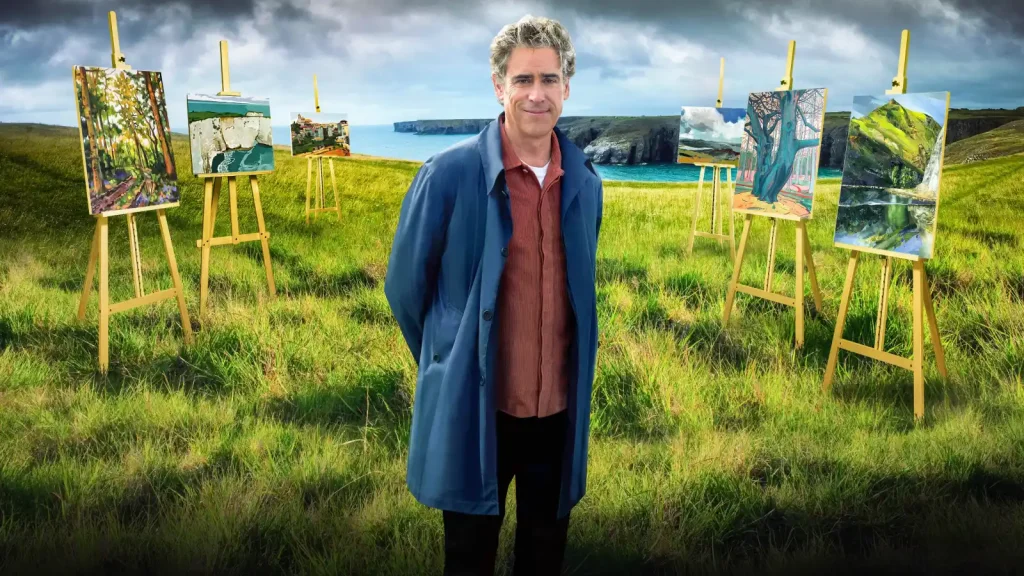
Landscape Artist Of The Year 2026 episode 9 opens not with a competition but with a homecoming — an unveiling ceremony at the National Gallery of Ireland in Dublin, where the painting created by series winner Kim Day was set to take its place as the first commissioned landscape work in the institution’s history.
From over 2,000 applicants, 48 artists competed across stunning locations throughout the UK for a £10,000 prize commission, and Kim Day emerged as the winner. Her prize would take her not back to familiar English countryside but across the Irish Sea, to the wild west coast of County Mayo, where Ireland’s holy mountain, Croagh Patrick, rises in a pyramid-shaped peak visible for miles along the Atlantic shore.
The episode represents something distinct within the landscape artist series: a conclusion rather than a competition, a commission fulfilled and revealed, and a study of one artist’s relationship with a place she had never previously encountered. Kim Day’s journey — professional, geographical, and emotional — forms the backbone of what makes this special episode both intimate and expansive. Her dual life as a film scene illustrator and a landscape painter collides with the weight of Irish religious and cultural history, producing a commission that would ultimately hang in one of Western Europe’s great art collections.
The stakes were exceptional by any measure. The National Gallery of Ireland, founded in 1854, houses over 18,000 artworks. Head curator Brendan Rooney confirmed to Kim that this was the first commission of its kind the gallery had ever undertaken — working directly with an artist to produce a landscape painting. The collection, which holds the most comprehensive archive of Irish art in the world, had a conspicuous gap: very few paintings of Croagh Patrick existed in public collections. Kim Day’s task, therefore, was not merely artistic but historical.
Stephen Mangan, the presenter whose announcement of Kim’s name at the final had brought her to tears, introduced the Dublin unveiling with characteristic warmth. He noted that the painting was the first landscape commission in the gallery’s history, and that Kim, as an Irish woman by heritage and spirit if not by passport, felt a personal resonance in returning to this island. The crowd gathered in the impressive Shore Room to witness the unveiling included friends, gallery staff, and volunteers, alongside the three judges who had tracked Kim’s artistic progress across the entire series.
Before the painting appeared before that Dublin audience, however, weeks of research, travel, and creative decision-making had taken place. The episode traces Kim’s full commission journey: from her meeting with Brendan Rooney in Dublin, through her immersive exploration of County Mayo’s coast and communities, to her pilgrimage on foot to the summit of Croagh Patrick, and finally back to her painting shed in Dorset where the commission took its definitive shape. Each stage informed the next. Nothing about the finished work was accidental.
Kim approached the brief with characteristic directness balanced against genuine uncertainty. She told herself to think only as far as the painting and to worry about the gallery afterwards. That psychological pragmatism — a trait visible throughout her competition performances — served her well during the research phase, when the sheer scale and significance of her subject threatened to overwhelm rather than inspire. Croagh Patrick, she discovered, was not simply a mountain. It was a weather vane, a pilgrimage site, a cultural memory, and a sacred axis around which multiple generations of Mayo people had organised their lives.
Two decades of professional work in film had given Kim Day a finely honed understanding of light, composition, and visual storytelling. Yet the freedom of her own painting, pursued in stolen hours at night and on weekends, represented something her day job could never provide: the chance to create her own formula rather than serve someone else’s. The commission offered an extraordinary expansion of that freedom, placing institutional weight behind her most personal creative instincts. The result, visible to the Dublin audience at the episode’s close, was a painting that Brendan Rooney described as one that could not be contained — the mountain refusing to stay within the frame, which was, he said, entirely right.
The episode is, at its core, a portrait of artistic process as much as artistic product. Landscape Artist Of The Year 2026 episode 9 traces the transformation of a place into a feeling, and a feeling into paint, with candour and care.
Landscape Artist Of The Year 2026 episode 9
Kim Day: The Artist Behind Landscape Artist Of The Year 2026 Episode 9
Kim Day’s path to the National Gallery of Ireland commission began long before the competition. For over twenty years, she worked as a film scene illustrator on some of the most ambitious productions in modern cinema. Her credits include The Matrix 4, Wonder Woman, Game of Thrones, and Star Wars, alongside her current project, A Knight of the Seven Kingdoms, a spin-off set within the Game of Thrones world.
Her professional life involves visualising entire environments before they are built — explaining to a stranger, she put it plainly: if you see a scene in a film and assume it is the real world, it is not. Everything has been built, painted, lit. Her job is to illustrate that before it happens.
The aspect of that work she loves most is light. She described it as intangible — the way it transforms colours, the strange calculations required to capture its effects. That professional obsession with light flows directly into her painting. She works from a shed down the road from her home in Dorset, fitting sessions around film deadlines, often painting at night or on weekends. The schedule is a genuine juggle, she admitted, but the painting represents something irreplaceable: a space where she creates her own formula, answers to no one, and finds joy in the simple act of mixing colours and watching them come together.
Her artistic identity centres on the landscape as a conduit for feeling. She is not documenting what she sees so much as translating how she feels about what she sees, using colour as the primary carrier of emotion. That approach was visible throughout her competition appearances. At her heat in the Lake District, judges praised her fantastical interpretation of Derwent Water and the surrounding mountains for its response to place — magical, deep, and rich.
At the semi-final, she demonstrated technical range with a more realistic rendering of the nineteenth-century Ouse Valley Viaduct in Sussex, capturing light through trees with luminous precision. At the final, her zoomed-in composition from the base of the Falkirk Wheel wowed the judges, and her commissioned piece of the view from her Dorset studio was described as harmonious, gorgeous, and glowing from within. Stephen Mangan announced her the winner, and Kim described the moment as overwhelming — an immediate, physical rush of disbelief and joy.
The National Gallery Brief and the Significance of the Landscape Artist Commission
The meeting between Kim and Brendan Rooney at the National Gallery of Ireland set the entire commission in motion. Rooney outlined the gallery’s history and ambitions with calm authority. Founded in 1854, it showcases some of the finest art in Western Europe while also holding the world’s most comprehensive collection of Irish art. The gallery had been thinking about gaps in its depiction of Ireland, and Croagh Patrick — known locally as the Reek — was conspicuously absent. Artists had painted both the mountain and views from it, Rooney explained, but not in large numbers, and the institution had nothing significant in its holdings.
The brief was deliberately open. Rooney stipulated only that the canvas not reach five metres in height, given the conventional scale of the gallery’s exhibition spaces. Everything else — viewpoint, palette, style, compositional approach — was left entirely to Kim. She responded with characteristic candour: she would go with her gut and hope for the best. That openness, combined with the institutional gravity of the commission, created a productive tension she would carry with her throughout the research trip.
Before Kim set off for County Mayo, Rooney showed her a painting by Paul Henry, Ireland’s most celebrated landscape artist. Henry, he explained, was inextricably linked with the depiction of the West of Ireland, to the point where the landscape itself had come to look like his paintings as much as his paintings looked like the landscape.
Henry had a feel for the essence of the place, Rooney noted, particularly his understanding of balance, composition, and the space he gave to clouds. Kim studied the work carefully, noting the simplicity of form and the consistently strong compositional intelligence. The visit gave her what she described as scope — a sense of the tradition into which her own work would now enter.
Croagh Patrick: Sacred Landscape at the Heart of Landscape Artist Of The Year 2026
Croagh Patrick sits high above the Atlantic shore in County Mayo, its pyramid-shaped peak visible on the horizon for miles around. For the local community in Westport, the nearest sizeable town, the mountain is a constant presence — what journalist and local expert Liami McNally described as part of their psyche, morning, noon, and night. Locals read the weather from it: cloud over the summit means rain is coming. The Irish language has a specific term for this kind of connection, he explained — dúchas, meaning a sense of place, deeply embedded in Irish cultural identity.
The mountain’s history is ancient and layered. Pagan worship took place there for thousands of years before St Patrick arrived in 441 AD, establishing the site as a Christian pilgrimage destination. McNally described the Christianisation of the mountain as a strategic replacement of one spiritual tradition with another, bringing Christianity to Ireland by occupying already sacred ground. He showed Kim a painting by American artist Henry Bruckner from 1872, depicting St Patrick casting out pagan snakes — a visual representation of the battle between good and evil, the snakes themselves a metaphor for older spiritual forces being displaced.
He also read her a passage from W.M. Thackeray’s Irish Sketchbook, written in the 1800s, in which the author described the view of the bay and the Reek as the most beautiful he had ever seen in the world — dressed in gold, purple, and crimson, with the whole cloudy west in a flame. Kim found the colour language electrifying: that light and colour had been a defining part of the mountain’s impact on observers for centuries felt entirely aligned with her own artistic preoccupations.
Over 100,000 people climb to the summit each year, many for personal rather than strictly religious reasons. Kim met local women on the path who described using the mountain for charity events, community fundraising, and personal healing. One woman, Louise, spoke about completing a brat chain on the mountain for Mayo Cancer Support, describing the climb as being in life itself — experiencing joy, happiness, and pain all in the same ascent. Father John Kenny, the priest in charge of the chapel built on the summit in 1905, told Kim that the pilgrimage appeals because everyone has a journey in life, and the mountain transforms any motivation — sporting, spiritual, or charitable — into a connection with nature.
Exploring the West Coast: Landscape Artist of the Year and the Spirit of Place
Kim’s research in County Mayo took her well beyond Westport. Keen to understand where Croagh Patrick sat within the wider landscape, she explored the coastline by boat, gaining perspective on the mountain from across the water. From out on the bay, she could see the mountain in what she called its full glory, surrounded by the body of water spread before it. The shifting weather provided immediate and dramatic visual material: rainfall created mist across the mountain’s face; sunlight cleared it moments later. The changes, she observed, were instant, and gave a painter a great deal to work with.
She also visited Achill Island, just north of Croagh Patrick. Achill had been home to Paul Henry for nearly ten years, during which he was endlessly fascinated by the rugged contours of the landscape and the power of the elements. Standing on the island, Kim could see exactly why. The skies above Achill were enormous, the cloud formations consistently dramatic — tall, billowing cumulus shapes she described as cottonball clouds, distinctive to the region.
She studied Henry’s painting Achill Head, created between 1918 and 1920, and admired how it conveyed the sense of the cloud formations rising up and up, filling the composition with space. The grey-slate blue he used struck her as precisely the colour of these mountains — not an interpretation but an accurate record of what the light actually does here.
Following in Henry’s footsteps, Kim made her way to the dramatic limestone cliffs of Ashleam, rising one hundred feet above the bay, where she produced a landscape study from the cliff edge. She made an artistic decision with immediate consequences: the painting would be almost two-thirds sky. The sky over this coastline was simply too significant to compress into the upper portion of a canvas.
She began, as always, with the facts — recording what was in front of her — before allowing herself to push the colours away from comfort, making them slightly less settled with each other, generating the emotional temperature she wanted the painting to carry. Sitting at Bertra Bay, a narrow sandy peninsula two and a half kilometres long with striking views of Croagh Patrick, she produced further sketches, noting how the glowing green grass provided a graphic element, a full stop before the eye moved upward into the mountains.
Meeting Mike McCormack: Writing, Memory, and Landscape Artist Of The Year 2026 Episode 9
The most philosophically resonant conversation Kim had during her Mayo research trip was with award-winning Irish author Mike McCormack, whose novels are set within the landscape of the west coast. McCormack grew up in a house within sight of Croagh Patrick — the mountain was literally outside his back door throughout childhood, present in his visual, literary, and religious imagination simultaneously. He described it as a massive ambient presence in his life, something that had mood and colour: sometimes brown, sometimes slate blue, shifting with the light.
His description of the mountain’s effect on light and colour animated Kim’s painter’s instincts immediately. She told him she was fascinated by exactly that — by the way light can affect colour. McCormack went further, describing days when light fills with moisture and seems to magnify the mountain, making it more vivid, as if you could reach out and touch its side.
He spoke of growing up between two elemental forces — the Reek to his back and the sea to his front — as something that centred you, that gave you coordinates in the world. Even now, living away from Mayo for over thirty years, every time he puts pen to paper, his writing veers back to this landscape, to these mountains. It has, he said, a magnetism, and it casts light and shadow not just on the physical world but within people as well.
Kim took that last idea directly into her thinking about the commission. The notion that the mountain exists as much inside the people who know it as it does in physical reality gave her a conceptual framework for the painting. She did not want to populate the canvas with crowds of people. She wanted to convey the human-ness of the mountain through tone and colour alone — to make the interior experience of the place visible without making it literal.
The Pilgrimage to the Summit and Its Creative Impact
Kim’s ascent of Croagh Patrick was both a physical and an artistic act. She carried her painting board strapped to her back, worried it might act as a sail in the high wind, and set off on a three-hour hike up 746-metre slopes that pilgrims have been climbing for 1,500 years, traditionally barefoot. She met a man on the path doing exactly that — walking in bare feet to focus his mind, to remember things that had happened in his life, and to tread carefully in how he moved through the world. The metaphor was not lost on her.
At the summit, she felt something she struggled to articulate except in simple, physical terms: she felt as though she was at the centre of the world. The views changed every minute, the light shifting constantly, the islands in the bay below looking — she said — like wispy paintbrush marks, almost fantastical in their shapes.
Father John Kenny welcomed her into the summit chapel and spoke about the pilgrimage’s appeal as a universal journey. Everyone has a journey in life, he told her, and the mountain transforms that fact into a connection with nature. Kim felt the particular spiritual quality of the chapel space immediately, describing it as all tingly — a sensation she had associated with the commission since its announcement.
She set up just below the summit to make the final study of her trip. Looking across the side of the mountain before the highest peak, she observed the sea — not the obvious blue a viewer might expect but a silvery grey with a slight lilac quality. She noted the unusual island shapes below, and considered the palette available to her: greeny, goldy brown, the kind of subtle, soft tones that resist drama in favour of intimacy. She began thinking about whether the darkness associated with pilgrimage and penance — its roots in atonement and the correction of wrongs — should also find expression in the painting, through something that described the darker side of the interior self through colour.
Returning to the Studio: Creating the Commission for Landscape Artist Of The Year
Back in Dorset, Kim began work on the commission proper, surrounded by reference sketches pinned to the wall of her painting shed. The decision about what exactly to paint had been the hardest part of the entire process, she admitted. There was a part of her that knew what she could do that would please people, and she needed to resist that impulse — to push past comfort into something more honest and more risky.
The view she settled on was the beginning of the pilgrim’s path up Croagh Patrick. The conceptual core of the painting was the idea of taking a path without knowing the destination: setting out on a journey, the end uncertain, the act of beginning sufficient in itself. She wanted the drama of light built into the composition — light as a metaphor for the path forward, for illumination and guidance.
The great billowing clouds she had observed at Achill came back into the painting, providing the sky presence she knew was essential to capture the atmosphere of the place. She described Saint Patrick as a kind of imaginary witness to her work — present in spirit above the painting board, guiding her forward.
Her stated ambition for the finished piece was not technical perfection but emotional transmission. She wanted people to feel the painting more than to study it — to sense the energy and the light, to be carried somewhere without necessarily knowing where they had arrived. That would be the best result, she said: not that the painting be admired but that it be felt.
The Unveiling at the National Gallery: Landscape Artist Of The Year 2026 Episode 9 Comes Full Circle
The Shore Room at the National Gallery of Ireland filled with an audience of friends, staff, and volunteers as Stephen Mangan prepared to unveil Kim’s finished work. The judges who had followed her throughout the landscape artist series were present, their anticipation visible. One noted having seen her work small throughout the competition, and wondered whether she would go bold for the commission. Another observed that Croagh Patrick was a place Kim had not known before this commission — an unfamiliar subject, with enormous cultural and historical weight — and that the real test was whether she could make it her own.
Brendan Rooney’s immediate response on seeing the painting was delight. His first observation was pointed: the canvas and the frame could not contain the mountain, which was, he said, exactly right. A landmark of that cultural, historical, and religious significance should refuse to be enclosed. He noted the painting’s handling of the idea of journeys, of destinations unknown, of setting out regardless — the very spirit of the pilgrimage given visual form. He called it one very atmospheric painting.
The judges were equally enthusiastic. One praised the fogginess and fuzziness of Kim’s characteristic use of texture, and noted the symbolism embedded in the work — small souls ascending towards heaven, the whole religious sense of atonement and the attempt to right wrong. The burning lights in the painting, she observed, really glowed from a distance. Another judge was struck by the decision to cut the mountain off at the top: the summit exceeds the frame’s scope, forcing the viewer to go inward. That, he said, is what the mountain is about. It is inventive, and it sings.
Kim herself described feeling high in the best sense — genuinely elevated. She reflected on how the work produced during the landscape artist series had pushed her, teaching her about herself and clarifying what she wanted to do going forward. The commission represented a significant moment in her career, and she was proud. As the applause filled the Shore Room, her painting took its place among the works of Caravaggio, Rembrandt, Vermeer, and Yeats in one of the great galleries of the Western world — the first landscape commission in the institution’s history, and the result of a journey that had begun with a competition, crossed an Irish sea, climbed an ancient holy mountain, and ended in colour, light, and feeling.
FAQ Landscape Artist Of The Year 2026 episode 9
Q: What is Landscape Artist Of The Year 2026 episode 9 about?
A: Landscape Artist Of The Year 2026 episode 9 is a special commission episode following series winner Kim Day. She travels to County Mayo in Ireland to research and paint Croagh Patrick, Ireland’s holy mountain, for a prize commission displayed at the National Gallery of Ireland in Dublin.
Q: Who won Landscape Artist of the Year 2026?
A: Kim Day won Landscape Artist of the Year 2026. She impressed the judges throughout the series with her semi-abstract, colour-driven work. Her competition paintings included scenes at the Lake District, the Ouse Valley Viaduct, and the Falkirk Wheel in Scotland. Presenter Stephen Mangan announced her victory at the live final.
Q: What was Kim Day’s prize commission for winning Landscape Artist of the Year?
A: Kim Day’s prize was a £10,000 commission to paint a view of Croagh Patrick for the National Gallery of Ireland. Notably, this was the first landscape painting the gallery had ever commissioned. Head curator Brendan Rooney briefed Kim directly and provided an open brief with no fixed stylistic requirements.
Q: Where is Croagh Patrick and why is it significant?
A: Croagh Patrick is a 746-metre mountain on the west coast of County Mayo, Ireland. Its pyramid-shaped peak is visible for miles along the Atlantic shore. The mountain has been a sacred site since pre-Christian times and became a Christian pilgrimage destination after St Patrick arrived in 441 AD. Over 100,000 people climb it annually.
Q: What is Kim Day’s background as an artist?
A: Kim Day works professionally as a film scene illustrator, a role she has held for over 20 years. Her credits include The Matrix 4, Wonder Woman, Game of Thrones, and Star Wars. Additionally, she paints independently in a shed near her Dorset home, fitting sessions around film work in evenings and on weekends.
Q: How did Kim Day approach the Croagh Patrick commission?
A: Kim researched the commission through extensive fieldwork in County Mayo. She sketched at Westport Harbour and Bertra Bay, explored Achill Island to study Paul Henry’s landscape legacy, met author Mike McCormack and journalist Liami McNally, and climbed to the summit of Croagh Patrick herself. These experiences directly shaped her final composition.
Q: Who is Paul Henry and what is his connection to this episode?
A: Paul Henry is Ireland’s most celebrated landscape artist, inextricably linked with the depiction of the west of Ireland. He lived on Achill Island for nearly ten years. Curator Brendan Rooney showed Kim his work before her trip to illustrate the tradition she was entering. Kim studied his cloud formations and palette directly during her Achill visit.
Q: What view of Croagh Patrick did Kim Day choose to paint?
A: Kim chose the view from the beginning of the pilgrim’s path at the base of Croagh Patrick. The composition centres on the idea of setting out on a journey without knowing the destination. She incorporated dramatic light as a metaphor for guidance, along with the large billowing clouds she observed at Achill Island during her research.
Q: How was Kim Day’s finished painting received at the National Gallery of Ireland?
A: The unveiling in Dublin received enthusiastic responses from both the curator and the judges. Brendan Rooney praised the painting for allowing the mountain to exceed the canvas frame. The judges admired its atmospheric fogginess, embedded symbolism of souls ascending, and the decision to cut off the summit, which they described as inventive and powerful.
Q: What makes Landscape Artist Of The Year 2026 episode 9 different from a standard competition episode?
A: Unlike regular artist heat or semi-final episodes, this special episode focuses entirely on the winner’s commission journey. There is no competitive element. Furthermore, the episode explores Irish cultural history, the significance of pilgrimage, and one artist’s creative process in depth. It culminates in a public gallery unveiling rather than a judging panel verdict.