The documentary Hidden Treasures of the National Trust 2025 episode 6 explores the profound intersection of faith, family, and endurance, showcased through two magnificent English country homes. It reveals how two families, on opposite sides of a great religious divide, risked everything to uphold their beliefs. Their legacies are not just recorded in historical texts but are physically embodied in the very fabric of their ancestral houses and the precious artifacts they contain. Consequently, the preservation of these sites becomes a crucial act of historical storytelling, connecting us to a turbulent past.
The importance of this subject lies in its human-scale illustration of vast historical forces. During the 17th century, England was torn apart by religious conflict that pitted neighbor against neighbor and subject against king. The featured homes, Lanhydrock in Cornwall and Coughton Court in Warwickshire, serve as powerful case studies of this era. The ongoing conservation efforts at these properties are more than just architectural maintenance; they are a mission to save the tangible evidence of these deeply personal and perilous struggles, ensuring future generations can understand the sacrifices made for faith.
This exploration delves into the epic conservation projects undertaken by the National Trust to safeguard these invaluable pieces of history. The scope of Hidden Treasures of the National Trust 2025 episode 6 covers both the grand vision and the microscopic detail of this work. It examines the immense structural repairs at a Tudor manor and the delicate, painstaking restoration of a unique Jacobean ceiling. Furthermore, it follows the dramatic journey of priceless artifacts, each with a story of devotion and persecution to tell, as they are carefully preserved for the future.
At the heart of these stories are the families who built and inhabited these homes. In Cornwall, the Robartes family, devout Puritans, established the grand estate of Lanhydrock. Their story is one of rising influence and unwavering religious conviction that led them into direct conflict with the Crown during the English Civil War. In Warwickshire, the Throckmorton family of Coughton Court faced persecution for their steadfast Catholic faith. They navigated a treacherous political landscape where their beliefs made them outcasts and suspected traitors, a reality starkly captured in the treasures they protected.
These parallel narratives provide a fascinating insight into the lived experience of faith during a period of intense religious upheaval. The challenges faced by the Robartes family and the Throckmorton family, though stemming from opposing Puritan and Catholic beliefs, were remarkably similar. Both families used their homes as statements of their identity and faith, embedding their stories in architecture and art. As we explore the complex restoration projects at Lanhydrock and Coughton Court, we uncover the layers of history preserved within their walls, each detail a testament to a family’s enduring spirit.
Hidden Treasures of the National Trust 2025 episode 6
Saving a Divine Vision at Lanhydrock
Deep in the Cornish countryside, Lanhydrock stands as a monument to the Robartes family, who amassed great wealth from the tin trade. The house, largely the vision of John Robartes, the second Baron of Truro, reflects the peak of Jacobean design. The centerpiece of his vision is the magnificent Long Gallery, which, remarkably, survived a devastating 19th-century fire. Its most spectacular feature is a 35-metre-long plasterwork ceiling, a masterpiece of 17th-century craftsmanship.
The ceiling is a complex tapestry of biblical scenes from the Old Testament and a menagerie of mythical creatures. This was not merely decoration; it was a public declaration of John Robartes’ deeply held Puritan beliefs. In an age where religious symbolism was universally understood, any visitor would immediately recognize the stories and understand the owner’s piety.
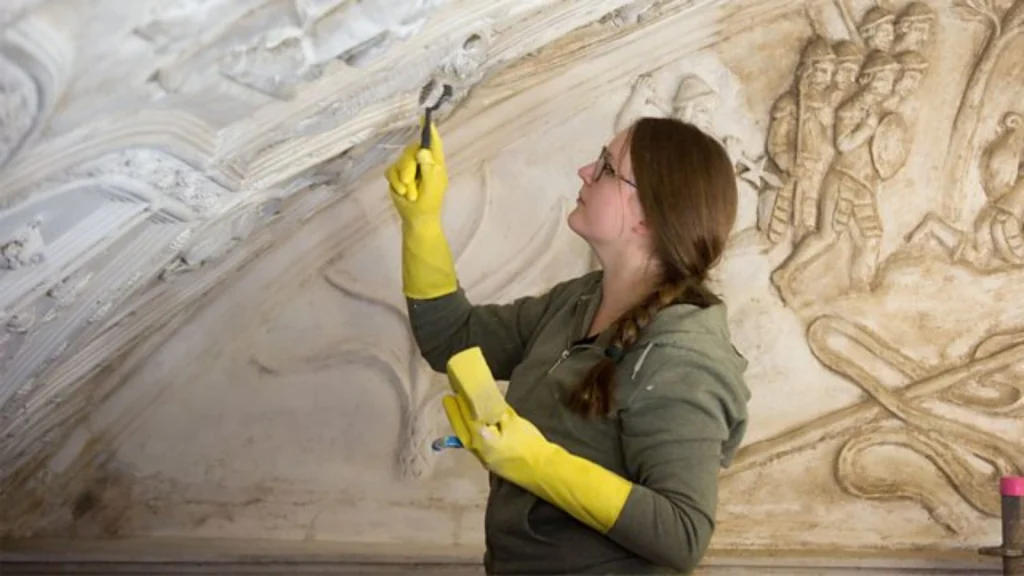
The passage of 400 years, however, has taken a severe toll. The intricate details have been obscured by layers of dirt, and the plaster itself has become unstable. The National Trust has embarked on a colossal conservation project, treating the ceiling with the reverence it deserves. As senior conservator Douglas explains in Hidden Treasures of the National Trust 2025 episode 6, every square centimeter requires meticulous attention. His team has erected extensive scaffolding to get close to the artwork, revealing its incredible detail and the alarming extent of its decay.
The cleaning process is a delicate operation, using little more than water, specialized brushes, and immense patience to gently peel back the centuries of grime. This work has unveiled the vibrant artistry hidden beneath, from a comical, gender-fluid Lamia to a sea serpent devouring a helpless human.
Beyond cleaning, the project involves complex structural repairs. Conservator Laura is tasked with tasks like recreating a missing horn for a bull figure, a process that blends artistry with scientific precision. She drills into the existing structure to insert a stainless-steel armature before modeling a new horn from a specialized compound.
Elsewhere, Douglas confronts a more serious problem: sections of the plaster are detaching from the wooden laths of the ceiling. He notes that the plaster feels “live,” and there is a real fear of “catastrophic loss.” To prevent this, he injects a liquid grout into tiny holes, which acts as an adhesive to re-bond the plaster to the structure. It is a slow, nerve-wracking process, but essential for preserving this divinely inspired masterpiece for generations to come.
Raising the Roof at Coughton Court
Meanwhile, in Warwickshire, an even larger crisis looms at Coughton Court, the ancestral home of the Throckmorton family. This formidable Tudor manor has been a bastion of Catholic faith since the 16th century. The family’s fortunes turned dramatically with the Reformation, when Henry VIII established the Church of England. Robert Throckmorton, a man of great conviction, refused to convert to Protestantism. This decision cast his family out of society’s elite and placed them under constant suspicion and persecution, especially during the reign of Elizabeth I. Their home became a sanctuary, but also a symbol of their defiance, a place where their forbidden faith was practiced in secret.
Centuries of exposure to the elements have left the building vulnerable. As revealed in Hidden Treasures of the National Trust 2025 episode 6, the massive 840-square-metre roof has been failing for years. Water ingress became a constant threat, endangering the historic plaster ceilings and the priceless collection within. The National Trust initiated a massive project to completely replace the roof, a task fraught with complexity on a 600-year-old building where, as one of the team members notes, “nothing’s actually square.” The work is further complicated by the presence of a protected bat colony, meaning the entire project is on a strict timetable dictated by the bats’ migration patterns.
The roofing project, while a huge undertaking, has presented a unique opportunity to address another pressing conservation issue. High in the tower, a priceless artifact has been effectively trapped for decades: the Tabula Eliensis. This large painted cloth is a unique historical document. On its surface, it depicts the history of Ely Cathedral, but its true significance lies in the coats of arms it displays.
These belong to 29 prominent Catholic gentlemen, including Thomas Throckmorton, who were interned by Queen Elizabeth I as a way of holding their families to ransom. The Tabula is a powerful and subtle protest against this injustice. However, its fragile condition and immense size—at 2.5 metres wide—meant it could not be moved down the tower’s narrow, winding staircase. The roofing project provided a once-in-a-generation chance: to cut a hole in the roof and lift the Tabula out with a crane.
A High-Stakes Heist: Freeing the Tabula Eliensis
The extraction of the Tabula Eliensis from Coughton Court was an operation of military precision, as documented in Hidden Treasures of the National Trust 2025 episode 6. Project Manager Aimee and a team of art handlers planned the maneuver for months. The plan involved cutting a narrow slot in the roof and threading the artwork through a gap with only centimetres of clearance. The first attempt was thwarted by high winds, a crushing disappointment for the team. The crane could not operate safely, and the risk of the wind catching the Tabula like a sail and smashing it was too great.
With the clock ticking and the weather forecast unpredictable, the team had to regroup and wait for a second chance. The pressure was immense; the artifact is considered priceless and unique. Finally, a window of calm weather appeared. The team sprang into action, with all eyes on the wind speed. With nerves of steel, the crane operator began the lift. The specialist team on the roof carefully guided the massive, fragile painting through the narrow gap. After a tense few moments, the Tabula was free from the tower that had been its prison for so long. It was carefully lowered to the ground, greeted by the applause of the relieved team.
This dramatic “heist” was only the beginning of the Tabula’s journey. It was carefully packed and transported to a conservation studio where it will undergo months, if not years, of meticulous work. Experts will seek to understand its construction better, stabilize its peeling paint, and ensure it can be safely displayed in the future. The removal of the Tabula is a powerful symbol of the lengths the National Trust will go to in order to protect the treasures entrusted to its care. It also underscores the story of the Throckmorton family, whose history of resilience and quiet defiance is encapsulated in this remarkable object.
Conserving the Treasures Within Lanhydrock’s Long Gallery
The Long Gallery at Lanhydrock was more than just a place for exercise and entertainment; it was the intellectual and spiritual heart of the Robartes family home. Along with its magnificent ceiling, it housed one of the most significant book collections in the National Trust. One volume, in particular, stands out: the Lanhydrock Prayer Book.
This 1636 Bible is exquisitely bound in an embroidered cover featuring silver and gold thread, depicting Queen Esther and King David. It is believed to have belonged to Lucy, John Robartes’ first wife. As a devout Puritan, Lucy would have played a key role in the religious life of the household, and this beautiful object would have been a cherished personal possession. However, its threadbare and fragile condition meant it has been kept in storage for many years, too delicate to display.
To assess its condition without causing further damage, the prayer book was sent to Exeter University’s Digital Imaging Lab. Using a CT scanner, scientists were able to create a 3D X-ray image of the book. This allowed them to look inside the binding and see the structure non-invasively. The scan revealed that while the exterior threads were loose and faded, the book’s internal structure was surprisingly sound. This good news meant that with careful conservation, the book could be stabilized and eventually returned to display.
The book was then sent to a textile conservator, Elaine, who undertook the painstaking task of securing the lifting metal threads. Using a tiny amount of adhesive and immense patience, she carefully repositioned each wayward thread, restoring a degree of regal pride to King David’s frame.
Another treasure from the gallery that required expert attention was a stunning 17th-century Antwerp Cabinet. Lavishly decorated with ebony and red tortoiseshell, these cabinets were designed to display curiosities and were a symbol of wealth and worldliness. Over time, however, pieces of the intricate ebony mouldings and tortoiseshell veneer had been lost. Conservator Nicola faced a significant challenge. The use of new ebony, a regulated hardwood, was not feasible, and the use of real tortoiseshell, from an endangered turtle, was ethically out of the question.
Her solution was a testament to the innovative spirit of modern conservation. For the ebony, she created a mould from a surviving section and cast replacements using a black-pigmented epoxy paste. The result was a near-perfect match in both colour and gloss. For the tortoiseshell, she sliced a thin piece from a rod of polyester resin, carefully sanding and polishing it to replicate the translucency and patterning of the original. This intricate work has restored the cabinet to its former glory, allowing it to once again be a “wow factor” in the magnificent Long Gallery.
When Stone and Plaster Become Keepers of the Soul
As the scaffolding comes down at Lanhydrock and the last slate is secured at Coughton Court, something profound emerges from these epic conservation efforts. These projects represent far more than architectural preservation—they’re acts of resurrection, breathing life back into the silent testimonies of families who refused to bend under the weight of persecution.
The painstaking work of cleaning centuries of grime from a biblical ceiling or engineering the rescue of a trapped historical document reveals a deeper truth: our built heritage is really a collection of human stories made tangible. When Douglas injects grout into failing plaster or when the crane lifts the Tabula Eliensis to freedom, they’re not just saving objects—they’re preserving the DNA of defiance, faith, and endurance that once pulsed through these walls.
The parallel journeys of the Robartes and Throckmorton families offer us something invaluable in our own polarized times. Despite standing on opposite sides of England’s great religious divide, both families faced remarkably similar challenges: how to maintain identity when the world demands conformity, how to protect what matters most when everything is at stake. Their homes became more than shelters; they evolved into physical manifestations of belief, each architectural detail and hidden treasure a chapter in their ongoing resistance to erasure.
Perhaps most striking is how these conservation efforts mirror the original builders’ determination. Just as John Robartes embedded his Puritan convictions in intricate plasterwork and the Throckmortons encoded their Catholic resistance in hidden artifacts, today’s conservators approach their work with similar devotion. Laura’s meticulous recreation of a bull’s horn and Elaine’s patient restoration of King David’s embroidered frame carry forward the same spirit of preservation that once motivated families to risk everything for their beliefs.
The National Trust’s commitment to these projects—from the years-long ceiling restoration to the military-precision extraction of priceless documents—demonstrates something crucial about our relationship with the past. These aren’t museum pieces gathering dust; they’re active participants in an ongoing conversation between past and present. When we walk through Lanhydrock’s Long Gallery or stand in Coughton Court’s great hall, we’re not just observing history—we’re completing a circle of connection that spans four centuries.
As these newly restored treasures prepare to welcome future generations of visitors, they carry forward an essential reminder: the struggles that shaped these families—for religious freedom, for the right to believe differently, for the courage to stand against the crowd—remain startlingly relevant today. In a world where division often seems insurmountable, these houses whisper a different message: that the human capacity for faith, resilience, and quiet heroism transcends the boundaries that seem to separate us.
The next time you visit a historic house, look beyond the roped-off rooms and polished artifacts. Listen for the echoes of ordinary people making extraordinary choices, and remember that every careful conservation project is really an investment in keeping those essential human stories alive for when we need them most.
FAQ Hidden Treasures of the National Trust 2025 episode 6
Q: What is the National Trust and what role does it play in historic preservation?
A: The National Trust is a conservation charity that protects over 500 historic houses, gardens, and landmarks across England, Wales, and Northern Ireland. Additionally, the organization employs specialist conservators who undertake complex restoration projects to preserve architectural heritage for future generations. Furthermore, the Trust maintains these properties through membership fees and donations, ensuring priceless artifacts and buildings remain accessible to the public.
Q: How does the National Trust prioritize which properties require urgent conservation work?
A: Conservation priorities are determined through detailed condition surveys that assess structural integrity, environmental risks, and historical significance. Moreover, factors like water damage, failing roofs, and deteriorating plasterwork often dictate immediate action. The Trust also considers the uniqueness of artifacts, such as the Tabula Eliensis at Coughton Court, when planning extraction and restoration timelines.
Q: What are the most common challenges conservators face when restoring centuries-old buildings?
A: Historic buildings present unique structural irregularities, as team members note that “nothing’s actually square” in 600-year-old constructions. Additionally, conservators must work around protected wildlife, such as bat colonies that dictate project schedules. Furthermore, they face the delicate balance of preserving original materials while ensuring structural stability, often requiring innovative solutions like specialized grout injection for failing plaster.
Q: How long do major conservation projects typically take to complete?
A: Conservation timelines vary dramatically depending on project scope and complexity. For instance, ceiling restoration projects like Lanhydrock’s 35-meter plasterwork can span several years, requiring meticulous attention to every square centimeter. However, roof replacements might take 12-18 months, while artifact conservation in specialized studios can extend even longer to ensure proper stabilization and preservation.
Q: What modern technologies assist conservators in their preservation work?
A: Contemporary conservation employs cutting-edge techniques like CT scanning to examine fragile artifacts non-invasively. Additionally, 3D X-ray imaging allows experts to assess internal book structures without causing damage, as demonstrated with the Lanhydrock Prayer Book. Furthermore, specialized compounds and stainless-steel armatures enable precise reconstruction of missing elements while maintaining historical authenticity and structural integrity.
Q: How does the National Trust fund these expensive conservation projects?
A: Funding comes from multiple sources including membership subscriptions, public donations, government grants, and heritage lottery funding. Moreover, visitor entrance fees contribute significantly to conservation budgets. The Trust also launches specific appeals for major projects, highlighting the urgent need to preserve unique treasures like embroidered prayer books and centuries-old plasterwork that represent irreplaceable cultural heritage.
Q: Can visitors still tour properties during active conservation work?
A: Many properties remain partially open during conservation projects, though access to specific areas may be restricted for safety reasons. Additionally, the Trust often provides special behind-the-scenes tours that offer unique insights into conservation processes. However, major structural work like roof replacement or ceiling restoration typically requires temporary closure of affected areas while maintaining access to other parts of the property.
Q: What happens to extremely fragile artifacts that cannot be safely displayed?
A: Fragile items are carefully stored in climate-controlled environments until conservation work can stabilize them for display. Furthermore, some artifacts like the Tabula Eliensis require dramatic extraction procedures using cranes and military-precision planning. Subsequently, these treasures undergo months or years of specialized treatment in conservation studios before returning to public view, ensuring their preservation for future generations.
Q: How do conservators address structural problems like detaching plaster or failing roofs?
A: Structural issues require immediate intervention to prevent catastrophic loss of historic fabric. Additionally, techniques like liquid grout injection help re-bond loose plaster to underlying wooden laths, though the process demands patience and precision. Moreover, complete roof replacement becomes necessary when water ingress threatens interior collections, requiring careful coordination to protect both the building structure and its contents.
Q: How can visitors and supporters contribute to National Trust conservation efforts?
A: Visitors can support conservation through National Trust membership, which provides essential ongoing funding for preservation work. Additionally, targeted donations to specific appeals help fund major projects like ceiling restoration or artifact conservation. Furthermore, volunteering opportunities allow hands-on participation in heritage preservation, while simply visiting properties generates crucial revenue that directly supports the Trust’s conservation mission and expertise.