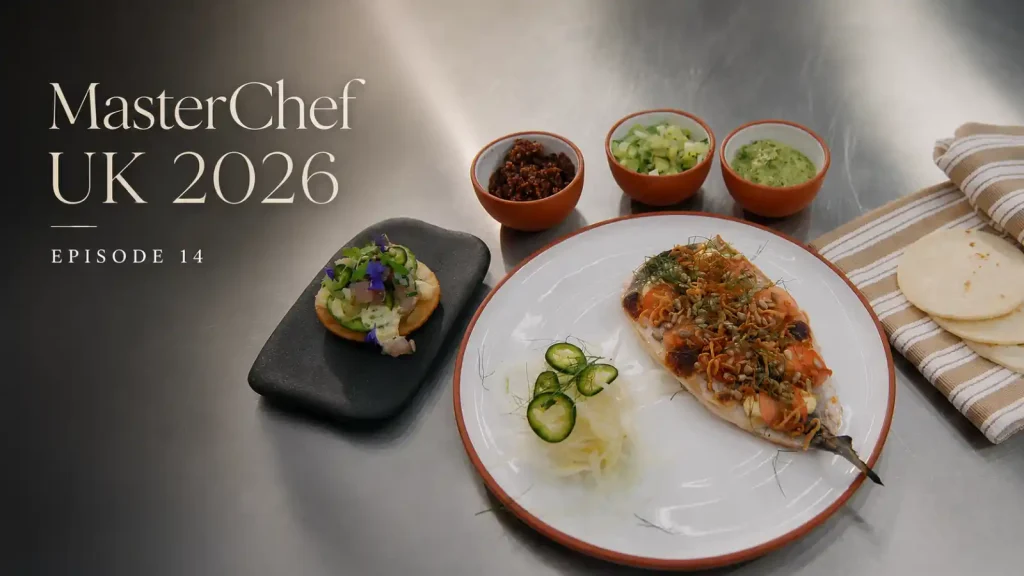
MasterChef UK 2026 episode 14 delivers one of the most demanding and revealing rounds of the entire series, with seven amateur cooks facing not just the judges’ scrutiny but their own ambitions. After four weeks and 48 contestants whittled down to the best 14, knockout week shows no mercy. Two cooks will be eliminated. The survivors will earn their first-ever shift in a professional kitchen, a five-star London restaurant where real diners sit waiting for real food. What unfolds across this episode is a masterclass in the gap between dreaming about food and actually being able to deliver it under pressure.
The episode centres on two separate but connected challenges. First, judges Anna and Grace demand each cook’s “food dream” — a dish that could sit on a restaurant menu, feature in a cookbook, or headline a pop-up stall. One hour and forty-five minutes. Seven cooks. Seven visions. Then, the five who make it through head to Straits Kitchen at the Pan Pacific Hotel in the City of London, where executive head chef Adam Bateman runs a tight, demanding lunchtime service built around a five-course tasting menu fusing French technique with Southeast Asian flavour. Everything about this episode is high-stakes. Everything matters.
Anna and Grace make the brief immediately clear. Every cook in the room has a food dream — that is why they are standing in the MasterChef kitchen. Now, they have to put it on a plate. The dish must be outstanding, presentation worthy of a gallery space, and flavour deserving of a menu. Two cooks will go home. The rest earn something money cannot buy.
The seven contestants respond with an ambitious, eclectic collection of dishes that span continents. Communications director Kristen, whose cooking has consistently impressed with bold Southeast Asian flavour, takes the judges to Mexico with grilled mackerel tacos. Her spread is extraordinarily complex: soft corn tortillas, smoked mackerel mayonnaise, crispy shallots, sunflower seeds, three separate salsas — verde, macha, and a pico de gallo made with pickled cucumber and grapes — alongside a mackerel tartare tostada on the side. Anna’s response is immediate: exhausted just hearing the list. Grace, meanwhile, is already curious.
Dairy factory worker Tony takes a different route entirely. His food dream is fine dining, and he commits fully to that vision with a pan-roasted halibut dressed up as the most elevated version of fish and chips imaginable. There is a crispy potato spiral in place of chips, a silky broad bean purée where mushy peas once sat, a tempura oyster, asparagus, braised leeks, and a beurre blanc split with dill oil. The judges flag the difficulty immediately. Broad beans are notoriously hard to turn into a smooth purée. One minute too long on the halibut, and the whole dish falls apart.
Music producer Jim returns to the place where his heart lives: Sri Lanka. His food dream is a home-style Sri Lankan restaurant where people eat with their fingers, and his dish reflects exactly that spirit. A red chicken curry built from 18 different ingredients, a polo roti with coconut, a brinjal moju — sweet and sour aubergine with cinnamon and chilli — and a coconut sambal. Grace, who has never encountered brinjal moju before, is genuinely intrigued.
MasterChef UK 2026 episode 14
Seven Chefs, Seven Visions: How Each Dish Defined the Competition
PhD student Matt produces the most technically audacious dish in the room. A polenta crepe filled with poached lobster tail and lobster head in a dried chilli sauce, creamed beer-braised greens, and a tempura lobster claw served alongside a Japanese mirin, soy, and dashi dipping sauce. Matt himself acknowledges it as his most ambitious dish yet — something the judges may not have seen before. The key challenge, he explains, is balancing the flavours inside the crepe without letting the spicy lobster head sauce or the bitter beer overwhelm the sweetness of the lobster itself.
Northern Irish PhD student Adam cooks pork fillet with Pommes Anna, braised cabbage and bacon inside a crispy cabbage tuile, cider gel, and Madeira jus. It is classic food with Northern Irish roots, done differently. He wants to elevate familiar, homely combinations. However, the judges immediately identify the risks. Pork fillet is lean and unforgiving: one minute over time and it turns dry. The cabbage tuile needs to be crisp enough to hold its cylindrical form. The cider gel must set correctly. Several technical elements need to work simultaneously.
Cake decoration business owner Joyce brings Mauritian flavours to a quail’s egg Scotch egg on a sweet potato rosti, with coconut and mint chutney and pickled apple. Her dream is a food festival stall celebrating the cuisine she grew up with. The Scotch egg meat is seasoned with lime powder, onion powder, ginger, and garlic. The rosti is bound with ginger, garlic, soy sauce, and cornflour. Anna and Grace expect a flavour bomb. They need the pork to sing with spice.
Civil servant Frankie goes to Italy, making squid ink and red pepper cappelletti stuffed with sardine, mascarpone, and red pepper, on a kale and walnut pesto with confit tomatoes, crispy fennel, and walnut pangrattato. Her food dream is a cookbook celebrating healthy food built on addition rather than subtraction — omega-3 from sardines, good fats from walnuts, cruciferous goodness from kale. Technically, she makes two separate pasta doughs, one coloured with squid ink and one with roasted red pepper, then rolls them together to produce striking black-and-white striped sheets.
The Judging Round: Triumph, Caution, and the Fine Details That Decide Everything
Kristen’s mackerel tacos land well. The mackerel is beautifully cooked, still pink in the centre. The mackerel tartare is delicious. The pico de gallo made with grapes is called “really beautiful.” Grace calls it “really fantastic food.” The salsa macha — crunchy, oily, and hot — earns specific praise. Kristen walks away from the judges’ table relieved and proud.
Tony’s fine-dining fish and chips impresses significantly. The halibut is cooked exactly as Anna likes it. The beurre blanc split with dill oil is described as silky and meaningful. The broad bean purée is creamy and delightful — the judges compete to describe it as the finest mushy peas they have ever encountered. The crispy potato spiral is golden outside and soft within, called a brilliant alternative to chips. The tempura oyster is crisp, nicely seasoned, and well-executed. Tony leaves the judging on cloud nine.
Matt’s polenta crepe provokes genuine enthusiasm. Anna praises the lobster sauce as wonderful, the use of chilli as masterful, and the beer-braised greens as a dash of genius. Grace says she has had many lobster dishes in her career, but never one wrapped in a polenta pancake. She calls it very unique and says she really likes it. Matt feels weirdly calm afterwards — a sign that something has gone exactly right.
Jim’s Sri Lankan spread generates the most unambiguous response of the entire round. Anna says the sauce is just heaven — creamy, coconutty, with rising heat she loves. Grace calls the aubergine stunning. The sweet, pickled, spicy curry leaves and garlic inside the brinjal moju draw particular praise. Then Grace delivers what amounts to a standing order: if Jim opens a Sri Lankan restaurant in the future, she wants this dish on the menu. Jim promises it will be.
Frankie’s cappelletti divides the room. Anna admires the texture of the pasta, loves the herby walnut pesto, and calls the mouthful of stuffed pasta with tomato and pangrattato perfect. Grace, however, finds that the mascarpone and red pepper have diluted the punch of the sardine. She is not getting enough sardine. Frankie comes away with mixed feelings.
Adam’s pork fillet earns qualified praise. The Pommes Anna is loved — crispy, buttery, fluffy inside. However, the cider gel comes out lumpy and chopped rather than smooth. The Madeira jus is too heavy-handed. The cabbage tuile, while clever in concept, is not entirely convincing on the palate. Crucially, Grace observes that nothing on Adam’s plate represents a creative risk. At this stage in the competition, elegant is no longer enough.
Joyce and Adam Eliminated: The Decisions That Changed the Game
Joyce and Adam go home. Four cooks who clearly impressed — Matt, Kristen, Tony, and Jim — go straight through. That leaves Adam and Frankie alongside Joyce, requiring a final decision between three cooks. The judges acknowledge that Frankie’s technique with that striped cappelletti is outstanding. She is pushing herself and revealing depths of cooking ability nobody had yet seen. That technical ambition, combined with the quality of the pasta execution, is enough.
Joyce’s exit comes down to the fact that her food dream was a Mauritian Scotch egg, and the Mauritian flavours did not make the transfer from idea to plate. The spicing was too timid. The dish also lacked a sauce or mayonnaise that the judges felt it was crying out for. Those details, in MasterChef UK 2026 episode 14, are the difference between staying and leaving.
Adam’s exit is more painful in a different way. The elements were competent. Some were genuinely lovely. But the cider gel was technically flawed, the Madeira jus was unbalanced, and the overall plate did not push into new territory. At week four, not pushing is its own kind of failure. Grace tells him directly: do not give up on your food dream. He leaves bittersweet but gracious.
Straits Kitchen and the Reality of Professional Service
The five survivors — Kristen, Tony, Matt, Jim, and Frankie — report to Straits Kitchen inside the five-star Pan Pacific Hotel in the City of London at 8am. The restaurant takes its name from the Straits of Malacca in Southeast Asia, and its tasting menu reflects that geography: French and European technique carrying Eastern flavours.
Executive head chef Adam Bateman is a Birmingham-born chef who never intended to cook professionally. His mother worked at The Belfry hotel in the Midlands, steered him into a kitchen stint when he was in trouble as a young man, and he instantly fell in love. Over 20 years running hotel kitchens across the Midlands, he moved to London to take over the Pan Pacific operation. His cooking philosophy is specific: French foundations, Asian soul. Bisques and beurre blancs carrying laksa paste and yuzu. Duck breast cooked with Thai-style nam phrik ong lentils. Char siu pork with preserved plum ketchup.
Each of the five contestants is assigned one course from the five-course tasting menu. They have three hours to prepare, then execute under a full lunchtime service with real paying guests. Bateman is candid: he is nervous about having five amateurs in the kitchen. His dining room is full of City professionals who want great food delivered fast. There is no flexibility in the schedule.
MasterChef UK 2026 Episode 14 at Straits Kitchen: Who Cracked and Who Delivered
Frankie takes the first course — Orkney scallops with dulse beurre blanc and yuzu gel. The scallops are premium, hand-dived, and enormous. Her first challenge is simply preparing them without damaging the flesh. During service, she immediately encounters the difficulty of cooking at professional volume. The pans run hotter than she expects. Bateman intervenes to save the first scallops before the heat destroys them. She also overdoses the yuzu gel on her first plating — Bateman corrects her gently but clearly. By the next round, she has calibrated both elements. The finished dishes are praised: beautifully coloured scallops, buttery dulse beurre blanc, a delicate touch of yuzu that complements rather than overwhelms.
Jim handles the second course: duck breast with nam phrik ong-style lentils and wok-charred cauliflower. The duck demands cold-pan rendering to release the fat slowly without burning. Jim manages 20 duck breasts through the process while simultaneously managing the ferocious heat of the wok for the cauliflower. Both elements must be live simultaneously during service. By the final plates, the duck is crispy-skinned and pink at the centre, the lentils carry proper heat, and the cauliflower arrives with beautiful colour. Bateman identifies the slicing consistency as the one ongoing struggle, pushing Jim harder as each round progresses until the final plates are even and precise.
Tony takes the pasta course: a crab raviolo with a laksa crab bisque. Making crab ravioli from scratch under restaurant conditions is genuinely punishing. The pasta must be thin enough to cook properly but thick enough to contain the dressed crab filling without pockets of air that will split during cooking. Tony nearly runs out of time during prep, losing some ravioli to drying and cracking. Bateman pushes him hard. However, the finished dish is praised with real enthusiasm: pasta thin and bursting with crab, a laksa bisque that is elegant and spiced, and, as the judges observe, tons of attention to detail.
Matt takes the main course — sous vide pork cutlets with char siu glaze and preserved plum ketchup. The plum ketchup comes out too acidic during prep and requires correction with sugar. During service, the key challenge is applying the glaze with precision and maintaining identical presentation across all six plates simultaneously. His plating grows visibly better through the service. By the final round, the pork is perfectly cooked and glazed with delicacy. The preserved plum ketchup pairs beautifully with the char siu flavour profile. Bateman calls it a great dish.
Kristen, despite having built her reputation on savoury cooking, takes the dessert: a white chocolate-dipped ice cream cylinder with caramel inserts, sable biscuits, and chocolates, finished with gold leaf. She is working with techniques she has never attempted. Making ice cream, tempered chocolate shells, caramel inserts, and sable biscuits simultaneously in a professional pastry section is a different kind of pressure from anything she has encountered. She holds her nerve. The ice cream cylinders are dipped in white chocolate and returned to the freezer without collapsing. By the final service, her plates are described as a real show-stopper — a thin layer of chocolate around the ice cream, delicious chocolates, multiple elements pulled off beautifully.
What the Straits Kitchen Experience Revealed About Each Cook’s Future
By the end of service, Bateman reflects that every table improved as the session progressed, and that the final plates were food he was genuinely happy with. Anna tells Grace she expects these five cooks will never be the same again. She is right. Each of them articulates it differently, but the experience has shifted something fundamental.
Frankie talks about the pressure ramping up minute by minute until all systems were firing at once. Tony speaks about reaching a level he never thought possible, and expresses deep new respect for anyone who cooks professionally for a living. Jim says he wants to do dinner service immediately — that precision at volume is something he has never experienced, and loved. Kristen comes away filled with confidence, thinking for the first time that she could genuinely do this. Matt describes a massive roller-coaster of learning and an excitement to take what he has absorbed back into the MasterChef kitchen.
These are not the words of amateur cooks who have completed a competition task. These are the words of people who have crossed a threshold. MasterChef UK 2026 episode 14 doesn’t just advance five amateur cooks into the next round of a cooking competition — it fundamentally changes how they think about what they are capable of. That is the true prize, before the MasterChef trophy is even a consideration.
FAQ MasterChef UK 2026 episode 14
Q: What happens in MasterChef UK 2026 episode 14?
A: Knockout week continues with seven amateur cooks presenting their personal food dream dishes to judges Anna and Grace. Two are eliminated after the first round. The remaining five travel to Straits Kitchen at the five-star Pan Pacific Hotel in London, where they cook a course each from a tasting menu during a real lunchtime service, supervised by executive head chef Adam Bateman.
Q: Who gets eliminated in MasterChef UK 2026 episode 14?
A: Joyce and Adam are sent home. Joyce’s Mauritian spiced quail’s Scotch egg failed to deliver the bold Mauritian flavours the judges expected, and the dish lacked a sauce or mayonnaise. Adam’s pork fillet plate had a lumpy cider gel, an overly heavy Madeira jus, and crucially showed no creative risk-taking at a stage in the competition that demands it.
Q: What is the food dream challenge on MasterChef UK?
A: The food dream challenge asks each contestant to cook a single dish that represents their ultimate culinary ambition — something they would serve at their own restaurant, pop-up, or feature in a cookbook. Judges assess flavour, skill, and presentation. It is designed to reveal not just cooking ability but personal identity and vision, making it one of the most revealing and high-stakes rounds in the competition.
Q: What is Straits Kitchen and where is it located?
A: Straits Kitchen is the restaurant inside the five-star Pan Pacific Hotel in the City of London. Its name references the Straits of Malacca in Southeast Asia. Executive head chef Adam Bateman, originally from Birmingham, runs a tasting menu that fuses classical French and European technique with vibrant Southeast Asian ingredients and flavours, serving a demanding City clientele during a fast-paced lunchtime service.
Q: What dishes do the contestants cook during the professional kitchen challenge?
A: Frankie cooks Orkney scallops with dulse beurre blanc and yuzu gel. Jim handles duck breast with nam phrik ong-style lentils and wok-charred cauliflower. Tony makes crab raviolo with a laksa crab bisque. Matt plates sous vide char siu pork cutlets with preserved plum ketchup. Kristen takes on the dessert: a white chocolate-dipped ice cream cylinder with caramel inserts and sable biscuits, finished with gold leaf.
Q: Why is cooking scallops at restaurant volume so difficult?
A: Cooking one or two scallops at home is straightforward, but producing 15 to 20 consistently during service is a different challenge entirely. Heat regulation becomes critical — pans run hotter than expected, and even a small lapse destroys the delicate caramelisation needed for flavour. Frankie encounters this directly on her first orders, with Chef Bateman stepping in to prevent overcooked scallops before she recalibrates for subsequent rounds.
Q: What made Matt’s lobster polenta crepe stand out to the MasterChef judges?
A: Grace told Matt she had eaten many lobster dishes throughout her career but had never encountered one wrapped in a polenta pancake. Anna praised the chilli use as masterful, the lobster sauce as wonderful, and the beer-braised greens as a dash of genius. The dish was called truly unique. Matt’s real challenge was balancing the spicy lobster head sauce and bitter beer against the sweetness of the lobster without any single element dominating.
Q: How should duck breast be cooked correctly according to professional chefs?
A: Duck breast must start in a cold pan, not a hot one. Starting cold allows the fat to render slowly and completely. If the pan is too hot, the skin burns before the fat releases, leaving a chewy, unpleasant layer. Chef Bateman demonstrates basting with butter, garlic, and thyme once the fat has rendered. The result should be crispy skin with pink, moist flesh in the centre — the standard Jim works toward across the service.
Q: Why did Jim’s Sri Lankan curry impress the judges so much?
A: Jim built his dish from 18 different ingredients, anchored by a coconut curry sauce Anna described as heaven — creamy with building heat she loved. The brinjal moju, a sweet and sour aubergine preparation with curry leaves, cinnamon, and chilli, drew particular praise from Grace, who called it stunning. Grace finished by telling Jim directly that if he ever opens a Sri Lankan restaurant, she wants that dish on the menu. He promised it will be.
Q: What do MasterChef contestants learn from working in a professional kitchen?
A: The experience forces amateur cooks to operate at a precision and speed that home cooking never demands. Contestants must manage multiple elements simultaneously, cook to exact portion consistency, respond to chef instruction under real service pressure, and maintain quality across a full dining room. Tony, Kristen, Jim, Frankie, and Matt each describe leaving the kitchen transformed — more confident, more technically aware, and with a far deeper respect for professional cooking as a discipline.