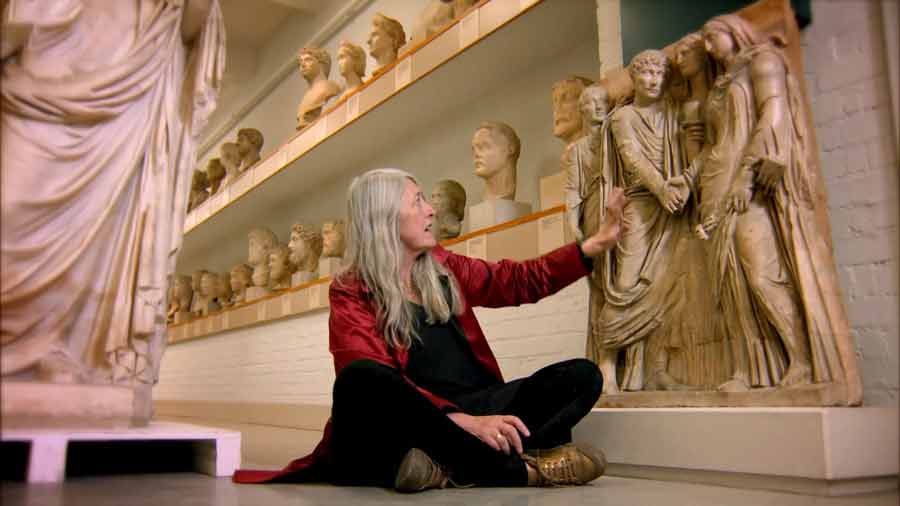
Meet the Romans with Mary Beard episode 3 – Behind Closed Doors: We still live in the shadow of ancient Rome – a city at the heart of a vast empire that stretched from Scotland to Afghanistan, dominating the West for over 700 years. Professor Mary Beard puts aside the stories of emperors and armies, guts and gore, to meet the real Romans living at the heart of it all.
In this final episode, Mary delves even deeper into ordinary Roman life by going behind the closed doors of their homes. She meets an extraordinary cast of characters – drunken housewives, teenage brides, bullied children and runaway slaves – and paints a more dynamic, lusty picture of Roman family life.
Mary uncovers their preserved beds, furniture and cradles, tries on Roman wedding rings and meets some eccentric wives like Glyconis, praised by her husband for liking a drink or two, and Allia Potestas, who lived in a Roman ménage a trois. Mary explores Roman parenting, childbirth and children, including Sulpicius Maximus, an 11-year-old schoolboy who was worked to death by his pushy parents, and Geminia Mater, a five-year-old tomboy.
Finally, Mary paints a more nuanced picture of Roman slavery and asks why if it was such a brutal institution did many Romans choose to be buried with their servants – living cheek by jowl in death, as in life.
Meet the Romans with Mary Beard episode 3 – Behind Closed Doors
In Meet the Romans with Mary Beard episode 3, the grand narrative of imperial power gives way to the intimate, often messy, reality of domestic life. The familiar image of ancient Rome, with its marble ruins and imperial spectacle, is deliberately turned upside down. Instead of focusing on emperors and armies, this exploration peers into the world of bakers, slaves, and children, using forgotten voices to reconstruct what truly happened behind the closed doors of the Roman home. This shift in perspective offers a more complete and relatable understanding of a civilization that continues to shape our own.
Examining the domestic history of this ancient culture provides a unique mirror to our modern lives. Our own idealizing images of family can often color our perception of the past. We might be tempted to simply dress up our contemporary family structures in togas and call it a Roman family. However, a deeper look reveals a society grappling with familiar struggles, from teenage pregnancies and domestic violence to the simple joys of loving relationships. Understanding ancient Rome through this lens reminds us that the core of human experience remains remarkably consistent across millennia.
This journey goes beyond the standard view of Roman life to reveal a more dynamic and surprising picture of their personal lives. The scope of Meet the Romans with Mary Beard episode 3 covers the full spectrum of the household, investigating everything from marriage and parenting to housing and the complex role of slavery. By looking at Rome from the bottom up, it uncovers stories of drunken housewives, bullied children, and runaway slaves. These personal histories paint a far more intricate and compelling portrait than the cold marble statues of emperors suggest.
The primary evidence for this intimate history comes from an extraordinary source: the tombstones of ordinary people. All over the modern city of Rome, thousands of epitaphs and portraits give clues about who these individuals loved and how they lived. While the wealthy commissioned elaborate statues, many others left just a few lines of text. Yet these inscriptions are invaluable. They are the forgotten voices of an entire segment of society, compelling us to read their stories and see beyond the stereotypes.
These memorials, found in museums and ancient cemeteries, serve as a gateway to the Roman family. Some commemorate the heartbreaking death of a baby who lived for just one year, while others tell the story of a young slave girl from Africa. They reveal the passion, turmoil, and affection that defined Roman relationships. Through these voices from beyond the grave, we can begin to piece together what really went on within the walls of a Roman home and get closer to a real Roman family.
A typical tour of Pompeii might present a conventional Roman house with a grand formal hall, a water-collecting pool, and a reception room, or tablino, where the master presided. In this standard view, the wife, children, and cook are relegated to the private quarters at the back. However, this image is deceptively simple. While some elements feel familiar, like “Beware Of The Dog” signs, a closer look reveals a much more complex reality. The lives lived within these homes were far from the neat and orderly stereotype.
The Complex Tapestry of Roman Marriage
Roman tombstones often present a poised, almost cold, view of marriage. A common and clichéd image found on marble coffins is that of a husband and wife holding hands. This motif was so popular that stone carvers likely produced them in large numbers, simply carving the faces of the deceased onto premade figures. In this stereotypical portrayal, the relationship is unequal. The husband holds all the power, and the wife’s role is defined by her service to him. Some epitaphs summarize a woman’s entire life by stating that she spoke and walked nicely, had children, kept the house, and made wool.
This ideal of wifely duty extended to the very top of society. The Empress Livia, wife of Augustus, was said to have made a point of being seen spinning and weaving the wool for her husband’s togas in the Imperial Palace. This was the expected role for a Roman woman. However, as presenter Mary Beard notes, tombstones, even today, tend to trade in clichés. Fortunately, other evidence helps us get behind these standardized impressions. For instance, Roman rings often featured the same imagery of clasped hands. The Romans even believed a direct link existed between the wedding finger and the heart.
Occasionally, a more personal voice breaks through the clichés. One plain gold ring discovered from the era bears the Latin inscription “Te Amo Parem,” which translates to “I don’t love you enough.” At first, this seems like a peculiar message for a gift. However, the likely meaning is far more romantic: “I can’t possibly love you as much as you deserve.” It is a rare and wonderful glimpse of genuine passion. Another example comes from the tombstone of a woman named Glyconis, whose name means “sweetie.” Her husband describes her as sweet by name and even sweeter by nature, a “bit wild” and “rather sexy” woman who liked to “get a bit drenched in Bacchus,” the god of wine.
However, not all stories are so affectionate. Some tombstones reveal a much darker side to Roman marriage. One memorial, put up by parents for their “dearest daughter,” Prima Florentia, has a horrible sting in the tail. It states that she was thrown into the Tiber river by her husband, Orpheus, at just sixteen and a half years old.
Another tombstone tells the story of Allia Potestas, an ex-slave who lived in a ménage-à-trois with two lovers in one household, which they shared in “perfect harmony.” Her partner’s epitaph for her becomes strangely explicit, describing her body in detail and noting that she was an “active depilator.” These stories reveal that Roman relationships could be as messy, murky, and mixed-up as our own.
Behind Closed Doors: Housing and Daily Life in Meet the Romans with Mary Beard episode 3
The grand, painted houses of Pompeii do not represent how most Romans lived. The reality of ancient Rome was a wide variety of housing that mirrored the diversity of their relationships. Many buildings were in multiple occupancy, with three or four separate apartments. In some, the interior walls were even made of wicker, an ancient equivalent of prefab construction. These were not necessarily homes for the poor; a pricey collection of bronze statuettes was found in one such dwelling. Other structures served as a combination of apartment block, lodging house, and bed-and-breakfast.
One of the most surprising examples of Roman housing is the ground-floor flat of a comfortable apartment block, now called the Insula of the Painted Ceiling. Its layout, a series of rooms off a central corridor, feels strikingly modern. At the bottom of the social ladder, people lived in slum tenements, in a room over a shop, or simply bedded down under someone else’s staircase. The Insula represents a comfortable middle-ground accommodation—someone’s “home, sweet home.” The challenge in bringing these spaces to life is the scarcity of the domestic objects that once filled them.
Fortunately, a storeroom in Herculaneum holds a priceless treasure trove of domestic furniture. Carbonized when Vesuvius erupted in AD 79, these items have been painstakingly reassembled. The collection includes tables for eating or placing by a bed, little wicker baskets, and table legs with stunning ivory decoration. There is even a sofa bed with beautiful inlay and a perfectly preserved cupboard that once held various trinkets. This collection feels like stepping into a Roman furniture shop, offering a tangible connection to their daily lives.
Among these evocative finds, one piece is the rarest of all: a baby’s cradle. It is the only cradle to have survived from the Roman world. This unique artifact prompts questions about how most infants slept. Perhaps they bedded down in the ancient equivalent of a drawer or slept with their mother or nurse. When this cradle was discovered, it contained a tiny skeleton. Analysis revealed that the baby was sleeping on a mattress stuffed with leaves and covered by a blanket when the eruption of Vesuvius put an end to its short life.
A Precarious Existence: Childhood in Ancient Rome
Childhood in ancient Rome was a starkly different and more brutal phase of life than our own. One of the most shocking realities was the incredibly high rate of child mortality. Records of over 30,000 tombstones from the city of Rome are filled with memorials for children. It is estimated that at least half of all Roman children would not have lived until age ten, and a third would not have survived their first year. This statistic is profoundly moving, yet it was a normal tragedy for Roman families.
For children from poorer families who survived infancy, life was incredibly difficult. An analysis of over 6,000 Roman skeletons revealed telling signs of wear and tear on the bones of children. The skeleton of a 16-year-old boy showed lesions consistent with years of hard manual labor, likely from working in a fullonica, or laundry, where he would have been stamping on cloth.
This suggests children were put to work at an age when we would expect them to be in school. Another dark aspect of Roman culture was child exposure, where an unwanted child could be abandoned on the street or a rubbish dump. Sometimes, parents left their babies with necklaces of trinkets called crepundia. These served as amulets but also as a potential link to their birth family, a plot device often used for happy endings in Roman comedies.
Further up the social scale, life was different. Evidence of a Roman school can still be found on the plaster walls of a covered arcade in Rome. The walls are covered in writing, drawings, and caricatures of the schoolmaster. Roman schools were not formal buildings; lessons took place in arcades, under trees, or even in the streets. They were largely fee-paying and only for well-off boys. The curriculum included reading, writing, a modern language (ancient Greek), public speaking, and poetry. Discipline was harsh. A 19th-century copy of a faded Pompeian painting shows a boy being held down by his peers and beaten by the schoolmaster, a punishment so common it had its own name: catomus.
For aspiring families, education was a pathway to social mobility, but it could come at a cost. The memorial of Sulpicius Maximus, a Roman child prodigy, tells a poignant story. At just 11 years old, he entered a grown-up poetry competition but died shortly after. His tombstone claims he died from “too much study,” hinting he may have been a victim of pushy parents.
The lives of wealthy girls were different, focused on preparing for marriage. An exquisite ivory doll, found in the coffin of a 20-year-old woman named Creperia Tryphaena, illustrates this. Like modern dolls, it helped teach a girl her future role. The story of Minicia Marcella, who died at 12 years and 11 months old, reveals just how young girls could be married.
The Paradox of Slavery in the Roman Household in Meet the Romans with Mary Beard episode 3
Slavery was deeply embedded in Roman culture, a fundamental part of the society that feels completely alien to us now. In a city with a population of a million, as many as a third might have been slaves. It was an institution that was not just for the rich; poorer households had them, and even some slaves had their own slaves.
The brutal nature of this institution is captured by objects like a Roman slave collar, a band of iron with a metal tag reading, “I’ve escaped, catch me. If you take me back to my master, Zoninus, you’ll get a gold coin.” The fact it could be mistaken for a dog collar speaks volumes about the inhumanity of Roman slavery.
Despite its brutality, the relationship between masters and slaves was not as black and white as we often imagine. There was certainly fear and hatred, and slaves likely showed their resentment through small acts of domestic warfare like pilfering, breaking ornaments, or spitting in the master’s soup. Yet, there was also respect, affection, and even love. One reason for this complexity is that the majority of slaves were probably not bought at a market but were born into the household. They grew up alongside their owners, serving as wet nurses, tutors, and nannies, which allowed for strong bonds to form.
The Roman word for family, familia, did not just include the nuclear family; it also included the slaves. They were truly part of the family, not always segregated from the master and mistress. This is powerfully illustrated in Roman family tombs. In ancient Ostia, tombs were set up for the master and his male and female ex-slaves, the libertis and libertabus. Inside these tombs, the niches for burial urns are all mixed together. There is no separate “master’s niche.” This shows that masters and slaves chose to live together in death, reflecting a desire to project an image of an inclusive, large family.
However, it was not always happy families. The tombstone of a little girl named Junia Procula reveals a Roman soap opera. Her father, Euphrosinus, initially set up the stone for his daughter, himself, and one other person whose name was later hacked out. The back of the stone reveals that he had freed and married a slave named Acti. After their child died, the relationship soured dramatically. He curses her on the stone, calling her a poisoner and faithless, accusing her of running off with another and stealing two of his slaves, leaving him robbed and alone. This story shows how one person’s domestic fluidity could be another’s domestic mess.
The Timeless Mirror: What Roman Doorways Reveal About Our Own Lives
Peering behind the closed doors of ancient Rome does more than satisfy our curiosity about the past—it holds up a mirror to our own complicated lives. Through Mary Beard’s intimate exploration, we discover that the Romans weren’t marble statues frozen in imperial grandeur, but flesh-and-blood people grappling with the same fundamental human experiences that define our own households today.
The tombstones and artifacts scattered throughout Rome speak with voices that echo across two millennia. When we read about Glyconis, the wine-loving wife praised for her wildness, or witness the tragic story of Prima Florentia, murdered by her husband at sixteen, we’re not just learning about Roman marriage—we’re confronting the eternal spectrum of human relationships. Love, passion, violence, and heartbreak haven’t changed their essential nature, only their context. The Roman couple’s clasped hands carved in stone remind us that the desire for connection transcends time, even when the legal and social frameworks surrounding that connection feel completely foreign.
Perhaps most striking is how this domestic archaeology reveals the Romans’ own contradictions. A society that could produce both the brutality of slave collars and the touching intimacy of master-slave family tombs forces us to question our neat categorizations of past and present. The Roman familia, which included slaves as integral family members, challenges our assumptions about both ancient cruelty and modern enlightenment. These weren’t simply more primitive versions of ourselves—they were complex people navigating their own moral landscape, just as we navigate ours.
The archaeological evidence—from the carbonized baby cradle in Herculaneum to the scratched schoolboy drawings on Roman walls—reminds us that history’s most profound insights often come from the smallest, most intimate objects. These fragments of daily life preserve emotions and experiences that grand historical narratives miss entirely. They teach us that understanding the past requires looking beyond the official story to find the human truth hiding in forgotten corners.
What makes this exploration particularly powerful is how it reveals the persistence of human nature while highlighting the fragility of human life. The devastating child mortality rates, the harsh realities of Roman education, and the complex dynamics of household slavery remind us that progress isn’t inevitable—it’s earned through centuries of struggle and change.
As we face our own domestic challenges—from changing family structures to questions about work-life balance—the Romans offer both comfort and caution. Their experiences suggest that families have always been messy, complicated, and resilient. They’ve always been places where love and conflict, tradition and change, intimacy and power collide in ways that can’t be neatly resolved.
The next time you walk through your own front door, remember that you’re continuing a conversation that began thousands of years ago. The Romans remind us that behind every door, in every era, real people are writing their own stories of survival, love, and loss—stories that deserve to be heard, remembered, and honored.
FAQ Meet the Romans with Mary Beard episode 3 – Behind Closed Doors
Q: What was daily life like inside Roman homes?
A: Roman domestic life was far more complex than typical tourist sites suggest. Most Romans lived in diverse housing arrangements, from comfortable apartments to cramped tenements. Additionally, families included not just parents and children, but also slaves who were integral household members. Furthermore, daily routines revolved around work, education for wealthy boys, and maintaining intricate social relationships that extended beyond blood relatives.
Q: How did Roman marriages differ from modern relationships?
A: Roman marriages exhibited remarkable diversity, from conventional partnerships to unconventional arrangements. While tombstones often depicted idealized clasped-hand imagery, reality proved messier. For instance, Glyconis was praised for enjoying wine and wildness, whereas Prima Florentia was murdered by her husband at sixteen. Moreover, some couples like Allia Potestas lived in ménage-à-trois arrangements, demonstrating that Roman relationships could be as complicated as contemporary ones.
Q: What types of housing did Romans live in?
A: Roman housing varied dramatically across social classes, contradicting stereotypical grand villa images. Many Romans occupied multi-family buildings with three or four separate apartments, sometimes featuring wicker interior walls. Additionally, the Insula of the Painted Ceiling represents middle-class accommodation with modern-feeling layouts. However, poorer citizens lived in slum tenements, rooms above shops, or even under staircases, while others enjoyed combination apartment-lodging houses.
Q: How did Roman families raise their children?
A: Roman childhood was harsh and precarious compared to modern standards. Wealthy boys attended fee-paying schools in arcades or streets, studying reading, writing, Greek, and public speaking under strict discipline. However, poorer children worked from young ages, as evidenced by skeletal remains showing manual labor damage. Furthermore, pushy parents sometimes drove children to extremes, like Sulpicius Maximus who died at eleven from excessive studying.
Q: What role did slaves play in Roman households?
A: Slavery was fundamental to Roman society, with potentially one-third of Rome’s population enslaved. Nevertheless, household slaves weren’t simply property but integral family members included in the familia. They served as wet nurses, tutors, and nannies, often forming strong emotional bonds with owners. Additionally, many slaves were born into households rather than purchased, creating complex relationships mixing affection, respect, and inevitable tension.
Q: How high was child mortality in ancient Rome?
A: Roman child mortality rates were devastatingly high by modern standards. Records from over 30,000 tombstones reveal that approximately half of all Roman children died before age ten. Furthermore, one-third didn’t survive their first year, making infant death a normal family tragedy. Additionally, unwanted children faced abandonment through child exposure, though some parents left identifying trinkets called crepundia as potential family links.
Q: What evidence do we have about Roman domestic life?
A: Roman domestic life emerges primarily through tombstones and archaeological artifacts rather than official historical records. Thousands of epitaphs throughout Rome provide intimate glimpses into ordinary people’s relationships and daily experiences. Moreover, Herculaneum’s carbonized furniture collection offers tangible connections to Roman homes, including the world’s only surviving Roman baby cradle. Additionally, skeletal analysis reveals working conditions and health patterns across social classes.
Q: How did Roman women’s roles compare to men’s?
A: Roman women’s roles were traditionally defined by domestic duties, including spinning wool, managing households, and raising children. Even Empress Livia publicly demonstrated these expectations by weaving Augustus’s togas. However, some women challenged conventions, like Glyconis who was celebrated for her spirited nature. Additionally, wealthy girls received education focused on marriage preparation, while poorer women often worked alongside men in various trades and businesses.
Q: Why were Roman family tombs significant?
A: Roman family tombs reveal the inclusive nature of the familia concept, which extended beyond blood relatives to include slaves and former slaves. In Ostia’s ancient tombs, burial niches for masters and ex-slaves intermingle without segregation. This arrangement demonstrates that Romans chose to maintain family unity in death, reflecting genuine emotional bonds. Furthermore, these tombs project images of large, inclusive families that transcended traditional social boundaries.
Q: What can Roman domestic life teach us about our own families?
A: Roman domestic experiences reveal that fundamental human challenges remain constant across millennia. Their struggles with teenage pregnancies, domestic violence, educational pressures, and complex relationships mirror contemporary family issues. Additionally, Roman families demonstrate that households have always been messy, complicated spaces where love and conflict coexist. Moreover, their stories remind us that progress isn’t inevitable but earned through centuries of social evolution and conscious change.