The second heat of Portrait Artist of the Year 2025 episode 2 brought a new group of talented individuals to the historic Battersea Arts Centre, each hoping to secure a coveted spot in the competition’s semi-final. Following a compelling first heat where Edie Bounds captured a win with her portrait of the musician Youngblood, the pressure was palpable. Nine new artists readied their easels and palettes for a demanding four-hour session, a testament to the intensity of this premier art competition. The challenge required not only technical skill but also the ability to connect with and interpret a personality under the immense pressure of time and television cameras.
At stake for the ultimate winner is a prestigious £10,000 commission to create a portrait of the award-winning mathematician and broadcaster, Professor Hannah Fry. This significant commission is for the esteemed Royal Society, an institution with a rich history of scientific achievement. The painting will commemorate the 80th anniversary of the first women elected to its fellowship, Professor Kathleen Lonsdale and Professor Marjorie Stevenson. This prize elevates the competition beyond a simple contest, linking the contemporary art of portrait painting with a legacy of pioneering women in science, offering the winning artist a place in that historical narrative.
This particular heat of Portrait Artist of the Year 2025 episode 2 featured a diverse lineup of nine artists from varied backgrounds. They included full-time artist Julianne Gurney, writer and researcher William Lee, and retired teacher Lindy Wright. Also competing were healthcare assistant Isfahani Mukha, landscape gardener Colin Fitzpatrick, and professional painter Paulina Kritnjevska. The group was rounded out by secondary school student Robbie Leach, product designer Helen Capewell, and video editor Yaz Bon. Each artist arrived with a unique style, ready to face the day’s painting challenge against one of three notable celebrity sitters.
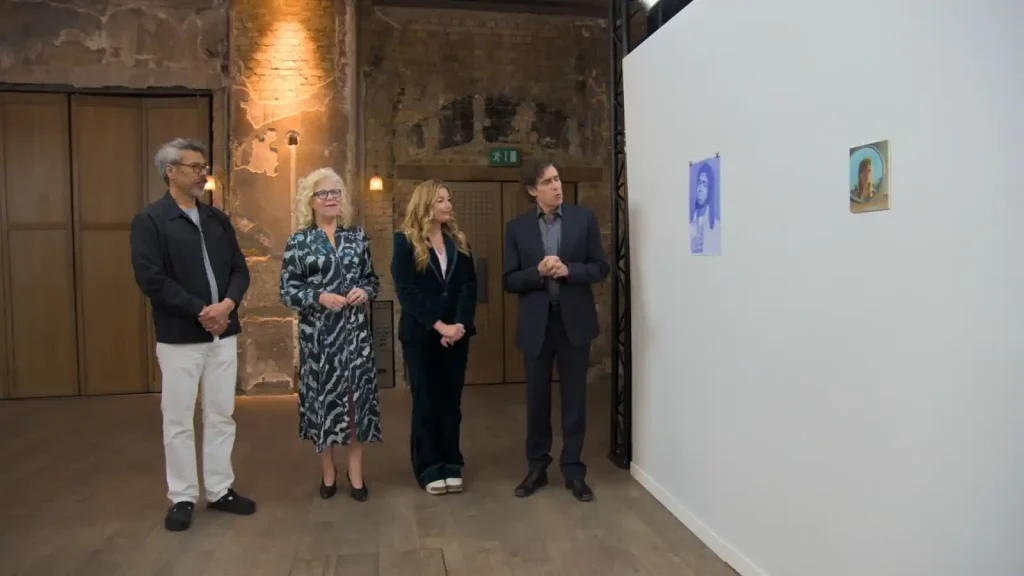
The task of judging these creations fell to a distinguished panel of art experts: art historian Kate Bryan, curator Kathleen Soriano, and award-winning artist Tai-Shan Schierenberg. Their role is multifaceted; they begin by examining a self-portrait submitted by each artist, gaining insight into their established style and technical capabilities before the live challenge even begins. Throughout the four-hour session, they observe the artists’ processes, critiquing their choices in composition, color, and technique. Ultimately, their combined expertise determines which three artists make the shortlist and who advances to the next stage of the competition.
Before the sitters were revealed, the judges offered their initial impressions of the artists’ submitted self-portraits, which provided a fascinating preview of the talent on display. They noted the frenetic, calculated quality of Isfahani Mukha’s biro pen drawing and the enigmatic, reflective quality of Lindy Wright’s oil painting. The judges were moved by the poignancy in her work, which contained a heavy narrative. They also highlighted the defiant, contemporary figure in Yaz Bon’s piece and the honesty of Robbie Leach’s self-portrait, which depicted a young portrait artist at the start of his journey with a blank canvas.
The atmosphere in the hall was a mix of quiet concentration and nervous energy as the artists prepared for the rigorous session ahead. The day would test their ability to not only capture a likeness but also to convey the essence of their sitter’s personality. This heat promised a compelling showcase of artistic interpretation, as nine distinct creative voices prepared to translate human character onto canvas. The introduction of the sitters marked the official start of a demanding and transformative day of portrait painting, a true test of artistry under pressure.
The Sitters and Their Stories
The first of the three sitters was television presenter, musician, and Hairy Biker, Si King. Known for his jovial and worldly persona, King expressed that he hoped the artists would capture emotion above all else, noting that an emotional response is his core requirement for art. For his significant object, he brought his father’s World War II medals. These medals represented his father’s service on the perilous Arctic convoys and in major naval engagements. This deeply personal item offered the artists a glimpse into a history of resilience and sacrifice, providing a profound narrative layer to incorporate into their celebrity portraits.
The second sitter was former rugby union player Joe Marler, an icon with 95 international caps who is now a podcast host and an ambassador for the mental health charity Calm. Marler presented a visually striking subject with his distinctive hairstyle, full beard, and the physical marks of a long rugby career, including his cauliflower ears. He brought a traditional Japanese mask as his object. This mask served as a good luck charm for the England team during the 2019 Rugby World Cup in Japan. Although the team ultimately lost in the final, the mask remained a powerful symbol of a pinnacle moment in his career.
Finally, the artists were introduced to the award-winning, best-selling novelist Elif Shafak. As an author of over twenty-one books, she projected an aura of quiet contemplation. For her session, she brought a book to read, hoping the artists could capture her in her natural element. Her chosen object was a beautiful tile from Istanbul, decorated with traditional Ottoman designs known as “Cintamani,” featuring patterns of fish that symbolized the sea’s beauty and complexity. This object, close to her heart, offered a story of culture, history, and artistic tradition for the painters to explore in their work.
Initial Approaches and Diverse Techniques
Once the four-hour clock started, the artists immediately launched into their work, each displaying a distinct methodology. Helen Capewell began with remarkable speed, using acrylics to quickly block in the form of Si King, aiming to establish a loose foundation before refining the details. Her energetic start was a stark contrast to the meticulous process of Isfahani Mukha, who began his portrait of King with a biro pen. His technique involved a patient and precise application of cross-hatched lines to build tone and form, a method requiring immense control and focus from the very beginning.
Meanwhile, Paulina Kritnjevska, painting Elif Shafak, drew inspiration from Pre-Raphaelite art, particularly the compositions of Rossetti. She made the deliberate choice to depict Shafak with her eyes downcast, absorbed in her book, aiming to capture a moment of natural, quiet introspection. Yaz Bon, who had submitted a self-portrait praised for its use of texture, decided to focus more on capturing Shafak’s energy and expression, even if it meant less emphasis on varied surface details. Colin Fitzpatrick also took a unique stylistic approach, using an abstract language of color that one judge likened to a thermal heat camera.
Painting Joe Marler presented its own set of challenges and opportunities. Julianne Gurney, a former teacher who turned to art for healing, approached the portrait with a confidence that reminded the judges of Holbein’s work, focusing on the weight and presence of the rugby player. The youngest contestant, sixteen-year-old Robbie Leach, undertook a particularly ambitious composition. He chose to paint a dual portrait, placing Marler’s face alongside the demonic Japanese mask, creating a direct visual dialogue between the man and the object. This decision highlighted a creative fearlessness that immediately caught the judges’ attention.
The Mid-Competition Judges’ Critique
At the halfway point, the judges toured the room to assess the artists’ progress and offer their expert commentary. They observed a wide range of interpretations taking shape on the canvases. Tai-Shan Schierenberg expressed a curious concern about Paulina Kritnjevska’s portrait of Elif Shafak, calling it “almost too good.” He elaborated that her composition, which elegantly incorporated the Istanbul tile as a halo, was so fluent and well-conceived that it risked feeling overly polished. However, the unfinished quality of some areas provided an open-ended narrative that the judges appreciated.
The judges were universally impressed with Robbie Leach’s work. Kate Bryan noted that he had achieved the best likeness of Joe Marler in the room, a remarkable feat for any artist, let alone the youngest. His ambitious choice to paint the mask side-by-side with the face was seen as a testament to his skill and confidence. In contrast, they felt William Lee was struggling slightly with Marler’s likeness but acknowledged his interesting play of shadows and light. Julianne Gurney’s portrait of Marler was likened to a painting of Henry VIII, praised for its focus on the head and hands which gave a real sense of volume.
Other artists also received detailed critiques. The judges noted that Helen Capewell had captured Si King’s energy and connection with the viewer, but the likeness needed more refinement. They were intrigued by Colin Fitzpatrick’s abstract style and the “weirdness of the red eyes” in his portrait of Elif Shafak but found the literal depiction of her necklace distracting. Yaz Bon’s portrait of Shafak was lauded for its amazing colors, which the judges suspected were part of a layering process. Finally, Isfahani Mukha’s biro pen portrait of Si King surprised them with its high level of skill and sophisticated use of negative space.
The Artists and Their Personal Journeys
Behind each portrait was a portrait artist with a compelling personal story. Julianne Gurney, a full-time artist from Cork, shared that she turned to art in 2019 as a form of healing after the premature birth and loss of her twin babies. Her submitted self-portrait reflected her efforts to balance her roles as a mother to her three other children and a dedicated artist, showcasing the complex and often chaotic intersection of family life and creative passion. Her confident and painterly approach to her work seemed to channel this resilience.
Lindy Wright, a retired teacher from Bath, brought a deeply moving narrative to the competition. She revealed that she had not painted since the sudden death of her son, William, and her participation in the event was a conscious step toward reclaiming her artistic practice. Her self-portrait was a tribute to him, featuring the Cassiopeia constellation, which forms a “W.” This celestial detail was a personal symbol she shared with her son, a way of finding connection across hemispheres. Her quiet, melancholic interpretation of Si King felt infused with this profound emotional depth.
The competition also featured Isfahani Mukha, who grew up in Cameroon and now works as a healthcare assistant in Birmingham. His chosen medium of biro pen was one he connected with from a young age, sketching in his schoolbooks. His Renaissance-inspired self-portrait, featuring a candle to symbolize light in darkness, demonstrated a mastery of this unconventional tool. At the other end of the age spectrum was Robbie Leach, a sixteen-year-old student from Edinburgh. As the youngest-ever contestant, his presence brought a fresh energy, a sense of a promising talent just beginning to unfold, much like the musician Youngblood from the previous heat.
The Final Reveal and Sitter Selections
After four intense hours, the artists stepped away from their easels, and the time came for the sitters to see their finished celebrity portraits. Joe Marler was first, and he was visibly impressed by the three interpretations of his likeness. He praised Julianne Gurney’s work for its powerful hands and William Lee’s for its dramatic use of color and shadow. However, he chose to take home the portrait by Robbie Leach. Marler was struck by the contrast between his happy expression and the “demon figure” of the mask over his shoulder, feeling it perfectly captured the duality he sometimes feels.
Si King was equally moved by his three portraits. He admired the jolly energy in Helen Capewell’s painting and the intense, thoughtful gaze captured by Lindy Wright. Isfahani Mukha’s detailed biro pen drawing, which included his father’s medals, was praised for capturing his “restless soul.” Ultimately, Si King selected Lindy Wright’s painting. He felt her work captured a deeper, more intense aspect of his personality that he recognized in himself when deep in thought, making it a particularly resonant piece for him.
Finally, Elif Shafak viewed her three portraits with grace and appreciation. She was taken by the expression Colin Fitzpatrick had captured and noted the beautiful detail of her necklace. She admired the bold colors and thoughtful inclusion of the tile in Yaz Bon’s painting. In the end, she chose the work by Paulina Kritnjevska. Shafak was particularly touched by how Paulina had positioned the decorative tile almost like a halo, creating a composition that was both beautiful and meaningful. Her choice highlighted the success of Paulina’s historically inspired and deeply sensitive approach.

Judging Deliberations for the Portrait Artist of the Year 2025 episode 2
With the sitters having made their choices, the judges began their final, difficult task of selecting a winner for the heat. They carefully reviewed all nine portraits, weighing the artists’ technical execution, creative choices, and ability to capture a compelling likeness. They acknowledged the strengths in each piece but were also critical of where some fell short. For example, while they admired Colin Fitzpatrick’s commitment to his abstract style, they found the literal elements clashed with the overall piece. Similarly, they felt Yaz Bon’s final portrait was not as polished as her submission.
The judges had high praise for Isfahani Mukha’s mind-blowing detail and sophisticated use of negative space with the humble biro pen. They also commended Helen Capewell for creating a fine painting that established a wonderful connection with the viewer, though they felt the likeness of Si King could have been stronger. Julianne Gurney was recognized as a brilliant painter who understood the medium and successfully conveyed the weight and volume of Joe Marler. However, the judges felt her portrait had a “sweetness” that didn’t quite capture the sitter’s edgier personality.
This rigorous process of elimination led them to a shortlist of three artists who they felt had produced the most successful works of the day. The first artist selected was Julianne Gurney, for her undeniable painterly skill and confident handling of the medium. The second was Robbie Leach, for his masterful restraint, excellent likeness, and the ambitious storytelling in his dual-subject composition. The final artist chosen for the shortlist was Paulina Kritnjevska, for her beautifully composed and sensitive portrait that successfully blended historical reference with a contemporary feel.
Announcing the Winner of the Portrait Artist of the Year 2025 episode 2
The final decision came down to a close comparison of the three shortlisted artists: Julianne Gurney, Robbie Leach, and Paulina Kritnjevska. The judges weighed Julianne’s confident, expressive brushwork against Robbie’s fearless narrative and technical precision. They noted that Robbie’s work demonstrated a completeness and a storyteller’s instinct, capturing a moment of hesitation in his sitter’s expression. His fearlessness as a young artist was a significant factor in his favor, showcasing immense potential for the future of his career.
They then considered Paulina’s work. Her portrait of Elif Shafak was praised for its formal, symmetrical composition, which the judges felt framed the perfection of the sitter’s beauty. They saw similarities between her submission and her heat painting, particularly in the circular framing device, but noted that her live work was far more complex and detailed in its skin tones. Her painting was described as beautifully done, stopping just shy of being overly romantic and successfully capturing a mobility in the sitter’s expression without being slavish to detail.
After careful deliberation, the judges announced the artist who would be advancing to the semi-final. They explained that their choice was based on a powerful connection with the sitter that resulted in a uniquely sensitive portrait. The winner of this heat of the art competition was Paulina Kritnjevska. The judges concluded that while she had a very refined style, they hoped to see her be a little braver in the next round to showcase the full range of her considerable skills.
The Canvas Speaks: Where Artistry Meets Emotional Truth
Paulina Kritnjevska’s victory in this riveting heat of Portrait Artist of the Year 2025 illuminates something profound about portrait painting itself: technical mastery alone never wins hearts. Her historically-inspired composition—that Ottoman tile positioned like a sacred halo above Elif Shafak’s contemplative form—succeeded because it balanced refined skill with genuine emotional resonance. The judges weren’t just selecting beautiful brushwork; they were recognizing an artist who understood that every portrait tells two stories simultaneously—the sitter’s and the painter’s.
What makes this particular episode so compelling is how it showcased the full spectrum of artistic courage. From sixteen-year-old Robbie Leach’s fearless dual composition of Joe Marler and the demonic Japanese mask, to Isfahani Mukha’s patient mastery of the humble biro pen, to Lindy Wright’s poignant return to painting after profound loss—each artist brought their whole self to the canvas. The competition revealed that portrait painting isn’t merely about capturing a likeness; it’s about creating a visual conversation between artist, sitter, and viewer that transcends the four-hour time constraint.
The judges’ careful deliberations underscored a crucial tension in contemporary portrait art. When Tai-Shan Schierenberg worried that Paulina’s work was “almost too good,” he touched on the perennial question: Where’s the line between polished perfection and sterile execution? The answer, it seems, lies in that elusive quality the judges kept returning to—connection. Whether it was Si King choosing Lindy Wright’s intense, thoughtful gaze or Joe Marler selecting Robbie’s narrative duality, the portraits that resonated most deeply were those that captured something true about the human experience, not just accurate facial features.
For aspiring portrait artists watching at home, this heat offers invaluable lessons. Technical skill provides the foundation—Julianne Gurney’s confident, painterly approach and Isfahani’s sophisticated use of negative space demonstrated that clearly. But winning requires pushing beyond competence into creative risk-taking. Robbie’s ambitious dual portrait and Paulina’s historically-informed composition both succeeded because they made bold choices that could have easily failed. They understood that memorable art lives in the space between safety and recklessness.
As the competition progresses toward its semi-finals, the stakes intensify. Paulina now carries the weight of expectation alongside the thrill of validation. The judges challenged her to be “a little braver” in the next round—a fascinating directive for someone whose work they just celebrated. It’s a reminder that artistic growth never stops, that even victory demands evolution.
For viewers, Portrait Artist of the Year continues to offer something rare in our screen-saturated age: the privilege of watching creative transformation happen in real-time. We witness not just paintings emerging from blank canvases, but artists discovering what they’re capable of under pressure. We see how personal history—whether Julianne’s journey through loss or Lindy’s constellation of grief—inevitably surfaces in the work, making each portrait a double exposure of two souls meeting across the easel.
The race toward that prestigious £10,000 commission grows tighter with each heat, but the real prize might be something more intangible: proof that in an age of AI and digital manipulation, the human hand interpreting the human face remains irreplaceably powerful.
FAQ Portrait Artist of the Year 2025 episode 2
Q: What is Portrait Artist of the Year 2025 and what makes it unique?
A: Portrait Artist of the Year is a prestigious British art competition where talented artists compete to create portraits of celebrity sitters within a demanding four-hour timeframe. What distinguishes this competition is its combination of technical skill assessment and emotional authenticity, judged by art experts including art historian Kate Bryan, curator Kathleen Soriano, and award-winning artist Tai-Shan Schierenberg. The ultimate winner receives a £10,000 commission to paint Professor Hannah Fry for the Royal Society, commemorating the 80th anniversary of the first women elected to its fellowship.
Q: Who won the second heat of Portrait Artist of the Year 2025 episode 2?
A: Paulina Kritnjevska, a professional painter, won the second heat after creating a beautifully composed portrait of novelist Elif Shafak. The judges praised her formal, symmetrical composition that incorporated an Istanbul tile as a halo-like framing device. Her work successfully blended Pre-Raphaelite-inspired historical references with contemporary sensitivity, capturing the sitter’s contemplative nature. Despite her refined style, the judges encouraged her to demonstrate more creative bravery in subsequent rounds to showcase the full range of her considerable artistic abilities.
Q: Who were the three celebrity sitters in this episode?
A: The episode featured three distinguished sitters: Si King, the television presenter and Hairy Biker who brought his father’s World War II medals; Joe Marler, former rugby union player with 95 international caps who presented a traditional Japanese mask from the 2019 Rugby World Cup; and Elif Shafak, award-winning novelist of over twenty-one books who brought a decorative Ottoman tile from Istanbul. Each sitter provided personal objects that added narrative depth and cultural significance, challenging artists to incorporate these meaningful elements into their celebrity portraits.
Q: How did sixteen-year-old Robbie Leach perform in the competition?
A: Robbie Leach, the youngest-ever contestant from Edinburgh, delivered an exceptional performance that earned him a place on the shortlist. His ambitious dual portrait of Joe Marler alongside the demonic Japanese mask demonstrated remarkable creative fearlessness and storytelling instinct. Kate Bryan noted he achieved the best likeness of Marler in the room, capturing a moment of hesitation in the sitter’s expression. Furthermore, Marler himself chose Robbie’s portrait to take home, praising how it captured the duality he sometimes feels. The judges recognized his masterful restraint and technical precision as indicators of immense future potential.
Q: What personal story did Lindy Wright bring to the competition?
A: Lindy Wright, a retired teacher from Bath, brought a deeply moving narrative to the competition. She revealed that she had not painted since the sudden death of her son, William, making her participation a conscious step toward reclaiming her artistic practice. Her self-portrait featured the Cassiopeia constellation forming a ‘W,’ a personal symbol she shared with her son to maintain connection across hemispheres. This profound emotional depth infused her portrait of Si King, which captured an intense, thoughtful quality that resonated with the sitter, ultimately leading him to select her work.
Q: What unusual medium did Isfahani Mukha use for his portrait?
A: Isfahani Mukha, a healthcare assistant from Birmingham who grew up in Cameroon, created his portrait using only a biro pen. His technique involved patient, precise application of cross-hatched lines to build tone and form, requiring immense control from the beginning. The judges were surprised by his mind-blowing detail and sophisticated use of negative space with this humble, unconventional tool. His Renaissance-inspired approach, which he connected with since sketching in schoolbooks as a young person, demonstrated exceptional mastery and earned high praise despite not making the final shortlist.
Q: Why did the judges express concern about Paulina’s work being ‘almost too good’?
A: Tai-Shan Schierenberg’s observation that Paulina’s composition was ‘almost too good’ highlighted a perennial tension in portrait art between technical perfection and emotional authenticity. He worried her elegantly composed work, which incorporated the Istanbul tile as a halo, risked feeling overly polished or sterile. However, the unfinished quality of certain areas provided an open-ended narrative that prevented this outcome. This critique reflects the judges’ belief that the most memorable portraits balance refined skill with creative risk-taking, capturing genuine human connection rather than merely demonstrating flawless execution.
Q: What artistic inspiration did Paulina Kritnjevska draw from for her winning portrait?
A: Paulina drew inspiration from Pre-Raphaelite art, particularly the compositions of Dante Gabriel Rossetti, when creating her portrait of Elif Shafak. She deliberately depicted Shafak with downcast eyes, absorbed in reading, capturing a moment of natural, quiet introspection. This historically-informed approach resulted in a formal, symmetrical composition that framed what judges described as the perfection of the sitter’s beauty. The circular framing device echoed elements from her submitted self-portrait, though the live work demonstrated far more complex and detailed skin tones, successfully stopping just shy of being overly romantic.
Q: How did Julianne Gurney’s personal journey influence her artistic approach?
A: Julianne Gurney, a full-time artist from Cork, turned to art in 2019 as a form of healing after the premature birth and loss of her twin babies. Her submitted self-portrait reflected efforts to balance her roles as mother to three other children and dedicated artist, showcasing the complex intersection of family life and creative passion. This resilience channeled into her confident, painterly approach when portraying Joe Marler. The judges likened her work to Holbein, praising how she conveyed weight and volume. Although her portrait demonstrated brilliant understanding of the medium, judges felt its sweetness didn’t fully capture Marler’s edgier personality.
Q: What criteria do the judges use to select the heat winner?
A: The judges employ a multifaceted evaluation process beginning with examination of submitted self-portraits to understand each artist’s established style and technical capabilities. Throughout the four-hour session, they observe artistic processes, critiquing choices in composition, color, and technique. Their final deliberation weighs technical execution, creative choices, and ability to capture compelling likeness alongside emotional connection with the sitter. Additionally, they consider how successfully artists incorporate personal objects and narrative elements. The winning work must demonstrate not just skill but also sensitivity, authenticity, and the courage to take creative risks that elevate portrait painting beyond mere representation.