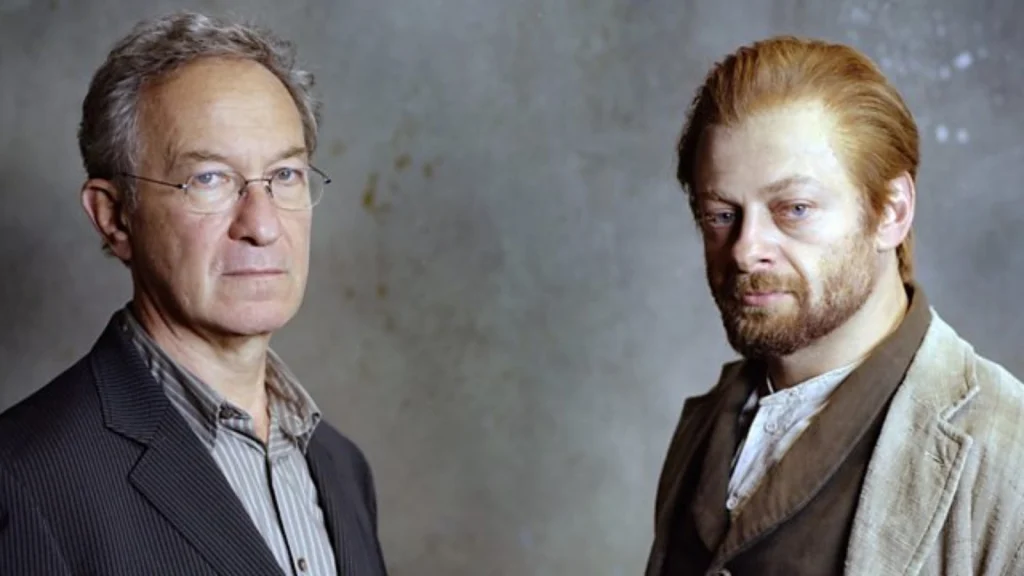
The Power of Art episode 6 – Van Gogh explores the profound paradox of an artist who, at the peak of his creative power, took his own life. Just weeks after completing Wheatfield with Crows, a painting that would become a cornerstone of modern art, Vincent Van Gogh was dead. He was painting prolifically, a picture a day, and had just sold his first work and been hailed as a genius. This begs the question that resonates throughout the documentary: was this final, revolutionary work a cry of despair that he could never fully realize his vision, or was it a shout of triumph that he had finally succeeded?
This exploration is crucial in the context of art history, as Van Gogh is often reduced to a caricature: the mad genius, the tortured artist. The story of him slicing off his ear is common knowledge, though the reality is that he cut off a fleshy piece of his earlobe. This single, violent act has largely defined his public image, making his eventual suicide seem almost inevitable to many. However, this simplistic view obscures the complex, intelligent, and deeply spiritual man who created some of the world’s most emotionally resonant paintings.
The Power of Art episode 6 – Van Gogh seeks to uncover this deeper truth by looking beyond the myth. It posits that the key to understanding the real Vincent lies within the hundreds of letters he wrote, mostly to his younger brother, Theo. These letters reveal not a creature of blind, crazed instinct, but a thoughtful, observant man with a burning intelligence. They paint a portrait of a man who saw what others called mental illness as a form of illumination, a new way of seeing the world that could reveal heaven on earth.
This other Van Gogh was an insatiable bookworm, a man who seriously studied Dickens, Victor Hugo, and even Aeschylus. Beneath a rough, unkempt exterior, Vincent lived a vibrant life of the mind. This intellectual and spiritual depth was rooted in his upbringing. His father was a pastor in the Netherlands, and for a long time, the search for salvation, not Art, was Vincent’s primary motivation. This deep-seated need to connect with a higher purpose would ultimately define his entire artistic journey.
His path to painting was not direct. After a stint as an art dealer in London, a world he grew to despise, the young Dutchman rediscovered his faith and appointed himself a missionary to the destitute. He found his calling among the drunks, whores, and dispossessed of the city, wanting to be a preacher who could bring them light. He pursued this mission in the bleak coal pits of southern Belgium, but his “excessive zeal” led to his dismissal by the missionary society.
It was only after this failure that Vincent hit upon a new way to preach: he would paint. At nearly 30 years old, with no formal training, he experienced a road-to-Damascus moment, convinced that painting was in the very marrow of his bones. He wanted to create drawings that would touch people, to make them see that he was a man who felt deeply and keenly. For Vincent, art would succeed where the Church had failed, offering salvation and comfort by opening people’s eyes to the miraculous force of life hidden in simple things.
Power of Art episode 6 – Van Gogh
The Pilgrim’s Progress: Early Works and Philosophy
To capture the truth of the working class, Vincent believed an artist must become a laborer himself and live among the people he wished to depict. He took this philosophy to an extreme, shacking up with a broken-down, alcoholic prostitute named Clasina Hoornik, or Sien. Sien, with her history of misery etched onto her body, became his unlikely muse. In the lovingly rendered lines of her used body, Vincent found something sublime, writing to Theo, “There’s no such thing as an old woman”. This relationship, unsurprisingly, did not go over well with his vicar father, and even Theo had his reservations.
Throughout this period, Theo remained his brother’s steadfast supporter, sending a monthly subsidy that kept Vincent afloat. In return, Vincent sent his brother paintings to sell in Paris, but Theo found them to be unsellable—dense, clotted, and murky works that stood in stark contrast to the bright canvases popular at the time. This created immense friction, with Vincent accusing his brother of not caring about his work and lapsing into a “cold respectability”.
This early phase of his artistic life culminated in his first knockout masterpiece, The Potato Eaters. The painting serves as a summary of everything he had felt and thought up to that point, containing all the elements that would make him a revolutionary artist. The dark, thick color was a philosophical choice, meant to evoke the earth itself. He described the color as “manure brown,” the color of dusty potatoes straight from the ground.
In this work, the heavy, loaded brush does its own form of manual labor; the picture seems almost troweled or dug rather than painted. Vincent explained his intent was to show that the people eating the potatoes had dug the earth with the very same hands they were now putting in the dish. Their simple supper becomes a kind of Holy Communion for the toiling class, a meal honestly earned. He excitedly sent the powerful work to Theo, who once again lamented how hard it was to sell such dark pictures when Paris demanded brightness.
Paris and the Explosion of Color in the Power of Art episode 6 – Van Gogh
Despite his frustration with Theo and the art market, something was niggling at Vincent, and he began to feel he had something to learn from the French. His move to Paris is often seen as the moment the “Dutch frog” was kissed by Impressionism and transformed into the prince of color painting. Indeed, Vincent did become addicted to color, consuming its brilliance and disgorging it onto his canvases. Tubes of carmine, cobalt, and chrome yellow replaced the murky browns of his earlier work.
For a time, he did his homework as a trainee Impressionist, studying the techniques of the masters. He painted by the river at Asnières, learning to trap the light in speckled, dappled brushstrokes. He meticulously studied Pointillism, replicating the color-coded dots of artists like Pissarro and Seurat. While he could execute these styles flawlessly, he ultimately found something too decorative about the Impressionists’ approach. He felt they were rinsing the “meat of human existence” in a wash of luminescence. Van Gogh’s art would always remain earthier, smellier, and truer—and, consequently, still unsellable.
Blaming Theo’s inability to sell his work, Vincent organized his own show in a local cafe, featuring paintings of hobnail boots and cut sunflowers. Though technically still lifes, these paintings were anything but still. The worn boots function as a self-portrait, symbolizing the long, weary march of the pilgrim toward a heavenly resting place. The sunflowers are even more dynamic, presented not as nature morte (dead nature) but as threateningly mysterious organisms, their black seed heads bristling with an irrepressible life force, as if they had landed violently from a burning star.
The Studio of the South: Arles, Gauguin, and the Descent
Feeling the need for a warmer, more regenerating environment, Van Gogh left Paris for Provence in the spring of 1888. He sought a place where the chilly Paris art scene would give way to what he imagined as a “monkishly pure way of life”. Under the southern sun, he felt his life force stir, and like a sunflower, he turned his face to the nourishing light. His paintings from this period are a testament to this creative surge.
In his version of The Sower, he transforms Jean-François Millet’s image of noble toil into a fertility miracle, where the sower seems to float on a carpet of brilliance like Jesus walking on water. He described paintings that truly worked as a “jouissance,” a French term for orgasm, signifying a great ejaculation of emotional energy and paint.
It was in Arles that Vincent longed to establish a creative nest, a studio where artists could live and work together in devotion to their craft. He set his sights on Paul Gauguin, another artistic misfit hanging around the edges of the Impressionist circle. Theo, ever supportive, offered to sponsor Gauguin if he would join Vincent in Arles. Vincent waited in a fever of excitement, preparing the house like a groom awaiting his bride, planning to hang yellow sunflowers in Gauguin’s room to create an air of permanence and calm.
The dream quickly soured after Gauguin’s arrival. Their philosophies on art were diametrically opposed. For Gauguin, art was an escape from the world, a swim in pure sensation; “It’s just a dream,” he once said. But for Vincent, there was no joy without sweat; art was a ride into the world, not away from it. Their debates became “exceedingly electric,” leaving their minds drained like discharged batteries. Gauguin, irked by Vincent’s manic pace of painting a picture a day, began to feel a shocking sense of envy. He exorcised this jealousy by painting Vincent as a deranged invalid, slumped in a chair, a portrayal Vincent himself acknowledged, saying, “It’s me. But it’s me gone mad”.
The tension culminated in the infamous ear incident, a pivotal event in this documentary. As Vincent’s frustration and anxiety grew, his mood swings became more frightening. After a confrontation where Vincent hinted at violence, Gauguin spent the night in a hotel. When he returned, the house was surrounded by police. Vincent had gone to his favorite brothel, handed a woman named Rachel a small package containing a large piece of his ear, and collapsed.
Asylum and the Revelation in the Power of Art episode 6 – Van Gogh
By the time Vincent was discharged from the hospital, Gauguin was gone. Van Gogh then voluntarily committed himself to a nearby mental asylum. He wrote to Theo, “it just won’t do for us to think that I’m…completely sane,” yet he also expressed a fear that in recovering, he would “never reach the heights to which the illness, to some extent, led me”. His sickness had become both the destroyer and the midwife of his masterpieces. It was in the moments of lucidity between his terrifying attacks that he saw the world with the most intense clarity, possessed by his vision of heaven on earth.
The surging, broiling works from this period are not products of his madness; they are the exact opposite. They are the documents of his heroic battle to keep disintegration at bay. He knew more attacks were inevitable, and his only remedy was to work. In these paintings, whether of cypresses or cartwheeling stars, we are always looking at the inside of Vincent’s head. His final self-portrait from 1889 is a powerful testament to this struggle. While his head is surrounded by a vortex of swirling paint, like the throbbing of a merciless migraine, the cast of his face is calm and watchful. With a jawline contoured by bristling red hair, he is a fighter, pugnacious and resolute.
Eventually, Theo arranged for Vincent to move to the village of Auvers-sur-Oise, under the care of Dr. Paul Gachet, a specialist in melancholy. There, Vincent seemed to relax, enjoying visits from Theo and his family. He became absorbed in painting the “immense plain with wheatfields against the hills… boundless as the sea”. These landscapes were also mindscapes, but they were anything but deranged; they were tumultuous, heroic, and completely new. The most startling of these is Wheatfield with Crows.
The painting is not a testament to frailty but a demonstration of an artist in total command, who was in the process of junking the entire history of landscape painting. He completely reversed traditional perspective; a central path becomes a road that goes nowhere, while two flanking paths seem to rise vertically like flapping wings. All our assumptions about how to read visual signs are scrambled. The result is a physical feeling, both thrilling and terrifying, of being swallowed alive by a massive wall of writhing, brilliant paint. It is with this independent life of formed blocks of color that Vincent Van Gogh creates modern art.
Yet, while his art had never been more brilliant, his life was beginning to falter. As spring turned to summer, his tower of strength, his brother Theo, began to look shaky. Worries about Theo’s own family and health began to weigh on Vincent heavily. “My life is also threatened at the very root,” he wrote, “and my steps are wavering”. Soon after, Theo arrived from Paris to find his brother mortally wounded, having suffered a single gunshot to the abdomen.
The Immortal Paradox: Van Gogh’s Eternal Flame
The trajectory of Vincent Van Gogh’s life presents us with perhaps art history’s most profound paradox. In those final sun-drenched days at Auvers-sur-Oise, we witness an artist at the absolute zenith of his creative powers—producing a masterpiece nearly every day—who nonetheless could no longer bear the weight of his existence. The traditional narrative of the “tortured artist” fails to capture the complexity of a man whose brilliance was not a product of his suffering but emerged despite it, in the lucid intervals between his episodes of mental anguish.
What makes Van Gogh’s story so compelling is not the caricature of madness that has dominated popular culture, but rather the deeply intellectual and spiritual journey revealed in his letters. These writings unveil not a creature of blind, crazed instinct, but a thoughtful, observant man with a burning intelligence—an insatiable bookworm who studied Dickens, Hugo, and Aeschylus with the same intensity he brought to his canvases.
This was a man for whom art became a form of salvation after his dismissal as a missionary. When the Church rejected his “excessive zeal,” Vincent found in painting a new pulpit from which to preach, a means to make people “see that he was a man who felt deeply and keenly.” For him, art would succeed where organized religion had failed—offering comfort by revealing the divine in the ordinary.
The revolutionary quality of Van Gogh’s final works like “Wheatfield with Crows” lies not in their expression of despair, but in their bold reimagining of artistic convention. By scrambling traditional perspective and unleashing autonomous blocks of vibrant color, Van Gogh wasn’t merely documenting his mental state—he was birthing modern art. These paintings weren’t products of madness but evidence of an artist in complete command of his vision, even as his personal life unraveled.
Today, when we stand before a Van Gogh canvas, we’re experiencing more than just color and form—we’re witnessing a profound act of resistance. Each brushstroke represents his defiance against the disintegration threatening to consume him. His art doesn’t memorialize his surrender to illness but celebrates his relentless fight to create meaning in the face of suffering.
Perhaps this is why Van Gogh’s work continues to resonate so powerfully across generations. In a world increasingly defined by surface appearances and instant gratification, his paintings remind us that true beauty often emerges from struggle, that authenticity requires courage, and that seeing the divine in the ordinary demands both vulnerability and strength.
The greatest tribute we can pay to Van Gogh isn’t pity for his troubled life, but recognition of his extraordinary achievement: creating art that, over a century later, still pulses with the raw electricity of human experience. His legacy isn’t defined by how he died, but by how vibrantly he lived through his work—work that continues to teach us how to see the world anew, with eyes wide open to both its terrors and its wonders.
FAQ Power of Art episode 6 – Van Gogh
Q: Who was Vincent Van Gogh beyond the “tortured artist” stereotype?
A: Beyond the caricature of madness, Van Gogh was an intellectual and deeply spiritual man. He was an insatiable bookworm who studied Dickens, Hugo, and Aeschylus. His letters reveal a thoughtful, observant individual with burning intelligence who saw mental illness as a form of illumination—a different way of perceiving the world that could reveal heaven on earth.
Q: What role did Van Gogh’s letters play in understanding his character?
A: The hundreds of letters Van Gogh wrote, primarily to his brother Theo, provide crucial insight into his true character. These writings reveal not a creature of blind instinct, but a thoughtful man with profound intellect. They document his artistic philosophy, spiritual journey, and show how he viewed his mental condition as offering a unique perspective on reality rather than a debilitating condition.
Q: How did Van Gogh’s religious background influence his art?
A: Van Gogh’s father was a pastor in the Netherlands, and for many years, salvation—not art—was Vincent’s primary motivation. After failing as a missionary due to “excessive zeal,” he turned to painting as a new way to preach. For Vincent, art would succeed where the Church had failed, offering comfort by revealing the miraculous force of life hidden in ordinary things and opening people’s eyes to heaven on earth.
Q: What was significant about Van Gogh’s painting “The Potato Eaters”?
A: “The Potato Eaters” was Van Gogh’s first knockout masterpiece, summarizing everything he had felt and thought. Its dark “manure brown” color was a philosophical choice, evoking the earth itself. The heavy brushwork performs its own form of manual labor; the picture seems almost troweled or dug rather than painted. Vincent transformed a simple supper into a Holy Communion for the toiling class—a meal honestly earned with the same hands that dug the earth.
Q: How did Vincent Van Gogh’s artistic style change when he moved to Paris?
A: In Paris, the “Dutch frog” was transformed by Impressionism into the “prince of color painting.” Van Gogh became addicted to color, replacing murky browns with vibrant carmine, cobalt, and chrome yellow. While he mastered Impressionist techniques like dappled brushstrokes and Pointillism, he ultimately found them too decorative. His art remained earthier and truer, capturing what he called “the meat of human existence” rather than rinsing it in luminescence.
Q: What was the relationship between Van Gogh and Paul Gauguin like?
A: Van Gogh and Gauguin had diametrically opposed philosophies on art. For Gauguin, art was an escape from the world—”just a dream.” For Vincent, art was a ride into the world, not away from it; there was no joy without sweat. Their debates became “exceedingly electric,” leaving their minds drained like discharged batteries. Gauguin eventually grew envious of Vincent’s prolific output of a painting per day, portraying him as “gone mad.”
Q: What is the truth behind Van Gogh’s infamous ear incident?
A: The common belief that Van Gogh cut off his entire ear is exaggerated—he actually cut off a fleshy piece of his earlobe. This happened after a tense confrontation with Gauguin where Vincent hinted at violence. After Gauguin spent the night in a hotel, Vincent went to his favorite brothel, handed a woman named Rachel a small package containing the piece of his ear, and collapsed. This single act has largely defined his public image, obscuring his complex character.
Q: How did Van Gogh view his own mental illness?
A: Van Gogh had a complex relationship with his mental condition. He acknowledged his instability, writing to Theo, “it just won’t do for us to think that I’m…completely sane.” Yet he also feared that in recovering, he would “never reach the heights to which the illness, to some extent, led me.” His sickness became both destroyer and midwife to his masterpieces, providing moments of lucid clarity between terrifying attacks when he saw the world with intense vision.
Q: What makes “Wheatfield with Crows” such a revolutionary painting?
A: “Wheatfield with Crows” demonstrates an artist in total command who was revolutionizing landscape painting. Van Gogh reversed traditional perspective—a central path goes nowhere while flanking paths rise vertically like wings. This scrambling of visual signs creates a physical sensation of being swallowed by writhing, brilliant paint. The independent life of formed blocks of color marked the birth of modern art, not as a testament to frailty but as evidence of artistic mastery.
Q: Why does Van Gogh’s work continue to resonate with audiences today?
A: Van Gogh’s work resonates across generations because it represents profound resistance against suffering. Each brushstroke shows his defiance against mental disintegration. In our world of surface appearances and instant gratification, his paintings remind us that true beauty often emerges from struggle, authenticity requires courage, and seeing the divine in the ordinary demands both vulnerability and strength. His legacy isn’t defined by how he died, but by how vibrantly he lived through his work.