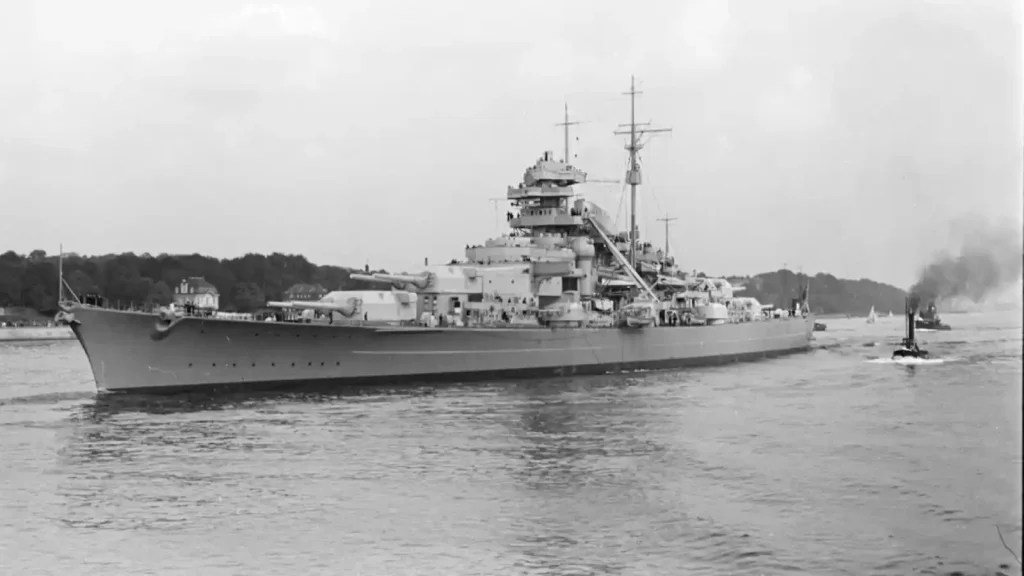
Search for the Battleship Bismarck: Three miles beneath the Atlantic, a feared Nazi warship rests, a defiant monument to a turbulent past. National Geographic’s “Search for the Battleship Bismarck” chronicles this vessel’s story. It details her brief, violent life and her remarkable rediscovery. The documentary follows explorer Dr. Robert Ballard. He famously located the S.S. Titanic. Now, he seeks the Bismarck, Hitler’s most formidable battleship. This is her unforgettable story: how she sailed, was sunk, and thrillingly found nearly fifty years later.
The Bismarck emerged as a legend. Launched on February 14, 1939, in Hamburg, her massive hull symbolized Germany’s resurgent military might. The Führer himself savored this moment. Two years later, the ship was primed for action. In the spring of 1941, she embarked on her maiden voyage. Many regarded her as the most elegant and dangerous battleship ever constructed. Her destiny, however, was to never return to port.
She was a monumental weapon, stretching a sixth of a mile and displacing 53,000 tons. Her powerful 15-inch guns, guided by stereoscopic rangefinders, could launch one-ton shells over 20 miles. A handpicked crew of over 2,000 men served aboard, many young and untested in combat. They believed the Bismarck to be unsinkable. Her first mission, commencing May 19, 1941, aimed for a three-month reign of terror against British shipping in the North Atlantic. The Bismarck was a predator, poised to strike unsuspecting prey. Yet, first, she had to stealthily navigate into enemy territory.
The British knew the stakes. If the Bismarck broke into the Atlantic with the cruiser Prinz Eugen, she could cripple the vital supply lines from America. These convoys carried food, petrol, and ammunition, essential for Britain’s survival. Such disruption could have altered the war’s course; therefore, sinking her became critical. Initially, British intelligence believed the Bismarck was still in German waters.
In reality, she was already escaping through the Baltic. The German plan was audacious: slip past Sweden and Norway, enter the North Sea, and then sail into the Atlantic, possibly via the Denmark Strait. However, a British Spitfire photographed the Bismarck in a Norwegian fjord, confirming her breakout attempt. The Royal Navy now had to find and intercept her.
The pursuit intensified. On Friday, May 23rd, a British cruiser spotted the Bismarck near the strait between Greenland and Iceland. Two hundred fifty miles away, the British warships Prince of Wales and HMS Hood were alerted. They set an intercept course. The Hood, the pride of the British fleet, led the charge. She was a magnificent ship, but her First World War design featured tragically thin deck armor. Conversely, German sailors knew and respected the Hood’s reputation.
On Saturday morning, May 24th, the titans clashed. At a range of about fourteen miles, the Hood fired first. The Bismarck swiftly retaliated. One of Bismarck’s shells pierced the Hood’s vulnerable deck, igniting her aft powder magazines. A colossal explosion ripped the Hood in half. For the Bismarck’s crew, jubilation was almost indescribable. Within ten minutes, the Hood vanished, taking all but three of her 1,400 crew. This news devastated Britain, a shock comparable to Pearl Harbor for America. If the Bismarck could destroy the Hood so quickly, people wondered what else she was capable of.
Despite this victory, the Bismarck had suffered damage and her commanders decided to head for occupied France for repairs. However, she was being shadowed by British warships, with another battle group moving to ambush her. During the night, the Bismarck executed a daring maneuver, turning sharply to cross her own track and evade her pursuers, disappearing into the vast ocean. For thirty-one agonizing hours, the British searched fruitlessly as the Bismarck sailed closer to safety. Then, fortune shifted. On Monday morning, a Catalina flying boat spotted the Bismarck, less than a day’s sail from Luftwaffe air cover based in France.
Most British ships were too far away to intercept. Only the aircraft carrier Ark Royal had a chance to slow her down. Her Swordfish torpedo planes were antiquated, with fabric wings and a slow attack speed, each carrying a single torpedo. Yet, they were Britain’s last hope. As night approached, these small planes attacked. The Bismarck’s crew fired relentlessly, but the Swordfish pressed on. One torpedo struck amidships, causing minor damage. Crucially, another hit the Bismarck’s rudders, jamming her steering gear. Now, the great battleship could only steer northwest, directly towards the converging British fleet. The Bismarck had been delivered into their hands.
The final battle commenced on Tuesday, May 27th, two hours after sunrise. The battleships Rodney and King George V opened fire. Survivors described a scene of stark color contrasts: the black Bismarck, grey British ships, green seas, brown cordite smoke, orange gun flashes, and white shell splashes as high as houses. It was a majestic, awesome, and dreadful sight. For an hour, British salvos pounded the Bismarck. Her bow plates glowed red hot from the damage. The upper deck became a burning heap of rubble; the ship’s beauty was gone. Eventually, men began jumping into the sea. The Bismarck, burning on the horizon, was filmed for the last time before she sank. More than 2,000 lives were lost.
Almost half a century later, Dr. Robert Ballard embarked on his quest. His story began in the summer of 1988 aboard the converted trawler Starella. Ballard, captivated by the Bismarck’s tale since childhood, saw parallels with the Titanic: an elegant ship on a maiden voyage with a short, violent life. Finding her offered a chance to retell this epic to a new generation. Unlike his Titanic search, where few believed in his success, now many expected him to find the Bismarck, a pressure he found less preferable. The search area was vast, nearly 100 square miles, complicated by four different reported sinking positions.
Ballard, a pioneer in deep-sea exploration technology, deployed transponders to map his position and sonar to glimpse the seabed three miles down. The initial sonar readings revealed horrific topography: huge mountains and solid rock, making it dangerous to maneuver Argo, his underwater video sled. Argo, tethered by miles of cable, was designed to skim just above the pitch-black seabed, photographing the ocean floor. Ballard’s greatest fear was losing the vehicle by snagging it on a cliff. Consequently, he initially focused on flatter mud plains. An early debris trail led to excitement, but the large object found turned out to be a 19th-century schooner, a “stake in your heart” moment for Ballard. Round one went to the elusive Bismarck.
Search for the Battleship Bismarck
A year later, in the summer of 1989, Ballard returned aboard the Star Hercules, better equipped to tackle the mountainous terrain he previously avoided. The new search area was still challenging, with a thousand-foot wall to navigate. Hours turned into days of “mud watching,” a tedious process where fatigue was a constant concern. After covering over 40 miles and finding nothing but mud and rocks, frustration mounted.
Then, on the ninth day of the hunt, after over 200 hours of searching, the team began finding man-made debris: a boot, a lantern. The clues were tantalizing but not definitive. Just before midnight, Argo passed over what appeared to be part of a gun turret. This was a key fingerprint of the ship. Though not the main hull, Ballard knew they were close; the debris trail would lead them to the wreck. Finally, on June 8, 1989, Argo’s cameras swept across the unmistakable bridge and gun decks of the Bismarck. She was found.
The documentary masterfully presents this dual narrative. It interweaves the historical wartime drama with the painstaking modern search. The subject matter expertise is evident. Dr. Ballard’s passion and deep knowledge of undersea exploration drive the contemporary story. Furthermore, the inclusion of German and British survivors provides poignant, firsthand accounts of the Bismarck’s final days and the terrifying battle.
Their testimonies lend profound emotional weight. Visually, the documentary excels. It combines archival footage of the Bismarck and the war with the incredible, exclusive undersea film of the wreck. These images of the surprisingly intact hull, three miles down, are hauntingly beautiful. The ship, though missing her main turrets, sits upright, her smaller guns still menacing.
“Search for the Battleship Bismarck” possesses significant strengths. Its narrative structure, shifting between past and present, creates sustained suspense and engagement. The personal stories, both of the young sailors in 1941 and Ballard’s determined team, humanize the immense historical and technological undertakings. The documentary also delves into the lingering question: was the Bismarck sunk by British firepower or scuttled by her own crew? Ballard suggests it was likely a combination, a matter still debated largely due to national pride. He is shocked by how little apparent damage there is beyond the lost turrets and superstructure.
One potential weakness, common in such focused narratives, might be the inherent emphasis on the primary subject. While perspectives from both German and British survivors are included, the narrative lens is primarily that of the search and the Allied perspective of the war. However, the respectful treatment of all combatants and the focus on shared humanity in moments of crisis largely mitigates this. The documentary powerfully conveys the futility and wastefulness of war. It serves as a reminder of these historical events, urging reflection to prevent their repetition.
The film’s societal impact is multifaceted. It vividly brings a crucial chapter of World War II naval history to life for new audiences. Moreover, it highlights the advancements in maritime archaeology and technology that make such discoveries possible. Critically, it raises profound ethical questions about exploring war graves. Dr. Ballard himself emphasizes the need to treat these sites with respect, not to disturb them. To him, the Bismarck is a war grave. The film also touches upon the controversial decision by the British cruiser Dorsetshire to abandon the rescue of many German survivors due to a U-boat scare, an act some survivors interpret as revenge for the Hood. This adds a layer of moral complexity to the historical account.
Compared to other documentaries in its genre, such as those detailing the Titanic’s discovery or other WWII wrecks, “Search for the Battleship Bismarck” stands out for its successful blending of high-stakes wartime action with the methodical, technologically driven modern exploration. While Titanic documentaries often focus on the civilian tragedy and maritime safety, this film is steeped in the grim realities of naval warfare.
It uniquely captures the dual drama of the ship’s life and its rediscovery, enriched by the voices of those who lived through the battle and those who sought its final resting place. The raw emotion of survivor testimonies, describing the horror of battle and the sorrow of burying a comrade at sea, gives it a depth that transcends simple historical recounting. One survivor eloquently notes the impersonality of such battles, where enemies rarely saw each other until the very end.
The story of the Bismarck is indeed one of the great sea epics, marked by dramatic shifts in fortune. A monstrous warship emerges, sinks Britain’s pride, vanishes, is found by a tiny aircraft, crippled by another, and then finally destroyed by overwhelming force. It is a narrative filled with heroism and pride on both sides, fought by men aboard magnificent, yet ultimately vulnerable, machines of war. The documentary compellingly argues that such stories, and the deep-sea memorials they leave behind, demand our attention and solemn respect.
The Enduring Legacy: Where History Meets Deep-Sea Discovery
The Bismarck’s story bridges time itself, connecting World War II’s naval battles with modern underwater exploration. Furthermore, this narrative transcends mere historical account; it reminds us of war’s brutal reality and human courage under fire. The Bismarck and Hood, once formidable floating fortresses, now rest as silent witnesses to mankind’s capacity for both engineering brilliance and devastating conflict.
Dr. Ballard’s discovery serves not only as technological triumph but also as profound memorial. Indeed, through his perseverance, these submerged war graves gained proper recognition. The surprisingly intact Bismarck, sitting upright on the Atlantic floor, continues to yield insights about her final moments. Meanwhile, debate persists about whether British shells or German scuttling charges delivered the final blow, yet perhaps this uncertainty matters less than the lessons we’ve learned.
Beyond historical fascination, the documentary raises vital questions about war memorials underwater. How should we approach these sites? Moreover, what responsibilities do we bear to preserve these locations while telling their stories? Ballard’s respectful methodology offers one answer: document without disturbing, remember without exploiting.
The surviving sailors’ testimonies bridge the gap between past and present. Their firsthand accounts transform abstract historical events into deeply personal experiences. Additionally, their reflections on former enemies, now viewed through decades of perspective, remind us that humanity persists even in conflict’s darkest hours.
The Bismarck’s legacy extends far beyond military significance. She represents technological ambition, strategic miscalculation, and ultimately, the futility of supposed invincibility. Likewise, her discovery demonstrates how modern science can illuminate history’s shadows.
This documentary masterfully weaves together maritime history, technological innovation, and human drama. Consequently, viewers gain both knowledge and emotional connection to events now eight decades distant. The Bismarck’s journey—from Hamburg’s shipyards to the ocean depths—stands as testament to war’s transience and the ocean’s permanence.
As the Atlantic waters continue their eternal watch over this massive steel tomb, we’re left with somber reflection. The Bismarck’s discovery didn’t just locate a legendary warship; it recovered a crucial chapter of our shared human story. Therefore, we honor these sailors best by remembering their sacrifice while working toward a world where such massive losses become truly history, never to be repeated.
FAQ Search for the Battleship Bismarck
Q: What was the Bismarck and why is it historically significant?
A: The Bismarck was Nazi Germany’s most formidable battleship, launched in February 1939 as a symbol of German military resurgence. Its historical significance stems from both its brief but devastating naval career and its rediscovery decades later. Furthermore, the ship represented the pinnacle of German naval engineering, stretching one-sixth of a mile and displacing 53,000 tons. During its maiden voyage in May 1941, it shocked Britain by destroying the HMS Hood, considered the pride of the British fleet, before being hunted down and sunk after an epic naval chase.
Q: How did the Bismarck’s final battle unfold?
A: The Bismarck’s final battle began on Tuesday, May 27th, 1941, when British battleships Rodney and King George V opened fire at sunrise. Survivors described a dramatic scene with stark color contrasts: the black Bismarck, gray British ships, green seas, and orange gun flashes. For approximately one hour, relentless British salvos pounded the Bismarck until its upper deck became a burning heap of rubble. Eventually, men began jumping into the sea as the ship’s structure failed. Consequently, the once-magnificent battleship sank with over 2,000 lives lost, bringing its brief seven-day naval career to a tragic end.
Q: Who was Dr. Robert Ballard and how did he find the Bismarck?
A: Dr. Robert Ballard was the pioneering deep-sea explorer who previously located the Titanic wreck. His search for the Bismarck began in 1988 aboard the converted trawler Starella, but initial attempts proved unsuccessful due to challenging underwater topography. However, Ballard returned in 1989 with improved equipment aboard the Star Hercules. After nine grueling days and over 200 hours of searching, his team began finding debris like boots and lanterns. Eventually, on June 8, 1989, Ballard’s underwater vehicle Argo captured images of the Bismarck’s bridge and gun decks, confirming the discovery of the wreck nearly 50 years after its sinking.
Q: What technology did Ballard use to locate the Bismarck?
A: Ballard utilized cutting-edge deep-sea exploration technology to find the Bismarck. His primary tool was Argo, an underwater video sled tethered by miles of cable, designed to skim just above the pitch-black seabed while photographing the ocean floor. Additionally, he deployed transponders to map his position accurately and used sonar to glimpse the seabed three miles below the surface. These technologies allowed Ballard’s team to navigate the treacherous underwater mountains and eventually follow a debris trail to the main wreck. Despite these advanced tools, the search remained challenging, with constant risks of losing equipment on underwater cliffs.
Q: How did the Bismarck manage to sink HMS Hood so quickly?
A: The Bismarck sank HMS Hood with astonishing speed due to a critical design flaw in the British battlecruiser. Although magnificent, the Hood featured tragically thin deck armor from its World War I-era design. During their clash on May 24, 1941, one of Bismarck’s 15-inch shells pierced the Hood’s vulnerable deck, igniting her aft powder magazines. Consequently, a colossal explosion ripped the Hood in half, causing it to vanish within ten minutes with the loss of all but three of her 1,400 crew. This devastating demonstration of the Bismarck’s firepower sent shockwaves through Britain, creating fear about what else the German battleship might accomplish.
Q: What role did the Swordfish torpedo planes play in the Bismarck’s demise?
A: The antiquated Swordfish torpedo planes from the carrier Ark Royal played a decisive role in the Bismarck’s ultimate destruction. Despite their fabric wings and slow attack speed, these planes became Britain’s last hope when most British warships were too far away to intercept the fleeing Bismarck. During their twilight attack, one torpedo struck amidships causing minor damage, but critically, another hit the Bismarck’s rudders, jamming its steering gear. As a result, the mighty battleship could only steer northwest, directly toward the converging British fleet. This damage transformed the Bismarck from a fleeing predator into helpless prey, demonstrating how even outdated technology can change military outcomes.
Q: What ethical questions does the Bismarck’s discovery raise?
A: The Bismarck’s discovery raises profound ethical questions about exploring underwater war graves. Dr. Ballard himself emphasized treating these sites with respect and not disturbing them, viewing the Bismarck primarily as a war grave rather than just an archaeological find. Moreover, the documentary examines controversial historical aspects, such as the British cruiser Dorsetshire abandoning the rescue of German survivors due to a U-boat scare. This decision, which some survivors interpreted as revenge for the Hood’s destruction, adds moral complexity to the historical account. Consequently, the film invites viewers to consider our responsibilities toward historical sites that are simultaneously scientific discoveries, archaeological treasures, and final resting places.
Q: What is unique about the documentary “Search for the Battleship Bismarck”?
A: “Search for the Battleship Bismarck” uniquely blends high-stakes wartime drama with methodical modern exploration. Unlike Titanic documentaries focusing on civilian tragedy, this film delves into the grim realities of naval warfare. Additionally, it captures the dual narrative of the ship’s life and rediscovery through testimony from both battle survivors and modern explorers. The documentary’s strength lies in its narrative structure that shifts between past and present, creating sustained suspense. Furthermore, it includes hauntingly beautiful underwater footage of the surprisingly intact hull sitting upright three miles below the surface, with smaller guns still menacingly in place despite missing main turrets.
Q: Was the Bismarck sunk by British firepower or scuttled by her crew?
A: The question of whether the Bismarck was sunk by British firepower or scuttled by her crew remains contentious. Dr. Ballard suggested it was likely a combination of both factors, though this remains debated largely due to national pride on both sides. Interestingly, Ballard expressed surprise at how little apparent damage existed beyond the lost turrets and superstructure, which supports the scuttling theory. Meanwhile, British accounts emphasize the effectiveness of their bombardment, with descriptions of the bow plates glowing red-hot from damage. This historical uncertainty adds another layer of complexity to the Bismarck’s story, demonstrating how even with modern exploration, some aspects of history remain open to interpretation.
Q: What larger lessons does the Bismarck’s story teach us?
A: The Bismarck’s story teaches us profound lessons about war, technology, and human nature. First, it demonstrates the futility of supposed invincibility, as even the mightiest warship proved vulnerable to coordinated attacks from seemingly inferior forces. Second, the epic naval chase illustrates how quickly fortune can shift in warfare, with the hunter becoming the hunted. Furthermore, survivor testimonies reveal the impersonality of modern naval battles, where enemies rarely saw each other until the very end. Perhaps most importantly, the documentary compels us to reflect on war’s wastefulness and serves as a powerful reminder of historical events that should never be repeated. Through this lens, the Bismarck becomes more than a sunken ship—it transforms into a lasting memorial to the consequences of conflict.