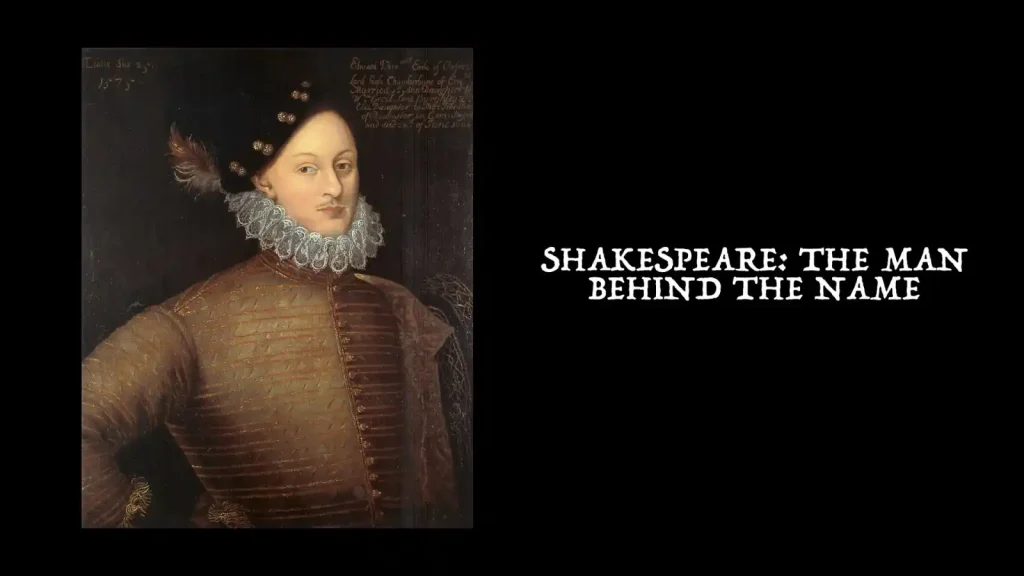
Shakespeare: The Man Behind the Name – In the realm of English literature, few names carry as much weight as William Shakespeare. For centuries, his works have captivated audiences, scholars, and creatives alike, leaving an indelible mark on the world of drama and poetry. However, the identity of the true author behind these iconic works has been a subject of debate and intrigue, stirring the imaginations of many. One of the most compelling theories revolves around Edward de Vere, the 17th Earl of Oxford, an Elizabethan nobleman whose life and literary achievements suggest he could be the true author of the works attributed to Shakespeare.
“Shakespeare: The Man Behind the Name” is a documentary that delves into this fascinating debate, exploring the life of Edward de Vere and the compelling evidence that supports the idea that he might be the real genius behind Shakespeare’s works. The film offers an in-depth look at the Elizabethan era, shedding light on the intricate political, social, and literary dynamics of the time, all of which played a crucial role in the shaping of what we now recognize as Shakespearean literature.
Edward de Vere was born into nobility in 1550, inheriting the title of the Earl of Oxford at the tender age of twelve. As a member of one of the most influential families in England, he was privy to the court’s inner workings, which exposed him to the intellectual and cultural currents of the time. De Vere received an extensive education, studying under the tutelage of prominent scholars, and his early exposure to literature, languages, and the arts set the foundation for his future endeavors as a writer and patron of the arts.
The documentary carefully examines the key pieces of evidence that link de Vere to the Shakespearean canon. One of the most notable points is his deep involvement in the theatrical world. De Vere was a known patron of the arts, financially supporting several acting companies, and he even penned plays and poems himself. This connection to the theater, coupled with his intimate knowledge of court life, lends credence to the theory that he could have authored the works traditionally attributed to Shakespeare.
The film also explores the numerous parallels between de Vere’s life and the themes, characters, and settings found in Shakespeare’s plays. For instance, de Vere’s extensive travels through Italy, particularly Venice, resonate with the vivid depictions of Italian locales in plays like “The Merchant of Venice” and “Othello.” Furthermore, the Earl’s tumultuous personal life, marked by scandal, political intrigue, and his complex relationship with Queen Elizabeth I, mirrors the dramatic tensions and royal intrigue that permeate the Shakespearean corpus.
Another compelling aspect of the documentary is its examination of the enigmatic nature of William Shakespeare himself. Despite being one of the most famous writers in history, relatively little is known about Shakespeare’s personal life. The gaps in his biography, such as the absence of formal education or any substantial travel abroad, have fueled speculation that the man from Stratford-upon-Avon may not have had the background necessary to produce such a profound and varied body of work. “Shakespeare: The Man Behind the Name” posits that de Vere, with his noble upbringing, education, and experience, fits the profile of the true author far more convincingly.
Shakespeare: The Man Behind the Name
The documentary does not shy away from addressing the counterarguments to the Oxfordian theory. It acknowledges the traditional view that attributes the works to William Shakespeare of Stratford, examining the evidence that supports this claim, such as the references to Shakespeare in contemporary documents and the praise he received from his peers.
However, the film argues that these references could be part of a deliberate effort to protect the true author’s identity. In an era where the social order was rigidly maintained, it would have been unthinkable for a nobleman like de Vere to publish works under his name, especially if they contained controversial or politically sensitive content. The use of a pseudonym, therefore, would have been a plausible strategy to avoid public scrutiny and maintain his standing at court.
“Shakespeare: The Man Behind the Name” also explores the broader implications of this authorship question. It challenges viewers to reconsider how we understand literary genius and the ways in which history is constructed. If de Vere were indeed the true author, what would this mean for our interpretation of the plays and poems? How might this shift our perception of the Elizabethan era and its cultural output? The film invites audiences to engage with these questions, encouraging a deeper exploration of the relationship between identity, authorship, and historical legacy.
In addition to its scholarly exploration, the documentary brings to life the vibrant world of Elizabethan England, offering viewers a visually rich and historically accurate portrayal of the period. Through meticulous reenactments, expert interviews, and detailed analysis, “Shakespeare: The Man Behind the Name” paints a comprehensive picture of the time, providing context for the debate and helping to illuminate the complex tapestry of influences that shaped the works in question.
Ultimately, “Shakespeare: The Man Behind the Name” is more than just a documentary about Edward de Vere and the Shakespearean authorship question. It is a thought-provoking exploration of how history is remembered and recorded, inviting viewers to consider the possibility that one of the greatest literary figures of all time might not be who we think he is. Whether one subscribes to the traditional view or entertains the Oxfordian theory, the film encourages a deeper appreciation for the works themselves and the mysterious circumstances surrounding their creation.
Shakespeare: The Man Behind the Name – The Mystery of Shakespeare’s Identity
Challenging the Traditional Narrative
For centuries, the name William Shakespeare has been synonymous with literary genius. His plays and sonnets have captivated audiences, inspired countless adaptations, and shaped the English language itself. But what if the man behind the quill isn’t who we thought he was?
A growing chorus of voices is challenging the traditional narrative, suggesting that the true author of Shakespeare’s works might be someone else entirely. This isn’t just academic nitpicking; it’s a mystery that could rewrite literary history. At the center of this controversy stands Edward de Vere, the 17th Earl of Oxford, a Renaissance man whose life reads like a Shakespearean play in its own right.
The case for de Vere isn’t built on mere speculation. It’s a tapestry woven from historical records, literary analysis, and compelling coincidences. As we delve deeper into this enigma, we’ll see how the pieces of this 400-year-old puzzle might finally be falling into place.
A Renaissance Man in Elizabethan England
Edward de Vere wasn’t just any nobleman; he was a true Renaissance man in the heart of Elizabethan England. Born into privilege, de Vere had access to the finest education of his time. He studied under some of the most brilliant minds of the era, including Sir Thomas Smith, whose vast library would have been a treasure trove for any aspiring writer.
But de Vere’s education didn’t stop at the borders of England. Like a character from one of Shakespeare’s Italian plays, he embarked on a grand tour of Europe. His travels took him through France and, most significantly, Italy. As he wandered the streets of Venice and breathed in the air of Verona, de Vere was unknowingly gathering the vivid details that would later bring Shakespeare’s Italian settings to life.
These journeys weren’t just sightseeing trips. They were transformative experiences that shaped de Vere’s worldview and, potentially, his art. The sights, sounds, and stories he encountered abroad would later find their way into the rich tapestry of Shakespeare’s plays, lending them an authenticity that has puzzled scholars for centuries.
Unveiling the Literary Genius
As we peel back the layers of history, we begin to see the outline of a literary genius emerging. Edward de Vere wasn’t just a well-traveled nobleman; he was also a known poet and patron of the arts. His own writings, though few have survived, show a command of language and a depth of emotion that mirror the Shakespearean style.
But it’s not just the style that’s compelling; it’s the substance. Shakespeare’s plays display a breadth of knowledge that seems almost superhuman – from law and medicine to music and falconry. This encyclopedic knowledge aligns perfectly with de Vere’s extensive education and life experiences.
Moreover, the plays are rife with insider knowledge of court politics and social commentary that would be beyond the reach of a commoner from Stratford. They paint a picture of a writer intimately familiar with the machinations of power, the kind of familiarity that comes from being at the center of it all. And at the center is exactly where Edward de Vere found himself, a courtier in the tumultuous court of Queen Elizabeth I.
As we continue to explore this theory, we’ll see how the life of Edward de Vere and the works of William Shakespeare intertwine in ways that are too numerous and too specific to be mere coincidence. The mystery of Shakespeare’s identity isn’t just an academic exercise; it’s a journey into the heart of one of the greatest literary legacies in history.
The Italian Connection: De Vere’s Grand Tour
Shakespeare’s Intimate Knowledge of Italy
Picture this: a quill scratching parchment, bringing to life the sun-drenched streets of Verona and the mysterious canals of Venice. The writer’s words paint such vivid pictures that you can almost smell the Italian air. But how did the Bard of Avon, a man supposedly anchored in Stratford-upon-Avon, capture the essence of Italy with such startling accuracy?
This question has puzzled scholars for centuries. Shakespeare’s plays set in Italy aren’t mere backdrops; they’re intricate tapestries woven with threads of local customs, geography, and cultural nuances. From the bustling markets of Venice in “The Merchant of Venice” to the romantic balconies of Verona in “Romeo and Juliet,” the details are so precise that they seem to come from firsthand experience. Yet, there’s no evidence that William Shakespeare of Stratford ever set foot outside of England. So, how did he do it?
Tracing De Vere’s Footsteps
Enter Edward de Vere, 17th Earl of Oxford. Unlike the Stratford man, de Vere’s travels are well-documented. In 1575, he embarked on a grand tour of Europe, spending significant time in Italy. His journey wasn’t just a fleeting visit; it was an immersive experience that would leave an indelible mark on his psyche.
De Vere’s Italian sojourn reads like a Shakespearean travelogue. He wandered the streets of Venice, perhaps crossing the very bridges that would later feature in “Othello.” In Padua, he might have encountered the learned doctors who inspired the characters in “The Taming of the Shrew.” His time in Verona could have planted the seeds for the star-crossed lovers’ tale that would become “Romeo and Juliet.”
But it wasn’t just the grand cities that caught de Vere’s attention. He noted the little things too – the way Italians greeted each other, the local wines they drank, the clothes they wore. These small details would later bring authenticity to Shakespeare’s Italian plays, lending them a realism that goes beyond mere imagination.
Uncovering the Authenticity
The parallels between de Vere’s travels and Shakespeare’s Italian plays are striking. Take, for instance, the play “The Merchant of Venice.” The author’s knowledge of Venetian law, particularly the rights of foreigners, is remarkably accurate. This level of detail would have been hard to come by for someone who had never set foot in the city.
Moreover, Shakespeare’s Italian plays often include references to specific locations that only a visitor would know. In “The Taming of the Shrew,” for example, there’s a mention of “Saint Luke’s Church” in Padua. This church actually exists and was a prominent landmark in de Vere’s time. Such precise geographical references appear throughout Shakespeare’s Italian plays, lending credence to the theory that the author had firsthand experience of these places.
But it’s not just about locations. The plays capture the spirit of Renaissance Italy – its art, its politics, its social structures. They reflect a deep understanding of Italian culture that goes beyond what could be gleaned from books or secondhand accounts. This intimate knowledge aligns perfectly with de Vere’s extensive travels and his reputation as a cultured nobleman.
As we delve deeper into the Italian connection, the case for de Vere as Shakespeare becomes increasingly compelling. His grand tour provides a tangible link between the man and the works, offering a possible explanation for the rich tapestry of Italian life that colors Shakespeare’s plays. It’s a connection that bridges the gap between the known facts of de Vere’s life and the enduring mystery of Shakespeare’s intimate knowledge of Italy.
The Courtier Playwright: De Vere’s Life at the Elizabethan Court
Shakespeare’s Insider View of Royal Politics
Imagine for a moment the glittering world of the Elizabethan court – a realm of intrigue, power plays, and whispered secrets. Now, picture a playwright who could capture this world with uncanny accuracy, weaving tales of kings and queens that felt startlingly real. This is the Shakespeare we know from plays like “Hamlet,” “King Lear,” and “Richard III.”
But how did Shakespeare, supposedly a commoner from Stratford, gain such intimate knowledge of royal life? The answer might lie not in the streets of Stratford, but in the opulent halls of Queen Elizabeth’s court. The plays reveal an insider’s view of politics that goes beyond mere observation. They show a deep understanding of the machinations of power, the subtle nuances of court etiquette, and the complex relationships between monarchs and their subjects.
Consider the political savvy displayed in “Hamlet,” where courtly intrigue is as deadly as any sword. Or the astute observations on leadership in “Henry V.” These aren’t just well-researched depictions; they feel lived, experienced. It’s as if the author had walked the corridors of power himself, privy to the secrets and strategies of the royal elite.
De Vere’s Position and Experiences at Court
Enter Edward de Vere, 17th Earl of Oxford, a man born into the very world Shakespeare wrote about with such insight. De Vere wasn’t just any nobleman; he held the prestigious position of Lord Great Chamberlain, a role that placed him at the very heart of court life. This wasn’t a mere ceremonial title – it gave de Vere unprecedented access to the inner workings of the monarchy.
Imagine de Vere, moving through the court with the ease of one born to it. He would have been present at state occasions, privy to private conversations, and witness to the daily dramas that unfolded behind closed doors. His relationship with Queen Elizabeth I was complex and, at times, tumultuous – much like the relationships between monarchs and courtiers in Shakespeare’s plays.
De Vere’s life at court wasn’t all glamour and intrigue, though. He experienced both favor and disfavor, success and failure. These ups and downs mirror the experiences of many Shakespearean characters, from the tragic fall of King Lear to the political maneuvering of Prince Hal in “Henry IV.” De Vere’s intimate knowledge of court life, combined with his personal experiences of triumph and disgrace, would have provided rich material for a playwright.
Connecting the Dots
When we look at Shakespeare’s historical plays and tragedies through the lens of de Vere’s experiences, suddenly the pieces start to fit together. The astute political commentary, the nuanced portrayal of royal figures, the understanding of power dynamics – all of these align perfectly with what we know of de Vere’s life at court.
Take, for instance, the play “Measure for Measure,” with its exploration of power, justice, and morality. The complex ethical dilemmas faced by the characters echo the real-life challenges that a courtier like de Vere would have encountered. Or consider “King Lear,” with its devastating portrayal of a monarch’s fall from grace. Could this be a reflection of de Vere’s own experiences of royal favor and disfavor?
Moreover, de Vere’s position at court would have given him the perfect vantage point to observe and critique the politics of his time. The plays often serve as a form of political commentary, sometimes subtle, sometimes overt. This fits with what we know of de Vere – a man who was both insider and outsider, able to see the court from multiple perspectives.
The use of theatrical performances as a means of political commentary was not uncommon in Elizabethan times. Plays could be powerful tools for expressing ideas that might be dangerous to voice directly. If de Vere was indeed Shakespeare, his position at court would have given him both the material and the motivation to craft these intricate political narratives.
As we connect these dots, the image of de Vere as the true Shakespeare becomes increasingly clear. His life at the Elizabethan court provides a compelling explanation for the depth of insider knowledge displayed in the plays. It offers us a Shakespeare who wasn’t just imagining the world of kings and queens, but one who lived it, breathed it, and ultimately transformed it into timeless art.
Conclusion: The Enduring Legacy of Shakespeare’s Works
The Timeless Appeal of Shakespeare’s Plays and Poems
From the star-crossed lovers of Verona to the ambitious Scottish thane, Shakespeare’s characters have captivated audiences for centuries. Their struggles, triumphs, and failures resonate with us today as strongly as they did four hundred years ago. But why? What makes these tales of kings, lovers, and fools so enduringly powerful?
The answer lies in the universality of Shakespeare’s themes. Love, ambition, jealousy, betrayal – these are the building blocks of human experience. Shakespeare didn’t just write about these themes; he dissected them, explored their every nuance, and presented them in ways that speak to the very core of our humanity. When Hamlet grapples with existential questions, we see our own doubts reflected. When Othello falls prey to jealousy, we recognize the destructive power of our own insecurities.
Moreover, Shakespeare’s language, though often challenging, has a musicality and depth that continues to enrich our cultural lexicon. His turns of phrase have become part of our everyday speech, his metaphors coloring our understanding of the world. From “to be or not to be” to “all the world’s a stage,” Shakespeare’s words have become shorthand for complex ideas and emotions.
The Importance of Authorship in Understanding the Works
While the beauty of Shakespeare’s works stands on its own, understanding their authorship adds a new dimension to our appreciation. If Edward de Vere is indeed the man behind the pseudonym, how does this change our reading of the plays and sonnets? The answer is: profoundly.
Knowing the author’s identity and life experiences allows us to see the works through a new lens. Suddenly, the insider knowledge of court life in the history plays takes on new significance. The Italian settings, so vividly portrayed, become not just imagination but lived experience. The complex emotions in the sonnets gain added poignancy when we consider de Vere’s tumultuous personal life.
This isn’t about diminishing the magic of the works. Rather, it’s about enriching our understanding. Just as knowing about Van Gogh’s struggles deepens our appreciation of his swirling night skies, understanding Shakespeare’s true identity can add layers of meaning to his words. It allows us to see the man behind the myth, the human experiences that shaped these timeless stories.
A Call to Action: Encouraging Further Exploration
The Shakespeare authorship question isn’t just an academic puzzle; it’s an invitation to engage more deeply with some of the greatest works in the English language. As we’ve seen, the case for Edward de Vere as Shakespeare is compelling. But what does this mean for you, the reader and lover of literature?
First, it’s an opportunity to rediscover these familiar works. Read “Hamlet” again, but this time imagine it written by a man intimately familiar with the intrigues of the Elizabethan court. Explore the Italian plays with the knowledge that their author may have walked the very streets he describes. Let this new perspective reignite your passion for these enduring works.
Secondly, don’t be afraid to question established narratives. The beauty of scholarship is that it’s always evolving, always open to new interpretations. Dive into the evidence yourself. Read de Vere’s known works, compare them to Shakespeare’s. Look for the connections, the similarities in style and substance.
Finally, share your discoveries. Discuss this theory with fellow literature lovers. Organize a reading group to explore Shakespeare’s works through the lens of de Vere’s life. Attend lectures, participate in online forums, engage with the vibrant community of Shakespeare enthusiasts and scholars.
Remember, every reader brings something unique to a text. Your insights, your questions, your interpretations are valuable. By engaging actively with this ongoing debate, you’re not just learning about Shakespeare – you’re contributing to a centuries-long conversation about literature, identity, and the nature of genius.
The mystery of Shakespeare’s identity isn’t just about setting the historical record straight. It’s about deepening our connection to these works that have shaped our culture. So, pick up that play, open that sonnet collection. Read with new eyes, question with an open mind, and let the enduring power of these words – whoever wrote them – continue to inspire and move you.
F.A.Q. Shakespeare: The Man Behind the Name
Q.: What is the main premise of the documentary “Shakespeare: The Man Behind the Name”?
A.: The documentary “Shakespeare: The Man Behind the Name” explores the theory that Edward de Vere, the 17th Earl of Oxford, might be the true author of the works traditionally attributed to William Shakespeare. It delves into de Vere’s life and the evidence that supports this controversial theory, challenging the conventional understanding of Shakespearean authorship.
A.: Edward de Vere was the 17th Earl of Oxford, a prominent Elizabethan nobleman, poet, and patron of the arts. He is considered a potential author of Shakespeare’s works because of his extensive education, intimate knowledge of court life, and documented involvement in the theatrical world. His life and experiences closely align with the themes and settings of many Shakespearean plays, leading some scholars to believe he could be the true author.
A.: The documentary presents various pieces of evidence, including de Vere’s documented travels in Italy, which correspond with the accurate Italian settings in several Shakespearean plays. It also highlights his deep involvement in the theatrical world, his education under prominent scholars, and the parallels between his life experiences and the themes found in Shakespeare’s works. Additionally, it addresses the possibility that de Vere used a pseudonym to publish his works due to the social and political constraints of the time.
Q.: How does the documentary address counterarguments to the Oxfordian theory?
A.: The documentary acknowledges the traditional view that attributes the works to William Shakespeare of Stratford-upon-Avon. It examines the evidence supporting this claim, such as contemporary references to Shakespeare and the recognition he received from his peers. However, it suggests that these references might have been part of an effort to protect the true author’s identity, given the societal implications of a nobleman like de Vere publishing controversial works.
A.: The documentary invites viewers to reconsider how literary genius is understood and how history is constructed. It challenges the traditional narrative of Shakespearean authorship and explores what it would mean for the interpretation of the plays and poems if de Vere were indeed the true author. The film encourages a deeper exploration of the relationship between identity, authorship, and historical legacy, prompting audiences to question long-held assumptions about one of the greatest literary figures in history.



Loved this – thank you for sharing