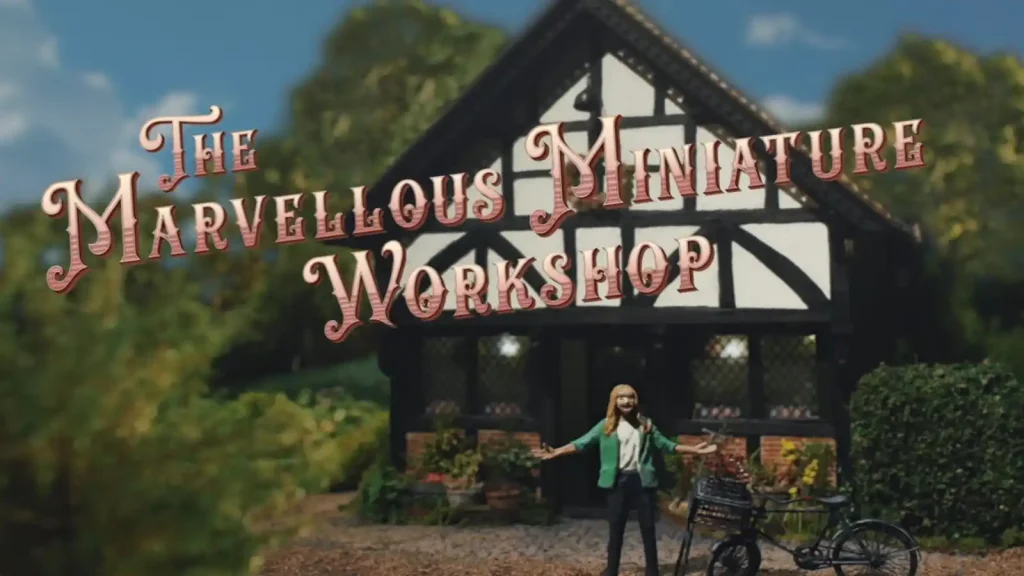
The Marvellous Miniature Workshop Episode 2 opens with a deceptively simple premise: rebuild a place that no longer exists, one tiny detail at a time, and watch what happens when cherished memories flood back. In this instalment of the documentary series, presenter Sara Cox welcomes restaurateur Karim from Hemel Hempstead to the workshop, where he makes an extraordinary request.
He wants the team to recreate his old secondary school, St Paul’s Way in Bow, East London, a 1960s concrete building that served as a sanctuary from the racism he endured growing up in the neighbourhood. Miniaturist Abi Trotman accepts the challenge, setting out to capture not grand architecture but the emotional weight of a maths classroom and the favourite teacher who made it feel like home.
What makes this episode of The Marvellous Miniature Workshop Episode 2 so compelling is the gap between the building’s outward appearance and the feelings it contained. St Paul’s Way looked like thousands of functional school buildings constructed across Britain in the 1960s and 1970s. The structure carried no Gothic arches, no sweeping facades, and nothing that would turn a head on the street. Yet for Karim, walking through its gates each morning meant stepping from danger into safety, from hostility into acceptance. The craft show takes this contradiction and transforms it into a project about emotional storytelling, artisan skills, and the power of intricate craft to hold something as vast as a childhood intact.
British daytime TV rarely delivers a story with this kind of depth, yet The Marvellous Miniature Workshop Episode 2 does so through the quiet accumulation of handmade miniatures and human stories. The episode traces Karim’s journey from a Bangladeshi village to the hostile streets of East London, documents the painstaking craftsmanship Abi employs to recreate a 1980s classroom in 1:24 scale, and builds toward an emotional surprise reuniting Karim with his beloved maths teacher after more than thirty years. Karim’s account of daily abuse sits alongside scenes of Abi scratching graffiti into tiny chair backs with a needle. The juxtaposition works because the show treats both elements with equal seriousness.
The episode belongs to a growing category of 2025 TV shows that blend creative workshops with documentary storytelling. Rather than staging a craft competition with eliminations, this series focuses on a single commission per episode, allowing the human interest series format to breathe. Sara Cox guides proceedings with warmth and humour, while Abi Trotman and fellow miniaturists like Ethan Goodbody and Hannah Lemon bring remarkable artisan skills to buildings that might otherwise exist only in fading photographs.
As the episode unfolds, viewers witness a careful interplay between Karim’s past and Abi’s present-tense work. Karim remembers; Abi builds. He recalls the feeling of safety; she recreates the physical environment that produced it. The episode also highlights how collectible models and dioramas serve purposes far beyond decoration. Karim’s school has been demolished and replaced with a modern structure. The miniature Abi creates becomes the only physical representation of the place where he felt he truly belonged. In this sense, the hobbyist craft of miniature-making takes on an almost archival function, preserving not just architecture but lived experience.
Sara Cox introduces Karim’s story with characteristic directness, noting that safety sometimes arrives not through locked doors but through open ones. The stage is set for an episode exploring belonging, craftsmanship, and the enduring influence of a good teacher.
The Marvellous Miniature Workshop Episode 2
Karim’s Childhood and the Search for Safety in The Marvellous Miniature Workshop Episode 2
Karim was born in a Bangladeshi village where daily life ran without electricity or running water. The quiet of rural existence gave way to overwhelming sensory contrast when his family moved to East London, joining his father, who had emigrated after the Second World War as part of the Commonwealth workforce invited to help rebuild Britain’s economy. By the late 1970s, when Karim and his mother arrived, attitudes toward immigrant communities had hardened significantly.
The East London that greeted Karim was a hostile place for Bangladeshi families. Racist attacks were a daily reality. Karim describes accepting that verbal abuse would come almost every day, with encounters sometimes turning physical. He recalls constantly looking over his shoulder, feeling like a punchbag for people who needed no reason beyond the colour of his skin to attack. The National Front operated openly in the area, fuelling violence against Asian communities.
The historical context deepens Karim’s personal account. In 1978, a young Bangladeshi textile worker named Altab Ali was brutally murdered in a racially motivated attack near Brick Lane. Around 7,000 people marched behind his coffin to Downing Street, demanding government action against racism. News reports from the period described the Asian community in the area as isolated and terrorised, the victims of an appalling catalogue of violent crimes. This was the environment in which Karim grew up, and it explains why school mattered so profoundly.
St Paul’s Way became Karim’s sanctuary. He describes the transformation that occurred each morning as he walked through the school gates. Outside, danger lurked on every corner. Inside, teachers understood what students from his background were going through. The school had a large percentage of pupils from Bangladesh, and the staff worked deliberately to make life good for them. For Karim, it was the first school where he truly felt comfortable, a rare pocket of acceptance in a neighbourhood defined by hostility.
The Emotional Significance of St Paul’s Way School
When Karim shares photographs of St Paul’s Way with Sara Cox and Abi Trotman, the reaction in the workshop carries a telling honesty. The building looks unremarkable. Sara notes the Brutalist concrete construction, typical of institutional architecture thrown up in the 1960s and 1970s. Abi acknowledges it is not her usual style. Even Karim laughs, conceding the building is not beautiful in any conventional sense. Yet he insists this is exactly the school he wants recreated.
The beauty of St Paul’s Way lived entirely in the memories Karim formed there. The classrooms were functional, not fancy. When he arrived in 1984, the building already needed a fresh coat of paint. The furniture was modern but unremarkable. None of this mattered because the school’s true value lay in the relationships it fostered. Plenty of good teachers staffed the building, and Karim believes they all understood what students from immigrant backgrounds were experiencing outside the gates.
One teacher stood above the rest. Mr Carter, the maths teacher, embodied the qualities that made St Paul’s Way a safe haven. Karim describes him as very kind, very empathetic, and blessed with a fantastic sense of humour. Photographs show a popular figure whom everyone loved. Crucially, Mr Carter taught far more than mathematics. He taught life, and Karim remembers him as one of those people who were just exceptionally kind. This emotional connection between student and teacher forms the beating heart of the episode.
The loss of the original building adds urgency to the commission. When Karim returns to Bow to visit St Paul’s Way, he discovers the 1960s structure has been completely demolished and replaced with a shiny new school. The sight hits him hard, leaving him almost in tears and describing the experience as gut-wrenching. He knows he will never see the building again. The miniature model becomes not merely a keepsake but the sole surviving physical link to a place that shaped his identity during the most vulnerable years of his childhood.
Abi Trotman’s Approach to Craftsmanship in The Marvellous Miniature Workshop Episode 2
Abi Trotman faces an unusual challenge with Karim’s commission. Most miniaturists thrive when working with architecturally distinctive buildings, structures whose character can be captured through ornamental detail and dramatic form. St Paul’s Way offers none of that. The building’s appeal lies entirely in what happened inside it, forcing Abi to rethink her approach entirely.
She decides to concentrate on a single room rather than the whole school. The maths classroom of Mr Carter becomes her focus, the space where Karim’s fondest memories were formed. Working from a photograph that she admits is not great quality, Abi plans to combine what the image shows with research about classrooms of the period to fill in the gaps. The challenge excites her precisely because it demands something beyond architectural recreation.
Abi identifies early on that injecting personal details and memories will be the key to success. She cannot rest on the architecture. Instead, the model must convey the feeling of being in a busy, lived-in school classroom. She lists elements that will bring the space to life: an overflowing bin, stationery supplies left out, chewing gum under the desks, compass etchings on table surfaces. Every small detail serves the larger purpose of transporting Karim back to the 1980s.
The decision to focus on fine detail over architectural grandeur defines Abi’s entire approach. She recognises that for Karim, the magic of the classroom lay in its ordinariness, the accumulation of small, everyday moments that together created a sense of safety and belonging. Her task is to capture that accumulation in 1:24 scale, a goal that demands extraordinary patience and precision from the miniaturist.
Building the Classroom at 1:24 Scale
Construction begins with the room itself. Abi builds a three-sided, open-room box from foam board, painting it white before adding grey board skirting and a dado rail of slender beechwood. Both elements receive a coat of paint in what the episode calls classroom sludge, that unmistakable murky shade found in institutional buildings of the era. The room shell is twenty-four times smaller than the real thing, yet it immediately evokes the generic 1960s school environment Karim remembers.
The desks come next, and they demand meticulous attention to detail. Karim’s photographs show classrooms packed with large shared desks, so Abi makes eight. She cuts frames from polystyrene rod, glues them together with precision, and paints them with black acrylic. The desktops use two-millimetre plywood topped with coloured paper to mimic an old Formica finish, then receive a coat of satin varnish. The result captures the look and feel of 1980s school furniture with remarkable accuracy. Each desk passes what the programme calls Karim’s school inspection.
The iconic polyprop chairs present a different technical challenge. Invented in 1963, these injection-moulded plastic seats became a British design classic, filling classrooms across the country for decades. Comfortable, stackable, wipeable, and famously cheap, they defined the school experience for generations of students. Abi recreates them using Worbla, a thermoplastic that bends when heated. She holds each piece over a candle flame, bends it to create the distinctive seat curve, and attaches legs made from styrene rod.
Crucially, Abi does not want the chairs to look beautiful and clean. They have been in a school, so they need to appear bashed around and distressed. She adds graffiti to the chair backs by scratching with a needle, creating tiny drawings and words of the kind found etched into school furniture everywhere. Miniature chewing gum, crafted by dotting neon paint onto wax paper, letting it dry, and rolling it into tiny balls, gets superglued to chair backs. One chair receives the inscription “Karim was here,” a small, playful touch that grounds the model in personal memory.
Mr Carter’s Classroom Details and the Blackboard Surprise
Sara Cox undertakes a fact-finding mission to meet Mr Carter himself, gathering information that will help Abi perfect the classroom model. The former maths teacher, whose first name is Chris, provides invaluable details about the room where he taught Karim. He remembers it as quite a busy place, with filing cabinets, shelving units, and walls covered in displays of students’ work and mathematical posters.
Mr Carter reveals a personal quirk that becomes central to the model’s emotional impact. At the beginning of each new term, he would write his name on the blackboard. Throughout his career, he maintained a strange foible of using the digits in the date to create a mathematical sum. Sara immediately recognises the potential. She asks Mr Carter to write his name so Abi can copy his handwriting onto the miniature blackboard. She also invites him to attend the model’s unveiling to surprise Karim, an offer he accepts with visible emotion, calling it an honour to meet his former pupil again.
Back in the workshop, Abi puts this intelligence to work. She creates notice boards by cutting greyboard rectangles and wrapping them in hessian for that classic pinboard texture. Kebab skewers become smart wooden frames. Tiny maths posters fill the boards. Textbooks receive similar care. Abi concertinas paper, glues each fold, and cuts out miniature covers. She recreates the SMILE mathematics series, the ubiquitous maths textbook that generations of students puzzled over during long division lessons.
The blackboard becomes the centrepiece. Abi paints special black paint onto greyboard using horizontal and vertical strokes for proper coating, then adds chalk dust for that neglected, uncleaned appearance. Coffee stirrers form the frame. Using Mr Carter’s handwriting sample, she inscribes his name on the miniature board. She also adds one of his signature date sums, with a hidden clue: the answer is the year Mr Carter first taught Karim. The sum reads 17 times 5, and the answer, 85, points to 1985. This detail transforms the blackboard from a classroom prop into a carefully planted trigger for the emotional reunion that follows.
The Reveal and the Reunion with Mr Carter
A month passes between Karim’s initial visit and the unveiling of the finished model. When he returns to the workshop, Sara Cox and Abi Trotman wait with visible anticipation. Karim expresses both excitement and nervousness. The cover comes off, and his reaction is immediate and genuine. He identifies the model instantly as his old maths classroom, Mr Carter’s classroom, and calls it absolutely wonderful.
The details register one by one. Karim recognises the door straight away. He spots the chairs, desks, filing cabinets, and textbooks. When Abi points out the SMILE maths books, Karim remembers them instantly, joking that he recalls being useless at the exercises. The chewing gum and graffiti on the chair backs prompt delighted recognition. Every element Abi crafted lands exactly as intended, triggering specific memories tied to specific objects.
Abi explains that she wanted the model to look as though a class had just stormed in and stormed straight back out, leaving a flutter of papers in their wake. The busy notice boards, shelves groaning with books, and the overflowing bin all contribute to an atmosphere of controlled chaos that captures school life in the 1980s.
Then comes the blackboard clue. Sara draws attention to Mr Carter’s name written on the board and the sum: 17 times 5. None of the three people standing before the model can solve it. Sara admits her maths is terrible. Abi declines to attempt it. Karim, the former student of Mr Carter’s maths class, confesses he cannot do it either. The moment that follows changes everything.
The Emotional Surprise That Defines The Marvellous Miniature Workshop Episode 2
Mr Carter walks into the workshop. Karim’s reaction is instantaneous and overwhelming. He exclaims in disbelief, calling out his old teacher’s name and asking how on earth he got there. The two men have not seen each other for thirty years. Mr Carter tells Karim he has not changed a bit. When Mr Carter invites Karim to call him Chris, the former student refuses. It just does not feel right to call him anything else but Mr Carter.
Mr Carter provides the answer to the sum on the blackboard: 85, pointing to 1985, the year he began teaching Karim. He examines the miniature classroom and praises the craftsmanship, calling the furniture fantastic. He notices the overflowing bin and laughs, admitting he was never super tidy.
Karim reflects on what Mr Carter and his colleagues meant to him. He acknowledges that the school occupied a difficult part of the world in which to teach, but insists the teachers were all fantastic. Mr Carter responds that teaching at St Paul’s Way was fulfilling and enjoyable. He saw a look of delight in Karim’s eyes, which he describes as very humbling. Sara congratulates Abi on her incredible creation. The model represents the feeling of school as a safe haven for Karim, a feeling to which Mr Carter contributed enormously. Built in 1:24 scale from foam board, polystyrene, Worbla, and coffee stirrers, it holds within it an entire world of belonging.
Craftsmanship as Emotional Archaeology in The Marvellous Miniature Workshop Episode 2
The episode demonstrates something profound about the relationship between handmade miniatures and human memory. Abi Trotman does not simply reproduce a room. She excavates the emotional layers within it. Every decision, from the shade of skirting paint to the placement of chewing gum, serves the goal of triggering recognition and feeling. This approach elevates miniature-making from hobbyist craft to something closer to emotional archaeology.
The technical artisan skills on display are remarkable. Heating thermoplastic over candle flames, scratching needle-fine graffiti, rolling paint dots into microscopic chewing gum balls, replicating handwriting on a blackboard smaller than a postage stamp: these acts demand extraordinary patience and dexterity. The documentary series captures each process with enough detail for viewers to appreciate the difficulty, making the programme a genuine celebration of creative workshops and traditional craft practices.
Yet the episode never loses sight of the human stories that give the craftsmanship its purpose. The model means something because the memory means something. The fine detail matters because the feelings it represents matter. The reunion between Karim and Mr Carter provides the emotional climax, but the lasting image is of the miniature itself, containing within its walls the story of a child who found belonging in a concrete building the rest of the world would never have looked at twice.
The Lasting Impact of Detailed Miniatures and Human Connection
Karim’s response to the finished model reveals the profound effect that dioramas and collectible models can have when they represent deeply personal spaces. He does not simply admire the craftsmanship. He inhabits it, recognising specific objects, recalling specific moments, and reconnecting with a period of his life that the demolition of the real building had threatened to erase.
Mr Carter’s presence amplifies this effect immeasurably. The teacher who made school safe for a vulnerable child now sees physical proof of how deeply that safety mattered. His admission that the experience was very humbling speaks to the often invisible impact that educators have on their students, an impact that sometimes takes thirty years to fully surface.
The episode also underscores the collaborative nature of the creative workshops at the heart of the series. Sara Cox’s investigative visit to Mr Carter provides details that Abi could never have obtained from photographs alone. The handwriting sample, the blackboard sum tradition, the description of wall displays: all required human conversation rather than reference images. This heartwarming TV programme demonstrates that the best detailed miniatures emerge from genuine engagement with the people whose stories they tell. For viewers drawn to craft shows and human interest series alike, The Marvellous Miniature Workshop Episode 2 makes clear that miniatures are never just miniatures. They are vessels for everything we hold dear, scaled down in size but not in significance.
FAQ The Marvellous Miniature Workshop Episode 2
Q: What is The Marvellous Miniature Workshop Episode 2 about?
A: This episode follows restaurateur Karim from Hemel Hempstead as he requests a miniature of his old secondary school, St Paul’s Way in Bow, East London. Specifically, miniaturist Abi Trotman recreates the 1980s maths classroom of his favourite teacher, Mr Carter. The episode combines intricate craft with emotional storytelling about childhood safety and belonging.
Q: Why did Karim choose his secondary school for the miniature model?
A: Karim grew up facing daily racism in East London during the 1980s. Consequently, St Paul’s Way School became his sanctuary from hostility on the streets. The teachers understood what students from his Bangladeshi background were going through. Furthermore, the original 1960s building has since been demolished, making the handmade miniature his only physical connection to those cherished memories.
Q: Who is Abi Trotman in The Marvellous Miniature Workshop?
A: Abi Trotman is the skilled miniaturist assigned to Karim’s school project. She specialises in painstaking craftsmanship and fine detail work. For this commission, she built an entire 1980s maths classroom at 1:24 scale. Her artisan skills turned everyday materials like foam board, coffee stirrers, and thermoplastic into remarkably detailed miniatures.
Q: What scale does the miniature classroom use?
A: Abi constructed the classroom in 1:24 scale, meaning every element is twenty-four times smaller than life size. This popular scale for dioramas allows sufficient room for fine detail. Additionally, it enabled Abi to include tiny chewing gum under chairs, needle-scratched graffiti, and miniature SMILE maths textbooks.
Q: How did Abi Trotman make the iconic school chairs?
A: Abi used Worbla, a thermoplastic that bends when heated over a candle flame. She shaped each seat into the classic polyprop chair curve, then attached styrene legs. Moreover, she deliberately distressed the chairs and added graffiti and tiny chewing gum balls to replicate authentic school wear and tear.
Q: Who is Mr Carter and why is he significant in Episode 2?
A: Mr Carter was Karim’s maths teacher at St Paul’s Way School. He stood out for his kindness, empathy, and fantastic sense of humour. Importantly, he taught far more than mathematics. He taught life lessons during a period when his Bangladeshi students faced hostility outside school gates. Sara Cox secretly met him to gather classroom details for the miniature.
Q: What surprise did Abi hide on the miniature blackboard?
A: Abi wrote Mr Carter’s name on the tiny blackboard using a sample of his actual handwriting. She also added one of his signature date sums: 17 times 5. The answer, 85, cleverly points to 1985, the year Mr Carter first taught Karim. This hidden clue ultimately led to the emotional surprise reunion.
Q: Does Karim reunite with Mr Carter in the episode?
A: Yes. When nobody at the reveal could solve the blackboard sum, Mr Carter walked in to provide the answer. Karim had not seen his former teacher for over thirty years. The heartwarming reunion brought genuine emotion, with Karim exclaiming in disbelief and still insisting on calling him Mr Carter rather than Chris.
Q: What materials did Abi use to build the miniature classroom?
A: Abi used foam board for walls, polystyrene rod for desk frames, and two-millimetre plywood for desktops. Meanwhile, she crafted the blackboard from greyboard painted with special black paint and framed with coffee stirrers. Hessian-wrapped greyboard became notice boards. Coloured paper mimicked Formica finishes, and Worbla thermoplastic formed the chair seats.
Q: When does The Marvellous Miniature Workshop air and who presents it?
A: The Marvellous Miniature Workshop airs on BBC One as a British daytime TV series in 2025. Sara Cox presents the craft show, guiding each episode’s human interest story. The team of miniaturists also includes Ethan Goodbody and Hannah Lemon. Each episode focuses on one deeply personal commission rather than a craft competition format.