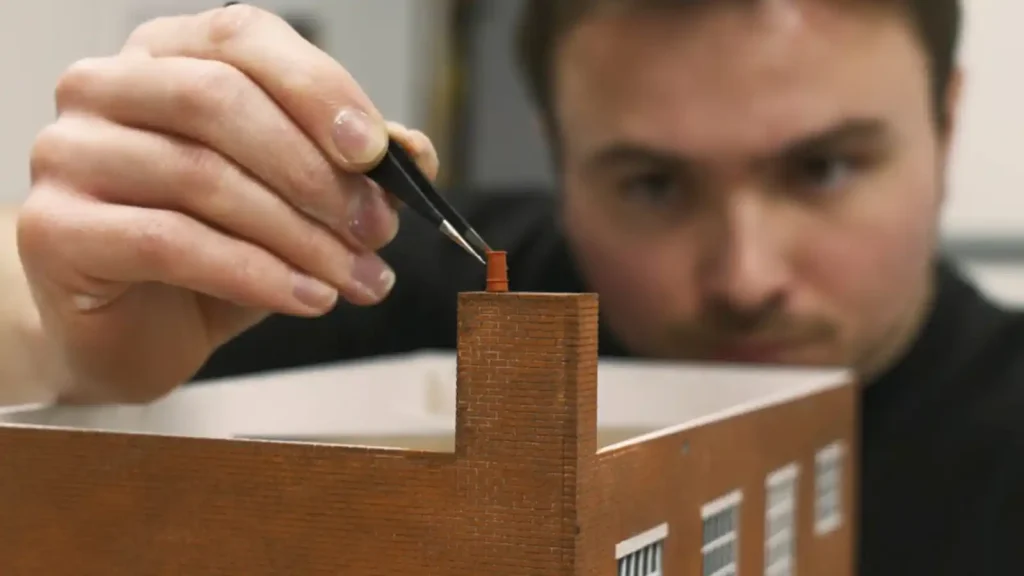
The Marvellous Miniature Workshop Episode 4 brings viewers into Reading’s Central Club, a derelict building whose crumbling walls once echoed with jazz music, dominoes clattering against tables, and the vibrant energy of the Caribbean community. Sara Cox introduces Julia, whose father became a legendary figure within this cultural landmark, and whose memories of the venue remain vivid despite decades of abandonment. The episode centers on whether Ethan Goodbody, a specialist in detailed miniatures, can transform Julia’s powerful recollections into a scaled replica that captures not merely the physical structure but the soul of a gathering place that defined an entire community’s identity.
This 2025 TV show arrives at a moment when British daytime TV increasingly explores emotional storytelling rooted in human interest series rather than superficial entertainment. The craft competition format has evolved beyond simple demonstrations of artisan skills toward documentary series that examine how physical spaces shape collective memory and cultural heritage. Julia’s request represents more than nostalgia—it becomes an investigation into how miniature craft can preserve histories that official archives overlook, particularly those of immigrant communities whose contributions remain underrepresented in mainstream British culture.
The Marvellous Miniature Workshop Episode 4 tackles multiple layers simultaneously: the technical challenge of recreating architectural details at 1:24 scale, the emotional weight of representing a father’s legacy, and the broader question of how craftspeople working with handmade miniatures can honor places that existed primarily through lived experience rather than comprehensive photographic documentation. Julia provides fragments—descriptions of murals, stage configurations, the arrangement of domino tables—but these memory-based specifications must somehow coalesce into a coherent physical object that satisfies both her emotional needs and the exacting standards expected in collectible models.
Reading’s Central Club emerged during the post-war period when Caribbean immigrants sought spaces where their culture could flourish without dilution or judgment. The building functioned as more than a social venue; it became a sanctuary where first-generation immigrants maintained connections to their heritage while navigating a society that frequently marginalized their contributions. Julia’s father achieved prominence within this community not through wealth or formal recognition but through his presence, his voice, and his commitment to creating joy within those walls. His status as a local legend rested on relationships forged over domino games and late-night conversations rather than conventional markers of success.
The abandonment of the Central Club reflects broader patterns of urban decay and demographic shifts that transformed Reading’s landscape. Buildings that once served as cultural anchors fall into disrepair when the communities they supported disperse or when economic pressures make preservation financially impossible. What remains are physical shells whose significance becomes invisible to those who never experienced their vibrant past. Julia’s decision to commission a miniature represents an act of historical preservation that operates outside traditional museum frameworks, creating a tangible artifact that can communicate the building’s importance to those who never walked through its doors.
Sara Cox’s role extends beyond simple presentation; she facilitates the translation of Julia’s memories into specifications that Ethan can execute. This process requires careful listening, sensitive questioning, and the ability to identify which details matter most for emotional authenticity versus structural accuracy. The heartwarming TV format could easily trivialize this exchange, reducing it to sentimental tearfulness, but instead the episode treats Julia’s recollections as primary source material deserving rigorous attention. Every description of color, texture, or spatial arrangement becomes a data point that must inform Ethan’s creative workshops.
Ethan Goodbody enters the episode carrying the weight of previous challenges and the knowledge that his handmade miniatures will be judged not merely on technical proficiency but on their capacity to evoke specific emotional responses. The abandoned Central Club presents unique difficulties: unlike intact buildings where measurements can be verified, or well-documented structures where photographs provide reference points, this project depends almost entirely on one person’s subjective memories filtered through decades of life experience. The risk of misinterpretation or inadvertent erasure looms over every decision about proportion, material, or decorative detail.
The episode’s structure follows Julia as she articulates what made the Central Club irreplaceable, shifting between specific architectural features and intangible qualities like atmosphere and community feeling. She describes the stage where musicians performed, the mural that dominated one wall with its bold imagery celebrating Caribbean identity, and the tables where domino tournaments unfolded with fierce competitive spirit. These elements must exist in relationship to each other within the miniature, creating spatial logic that reflects how people actually moved through and inhabited the building. Ethan faces the challenge of translating cherished memories into fine detail that registers at 1:24 scale without becoming overwrought or cluttered.
The Marvellous Miniature Workshop Episode 4
Reconstructing Architecture from Memory and Emotion
The process of creating dioramas based on personal recollection rather than blueprints introduces complications absent from more straightforward architectural modeling. Julia cannot provide exact measurements for the stage’s dimensions or the precise RGB values of the mural’s colors, yet Ethan must make concrete decisions about these variables. He approaches this challenge by identifying emotional priorities—which elements mattered most to Julia’s experience of the space—and ensuring those features receive maximum attention and resources. The domino tables, for instance, carry symbolic weight that transcends their utilitarian function; they represent gathering points where relationships formed and community cohesion strengthened.
Ethan’s craftsmanship demands he balance faithfulness to Julia’s descriptions against practical constraints of miniature construction. Materials behave differently at reduced scale; techniques that work for full-sized objects may prove impossible or unconvincing when replicated at 1:24 proportion. Wood grain becomes disproportionately prominent, paint requires different viscosity to avoid pooling, and lighting effects that seem subtle in full-scale environments can overwhelm miniature interiors. These technical considerations force constant negotiation between ideal representation and achievable execution.
The mural presents particular difficulty because Julia remembers its emotional impact more clearly than its specific imagery. She recalls colors that conveyed vibrancy and pride, figures that celebrated Caribbean culture, and an overall impression of boldness that contrasted with the muted aesthetics often imposed on immigrant communities. Ethan must somehow distill these qualities into a painted surface measuring mere centimeters while maintaining legibility and visual impact. The temptation to simplify or standardize must be resisted because the mural’s distinctiveness contributed fundamentally to the Central Club’s identity.
Research into the building’s physical state reveals extensive deterioration that complicates any attempt to extract surviving details. Walls have crumbled, exposing interior structures to weather damage. Paint has peeled away in sheets, leaving only ghostly traces of original colors. The stage area, once robust enough to support musicians and their equipment, now threatens to collapse under minimal weight. This decay means Ethan cannot visit the site to verify Julia’s memories or discover forgotten details that might enrich the miniature. He works instead from photographs Julia has preserved, from her verbal descriptions, and from his own interpretative instincts about how such spaces typically functioned.
The Cultural Significance of Caribbean Social Clubs in Post-War Britain
Understanding the Central Club requires examining the broader context of Caribbean immigration to Britain during the mid-twentieth century. Immigrants arriving from Jamaica, Trinidad, Barbados, and other islands encountered a society that simultaneously needed their labor and resented their presence. Housing discrimination forced many into overcrowded accommodations, while workplace prejudice limited employment opportunities despite chronic labor shortages. Social clubs emerged as essential infrastructure where Caribbean communities could maintain cultural practices, celebrate traditions, and support each other against external hostility.
These venues operated according to informal economies and social contracts distinct from mainstream British institutions. Leadership derived from community respect rather than formal election or appointment. Entertainment prioritized participation over passive consumption, with audiences expected to interact vocally with performers and contribute to the collective energy. Food, music, and social rituals all reinforced connections to Caribbean culture while acknowledging the reality of permanent settlement in Britain. The clubs became hybrid spaces where tradition and adaptation coexisted, allowing immigrants to honor their origins while building new identities.
Julia’s father’s prominence within this environment reveals how status functioned differently in immigrant communities compared to majority society. His legendary reputation rested not on wealth accumulation or professional achievement but on qualities like generosity, charisma, musical talent, and consistent presence. He became a fixture at the Central Club, someone whose attendance guaranteed a certain quality of experience and whose participation in domino games or musical performances elevated ordinary evenings into memorable occasions. This form of social capital, invisible to outsiders, structured community life and created hierarchies based on contribution rather than extraction.
The dominoes tournaments mentioned repeatedly throughout the episode carried particular cultural significance. Dominoes functioned as more than casual entertainment; the game facilitated intergenerational connection, provided structure for male bonding, and created opportunities for competitive display within safe boundaries. The sound of dominoes striking table surfaces became an auditory signature of Caribbean social spaces, recognizable and comforting to participants. Tournament formats introduced formality and stakes that transformed simple games into events worthy of spectator attention and emotional investment.
Music at the Central Club encompassed multiple genres, with jazz receiving special emphasis in Julia’s recollections. Her father’s involvement in musical performances suggests he possessed skills that contributed to the venue’s cultural programming. Jazz, with its improvisational nature and African diasporic roots, resonated with Caribbean audiences while also providing common ground with broader British musical culture. Performances at the Central Club likely blended standards with Caribbean rhythms, creating hybrid forms that reflected the community’s dual existence between two cultural worlds.
Technical Challenges in Miniature Recreation at 1:24 Scale
Working at 1:24 scale imposes specific constraints that affect every aspect of Ethan’s process. At this proportion, one foot in reality equals half an inch in the model, requiring extreme precision in measurement and construction. Details that seem insignificant at full scale become critical at miniature size because imperfections multiply their visual impact. A door that hangs slightly crooked becomes glaringly obvious; a paint application that appears smooth to the naked eye may show brush strokes under magnification; structural joints must achieve perfect alignment or the entire assembly appears amateur.
Ethan’s expertise with detailed miniatures means he understands these challenges intellectually, but each project introduces unique complications. The Central Club’s interior architecture, with its performance stage, multiple seating areas, and decorative elements, requires careful spatial planning to ensure all components fit logically within the available volume. Furniture must be sized appropriately relative to walls and ceilings, circulation space must remain adequate even when occupied by miniature figures, and sightlines must replicate the actual viewing experiences Julia remembers. These calculations demand both mathematical precision and intuitive spatial reasoning.
Material selection becomes crucial when creating hobbyist craft at this scale. Wood suitable for full-sized furniture may split when cut to miniature dimensions, requiring substitution with more stable alternatives like basswood or medium-density fiberboard. Fabrics intended for miniature upholstery must avoid weaves so coarse they appear absurd at reduced scale. Paint must be thin enough to avoid obscuring fine detail yet pigmented sufficiently to provide color saturation. Adhesives must bond quickly and cleanly without leaving visible residue or causing warping. Each material choice cascades into subsequent decisions about finishing techniques and final appearance.
Lighting design for miniature interiors presents particular difficulty because miniature light sources cannot replicate the output characteristics of full-scale fixtures. LED technology has revolutionized this aspect of miniature craft by providing small, bright, low-heat options, but challenges remain. Light diffusion behaves differently in miniature spaces, with reflections and shadows often appearing exaggerated compared to real environments. Ethan must carefully position light sources to suggest the Central Club’s atmosphere—the warm glow of stage lights, the ambient illumination from ceiling fixtures, perhaps the colored wash from decorative elements—without creating effects that feel theatrical or unconvincing.
The mural’s recreation demands expertise in miniature painting that extends beyond basic skill with brushes. Working at 1:24 scale means details that would span inches in reality must be rendered in millimeters. Human figures, architectural elements, and decorative patterns all require steady hands, excellent vision, and deep familiarity with how paint behaves when applied in tiny quantities. Ethan likely employs specialized tools like magnification systems, ultra-fine brushes, and thinned paints that allow precise control. The challenge intensifies when attempting to capture the mural’s emotional qualities—its boldness, its celebration of Caribbean pride—rather than merely copying a hypothetical design.
Human Stories Behind Competitive Craft Shows
The Marvellous Miniature Workshop distinguishes itself from typical craft shows by foregrounding the human interest series elements rather than treating craftsmanship as pure spectacle. Julia’s story provides context that transforms Ethan’s work from technical demonstration into an act of cultural preservation with personal stakes. The emotional storytelling woven throughout the episode ensures viewers understand why accuracy matters, why certain details carry disproportionate importance, and why the final miniature’s success cannot be measured solely through aesthetic criteria.
This emphasis on human stories reflects broader trends in 2025 TV shows that prioritize authentic emotion over manufactured drama. Earlier craft competitions often relied on artificial time pressure and interpersonal conflict to generate tension, but contemporary formats recognize that genuine emotional investment provides more compelling content. Julia’s relationship with her father, her connection to the Central Club, and her desire to preserve these memories create narrative momentum that artificial stressors could not match. Viewers become invested in whether Ethan can successfully honor her request rather than simply appreciating his technical proficiency.
The documentary series format allows extended exploration of how miniatures function as memory objects. Unlike photographs, which freeze single moments, or video recordings, which capture specific performances, miniatures attempt to distill an entire place’s essence into three-dimensional form. They invite physical engagement—viewers can change perspective, examine different areas, imagine movement through space—in ways that two-dimensional media cannot replicate. For Julia, the finished miniature will provide a tangible anchor for memories that otherwise exist only in her mind, creating an external reference point that can be shared with others who never experienced the Central Club.
Ethan’s role requires him to function simultaneously as artist, historian, and empathetic listener. He must extract actionable information from Julia’s memories while respecting their subjective nature and emotional significance. Questions must be specific enough to generate useful data without feeling like interrogation, and his responses to her descriptions must validate her experiences while clarifying details necessary for construction. This interpersonal dimension of artisan skills often receives less attention than technical abilities, yet proves equally essential for projects like this where client satisfaction depends on emotional resonance rather than objective accuracy.
The Stage as Central Performance Space
Julia’s descriptions emphasize the stage’s importance as the Central Club’s focal point and primary performance area. This elevated platform hosted jazz performances, spoken word presentations, and community announcements that structured social gatherings and provided entertainment. The stage’s physical characteristics—its height, depth, and relationship to the surrounding floor—affected how performers interacted with audiences and how crowds formed around musical acts. Recreating these spatial relationships in miniature requires Ethan to understand performance dynamics and translate them into scaled proportions that maintain functional logic.
Performance spaces in Caribbean social clubs typically featured minimal technical infrastructure compared to professional venues, relying instead on acoustic properties and audience proximity to create intimacy. The Central Club’s stage likely included basic lighting and perhaps rudimentary sound amplification, but its effectiveness derived primarily from the performers’ talent and the audience’s active participation. Julia remembers not passive spectatorship but engaged response—verbal encouragement, rhythmic participation, physical movement—that blurred boundaries between performer and observer. Capturing this quality in a static miniature presents conceptual challenges because the object cannot replicate the dynamic energy that defined actual events.
Ethan must decide whether to populate the miniature stage with figures representing musicians mid-performance or leave it empty, suggesting potential rather than frozen action. Each approach carries interpretative implications. Populated scenes provide immediate context and visual interest but risk appearing mannequin-like or failing to capture the performers’ actual energy. Empty stages invite viewers to imagine activity while potentially feeling incomplete or antiseptic. The decision ultimately depends on Julia’s preferences and her memories of whether the stage felt most vital during performances or whether its presence alone, even when empty, signified possibility and community gathering.
The stage’s construction materials and finish must suggest decades of use without appearing decrepit or neglected. Julia remembers the Central Club during its operational period, when wear patterns reflected active use rather than abandonment. Scuff marks on wooden surfaces, slight unevenness from years of foot traffic, perhaps minor repairs visible upon close inspection—these details communicate history and authenticity more effectively than pristine surfaces that suggest recent construction. Ethan’s fine detail work must therefore include intentional aging techniques that replicate realistic wear without crossing into decay.
Domino Tables as Social Infrastructure
The domino tables scattered throughout the Central Club functioned as more than furniture; they constituted social infrastructure that organized community interaction and facilitated relationship building across generational lines. Julia’s memories emphasize these tables’ centrality to the venue’s daily life, suggesting they remained occupied throughout operating hours with rotating participants engaged in games ranging from casual to intensely competitive. The tables’ placement within the larger room influenced traffic flow, created semi-private zones within public space, and established territorial divisions that regular attendees understood intuitively.
Recreating these tables in miniature requires attention to details that might seem insignificant but carry cultural specificity. Table height, surface material, and surrounding chair arrangements all affected gameplay comfort and social dynamics. Worn surfaces showing the impact patterns where dominoes repeatedly struck wood tell stories about usage intensity and favored playing positions. The dominoes themselves, whether stored in boxes on the tables or in nearby cupboards, represent material culture that connects to broader Caribbean traditions around game equipment and communal property.
Ethan faces decisions about whether to depict games in progress, with miniature dominoes arranged in partial patterns suggesting ongoing play, or tables cleared and ready for the next participants. Active games provide visual interest and narrative implication but require extreme precision to appear convincing at 1:24 scale. Individual dominoes measuring fractions of an inch must display accurate pip configurations while maintaining proportional thickness and surface finish. The alternative—empty tables—feels less dynamic but avoids technical challenges that might compromise overall quality.
The social dynamics surrounding domino play included spectators who gathered to watch particularly skilled players or significant tournament matches. These observers contributed to the atmosphere through commentary, encouragement, and occasional heckling that intensified competitive tension while maintaining communal good humor. Representing this human density in miniature form without creating cluttered, confusing scenes requires careful composition and strategic figure placement. Too few figures suggest emptiness that contradicts Julia’s memories; too many creates visual chaos that prevents individual elements from registering clearly.
Murals as Cultural Declaration and Visual Identity
The mural dominating one wall of the Central Club represented a bold declaration of Caribbean pride in an environment where such explicit cultural assertion often met hostility or incomprehension. Julia’s descriptions emphasize its colors, its celebration of Caribbean identity, and its role in making the space feel distinctly theirs rather than merely borrowed or tolerated. The mural functioned as visual shorthand communicating the venue’s values and cultural orientation to anyone entering the building. Its presence transformed generic architectural space into a culturally specific environment that announced its allegiances immediately and unapologetically.
Recreating this mural in miniature presents Ethan’s greatest artistic challenge because Julia cannot provide photographic references or detailed descriptions of specific imagery. She remembers impression and emotion more than precise composition—the vibrancy that made the wall feel alive, the figures that celebrated rather than apologized, the overall effect of claiming space through visual declaration. Ethan must therefore engage in informed interpretation, researching common motifs in Caribbean community art from the relevant period while allowing Julia’s emotional descriptions to guide aesthetic decisions.
Color selection becomes critical because Julia’s memories emphasize the mural’s bold palette and its contrast with the building’s otherwise modest decoration. Caribbean cultural aesthetics often embrace color saturation and pattern complexity that challenge British preferences for restraint and neutrality. The mural likely incorporated tropical hues—vibrant greens, warm oranges, deep blues—alongside symbolic imagery connecting to island landscapes, African heritage, or significant historical figures. These colors must translate effectively to miniature scale, where slight shifts in value or saturation can dramatically alter perceived mood and cultural authenticity.
The mural’s scale relative to the Central Club’s interior dimensions meant it dominated visual experience upon entering the building. This proportion must be maintained in the miniature to preserve the mural’s impact and properly communicate its importance within the space’s overall design. Ethan cannot relegate it to background detail or allow other elements to compete for visual priority. The mural functioned as the Central Club’s signature feature, the element that visitors remembered and that photographs inevitably captured. Its miniature recreation must therefore achieve similar prominence within the scaled environment.
Emotional Authenticity Versus Technical Perfection
Throughout The Marvellous Miniature Workshop Episode 4, tension emerges between Julia’s desire for emotional authenticity and the requirements of technical perfection expected in collectible models. These priorities do not necessarily conflict, but they emphasize different aspects of the miniature’s function and success criteria. Julia seeks an object that captures how the Central Club felt—its energy, its cultural specificity, its role in her father’s life—more than one that precisely replicates architectural details she cannot verify. Ethan must navigate between these objectives while maintaining standards of craftsmanship that satisfy both professional and personal expectations.
Emotional authenticity demands prioritizing elements that mattered most to Julia’s experience even when those features might not represent the most visually impressive or technically challenging aspects of the build. The specific arrangement of domino tables, for instance, might carry more emotional weight than the ceiling’s decorative molding despite requiring less artisan skills to execute. Recognizing and honoring these subjective priorities demonstrates Ethan’s understanding that his role extends beyond technical execution into emotional service and historical preservation.
Technical perfection, conversely, ensures the miniature functions as a durable, displayable object that can survive handling and endure as a family heirloom. Structural integrity, material stability, and finish quality all contribute to longevity that Julia may not initially consider but will appreciate over decades. Ethan’s commitment to detailed miniatures reflects professional standards that protect his reputation while also serving Julia’s long-term interests. The tension arises when technical considerations threaten to overwhelm emotional priorities, when craft show expectations impose standardization that erases cultural specificity.
The resolution involves recognizing that emotional authenticity and technical perfection share common ground in the concept of intentionality. Every decision about material, color, proportion, and detail should serve the larger goal of creating an object that honors Julia’s memories and her father’s legacy while demonstrating respect through excellent execution. Sloppiness would insult the Central Club’s significance; excessive technical showmanship would distract from the human stories the miniature exists to preserve. Balance emerges from continuous dialogue between maker and client, ensuring alignment between vision and execution.
Legacy and Memory in Physical Form
The finished miniature will exist as Julia’s primary tool for transmitting her father’s legacy and the Central Club’s significance to people who never experienced either firsthand. This educational function extends beyond mere preservation into active communication, as the physical object provides conversational anchor points and visual references that abstract descriptions cannot match. Julia can point to specific features while explaining their importance, invite observers to notice details that carried particular meaning, and create shared experiences around examining the miniature that partially replicate the communal nature of the original venue.
Physical objects carry authority that digital representations struggle to match. The miniature’s three-dimensionality, its material presence, and its status as unique handmade object all contribute to perceived authenticity and value. Future family members encountering this miniature will understand, in tactile and visual terms, that the Central Club mattered enough to warrant this investment of resources and expert attention. The object becomes evidence of significance that transcends verbal claims, creating tangible proof of heritage and history that descendants can literally hold.
The miniature also functions as counterweight to the Central Club’s physical decay and likely eventual demolition. Buildings abandoned and deteriorating rarely recover; more commonly, they collapse, burn, or get demolished to clear land for development. When that happens, the miniature becomes the most complete surviving representation of the structure and the community life it hosted. This preservation function operates outside official heritage frameworks that typically ignore immigrant community spaces in favor of architecturally distinguished buildings or sites connected to dominant cultural narratives. Julia and Ethan’s collaboration represents grassroots historical preservation that values cultural significance over architectural merit.
Memory’s unreliability means the miniature captures Julia’s understanding of the Central Club filtered through time, emotion, and personal significance rather than objective historical truth. This subjective quality does not diminish the miniature’s value; instead, it acknowledges that heritage preservation always involves selection, interpretation, and perspective. Julia’s memories matter precisely because they’re hers, because they connect to her father’s life and her own formation, and because they represent experiences that official histories overlooked. The miniature honors this personal truth while creating space for others to project their own memories and connections onto the object.
Conclusion and Broader Implications
The Marvellous Miniature Workshop Episode 4 demonstrates how craftspeople working with handmade miniatures can participate in cultural preservation projects that exist outside traditional museum or archival frameworks. Ethan Goodbody’s task of recreating Reading’s Central Club in 1:24 scale represents more than technical exercise or sentimental commission. The project acknowledges that immigrant communities’ gathering places carry historical significance deserving preservation even when mainstream institutions ignore or undervalue these spaces. The miniature becomes both memorial and evidence, documenting a vanished environment while asserting its continued relevance.
Julia’s collaboration with Ethan illustrates the complex negotiations required when memory provides the primary source material for recreation. Her descriptions balance specificity about meaningful details against uncertainty about technical particulars, forcing creative problem-solving that honors emotional truth while meeting craft standards. This partnership between memory holder and skilled maker creates objects that merge subjective experience with objective fabrication, producing artifacts that function simultaneously as personal treasures and historical documents.
The episode’s emphasis on the Central Club’s role in Caribbean community life highlights how social clubs functioned as essential infrastructure during periods when mainstream society excluded or marginalized immigrant populations. These venues provided not merely entertainment but affirmation, not just gathering space but cultural sanctuary. Understanding their significance requires recognizing how racism and discrimination forced communities to create parallel institutions serving needs that dominant society refused to acknowledge or meet. The Central Club’s abandonment reflects broader patterns of displacement and cultural erasure that continue affecting minority communities throughout Britain.
Ethan’s expertise with dioramas and detailed miniatures enables him to translate Julia’s fragmented memories into coherent physical form that communicates across generational and cultural boundaries. The finished miniature will serve audiences ranging from Julia’s immediate family to potentially museum visitors or researchers studying Caribbean immigration history. Its multiple functions—memorial object, educational tool, family heirloom, historical document—demonstrate how craftspeople contribute to knowledge production and cultural transmission beyond conventional academic or institutional frameworks.
The emotional storytelling embedded throughout the episode prevents the miniature’s creation from becoming mere spectacle or technical demonstration. Viewers understand the stakes involved—Julia’s desire to honor her father, to preserve his legacy, to create tangible connection between past and present. This human context transforms craft competition into documentary series that explores how objects carry meaning, how skilled making preserves memory, and how artisan skills serve communities in ways that extend far beyond aesthetic appreciation or commercial value.
FAQ The Marvellous Miniature Workshop Episode 4
Q: What is The Marvellous Miniature Workshop about?
A: The Marvellous Miniature Workshop is a British craft show where presenter Sara Cox meets individuals with cherished memories of significant places. Expert miniaturists then recreate these meaningful locations as detailed scale models, preserving personal histories through handmade miniatures. Each episode combines emotional storytelling with artisan skills, transforming memories into tangible collectible models that honor human stories.
Q: Who is Julia and what was her connection to Reading’s Central Club?
A: Julia is a jazz singer whose father became a local legend at Reading’s Central Club, a Caribbean community hub. She possesses powerful memories of this venue where domino tournaments, live music, and cultural celebrations occurred regularly. The building holds profound significance because it represents her father’s legacy and a vanished community space where Caribbean pride flourished. Consequently, she commissioned a miniature to preserve these irreplaceable memories.
Q: What makes Ethan Goodbody’s miniature work particularly challenging in this episode?
A: Ethan faces the challenge of recreating an abandoned building using primarily memory-based descriptions rather than architectural plans or comprehensive photographs. The Central Club has deteriorated significantly, preventing accurate measurements or detail verification. Furthermore, he must capture intangible qualities like atmosphere and cultural significance alongside physical structures. Working at 1:24 scale requires exceptional fine detail execution while maintaining emotional authenticity throughout the project.
A: Caribbean social clubs provided essential cultural sanctuary for post-war immigrants facing housing discrimination and workplace prejudice in Britain. These venues allowed communities to maintain traditions, celebrate heritage, and support each other against external hostility. Additionally, they functioned as spaces where leadership derived from community respect rather than formal appointment. The Central Club specifically fostered Caribbean pride through music, dominoes, and social gatherings that reinforced cultural identity.
Q: What technical considerations affect miniature creation at 1:24 scale?
A: At 1:24 scale, one foot equals half an inch, demanding extreme precision in measurement and construction. Materials behave differently at reduced dimensions; wood may split, paint can pool excessively, and lighting effects become exaggerated. Moreover, imperfections multiply their visual impact significantly. Ethan must select specialized materials like basswood, employ ultra-fine brushes, and utilize magnification systems to achieve convincing detail while maintaining structural integrity.
Q: What role did the iconic mural play at the Central Club?
A: The mural functioned as a bold visual declaration of Caribbean pride, transforming generic space into culturally specific environment. Its vibrant colors and celebratory imagery announced the venue’s values immediately upon entry. Recreating this feature presents Ethan’s greatest artistic challenge because Julia remembers emotional impact more than specific imagery. Therefore, he must engage in informed interpretation while researching period-appropriate Caribbean community art motifs.
Q: How did domino tournaments contribute to the Central Club’s community culture?
A: Domino tournaments facilitated intergenerational connection and male bonding within safe competitive boundaries. The distinctive sound of dominoes striking tables became an auditory signature of Caribbean social spaces. These games ranged from casual to intensely competitive, with spectators contributing commentary that intensified matches while maintaining communal good humor. Consequently, domino tables functioned as social infrastructure organizing community interaction throughout the venue’s operational hours.
Q: What distinguishes The Marvellous Miniature Workshop from typical craft competitions?
A: Unlike conventional craft shows emphasizing manufactured drama or artificial time pressure, this documentary series prioritizes authentic emotional investment and human interest storytelling. The program explores how miniatures function as memory objects and cultural preservation tools rather than mere technical demonstrations. Furthermore, it acknowledges that craftspeople participate in historical documentation outside traditional museum frameworks. This approach reflects broader trends in 2025 TV shows favoring genuine emotion over contrived conflict.
Q: How does the miniature serve as a legacy preservation tool for Julia’s family?
A: The finished miniature provides tangible evidence of the Central Club’s significance that future generations can physically examine. Its three-dimensional presence carries authority that digital representations cannot match, becoming conversational anchor points for explaining heritage. Additionally, when the deteriorating building inevitably faces demolition, this handmade replica will represent the most complete surviving documentation. The object therefore functions simultaneously as family heirloom, educational tool, and historical document.
Q: What balance must Ethan achieve between emotional authenticity and technical perfection?
A: Ethan must prioritize elements carrying greatest emotional weight for Julia while maintaining craftsmanship standards ensuring durability and displayability. Emotional authenticity demands honoring subjective memories even when they conflict with typical aesthetic priorities. However, technical perfection protects the miniature’s longevity as a generational heirloom. The resolution involves intentional decision-making where every material choice, color selection, and detail serves both memory preservation and excellent execution without overwhelming either objective.