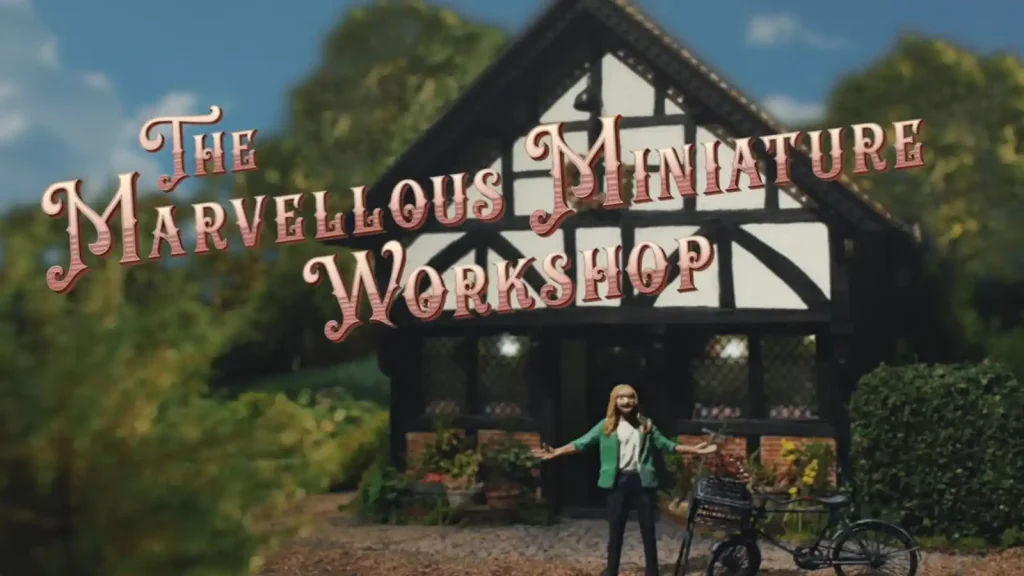
The Marvellous Miniature Workshop Episode 6 opens with a question that many people quietly carry through their lives: what would it mean to hold a lost place in your hands? For Sue and Kathie, two lifelong friends who trained together as nurses at Winford Hospital in Somerset during the 1960s, that question became reality when miniaturist Hannah Lemon set about recreating the building where their bond was forged. The result was more than a collectible model. It was a physical act of remembrance, a handmade miniature that compressed decades of shared experience into a scale of 1:24.
The episode arrives at a cultural moment when audiences are increasingly drawn to craft shows that root artisan skills in genuine human feeling. The Marvellous Miniature Workshop has distinguished itself within British daytime TV precisely because its commissions are never purely decorative. Each miniature carries the emotional weight of the person who requested it, and Episode 6 exemplifies that quality more completely than perhaps any preceding instalment. Winford Hospital no longer exists in its original form, which makes the recreation doubly significant. For Sue and Kathie, the building is not merely a backdrop to memory but the very architecture of their friendship.
Sara Cox hosts the series with warmth that never tips into sentimentality, drawing out the personal histories of contributors without overwhelming the craft itself. In this episode, her conversations with Sue and Kathie reveal a story that spans more than half a century. The two women met on their first day of nurse training, formed an immediate connection, and have sustained that friendship across marriages, moves, and the passage of time. Winford Hospital gave them both a vocation and each other, which is why the commission carries such specific gravity.
Hannah Lemon, the episode’s featured miniaturist, faces the challenge of translating these layered associations into physical form. Working at a scale where a standard door stands barely an inch tall, she must render not only the architecture of the hospital but also the lived texture of the spaces within it: a ward where patients were cared for, a sitting room where nurses gathered after exhausting shifts. These detailed miniatures are not replicas in a purely technical sense. They are emotional arguments made in wood, fabric, and paint.
The wider context of the NHS adds another dimension to the commission. Sue and Kathie trained during a formative period for British healthcare, when the NHS was still establishing its rhythms and nursing was a vocation defined by strict discipline alongside genuine camaraderie. Their recollections carry the imprint of that era. The sitting room, the ward, the particular quality of light in an old Somerset building — all of these details arrive in the episode freighted with historical resonance as well as personal meaning. Hannah Lemon’s task, therefore, is not only one of craft competition between skill and scale but of historical documentary series work conducted entirely in miniature.
Ethan Goodbody and Abi Trotman, the other miniaturists featured across the series, represent the broader community of makers whose work Hannah’s episode sits alongside. Their presence throughout the 2025 TV shows series reminds viewers that the world of handmade miniatures is populated by practitioners with distinct aesthetics and methods. Hannah’s particular approach, characterised by meticulous attention to period detail and a sensitivity to the emotional brief, makes her a natural fit for a commission as layered as this one. The episode tracks her process from initial research through to the final reveal, and that journey rewards close attention.
Dioramas have a long history as instruments of memory and commemoration, from military displays to natural history museum reconstructions. What distinguishes the work in The Marvellous Miniature Workshop from those traditions is the explicitly personal register of the commissions. The miniatures here are not made for institutions or exhibitions. They are made for individuals who need an object that can hold what photographs and words cannot. In Episode 6, that need is particularly acute, because what Sue and Kathie are asking for is nothing less than a reconstruction of who they were before the decades accumulated.
The transition from introduction to the structured account of Hannah’s process marks a shift in the episode itself. Sara Cox’s opening conversations with Sue and Kathie give way to the workshop, and the camera settles into the measured rhythms of craft. It is in this shift that the episode reveals its deeper argument: that the most sophisticated form of emotional storytelling is sometimes one conducted not in language but in the patient, precise manipulation of very small things.
The Marvellous Miniature Workshop Episode 6
The Commission Behind The Marvellous Miniature Workshop Episode 6
Sue and Kathie arrive at the commission with a clarity of purpose that immediately distinguishes them from clients who want a miniature simply as a curiosity. They want Winford Hospital because the building represents the origin point of their friendship. Their nurse training in the 1960s was the shared experience that made everything else possible, and Winford was the institution that structured that experience. The hospital is gone in its original form, which means no amount of returning to the physical location can recover what they are seeking. Only a handmade miniature can do that.
Their conversations with Sara Cox are specific and unhurried. They describe the ward where they worked, its layout, its particular furniture, the way the beds were arranged. They recall the sitting room where nurses gathered off-duty, the texture of its domestic informality within an otherwise austere institutional setting. These are not vague nostalgic impressions. They are precise architectural and social memories, and they constitute the brief that Hannah Lemon will work from.
The friendship between the two women adds further emotional dimension to the commission. More than fifty years have passed since they trained together, yet their connection remains immediate. They finish each other’s sentences, correct each other’s recollections gently, and share a quality of mutual recognition that is immediately apparent. The miniature they are commissioning is, in one sense, a tribute to the NHS and to nursing. In another sense, it is a monument to a friendship that outlasted the institution that created it.
Hannah Lemon’s Research and the Challenge of Period Accuracy
Before Hannah Lemon lifts a tool or cuts a single piece of material, she must understand what Winford Hospital actually looked like in the 1960s. This research phase is one of the most demanding aspects of the commission, because the building no longer exists in the form Sue and Kathie remember. Hannah works from photographs, from the two women’s descriptions, and from her own understanding of mid-century NHS hospital design. The goal is not photographic replication but emotional accuracy — the miniature must feel true to Sue and Kathie’s experience of the place.
The sitting room presents particular challenges. It was an informal space within a formal institution, which means it had accumulated the domestic objects and arrangements that institutions accumulate over time: particular chairs, small personal items, a specific quality of domestic comfort against an institutional backdrop. Recreating this at 1:24 scale demands that Hannah make decisions about which details carry the most emotional weight. She cannot include everything. She must choose.
The ward presents a different set of challenges. Here the emotional register is more austere. This is where the actual work of nursing took place, where Sue and Kathie and their colleagues cared for patients during long and demanding shifts. The furniture is more uniform, the spatial arrangement more deliberate. Hannah’s task is to render the specific quality of purposeful order that characterised NHS ward design in that period, while leaving enough humanity in the details to make the miniature recognisable to the women who worked there.
Building the Ward: Artisan Skills at 1:24 Scale
The ward is the centrepiece of the commission in terms of craft complexity. Hannah begins with the architectural frame, establishing the room’s proportions and then working inward. At 1:24 scale, standard furniture dimensions become extraordinarily small. A hospital bed that would stand roughly two feet high in reality becomes approximately one inch high in the miniature. Every joint, every surface, every piece of period-appropriate equipment must be fabricated at that scale.
Hannah’s artisan skills are displayed most clearly in the handling of texture and finish. The floors of NHS wards in the 1960s had a specific look — hard-wearing, institutional, easily cleaned. She renders this in the miniature through careful painting and surface treatment. The walls carry the muted colour palette of the period. The beds are dressed with bedding that has been cut and shaped from actual fabric, hemmed and folded at a scale that tests the limits of manual dexterity.
The period details extend to the medical equipment visible in the ward. This is where the research phase pays dividends. Hannah incorporates elements that are recognisably of the era without tipping into caricature or pastiche. The result is a detailed miniature that reads as documentary rather than decorative — an important distinction given the emotional purpose of the commission. Fine detail is not applied for its own sake here. Each element earns its place by contributing to the overall sense of time and place that Sue and Kathie have described.
Reconstructing the Sitting Room in The Marvellous Miniature Workshop
If the ward represents discipline and purpose, the sitting room represents the human dimension of nursing life. This is where Sue and Kathie and their colleagues recovered from difficult shifts, where friendships deepened, where the informal social world of the hospital took shape. Hannah approaches this space differently, allowing for a greater degree of individual character in the furnishings and arrangement.
The chairs in the sitting room are particularly important. Hannah fabricates them at 1:24 scale using period-appropriate shapes, and the upholstery — where present — is handled with the same care as the bedding in the ward. Small objects on surfaces add to the sense of inhabited space. The room must look used and lived-in rather than dressed for display, which is a subtler challenge than it might appear. Dioramas that feel too curated lose the quality of authenticity that makes them emotionally resonant.
Hannah also considers the relationship between the two rooms. The ward and the sitting room, taken together, tell a more complete story than either would alone. The contrast between the formal purposefulness of the ward and the informal warmth of the sitting room captures something essential about the experience Sue and Kathie have described. Hannah’s decision to recreate both spaces rather than just one reflects an understanding of the commission that goes beyond technical execution into genuine emotional storytelling.
The Role of Sara Cox and The Marvellous Miniature Workshop Format
Sara Cox’s contribution to Episode 6 is more significant than a conventional presenter role might suggest. Her conversations with Sue and Kathie are the foundation on which Hannah’s work rests, because they extract the specific details and emotional textures that give the commission its particular character. Cox’s approach is conversational and attentive. She does not rush the two women through their recollections or summarise their experiences in ways that would flatten them.
The format of The Marvellous Miniature Workshop gives these conversations space to develop. Unlike craft competition formats that subordinate personal history to dramatic structure, this series treats the human stories behind the commissions as primary. The miniature is always the destination, but the journey matters. In Episode 6, that journey includes extended sections in which Sue and Kathie discuss the specific rhythms of nursing life in the 1960s — the hierarchy of the ward, the relationships between nurses and patients, the particular pleasures and demands of the vocation.
This approach places the series firmly within a tradition of British daytime TV that values depth of feeling over spectacle. The Marvellous Miniature Workshop does not rely on manufactured tension or competitive elimination. Its emotional power comes from the genuine investment of its contributors and makers. Episode 6 represents the series at its most effective, because the connection between the two women and the place they are commemorating is so clearly and specifically articulated.
Cherished Memories and the Meaning of Miniature Scale
The choice of 1:24 scale is not arbitrary. At this scale, a full room can be presented in a format that is physically manageable — placeable on a shelf, viewable from the front, small enough to be domestic but large enough to contain recognisable detail. Hannah Lemon works consistently at this scale, and her facility with it is apparent in the quality of the finished work. But the scale also carries symbolic significance for a commission about cherished memories.
Memory itself operates at a kind of reduced scale. We do not retain everything. We retain certain rooms, certain objects, certain exchanges, and these carry the weight of the whole experience. A handmade miniature externalises that process of reduction and selection. The objects that Hannah chooses to include in the ward and sitting room are, in a real sense, the objects that matter — the ones that Sue and Kathie have identified, through their conversations with Sara Cox, as the carriers of their experience.
The fineness of the detail matters here. Fine detail in a miniature is not simply a demonstration of technical skill, though it is that too. It is a form of respect for the subject. When Hannah renders the hem of a bedsheet or the profile of a period chair at 1:24 scale, she is insisting that these things deserve to be taken seriously. The commission is not a novelty item. It is a considered act of commemoration, and the quality of the craft is the measure of that seriousness.
The Reveal and Its Emotional Storytelling
The reveal in The Marvellous Miniature Workshop Episode 6 is handled with care. Sue and Kathie see the finished miniature for the first time together, which is entirely appropriate given that the commission was always as much about their shared experience as about the building itself. Their response is immediate and specific. They do not simply react with general pleasure. They identify particular elements — a specific piece of furniture, the arrangement of the ward beds, the character of the sitting room — and connect them to precise memories.
This specificity is the mark of a successful commission. A miniature that provokes vague nostalgia would be one thing. A miniature that provokes the retrieval of specific, named memories is something altogether more significant. Hannah Lemon’s work achieves the latter, which confirms that her research and her interpretive choices were well-founded. The emotional storytelling in this episode does not reside only in the conversations between Sara Cox and the two women. It resides in the miniature itself, in the evidence it provides of having been made with genuine understanding of what was required.
The moment also carries implications beyond the personal. Winford Hospital, as a piece of NHS history, represents a broader story about British healthcare and the women who sustained it. Sue and Kathie’s nursing careers were part of an enormous collective project, and the miniature commemorates that project as well as their individual friendship. The handmade miniature becomes, at the moment of the reveal, a small monument to a generation of nurses whose working lives built the foundations of modern British healthcare.
The Marvellous Miniature Workshop and the Broader Craft Community
Episode 6 situates Hannah Lemon’s work within the wider creative workshops environment that the series documents across its run. Ethan Goodbody and Abi Trotman bring their own distinct approaches to the series, and their presence creates a context in which Hannah’s methods can be seen as one option among several rather than the only possible approach. This is valuable. It reinforces the idea that the world of handmade miniatures is genuinely diverse, shaped by individual practitioners with individual aesthetics.
The hobbyist craft dimension of the series is never condescending. The makers featured in The Marvellous Miniature Workshop are professionals with developed bodies of work, and the series treats their craft with the seriousness it deserves. At the same time, the accessibility of the format — the clarity with which Hannah explains her choices and processes — makes the work legible to viewers who have no prior knowledge of miniature-making. This dual address, to specialists and to general audiences, is one of the series’ strengths.
The 2025 TV shows landscape has seen a renewed interest in craft-based programming, but The Marvellous Miniature Workshop distinguishes itself by keeping the human commission at the centre of each episode. The miniatures are extraordinary objects, but they are always in service of the stories behind them. Episode 6, with its hospital ward and sitting room and the two women who once lived and worked in those spaces, makes that argument with particular force.
Legacy and the Lasting Significance of The Marvellous Miniature Workshop Episode 6
The lasting significance of this episode lies in what it demonstrates about the capacity of handmade objects to carry emotional and historical weight. Sue and Kathie now possess a physical object that holds their shared past in a form that photographs and documents cannot replicate. The miniature exists in three dimensions, can be turned and viewed and placed in a room. It is present in the world in the way that memories are not, and that presence constitutes its specific value.
The documentary series dimension of the episode ensures that this story reaches a wider audience. Viewers who have no personal connection to Winford Hospital or to nursing in the 1960s nonetheless encounter, through the episode, a story about friendship, vocation, and the passage of time that resonates well beyond its specific circumstances. The artisan skills on display are compelling in themselves, but the episode’s emotional power comes from the alignment of those skills with a commission that genuinely required them.
The Marvellous Miniature Workshop Episode 6 stands as one of the series’ most fully realised achievements. The commission was demanding, the craft equal to the demand, and the emotional outcome entirely commensurate with the investment of all involved. Hannah Lemon’s recreations of the ward and sitting room at Winford Hospital are not merely detailed miniatures. They are evidence that the smallest possible scale can hold the largest possible feelings — that friendship, memory, vocation, and the deep currents of a shared life can be made, with sufficient care and skill, to fit in the palm of a hand.
FAQ The Marvellous Miniature Workshop Episode 6
Q: What is The Marvellous Miniature Workshop Episode 6 about?
A: The Marvellous Miniature Workshop Episode 6 follows miniaturist Hannah Lemon as she recreates Winford Hospital in Somerset for Sue and Kathie, two lifelong friends who trained there as nurses in the 1960s. Sara Cox hosts the episode, drawing out their cherished memories to guide the commission. Hannah builds both a hospital ward and a nurses’ sitting room at 1:24 scale, producing a deeply personal tribute to their friendship and NHS careers.
Q: Who are Sue and Kathie, and why did they commission the miniature?
A: Sue and Kathie are lifelong friends who met on their first day of nurse training at Winford Hospital in the 1960s. They commissioned the miniature because the hospital no longer exists in its original form, and they wanted a tangible way to honour their shared past. The handmade miniature captures the place where their enduring friendship began, making it far more than a decorative collectible model.
Q: Who is Hannah Lemon, and what is her role in the episode?
A: Hannah Lemon is the featured miniaturist in Episode 6, tasked with recreating Winford Hospital at 1:24 scale. She researches the building using photographs and the detailed recollections Sue and Kathie provide. Her artisan skills are central to the episode’s emotional storytelling, as she translates fifty years of cherished memories into two precisely crafted miniature rooms. Her work combines documentary accuracy with genuine sensitivity to the personal brief.
Q: What scale are the miniatures made at, and why does it matter?
A: The miniatures are built at 1:24 scale, meaning every real-world inch represents two feet. At this scale, a standard hospital bed stands roughly one inch tall. This scale is significant because it allows an entire room to be presented in a physically manageable, displayable format while still containing fine detail. Furthermore, it mirrors how memory itself works — compressing vast experience into specific, carefully selected details that carry the greatest emotional weight.
Q: Which two rooms does Hannah Lemon recreate, and how do they differ?
A: Hannah recreates a hospital ward and a nurses’ sitting room. The ward represents the formal, purposeful side of nursing life, with period-accurate beds, floors, and medical equipment arranged in deliberate order. The sitting room, however, captures informal warmth — the space where nurses recovered after demanding shifts and friendships deepened. Together, the two dioramas tell a more complete story than either room could achieve alone, reflecting the full texture of Sue and Kathie’s experience.
Q: How does Hannah Lemon research a building that no longer exists?
A: Hannah draws on period photographs, mid-century NHS hospital design conventions, and the precise architectural and social memories that Sue and Kathie share with Sara Cox. Their recollections are notably specific, covering furniture layouts, colour palettes, and the character of individual spaces. This research phase is demanding because the goal is not merely photographic replication. Instead, Hannah aims for emotional accuracy — ensuring the finished miniature feels authentically true to the women’s lived experience of the place.
Q: What role does Sara Cox play in The Marvellous Miniature Workshop?
A: Sara Cox hosts the series and conducts the conversations that form the foundation of each commission. Her approach is unhurried and attentive, allowing contributors like Sue and Kathie to share specific details rather than generalised impressions. Additionally, she gives the personal histories behind the miniatures the same weight as the craft itself. In Episode 6, her conversations extract the precise information Hannah needs to build rooms that genuinely reflect the commissioners’ cherished memories rather than a generic hospital setting.
Q: How does Episode 6 connect to the broader history of the NHS?
A: Sue and Kathie trained during a formative era for British healthcare, when the NHS was establishing its working rhythms and nursing was defined by strict discipline alongside genuine camaraderie. Their recollections carry real historical weight, documenting ward hierarchies, nurse–patient relationships, and the social culture of 1960s hospital life. Consequently, Hannah’s miniature functions as both a personal tribute and a small-scale documentary record of a generation of nurses whose dedication built the foundations of modern British healthcare.
Q: How do Sue and Kathie respond when they see the finished miniature?
A: Their response is immediate and strikingly specific. Rather than reacting with general pleasure, they identify particular elements — individual pieces of furniture, the arrangement of the ward beds, the character of the sitting room — and connect them directly to named memories. This specificity confirms the commission’s success. A miniature that provokes the retrieval of precise, personal memories achieves something far more meaningful than one that simply evokes vague nostalgia, and Hannah’s work clearly accomplishes the former.
Q: How does The Marvellous Miniature Workshop differ from other craft competition formats?
A: Unlike conventional craft competition shows that use elimination and manufactured tension, The Marvellous Miniature Workshop places human stories at the centre of every episode. The miniatures serve the commissioners’ emotional needs rather than existing as standalone technical exercises. Furthermore, the series treats artisan skills with genuine seriousness while remaining accessible to viewers unfamiliar with the hobbyist craft world. Episode 6 exemplifies this balance, demonstrating that the most powerful creative workshops produce objects capable of holding memory, history, and human connection simultaneously.