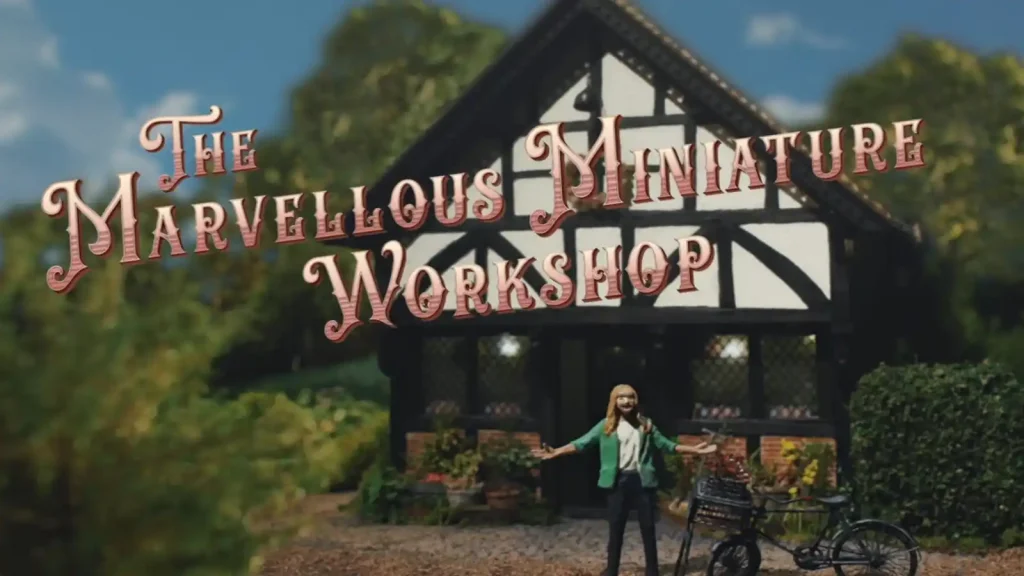
The Marvellous Miniature Workshop Episode 7 opens a window into something genuinely extraordinary: the idea that a tiny, handcrafted object can carry the full emotional weight of a life lived. This instalment centres on one of the most poignant commissions the series has yet attempted, as contestant Ethan Goodbody takes on the task of recreating Hollyhill Farmhouse in painstaking 1:24 scale — a real home belonging to Katie and Lee, a couple whose entire adult life together unfolded within its walls.
The farmhouse is no longer theirs, sold and gone, yet the memories it holds remain vivid and irreplaceable. This episode asks whether handmade miniatures can do what photographs and words sometimes cannot: physically restore a lost place and make it present again.
The commission arrives with considerable emotional freight. Katie and Lee contact the show not simply because they admired a building, but because Hollyhill Farmhouse was where they met, where they raised their children, where decades of ordinary and extraordinary moments accumulated into something that now feels irretrievable. Presenter Sara Cox, who guides the series with warmth and considerable sensitivity, introduces their story to the workshop team and to the viewer with evident care. The couple’s attachment to the property is not sentimental in any vague way. It is specific and detailed, grounded in real rooms, real features, and real textures that meant something at precise moments in their lives.
What makes this particular episode of The Marvellous Miniature Workshop so compelling is the convergence of craft competition and human interest storytelling. The programme is structured around skilled artisans competing to produce the best miniature of each commission, with craft show judges evaluating the results against criteria of accuracy, ingenuity, and emotional resonance. That last criterion is the hardest to quantify and, in this episode, the most important. Ethan Goodbody’s challenge is not simply to build a small farmhouse. It is to build the right farmhouse — the one that exists in Katie and Lee’s memory rather than merely in architectural fact.
The 1:24 scale format that defines the series imposes genuine discipline on every maker. At this ratio, one inch in the model represents two feet in reality, which means every window frame, every roof tile, every door hinge must be reduced to dimensions that challenge the limits of both tools and human dexterity. The scale is small enough to feel precious but large enough to admit real detail — a balance that makes 1:24 scale the preferred medium for serious miniaturists and collectible models of this type. Working within these constraints, the artisans must make constant decisions about what to include, what to simplify, and what to prioritise when full accuracy is physically impossible.
Sara Cox’s role in the episode extends beyond simple presentation. She serves as the emotional interpreter between the clients and the makers, translating Katie and Lee’s memories into something Ethan and the wider team can act upon. She visits the couple before the build begins, drawing out the specific details that matter most to them. This visit reveals a wealth of particular information: the farmhouse’s stone facade, the character of its windows, the layout of the yard, the way light fell across certain rooms. These are not decorative details. For Katie and Lee, they are the substance of memory itself.
The broader context of the series matters here. The Marvellous Miniature Workshop has, across its run, established itself as a programme genuinely interested in artisan skills rather than simply in competitive entertainment. The show’s makers understand that detailed miniatures carry cultural and emotional significance far beyond their physical size, and this episode represents perhaps the clearest expression of that understanding. Ethan Goodbody, as the primary maker on this commission, brings a background in fine detail work that makes him a credible candidate for the task. His approach is methodical, considered, and visibly informed by both technical knowledge and emotional intelligence.
Meanwhile, the competition element of the series runs alongside the human interest thread without ever overwhelming it. Other participants in the craft competition are present throughout, each working on their own version of the farmhouse commission or on parallel tasks, and the dynamic between competitors adds texture and energy to the workshop scenes. The programme handles this balance with care, ensuring that the competitive structure never trivialises the emotional stakes of the central commission. The result is a piece of British daytime TV that manages to be simultaneously entertaining, technically informative, and genuinely moving.
By the time the episode settles into its central build, the viewer understands exactly what is at stake and why it matters. This is the particular achievement of the opening movement: it earns the emotional investment it will later call upon. The craftspeople working in the workshop know this too. They are not building a model. They are building a memory, shaped to fit in the palm of a hand, detailed enough to make the past feel briefly, bracingly present.
The Marvellous Miniature Workshop and the Art of Emotional Commission
Every commission that arrives at the workshop brings its own particular challenge, but the farmhouse brief stands apart from the outset. Katie and Lee’s request is unusual because the building they want recreated no longer exists in their lives. It has been sold. Other people live there now. The farmhouse has become, in that peculiar way of lost homes, more vivid in memory than it ever was in daily life. This is the emotional condition the miniature must address, and it is a more demanding brief than it might initially appear.
Sara Cox’s preliminary conversation with the couple surfaces the specific elements they most want preserved. The stone exterior is paramount. The farmhouse’s character comes from the particular texture and colour of its walls, the way the stonework gives the building weight and permanence. Beyond the exterior, Katie and Lee speak with great specificity about interior details: the kitchen, the staircase, the windows that looked out onto the yard. Each of these features carries associated memory. The staircase is not just a staircase. It is the place where children ran down on Christmas mornings, where the family gathered at moments of importance.
Ethan Goodbody listens to this briefing with visible attentiveness. His task is to identify which details are architecturally essential and which are emotionally essential, and to find the points where those two categories converge. In a 1:24 scale model, not everything can be included. Choices must be made about what to foreground and what to simplify. Ethan’s skill lies partly in making those choices in alignment with what the clients actually value rather than what a purely technical approach might prioritise.
The broader craft competition structure creates productive pressure here. Knowing that other participants are working on versions of the same commission — or that their own work will be evaluated alongside others’ — sharpens Ethan’s focus without distorting it. The competition functions as a mechanism for raising standards rather than for introducing conflict, and in this episode that function is particularly visible. The pressure to produce excellent work and the desire to honour Katie and Lee’s memories point in exactly the same direction.
Building Hollyhill: Ethan Goodbody’s Approach to the 1:24 Scale Commission
The physical build that Ethan undertakes is one of the most technically ambitious the programme has documented. Hollyhill Farmhouse is a substantial property, irregular in its layout, built from natural stone in the manner of working farmhouses rather than designed for architectural elegance. Recreating this in 1:24 scale means working with stone effects, irregular rooflines, multiple outbuildings, and a yard space that was as much a part of the home’s character as the house itself.
Ethan begins with the exterior walls, which are the visual and emotional foundation of the piece. Achieving a convincing stone effect at this scale requires techniques that are quite different from those used at larger scales. The texture must suggest individual stones without becoming cluttered or visually confusing. The colour must read as authentic farmhouse stone — warm but not golden, grey-tinged but not cold. Ethan works through several approaches before settling on a method that satisfies him, and the programme gives this process proper time rather than rushing past it.
The roof presents its own challenges. Farmhouse rooflines are rarely perfectly regular, and the irregularity is part of what gives them character. Reproducing this in miniature requires Ethan to make deliberate decisions about how much irregularity to introduce and where. Too little and the model looks generic; too much and it looks inaccurate. This is a judgment that cannot be reduced to measurement. It requires an eye trained by experience, and Ethan’s background in detailed miniatures proves directly relevant here.
Meanwhile, the interior work proceeds in parallel. The rooms that Katie and Lee mentioned most specifically receive the most detailed treatment. The kitchen is furnished with miniature objects that speak to the farmhouse’s working character rather than to any decorative aspiration. The staircase is constructed with attention to proportion and finish that reflects its emotional significance in the clients’ account. Ethan understands that these interior spaces will be seen and appraised by people who knew the real rooms intimately. There is no room for approximation.
The yard space surrounding the farmhouse adds a further layer of complexity. Farmhouses exist in relationship to their land, and the yard at Hollyhill was, by Katie and Lee’s account, a constant backdrop to family life. Including it in the model means extending the build well beyond the building itself, into a recreation of the working environment that surrounded it. Ethan approaches this as an integral element of the commission rather than as an optional addition, and the decision proves correct. The yard grounds the farmhouse model in a way that a building alone could never achieve.
The Marvellous Miniature Workshop’s Craft Competition: Standards, Pressure, and Precision
The competitive dimension of The Marvellous Miniature Workshop functions differently from most craft competition formats on British daytime TV. The programme is not primarily interested in eliminating contestants or manufacturing tension through adversarial editing. Its interest is in the elevation of craft itself, and the competition is structured as a mechanism for achieving that rather than as an end in itself.
In this episode, the competitive context produces some revealing moments of contrast between approaches. Where Ethan commits to the full complexity of the farmhouse commission, including exterior stonework, interior rooms, and yard, other participants make different choices about scope and emphasis. The programme presents these contrasts without editorialising, allowing the viewer to develop their own sense of which approaches serve the commission most fully. Abi Trotman, who features alongside Ethan and the other participants, brings a distinctive sensibility to her work that provides a useful point of comparison throughout the episode.
The judging process, when it comes, evaluates the models against criteria that the programme has established across the series: technical accuracy, quality of finish, ingenuity of approach, and fidelity to the commission brief. In an episode where the brief is so specifically emotional, that last criterion carries unusual weight. A technically perfect model that fails to capture the character of Hollyhill Farmhouse would be a lesser achievement than a slightly rougher model that gets the feeling right. The judges are aware of this, and their assessment reflects it.
Specifically, the evaluation of fine detail work in this episode is unusually nuanced. The judges examine each model at close range, assessing not just what has been included but how it has been rendered. The difference between a window frame that convinces and one that merely indicates is significant at 1:24 scale, and it is the kind of difference that the programme’s expert judges are well placed to identify and articulate. Their commentary throughout the judging sequence is informative and substantive rather than performative.
Artisan Skills and the Traditions Behind Detailed Miniatures
The Marvellous Miniature Workshop situates itself within a long tradition of miniature making that predates the modern craft competition format by several centuries. Detailed miniatures and dioramas have served different functions at different historical moments: as architectural models, as devotional objects, as educational tools, as expressions of extraordinary patience and skill. The programme draws on this tradition without being academic about it, allowing the work itself to make the case for its own seriousness.
The artisan skills on display in this episode are varied and impressive. Stone effect work, roofing, interior furniture making, soft furnishings at miniature scale, landscaping, and the creation of atmospheric accessories all feature at different points in the build. Each discipline has its own body of knowledge, its own accumulated techniques, and its own characteristic problems. The programme conveys the breadth and depth of this knowledge without becoming a technical manual, maintaining its human interest focus while genuinely informing the viewer.
Ethan’s particular strengths become clearer as the build progresses. His fine detail work is consistently precise, and his ability to shift between scales within the overall composition — managing the relationship between the large forms of the building and the tiny details of its surface texture — is one of the episode’s more instructive demonstrations. The programme captures this through close-up camera work that allows the viewer to appreciate what is happening at a level of detail that the naked eye might miss at normal viewing distance.
The role of tools and materials in miniature making is also addressed throughout the episode. Working at 1:24 scale requires tools that are themselves miniaturised or adapted, and the programme shows these in use without turning the episode into an equipment demonstration. The materials that Ethan uses for stonework, roofing, and interior finishing are identified, and the viewer gains a clear sense of the relationship between material choice and finished effect. This is genuinely useful information for anyone interested in hobbyist craft at this level.
The Marvellous Miniature Workshop and the Power of Handmade Miniatures in Emotional Storytelling
The emotional climax of the episode arrives with the reveal — the moment when Katie and Lee see Ethan Goodbody’s finished model of Hollyhill Farmhouse for the first time. This sequence is handled with restraint and care. The programme does not overload it with music or manipulative editing. It simply presents the moment and allows it to develop at its own pace.
Katie and Lee’s response to the model is immediate and genuine. They recognise the farmhouse at once — not just as a building, but as their home. The specific details that they had described to Sara Cox in the preliminary conversation are present in the model: the stone walls, the roofline, the windows, the yard. Ethan has rendered each of these with sufficient accuracy and sufficient feeling that the couple’s recognition is total. The model does not just look like Hollyhill Farmhouse. It feels like it.
This distinction — between looking and feeling — is the central insight that the episode offers about the nature of handmade miniatures at their best. A photograph of Hollyhill Farmhouse would look like the house. A professionally produced architectural model might achieve considerable accuracy. But Ethan’s miniature, made by hand over many hours in a workshop, carries something additional: the evidence of care, the traces of human attention, the quality that comes from a person choosing, at every moment, to get it right. Katie and Lee respond to this quality as much as to the accuracy of the model itself.
Sara Cox’s role in this moment is simply to be present. She does not narrate or explain. She allows the couple’s response to speak for itself, and the programme is wise enough to let the silence between reactions do its own work. The result is one of the most quietly effective emotional sequences that British daytime TV’s craft competition format has yet produced.
The Marvellous Miniature Workshop Conclusion: Craft, Memory, and the Scale of What Matters
The episode’s final movement draws together its technical and emotional threads with considerable elegance. The craft competition result is announced, the judges offer their considered assessments, and the programme closes with the knowledge that Ethan Goodbody has achieved something genuinely significant — not merely a technical success in the craft competition but a meaningful act of emotional restoration.
The 1:24 scale model of Hollyhill Farmhouse will belong to Katie and Lee. They will be able to hold their home in their hands, examine it from angles they could not have occupied in the real building, and find, in its miniature rooms and yards, the echoes of the life they built there. This is what the best handmade miniatures can do, and it is something that no digital reproduction or photographic archive can replicate: the object is present, tactile, and permanent in a way that images are not.
For the series itself, this episode marks a high point in its ongoing project of demonstrating that artisan skills and emotional intelligence are not separate things. The craftspeople who make detailed miniatures are not simply technicians. They are, at their best, people who understand that the objects they make will carry meaning beyond themselves — that a small stone farmhouse, rendered with care in 1:24 scale, can become the custodian of decades of human experience. The Marvellous Miniature Workshop understands this, and builds its most powerful episodes on that understanding.
The craft competition format, the human interest stories, and the extraordinary skill of makers like Ethan Goodbody and Abi Trotman combine, in this episode, to produce something that transcends any individual element. The programme demonstrates, with quiet but unmistakable conviction, that creative workshops devoted to the making of collectible models and dioramas are doing serious, important work — not despite their small scale, but precisely because of it. In miniature, it turns out, nothing is small.
FAQ The Marvellous Miniature Workshop Episode 7
Q: What is The Marvellous Miniature Workshop Episode 7 about?
A: The Marvellous Miniature Workshop Episode 7 follows contestant Ethan Goodbody as he recreates Hollyhill Farmhouse in 1:24 scale for Katie and Lee, a couple whose entire family life unfolded there. The farmhouse has since been sold. Presenter Sara Cox guides the emotional commission throughout.
Q: Who are Katie and Lee, and why did they approach the show?
A: Katie and Lee are the clients at the heart of this episode. They met at Hollyhill Farmhouse, raised their children there, and built decades of shared memories within its walls. After losing the property, they approached The Marvellous Miniature Workshop hoping a handcrafted miniature could restore what they could no longer revisit in person.
Q: What scale are the miniatures made to in The Marvellous Miniature Workshop?
A: The series works exclusively in 1:24 scale, meaning one inch in the model represents two feet in reality. This scale is widely favoured by serious miniaturists because it is small enough to feel precious yet large enough to accommodate genuine fine detail. It is the standard used for high-quality collectible models and dioramas.
Q: Who is Ethan Goodbody and what makes him suited to this commission?
A: Ethan Goodbody is the contestant assigned the Hollyhill Farmhouse commission in Episode 7. His background in fine detail work and handmade miniatures makes him well suited to the challenge. He approaches the brief with both technical precision and emotional sensitivity, recognising that accuracy alone cannot fulfil what Katie and Lee need from the finished model.
Q: What specific features of Hollyhill Farmhouse did Katie and Lee most want recreated?
A: Katie and Lee identified the stone exterior as their primary concern, valuing its texture and weight above all else. Additionally, they emphasised the kitchen, the staircase, and the farmyard surrounding the building. Each feature carried specific personal memories. Ethan used these details to guide his decisions about what to prioritise at 1:24 scale.
Q: How does the craft competition format work in The Marvellous Miniature Workshop?
A: The craft competition asks participants to produce detailed miniatures based on a shared commission brief. Judges then evaluate the results against criteria including technical accuracy, quality of finish, ingenuity, and fidelity to the client’s brief. However, the programme prioritises raising artisan standards over manufacturing conflict, making it distinctive among British daytime TV craft shows.
Q: What role does Sara Cox play in The Marvellous Miniature Workshop?
A: Sara Cox presents the series and acts as emotional interpreter between clients and makers. In Episode 7, she visits Katie and Lee before the build begins, drawing out the specific memories and features they most want preserved. Furthermore, she is present at the reveal, allowing the couple’s genuine response to the finished miniature to unfold without interruption.
Q: Who is Abi Trotman and how does she feature in the episode?
A: Abi Trotman is a fellow participant in the craft competition whose work appears alongside Ethan Goodbody’s throughout the episode. Her distinctive approach to the commission provides a point of contrast that enriches the viewer’s understanding of the creative choices each maker faces. The programme presents both approaches without editorial bias, letting the work speak for itself.
Q: What happens when Katie and Lee see the finished miniature of Hollyhill Farmhouse?
A: The reveal sequence in The Marvellous Miniature Workshop Episode 7 is handled with notable restraint. Katie and Lee recognise the farmhouse immediately, responding not just to its visual accuracy but to the quality of care embedded in every handmade detail. Their reaction is immediate and unscripted. The programme allows the silence between moments to carry its own emotional weight without editorial interference.
Q: Why do handmade miniatures carry emotional significance that photographs cannot replicate?
A: A photograph records a moment but remains flat and intangible. Handmade miniatures, by contrast, are physical objects carrying the visible evidence of sustained human attention. At 1:24 scale, every choice reflects care rather than automation. For clients like Katie and Lee, holding Hollyhill Farmhouse in their hands transforms memory into something tactile, permanent, and genuinely theirs to keep.