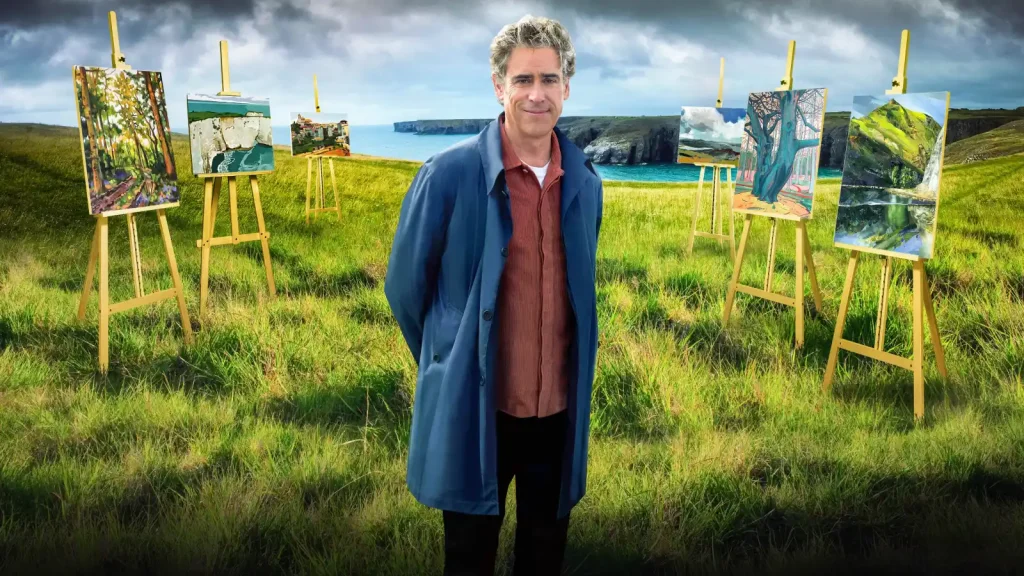
Landscape Artist of the Year 2026 episode 8 brought everything to a head at one of the most extraordinary and challenging locations the competition has ever chosen: the Falkirk Wheel, Scotland’s iconic rotating boat lift, rising dramatically from the central lowlands like something conceived by a fevered engineer and a science fiction novelist working in tandem. Over two thousand artists applied to take part in this year’s competition, and after months of heats, semi-finals, and increasingly demanding tests of skill, just three remained — each one a finalist in the truest sense of the word, each one standing within a single painting of the title that would change their artistic life.
The three finalists were Glaswegian illustrator and plein air painter Libby Walker, life-drawing tutor Tom Winter from Bournemouth, and film scene illustrator Kim Day from near Wareham in Dorset. Their arrival at the Falkirk Wheel carried a weight that was immediately apparent in how they spoke. Libby described the moment as “kind of overwhelming, exciting, just amazing to be at the final.” Tom, whose nerves had been manageable during the semi-final purely because he was elated simply to be there, acknowledged that the final felt categorically different. “This is really it,” he said. Kim, meanwhile, reflected quietly that if she won, she thought she would simply feel very proud of herself.
The prize at stake made that pride entirely justified. Beyond the title of Landscape Artist of the Year, the winner would earn a prestigious £10,000 commission from the National Gallery of Ireland in Dublin, tasked with painting Croagh Patrick — Ireland’s holy mountain in County Mayo, a site of profound spiritual and cultural significance that the gallery already represented through photographs but had never held as a painting. The opportunity to add such a landmark to the collection, in the distinctive hand of a living artist, was extraordinary by any measure.
Before the four-hour painting challenge began, the finalists had time to explore the location. The Falkirk Wheel is, by any standard, a staggering subject. It is the world’s only rotating boat lift, opened in 2002 to replace a series of abandoned nineteenth-century locks, and it functions by reconnecting the Union Canal with the Forth and Clyde Canal, which lies thirty-five metres below.
It achieves this feat through Archimedes’ principle — the understanding that anything floating in water displaces its own weight in water — meaning that a gondola carrying a large vessel and a gondola carrying a canoe remain perfectly balanced, allowing the entire mechanism of 1,800 tonnes of steel and water to rotate using no more power than eight kettles. One of the judges admitted with genuine candour that as an artist he would not know how to deal with it. The structure was man-made, it was fixed in the landscape, and it moved. That combination of qualities made it simultaneously compelling and ferocious as a painting challenge.
Each finalist brought their own lens to that challenge from the moment they arrived. Libby was immediately drawn to the movement of the wheel itself, deciding to focus on its rotation and include a length of canal as a compositional device that would propel the eye into the action. Tom found himself instinctively using the curve of the wheel’s arm as a framing element, allowing it to lead the viewer’s gaze deeper into the background landscape beyond.
Kim took a decision that surprised the judges but proved strategically shrewd: she moved in close, choosing not the full structure but only its base, and the reflection of the wheel in the water below. She had taken a photograph from a different vantage point and been captivated by that composition. She knew it was a risk in a final where boldness was expected, but she trusted it entirely.
The setting also came with its own physical character. The light that morning was flat, the concrete grey, the sky heavy. Tom noted that his usual yellows — a signature of his previous work throughout the competition — were not appropriate here. He adjusted his palette toward more muted oranges and reds, and the judges noticed immediately when they visited him midway through. One asked where the colour was coming from when the scene was so definitively grey. Tom explained that the palette was simply dictated by the subject: “I’ve tried to mute it a bit more.” The judges were satisfied. They praised the power and structure of his early marks. The bones of it, they agreed, had real strength.
Libby’s approach, as it had been throughout Landscape Artist of the Year 2026, was rooted in lyrical abstraction. She described her process as beginning with a realistic attempt to draw what she could see, then allowing play to take over once the foundation was in place. She had no fixed endpoint in mind. When a judge asked whether she knew where her painting would finish up, she laughed and said simply, “I have no idea.” That openness was precisely what had distinguished her throughout the competition, and the judges responded to what she was building — a swirling, vibrant evocation of the wheel’s rotation, with the structure feeling almost organic rather than industrial.
Landscape Artist Of The Year 2026 episode 8
The Falkirk Wheel as a Landscape Artist of the Year 2026 Challenge
The choice of the Falkirk Wheel as the final location was deliberate and loaded with artistic intention. The judges were explicit that they found it fascinating precisely because it resisted easy categorisation. It was man-made, but it existed within nature. It was rigid engineering, but it moved. It was grey and industrial, but it framed the surrounding landscape — the distant mountains, the basin below, the people gathered at its base — in a way that was genuinely beautiful.
One judge described the specific tension of what made the wheel a difficult subject: the flat light, the grey concrete, and the angular, almost aggressive geometry of its axe-headed pointers contrasted with the organic softness of the hills beyond. What was beautiful, however, was precisely that contrast — the hard edge of engineering placed directly against the landscape it inhabited. Another judge, who described himself as an “engineering geek,” said the structure was unlike anything he had ever seen, and that while it was fascinating to study, it was also genuinely difficult to paint.
The wheel’s cultural and environmental significance deepened the context further. Since its opening in 2002, it had attracted half a million visitors a year, transforming Falkirk’s profile internationally and reconnecting Edinburgh to Glasgow via the canal network. Wildlife had returned as well. A site representative noted that fish were now regularly observed moving through the wheel’s gondolas on their passage between the two canal systems. As a beacon of sustainable engineering — the power requirement so extraordinarily low given the mass being moved — the Falkirk Wheel represented a vision of infrastructure thinking about its own future, its own carbon footprint, its own place in the natural world.
How Each Finalist Approached the Landscape Artist of the Year 2026 Final
The three finalists could hardly have taken more different approaches to the same subject, and those differences illuminated exactly why each had made it to this stage.
Libby Walker arrived at the Falkirk Wheel with an established identity as a painter of movement and colour. Her semi-final piece, depicting a train passing over the Ewes Valley viaduct, had secured her place in the final through exactly that quality — a confident use of foreground and distance to convey momentum.
A judge noted that even in the early stages of her final painting, there was already a fantastic sense of revolution. Her marks captured the sweeps of the wheel’s rotation, and the judge wondered aloud whether those marks would disappear as the work developed or remain as echoes of movement. Libby confirmed that she could see them persisting.
The judges’ assessment at the halfway point was that she was giving them a lyrical, slightly lifted version of reality — what one described as a “utopian piece of architecture,” dreamlike and futuristic in a way that suited the subject almost perfectly. Her work suspended the viewer between reality and imagination, they agreed, and that was a quality no other finalist could offer in quite the same way.
Tom Winter had taken a more frontal approach. He had placed a large structural element of the wheel in the foreground and was using its curve to direct the viewer’s eye toward the landscape behind. One judge worried early on that he had gone too close, focusing on a single shape, but another defended him — the large element was only the foreground, and there was space to the right of the canvas that Tom had not yet populated. They speculated about mountains.
What they agreed on was the energy of his mark-making: gestural, alive, vibrating. One judge described the mechanical energy he was getting from Tom’s painting as matching the energy of the structure itself. Throughout Landscape Artist of the Year 2026, Tom’s work had been defined by bold colour and form, and here, adapting his palette to Scotland’s grey morning, he demonstrated the flexibility that had originally secured him an exceptional place in the competition — he had entered the semi-final as the strongest runner-up from the heats, the judges having made a deliberate exception to include him.
Kim Day’s choice was the one that generated the most debate. She had positioned herself away from the main structure, working instead from a photograph she had taken of the wheel’s base and its reflection in the water below. A judge raised the pointed concern directly: “We gave you a very complex, difficult thing. Have you sort of bypassed it all and found a little corner that makes it easier for you?”
The other judge pushed back firmly. Kim was doing exactly what a good artist should do — going out and finding something and making it her own. The more interesting challenge, they noted, was what her approach suggested about the forthcoming commission. Croagh Patrick was a spiritual site. The value of working with an artist was precisely in asking them to show the landscape that others did not see.
Commission Landscapes Reveal the Depth of Landscape Artist of the Year 2026 Finalists
Alongside the four-hour challenge at the Falkirk Wheel, each finalist had been asked to create an additional landscape close to their home, with a full week to complete it rather than the competition’s compressed time limit. These commission paintings were revealed to the judges after the main challenge concluded, and they changed the complexion of the decision entirely.
Tom Winter had found his subject on his own street in Bournemouth — a road he had lived on since 2016 without ever having drawn it. Taking a photograph one day, he noticed what he described as a “really quite nice, pleasing division of space.” His commission piece was built around the negative shapes between the houses, the diagonal of the road cutting across the canvas, and the way light fell differently on each property along the street. He minimised the sky and played with the spatial geometry of the scene.
The judges found something touching in the result. One said Tom had been “really clever” in taking something simple and unassuming and making it carry sensitivity and warmth — a clear love of place that shone through every detail. The way he used light to say what he needed to say was, in the judgement of one viewer, “just stunning.”
Libby Walker had gone to Pollock Country Park in Glasgow, a place she described as an outdoor space she used as her own garden, living as she did in a small flat nearby. She painted in the rain, and she welcomed it. The raindrops on her painting, the sounds of the park around her — all of it fed into what she was trying to convey: the feeling of being immersed in nature, sheltered by it, surrounded by it even in the pouring wet. The result was a painting the judges described as transporting them “somewhere far, far away.”
It was steamy above, intricate in the undergrowth below, and it evolved vertically from the detailed to the abstract as the eye moved upward. One judge called it “magical.” Another compared it to Narnia — then immediately qualified that by noting that once you looked closely at the undergrowth, what you actually saw was wet, gnarly ground. The juxtaposition of those two truths was what made it remarkable.
Kim Day had chosen to look at Corfe Castle in Dorset, near her studio — a view she encountered every time she drove home. Through two tree lines that framed the composition, she painted an obscured view of the ruins, pushing and pulling elements in ways she described as playful. She talked about the challenge of conveying not just what the scene looked like but what it felt like to stand in that specific spot, something a photograph could never capture.
Her medium was mixed: layers of muted pastels and saturated acrylics, the same combination that had won her heat at Derwent Water. The judges found the commission revelatory. One described it as showing the full, magical, transportive capacity of pastel, and noted that even while working in detail and reality, Kim had held onto mood throughout. The painting sat somewhere between abstraction and figuration — a balance she had demonstrated at every stage of Landscape Artist of the Year 2026, travelling the full spectrum in ways that consistently surprised the judges.
The Judges’ Final Assessment in Landscape Artist of the Year 2026
When the judges reviewed both sets of work together — the Falkirk Wheel paintings alongside the commission landscapes — they were frank about the difficulty of their task. One said the commission pieces had made the decision harder, not easier. All three artists had produced work that was distinctive, assured, and in each case entirely true to their individual vision.
Tom’s Falkirk Wheel painting was praised for its phenomenal understanding of space — the viewer’s eye crossed the landscape clearly, moving from ground to water to the structure and beyond. His mark-making remained the quality that had defined his presence throughout the competition. The judges marvelled at the balance he had struck between the man-made and the natural, and at the way his gestural energy translated the mechanical activity of the wheel into something almost visceral. His commission piece extended that analysis by showing how he handled light and the way it moved across the familiar surfaces of a street he knew intimately.
Libby’s Falkirk Wheel piece was described as “so alive” — alive in every single detail, much like the commission. The judges argued that she had done something remarkable: taken a structure full of metal and cement and made it feel organic. One described her work as the most appropriate response to a structure that could be read as utopian architecture, because her lyrical approach was uniquely suited to something that was simultaneously dreamlike and functional.
Kim, however, was the one the judges kept returning to. Her serenity, her calmness, her ability to convey mystery — these were qualities the pair observed when looking at her two paintings together. One judge noted a beautiful mauve passage on the edge of the water in her Falkirk painting, the colours moving in tonal harmony with an elegance that felt entirely effortless.
Her commission had a finish and a solidity that went a step beyond what the competition had previously seen from her, while retaining the lyricism and magic that had distinguished her from the start. Crucially, the judges anchored their decision in a specific question: who would do the best job with the commission? The answer, they concluded, was Kim.
Kim Day’s Victory and the Road to Landscape Artist of the Year 2026
When the winner of Landscape Artist of the Year 2026 was announced, Kim Day’s name was met with genuine cheering. Kim herself said she could not believe it, that she felt overwhelmed and emotional. The judges confirmed that her range throughout the competition — the way she had moved between abstraction and figuration, between muted and saturated, between distance and close detail — had been the decisive factor. Her commission piece, described as a “magical enchanted glade full of poetry and elegy,” was seen as a particularly appropriate preparation for tackling Croagh Patrick, Ireland’s holy mountain, a site of spiritual significance requiring exactly the kind of interior, emotional response to landscape that Kim had demonstrated repeatedly.
Tom was generous in his reaction, saying he was happy for Kim and that her decision to keep things simple had produced very strong work. He added that the entire competition had been extraordinary and that all three finalists should be proud of what they had made. Libby reflected on how much she had elevated her artwork throughout the process, noting that hearing from the judges at every stage had made the experience complete. Both were leaving as significantly better artists than the ones who had arrived.
For Kim, the victory represented more than a title. It meant a commission painting of one of Ireland’s most beloved and culturally charged landscapes, to be unveiled at the National Gallery of Ireland in Dublin. The gallery’s representative had noted that Croagh Patrick was already represented in the collection through photographs, but that a painting was missing — and that this was a great opportunity to add a place of such well-known significance in a form that captured not just the mountain’s appearance but an individual artist’s response to it. Kim’s response, on first learning she was heading to County Mayo, was a single phrase: “I feel quite emotional about it. Genuinely, it just takes my breath away.”
The Falkirk Wheel, in its own way, had done its job. Extraordinary, uncompromising, and unlike anything the competition had encountered before, it had forced three exceptional artists to reach deeper than comfort allowed, to find their own approaches to an impossible subject, and to remind viewers exactly what landscape painting — at its very best — can achieve.
FAQ Landscape Artist Of The Year 2026 episode 8
Q: What is Landscape Artist of the Year 2026 episode 8 about?
A: Landscape Artist of the Year 2026 episode 8 is the grand final of the competition, set at the Falkirk Wheel in Scotland’s central lowlands. Three remaining finalists — Kim Day, Libby Walker, and Tom Winter — each complete a four-hour painting of this iconic rotating boat lift. Judges then assess both their on-the-day work and a separately completed commission landscape to determine the overall winner.
Q: Who are the three finalists competing in Landscape Artist of the Year 2026 episode 8?
A: The three finalists are Kim Day, a mixed-media and film scene illustrator from near Wareham in Dorset; Libby Walker, a Glaswegian illustrator and seasoned plein air painter known for expressive, colour-led brushwork; and Tom Winter, a life-drawing tutor from Bournemouth with over 30 years of experience, celebrated for his bold, gestural mark-making. All three earned their places through earlier heats and semi-finals.
Q: Where is the Landscape Artist of the Year 2026 final filmed?
A: The final is filmed at the Falkirk Wheel in Scotland’s central lowlands. Opened in 2002, this remarkable structure is the world’s only rotating boat lift. It reconnects the Union Canal with the Forth and Clyde Canal, which lies 35 metres below. Additionally, it attracts around half a million visitors annually and has significantly raised Falkirk’s international profile since opening.
Q: What prize does the winner of Landscape Artist of the Year 2026 receive?
A: The winner earns a prestigious £10,000 commission to paint Croagh Patrick — Ireland’s holy mountain in County Mayo — for the National Gallery of Ireland in Dublin. Furthermore, the completed painting will enter the gallery’s permanent collection. Croagh Patrick is already represented through photographs in the collection, but this commission will add the first painted interpretation of this culturally significant landmark.
Q: How does Kim Day approach the Falkirk Wheel painting challenge?
A: Rather than tackling the full structure, Kim takes a close-focus compositional approach, concentrating on just the base of the wheel and its reflection in the water below. She works initially from a reference photograph, then responds directly to the canvas. The judges note this as a tactically shrewd decision, observing that Kim deliberately moves away from wide-distance views — a pattern from earlier rounds — and zooms into specific, intimate detail.
Q: What makes Libby Walker’s painting style distinctive in Landscape Artist of the Year 2026?
A: Libby works in expressive, loose brushstrokes with a strong focus on colour, light, and movement. Her approach begins with a realist foundation, then evolves through playful experimentation. However, what truly sets her apart is her ability to suspend the viewer between reality and imagination. Judges describe her work as lyrical, almost utopian, capable of transforming a steel-and-cement structure into something that feels organic and alive.
Q: Why did Tom Winter receive a special place in the semi-final of Landscape Artist of the Year 2026?
A: Tom originally competed in his heat aboard HMS Wellington, where his dynamic depiction of the Thames and London’s South Bank made a powerful impression on the judges. As the strongest runner-up from all the heats, he made such an extraordinary impact that the judges made a deliberate exception and awarded him a semi-final place. His gestural, energetic mark-making — described as “literally vibrating” — was cited as central to that decision.
Q: What commission landscapes do the finalists present in Landscape Artist of the Year 2026 episode 8?
A: Each finalist creates a landscape near their home without a time limit. Tom paints his own residential street in Bournemouth, exploring light, space, and everyday geometry. Libby paints Pollock Country Park in Glasgow in the rain, conveying immersion in wild nature. Kim paints the dramatic ruins of Corfe Castle in Dorset, capturing her deep personal connection to the place through layered pastels and saturated acrylics.
Q: Who wins Landscape Artist of the Year 2026?
A: Kim Day wins Landscape Artist of the Year 2026. The judges praise her remarkable range throughout the competition, noting she demonstrated the full spectrum from abstraction to figuration across every round. Her commission painting of Corfe Castle — described as a “magical enchanted glade full of poetry and elegy” — proves decisive. Furthermore, the judges conclude her lyrical, emotionally resonant style makes her the ideal artist to paint Croagh Patrick for the National Gallery of Ireland.
Q: How does the Falkirk Wheel work, as explained in Landscape Artist of the Year 2026 episode 8?
A: The Falkirk Wheel operates on Archimedes’ principle: anything floating in water displaces its own weight in water. This means both gondolas remain perfectly balanced regardless of what vessels they carry. Consequently, the entire mechanism — comprising 1,800 tonnes of steel and water — requires only the power equivalent of eight kettles to rotate. This ingeniously efficient system combines modern technology with centuries-old physics to transfer boats between two canals 35 metres apart.