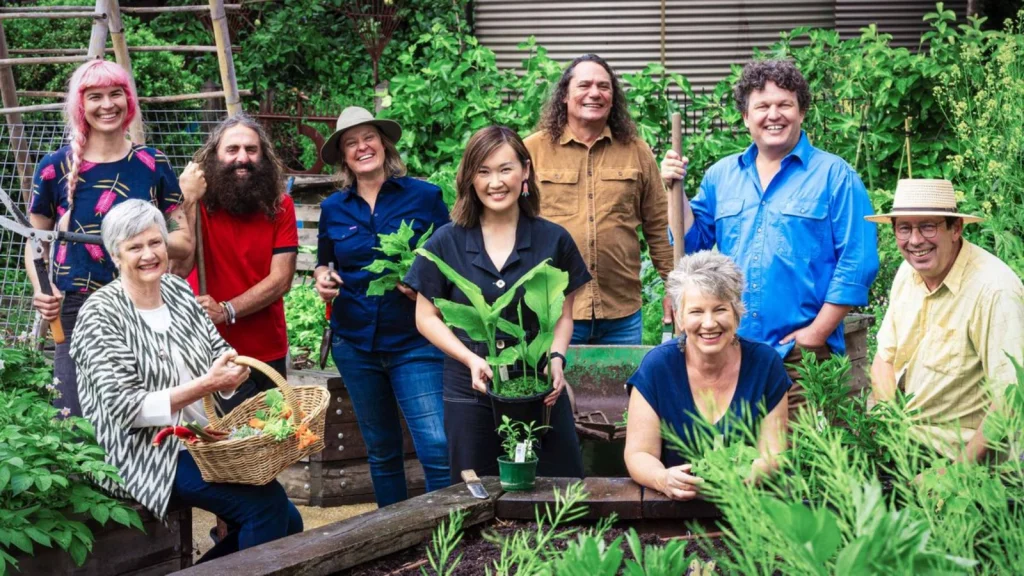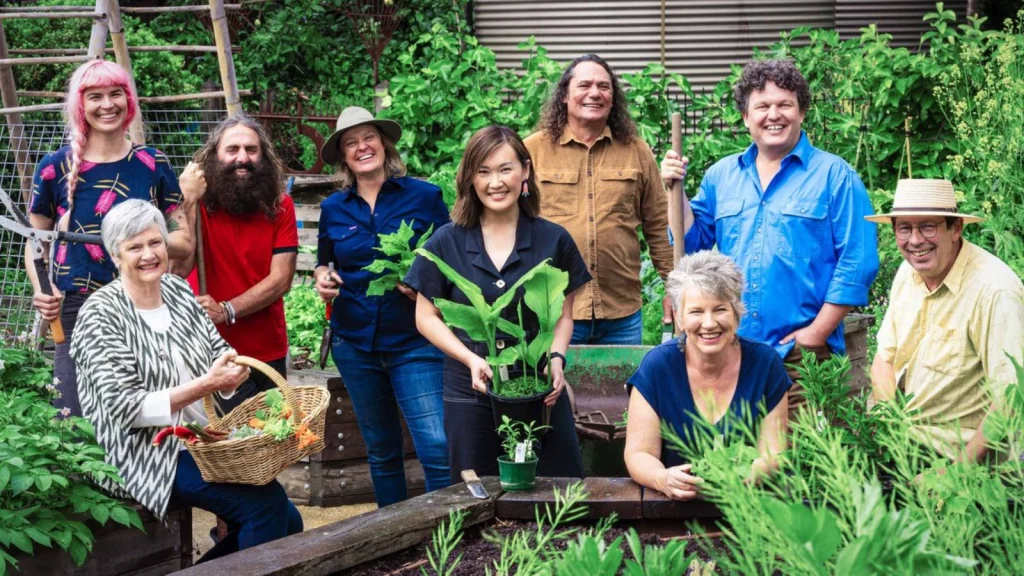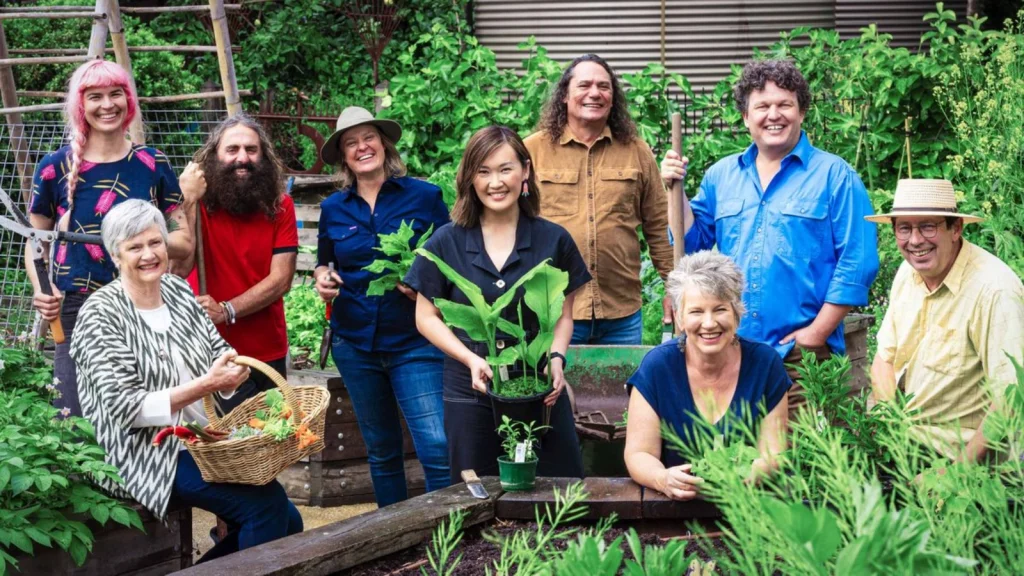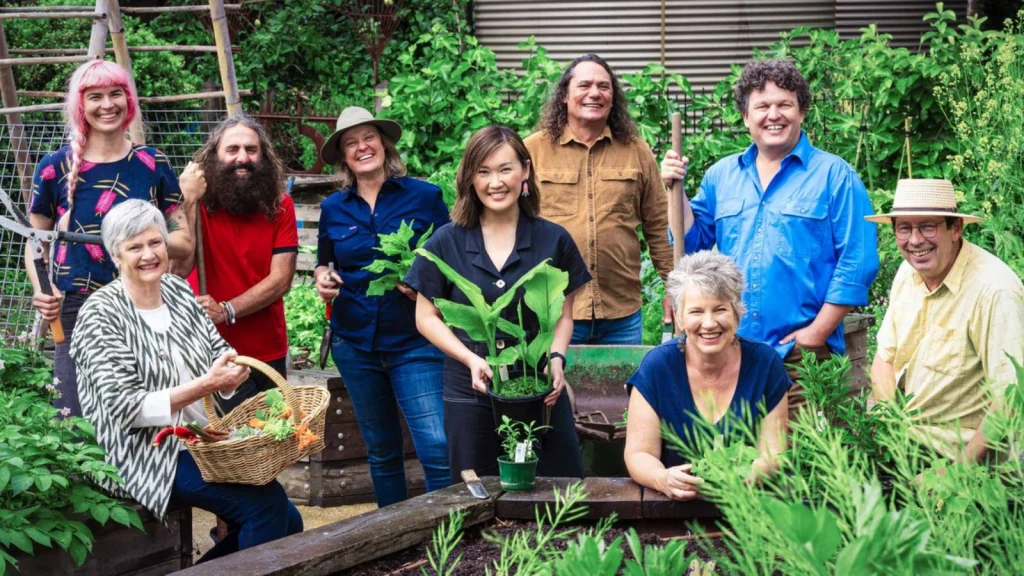
Gardening Australia 2026 Episode 18 closes out the autumn-to-winter stretch of the series with an episode built around resilience, experimentation and the quiet rewards of long-term planning. Jerry Coleby-Williams walks through a subtropical food forest packed with fruit most Australians have never tasted, Millie Ross investigates the growing problem of light pollution and how gardeners worsen or fix it, Josh Byrne completes a habitat project he first sketched out in 2013, Tammy Huynh builds a living tabletop garden from driftwood and succulents, and Hannah Moloney visits a windswept coastal garden east of Hobart. It is a wide-ranging hour of Australian gardening, and every segment leaves you with something you can actually try at home.
What ties these stories together is patience. None of these gardens happened quickly. Jason Spotswood’s Brisbane food forest took twenty years to mature, Paul Whelan’s Tasmanian coastal block took seventeen, and Josh Byrne’s Perth garden was deliberately engineered more than a decade ago to become exactly what it is today. Gardening Australia 2026 Episode 18 makes the case that the most satisfying gardens are not the fastest ones.
For viewers planning their own projects, this is one of the most practical episodes of the season. There are concrete techniques here for difficult soil, coastal exposure, wildlife habitat, water-wise planting and outdoor lighting, alongside a seasonal jobs guide spanning every Australian climate zone before the show breaks until August.
Northwest of Brisbane, near the D’Aguilar Ranges in the Moreton Bay Hinterland, Jason Spotswood has spent two decades turning agricultural land into a working subtropical orchard. Jerry Coleby-Williams arrives for what is essentially a tasting tour, and the variety on offer makes the case for why subtropical growing is so rewarding. Summers suit tropical plants, winters suit temperate ones, and the overlap opens up a whole world of fruit to experiment with.
The stars of the forest are the jaboticabas, a Brazilian species also known as Brazilian grape. They are cauliflorescent, meaning they flower and fruit directly from the trunk, which is exactly what stops most visitors in their tracks. Jason grows several types. The small-leaf jaboticaba delivers a complex sweet-then-sour flavour and freezes well for smoothies, blending up seeds and all for a hit of antioxidants. The ‘Grimal’ variety is noticeably sweeter and better eaten fresh, though its higher pectin content makes it less ideal for drinks. These plants thrive on the subtropical pattern of dry spells followed by heavy water, a rhythm Jason uses deliberately to trigger fruiting.
Beyond the jaboticabas sits a collection of fruit few shoppers will ever find in a supermarket. There is canistel, or yellow sapote, which tastes like sweet pumpkin with a butterscotch undertone and shines in baking. There is kwai muk, a lesser-known cousin of jackfruit that tastes like sweet rhubarb, a particular delight for a former cold-climate gardener. ‘Champagne’ loquat, grumichama, bignay and ‘Dwarf Ducasse’ bananas round out a planting designed to mimic the layered, naturalistic structure of a real forest.
Gardening Australia 2026 Episode 18
How Jason Built a Productive Food Forest on Difficult Granite Soil
The food forest did not start from ideal conditions, and that is what makes Jason’s approach so useful for ordinary gardeners. Jason grew up in Canada, where brutal winters made growing a constant battle, and his first taste of Australian abundance came from something as ordinary as a backyard orange. That sense of possibility shaped everything he built afterward.
Wind was the first major challenge. Jason planted bamboo as a windbreak to the south and used tough, wind-tolerant species like jackfruit, cherry of the Rio Grande and loquat on the western edge, plants that keep producing even when battered. His soil was decomposed granite, excellent as a subsoil but poor on top, so he poured organic matter into it, used Pinto peanut as a living ground cover and relied heavily on the chop-and-drop method. Even the footpaths double as low, flat compost heaps, quietly feeding the system underfoot.
Water management came next. Jason installed swales to slow runoff during the region’s heavy rainfall events, raising the root zones just enough to stop trees becoming waterlogged. The result is a self-sustaining patch where his daily smoothie comes entirely from the garden, oranges, Davidson’s plum, bananas, ginger, jaboticabas and pineapple picked within metres of the blender. As Jerry puts it, that is not food miles but food centimetres. For Jason, the motivation is simple: harvesting things you cannot buy, and sharing that knowledge with family.
Why Light Pollution Is the Garden Problem Most Australians Overlook
Millie Ross takes Gardening Australia 2026 Episode 18 into territory most gardening shows ignore entirely. At Uambi, a Trust for Nature property in the eastern Melbourne suburb of Heathmont, she meets Dr Kaori Yokochi, a wildlife ecologist at Deakin University and a member of the Network for Ecological Research on Artificial Light. The subject is light pollution, and the argument is that life on Earth evolved to read natural light as a biological cue, which artificial lighting has now thrown into disarray.
Dr Yokochi describes two forms of the problem. Direct light comes from individual sources you can switch off, such as street lights, house lights and garden lighting. Skyglow is the larger-scale accumulation of all that upward-pointing light, the orange dome you see hovering over a city from a rural distance. Both forms ripple through ecosystems in ways that are easy to miss. Australian magpies in lit areas suffer disrupted sleep, which compromises their immune systems and physiological processes. Willie wagtails have their natural night-calling behaviour altered.
Her own research focuses on microbats, the small insectivorous bats flying through gardens across the country. Australia hosts more than seventy species, with around seventeen in greater Melbourne alone, making them the most diverse group of animals living alongside us. Using a bat detector that records their ultrasonic calls for visual analysis, she has shown that species preferring cluttered, vegetated habitat simply avoid lit areas. That matters because these bats are voracious natural controllers of insects, including agricultural pests and mosquitoes.
The Hidden Health Risk of Outdoor Lighting and Why It Can Be Reversed
The mosquito connection is where light pollution stops being an abstract wildlife issue and becomes personal. Research has found that female mosquitoes extend their biting season in lit areas, meaning they feed on humans for longer. Combine that with fewer bats hunting those mosquitoes, because the bats are deterred by light, and the result can be an increased risk of mosquito-borne disease. Switching on too many garden lights, in other words, can quietly work against your own health.
The encouraging part of Dr Yokochi’s message is how solvable this is. Unlike a polluted waterway or a degraded ecosystem, light pollution does not require expensive rehabilitation. Awareness alone allows people to change how and when they use light, and much of the damage can be undone by simply flicking a switch. She also argues for thinking about dark corridors the way we already think about vegetation corridors, deliberately protecting and connecting naturally dark areas to support urban wildlife.
Those genuinely dark places are becoming rarer, which is exactly why they are so valuable to ecologists. Stand in central Melbourne and you may see only two or three stars, a striking measure of how bright the night sky has become for most Australians. The good news running through this segment of Australian gardening is that the solution sits within reach of every homeowner, and Millie returns later in the episode to show precisely how.
Practical Garden Lighting That Protects Wildlife and the Night Sky
To turn that awareness into action, Millie meets Landon Bannister, a lighting professional and chair of the technical committee at the Australasian Dark Sky Alliance. His day job involves talking clients out of using too many lights, paring outdoor schemes back rather than building them up. The Alliance wants to see dark sky places established across Australia and the trend of cities erasing the stars reversed.
The colour of light turns out to matter as much as the quantity. Bannister recommends warm colour temperatures, looking for a correlated colour temperature of 2700 Kelvin or lower. Warm light has far less impact on human sleep and circadian rhythm than cool light, which the body reads as a daytime signal, and it makes outdoor spaces feel cosier in the bargain. He demonstrates the difference dramatically, contrasting a harshly over-lit courtyard, glaring, two-dimensional and spilling light onto neighbouring walls and straight up into the sky, with a controlled, low-level alternative.
His core principle is counterintuitive but clarifying: light is invisible until it strikes an object. Rather than flooding an area, good lighting targets surfaces, columns and textures that reflect light back. Demonstrating on a tree, he swaps a wasteful 30-watt fixture for a directional 4-watt light angled tightly into the canopy, creating more visual interest with a fraction of the energy and spillage. The advice is unambiguous: do not leave such lights running all night, because insect and ant life will steadily abandon a lit tree. A good dark-sky-sensitive setup is targeted, low-wattage, warm, controlled and ideally on a sensor, with a single light often enough to make a path safe.
Josh Byrne’s Decade-Long Plan to Turn a Sandpit Into Wildlife Habitat
In Perth, Josh Byrne offers a masterclass in future-proofing. The area he is working on began life in 2013 as a sandpit within a nature play space for his two young children. Crucially, he designed it from the start to be repurposed later as a feature garden. Beginning incrementally around the edges in 2019, he removed the sandpit entirely by 2023, added soil and planted hardy natives that have since established well. Present-day Josh is now finishing what 2013 Josh planned.
The focus is a back section of about three square metres, intended to create habitat for local wildlife. Logs already provide basking spots and hiding nooks for lizards. The centrepiece is a birdbath fabricated from an old metal plough disk mounted on rolled secondhand steel tube, chosen to tie in with the existing trellis, and plumbed with a dripper so it tops up automatically. Beneath it, Josh digs a shallow basin and works in bentonite clay to hold water in the sandy soil, creating a small dampland environment from what would otherwise drain away instantly.
The planting is chosen for function as much as beauty. Centella asiatica and Lobelia anceps are low herbaceous species that make excellent frog habitat, while a hardy low Lomandra called ‘Little Pal’ edges the damp zone. Prickly Chorizema ‘Fire Sticks’ shelters small birds and erupts in bright orange and pink flowers, Astartea scoparia adds spring white blooms, and Correa ‘Dusky Bells’ draws nectar-feeding birds. A final habitat hack sees garden twigs bundled with twine and tucked between plantings, giving invertebrates a home and lizards a food source. Josh calls it playing the long game, and seeing it unfold over coming seasons is, for him, the great reward of gardening.
Tammy’s Tabletop Succulent Gardens Bring Living Art Indoors
At a nursery in Empire Bay on the Central Coast of New South Wales, Tammy Huynh explores miniature gardens with Susan Gao, whose property holds more than 150,000 plants. Susan’s path into succulents began almost by accident: a delayed flight in Shanghai led her to a botanical garden, where the plants eased a headache and redirected her entire career. The tabletop concept arrived just as serendipitously, when her cavoodle Lulu brought her a piece of driftwood shaped like a dolphin on a nearby beach.
She planted succulents into that driftwood, forgot about it, and returned a month later to find them not merely surviving but thriving, clinging tight to the cracks exactly as they would in the wild. One piece led to another, and the largest driftwood arrangement in her nursery now stretches more than two metres. The plant palette centres on echeverias, a vast family offering endless colours, forms and textures, from the waxy agavoides to the variegated, beauty-marked Echeveria ‘Beyonce’. Sedums such as ‘Ogon’ and ‘Rainbow Blob’ knit everything together, holding soil and hiding exposed dirt.
Building an arrangement follows a clear logic, much like composing a meal. Taller plants like ‘Teddy Bear’, ‘Bear’s Paw’ and Crassula ‘Baby’s Necklace’ go in first as a background. A large centrepiece anchors the design, here the frilly ‘Etna’, complemented by a purple highlight. Smaller fillers such as ‘Heart Throb’, more echeverias and a bridging band of Sedum ‘Joyce Tulloch’ fill the gaps, with trailing string of pearls softening the edges.
Care could not be simpler: shade in summer, maximum sun in winter, and water just once a week. Susan also runs community workshops where the real value, she says, lies not in the finished piece but in the shared process of making it, dirt, wood and real plants slowing breathing and rebuilding a connection with nature.
Hannah’s Windswept Coastal Garden Shows the Beauty of Tasmanian Natives
With 87 percent of Australians living within fifty kilometres of the ocean, coastal gardening speaks to a deep part of the national identity, and Hannah Moloney’s visit to Dodges Ferry, forty kilometres east of nipaluna, Hobart, leans straight into it. Here, gardener and landscape designer Paul Whelan has built a low-water, sandy-soil garden alongside his family, all of them passionate about native coastal plants. He is even teaching his daughter Sunny to forage edible saltbush along the shore, a slightly salty taste she may not love now but will likely thank him for later.
Paul’s design philosophy is to enhance what coastal plants already do naturally. He prunes natives to mimic the windswept, gnarled forms the coast produces on its own, highlighting old trunks and branches he likens to the dinosaurs of the plant world. Silver Leucophyta brownii brings colour and texture, and because it is short-lived, lasting only a few years, he plants young replacements nearby so there is always one ready to take over. Banksias feature heavily, including Banksia serrata with its big cones and gnarled trunk, alongside prostrate and tall forms drawn from both Tasmanian and Western Australian species.
The 600-square-metre block was almost bare seventeen years ago, just grass and a single struggling native cherry tree. Paul built slowly, camping in a caravan in the corner, then designing house and garden together with the garden always the focal point. Timber duckboard paths echo the wilderness walks of south-west Tasmania, framing and raising the plants.
Tough backbone species like Dodonaea viscosa and Rhagodia provide structure, with a pincushion hakea making them pop. In an area receiving under 500 millimetres of rain a year and relying solely on tank water, choosing local and hardy natives is what allows the garden to look, in Paul’s words, stoked. He also uses the buloke, or bull-oak, valuing its soft foliage and the self-mulching litter it drops to hold precious moisture in the sand.
Expert Answers and Weekend Jobs Across Every Climate Zone
Between the major features, the team tackles common reader questions with characteristically direct advice. For rabbit problems, the short-term fix is individual plant guards while you learn which plants they target, and the long-term solution is a rabbit-proof fence with a buried skirt so digging bunnies give up and move on, backed by contacting local vermin management.
On clumping bamboo, the guidance is to choose carefully, since most garden varieties are tight clumpers but some are wide clumpers reaching several metres across, so checking the mature height and width on the label matters. For chickens and goats, fruit and vegetable scraps and leafy greens are ideal, oily foods, dairy, meat and seafood should be avoided, and feeding in the morning rather than at night keeps rats and mice away.
Millie also offers a wider lesson on weeds. Although she fights them constantly, she points out that weeds reveal what is happening in the soil, quietly improve its structure, and can feed wildlife where nothing else is available, as stinging nettles do for the Australian admiral butterfly.
Her practical method is sheet mulching with newspaper or cardboard under mulch, with gravel a sturdy windproof alternative, and the key rule is to replace pulled weeds quickly with plants or mulch so the soil and its beneficial insects stay protected. Clarence Slockee adds a list of natives for permanently boggy spots, including Epacris longifolia, Melaleuca ‘Claret Tops’ and Casuarina ‘Green Wave’, the last of which binds soil, reduces erosion and fixes nitrogen.
The episode signs off with a seasonal jobs guide for every Australian climate. Cool-temperate gardeners should prune apples and pears and divide rhubarb, while saving prunings for stakes, edging or smoking wood. Warm-temperate growers can plant blueberry hedges and feed emerging spring bulbs. Subtropical gardeners can plant ‘Mary Washington’ asparagus and prune crepe myrtles, while tropical gardeners hack back bougainvillea, sow sweet potato and pick paw paws.
Arid-zone gardeners can sow green manure crops and plant potatoes, and a drip irrigation install is recommended everywhere. With that, Gardening Australia 2026 Episode 18 closes the season, the team heading off on break until August while promising plenty of inspiration on return, a fitting end to an hour that rewarded patience, planning and a willingness to try the unusual.
FAQ
Q: Why do jaboticabas fruit directly from the trunk?
A: Jaboticabas are cauliflorescent, meaning they flower and fruit straight from the trunk rather than the branch tips. This Brazilian species, also called Brazilian grape, evolved for a subtropical climate that swings between dry spells and heavy water. Growers use that rhythm deliberately to trigger fruiting, and the trunk-borne fruit is exactly what stops most first-time visitors in their tracks.
Q: How do you grow a food forest on poor decomposed granite soil?
A: Decomposed granite works well as a subsoil but performs poorly on top, so it needs heavy improvement. The fix is pouring in organic matter, using a living ground cover like Pinto peanut, and relying on the chop-and-drop method. Footpaths can double as low, flat compost heaps that feed the system underfoot, while swales slow runoff and stop roots becoming waterlogged in heavy rain.
Q: What does canistel fruit actually taste like?
A: Canistel, also known as yellow sapote, tastes like sweet pumpkin with a butterscotch undertone. It is best eaten when soft, which is where the name yellow sapote comes from. The flavour suits baking and pairs well with yoghurt, though it is less ideal in smoothies. To get good fruiting, avoid over-fertilising it, but give it plenty of water.
Q: How does light pollution affect garden wildlife?
A: Wildlife evolved to read natural light as a biological cue, so artificial light disrupts everyday behaviour. Australian magpies in lit areas suffer broken sleep, which compromises their immune systems. Willie wagtails have their natural night-calling altered. Microbats that prefer cluttered, vegetated habitat simply avoid lit areas, removing a valuable natural control on insects and agricultural pests.
Q: Can outdoor lighting increase the risk of mosquito-borne disease?
A: Research shows female mosquitoes extend their biting season in lit areas, feeding on humans for longer. Meanwhile, the bats that would normally hunt those mosquitoes are deterred by the same light. Fewer predators plus longer biting periods can raise the risk of mosquito-borne disease. Too many garden lights, in other words, can quietly work against your own health.
Q: What is the best colour temperature for wildlife-friendly garden lighting?
A: Aim for warm light with a correlated colour temperature of 2700 Kelvin or lower. Warm light has far less impact on human sleep and circadian rhythm than cool light, which the body reads as a daytime signal. Specifically, good outdoor lighting should be targeted, low-wattage, warm, controlled and ideally on a sensor, with one light often enough to make a path safe.
Q: How do you stop water draining away in sandy soil?
A: On sandy soil, water normally disappears almost instantly. Digging a shallow basin and working in bentonite clay helps hold moisture and create a small dampland environment. This technique lets you capture overflow from features like a birdbath and supports water-loving plants such as Centella asiatica and Lobelia anceps, which double as excellent frog habitat.
Q: How much care do tabletop succulent gardens really need?
A: Very little. Tabletop succulents need shade in summer, as much sun as possible in winter, and watering just once a week. Succulents are not fussy and survive almost anywhere, clinging tight to driftwood cracks exactly as they would in the wild. Sedums like ‘Ogon’ knit arrangements together, holding soil and hiding any exposed dirt.
Q: Why are local natives best for a low-water coastal garden?
A: Local and hardy natives suit the site, so they thrive on minimal water. In a coastal block receiving under 500 millimetres of rain a year and relying solely on tank water, that resilience is essential. Pruning natives to mimic their windswept forms enhances what they already do naturally, while self-mulching species like buloke drop litter that holds precious moisture in sandy ground.
Q: What native plants suit a permanently wet or boggy spot?
A: Several natives thrive where water always sits. Epacris longifolia, or native fuchsia, brings red-and-white candy-cane flowers. Melaleuca ‘Claret Tops’ copes with both waterlogging and dry, offering contrast foliage that responds well to pruning. Casuarina ‘Green Wave’ binds soil to reduce erosion and fixes nitrogen, feeding surrounding plants. Stopping the flow is often impossible, so planting for the conditions works better.