Hidden Treasures of the National Trust 2025 episode 3 unveils the complex colonial histories embedded within two of Britain’s most magnificent country houses. Behind the baroque facades and neoclassical splendor lie stories that span centuries of imperial ambition, from the earliest days of English expansion in the Americas to the height of the British Raj. These grand estates, now preserved by the National Trust, offer unprecedented insights into how wealth from the colonies shaped British society and culture, while modern conservation efforts reveal both the beauty and troubling legacies of these artifacts.
The documentary explores Kedleston Hall in Derbyshire and Dyrham Park in Gloucestershire, two properties that exemplify different eras of British imperial power. At Kedleston, the focus centers on the famous Peacock Dress, an extraordinary piece of Edwardian couture worn by Mary Curzon, wife of the Viceroy of India, at the spectacular Delhi Durbar of 1903. Meanwhile, at Dyrham Park, conservators work to restore a mysterious painting of Bridgetown, Barbados, that once belonged to William Blathwayt, the colonial bureaucrat who helped establish the administrative systems that would define British imperialism for centuries.
Hidden Treasures of the National Trust 2025 episode 3 presents conservation as more than mere preservation—it becomes a means of uncovering hidden narratives and confronting uncomfortable truths. Through meticulous restoration work, experts reveal how these objects tell stories not just of wealth and power, but of the millions whose labor and suffering made such opulence possible. The National Trust’s approach to presenting these histories reflects a growing recognition that Britain’s grandest houses cannot be understood without acknowledging their connections to colonialism, slavery, and exploitation.
The significance of these conservation projects extends beyond the objects themselves. Each artifact—whether a bejeweled dress or a colonial landscape painting—serves as a window into the mechanisms of empire. The documentary reveals how colonial administrators like Blathwayt transformed revenues from sugar plantations worked by enslaved Africans into English country estates, while imperial figureheads like Lord Curzon staged elaborate displays of power even as millions died from famine in the territories they governed.
These revelations emerge through the painstaking work of conservators, curators, and volunteers who dedicate thousands of hours to preserving these artifacts for future generations. Their efforts in Hidden Treasures of the National Trust 2025 episode 3 demonstrate how technical expertise combines with historical research to create a more complete understanding of Britain’s past, one that encompasses both the magnificence of these properties and the human cost of the wealth that created them.
Hidden Treasures of the National Trust 2025 episode 3
The Peacock Dress: Imperial Splendor and Personal Tragedy
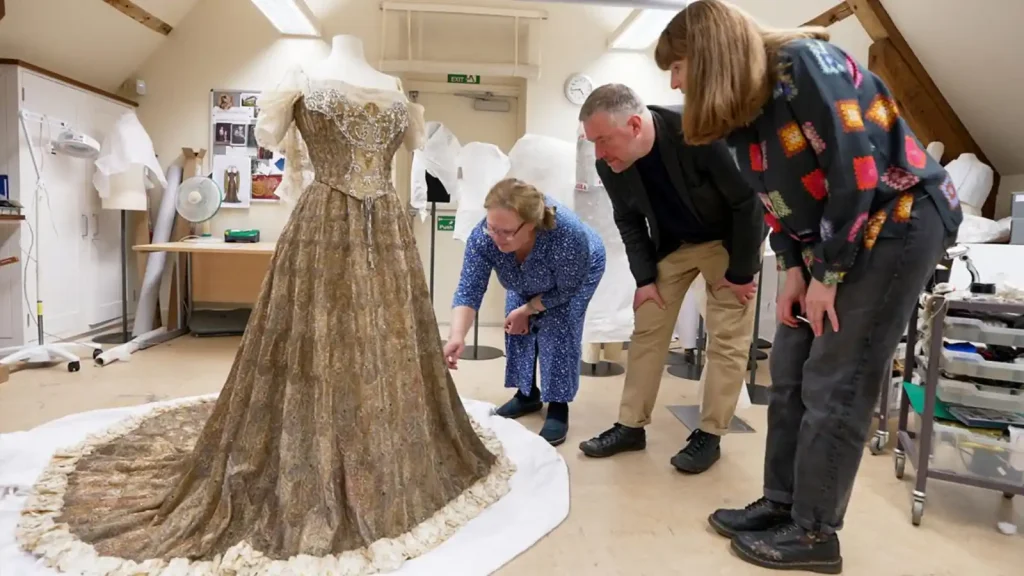
The Peacock Dress stands as one of the most spectacular examples of Edwardian fashion, created by the House of Worth in Paris using goldwork embroidery from the workshops of Kishan Chand in India. Textile conservator Rosamund’s examination reveals that the embroidery contains actual gold thread, making it both a masterpiece of craftsmanship and a symbol of imperial wealth. The dress earned its name from the embroidered peacock feathers covering its surface—a design choice that resonated with the peacock’s significance as a symbol of royalty and religious importance in India.
Mary Curzon wore this extraordinary gown to the Durbar Ball during the 1903 Delhi Durbar, an event orchestrated by her husband Lord Curzon to celebrate Edward VII’s accession as Emperor of India. The Durbar represented the ultimate display of British imperial power, bringing together maharajas, princes, and rulers from across British India to acknowledge British dominance. The documentary reveals how Lord Curzon meticulously planned every detail of this spectacle, viewing it as essential to maintaining British prestige and authority.
The conservation work on the dress uncovers a deeply personal story behind the imperial grandeur. Analysis of the garment reveals multiple alterations made during Mary’s lifetime, including adjustments to accommodate pregnancy and illness. Conservator Rosamund discovers perspiration marks and evidence of the dress being modified as Mary’s health deteriorated. These intimate details transform the Peacock Dress from a mere symbol of empire into a poignant reminder of the human cost of maintaining imperial power—Mary died in 1906 at just 36 years old, having endured multiple pregnancies and a miscarriage while fulfilling her duties as Vicereine.
The decision to restore the dress to its final form, as worn by Mary shortly before her death, rather than its original 1903 appearance, reflects the National Trust’s commitment to preserving human stories alongside historical artifacts. This choice acknowledges that objects carry multiple layers of meaning and that personal narratives can be as significant as grand historical events.
William Blathwayt and the Architecture of Colonial Exploitation
Dyrham Park presents a different but equally revealing story of empire through the figure of William Blathwayt, Auditor General of Plantation Revenues in the late 17th century. Unlike the military commanders and explorers typically associated with imperial expansion, Blathwayt exemplified the bureaucratic machinery that made colonialism profitable. His role involved managing finances from plantations across the Americas, particularly in Barbados and Jamaica, where enslaved Africans labored in brutal conditions to produce sugar for European markets.
The documentary emphasizes how Blathwayt’s administrative expertise made him indispensable to the colonial project. Speaking both French and Dutch, he professionalized the systems that extracted maximum financial benefit from the colonies. His success in this role enabled him to transform Dyrham Park into a baroque palace, importing materials like black walnut from Virginia through his colonial connections. Every luxury in the house represents wealth derived from human suffering on Caribbean sugar plantations.
Curator Lucy’s research reveals the extent to which Dyrham Park embodies colonial wealth. The house contains carvings depicting enslaved Africans, which the National Trust has chosen to keep on display with contextual information. This decision reflects the institution’s evolving approach to presenting difficult histories—acknowledging that removing such objects would be “like pretending it never happened,” while also recognizing that many visitors find them deeply troubling.
The restoration of the mysterious painting of Bridgetown, Barbados, originally owned by Blathwayt, provides additional insights into how colonialism was portrayed and promoted. Conservation work by Sarah reveals that 40% of the painting’s surface consists of later overpaint, requiring painstaking removal to uncover the original 17th-century view. The painting depicts Bridgetown as a prosperous port with windmills dotting the landscape—euphemistic representations of the sugar industry that carefully avoid any depiction of the enslaved people who comprised two-thirds of Barbados’s population at the time.
Confronting Imperial Narratives Through Conservation
Hidden Treasures of the National Trust 2025 episode 3 demonstrates how conservation work can challenge sanitized versions of history. Art historian Alice’s research into the Bridgetown painting reveals its function as essentially “a promotional poster,” designed to present Barbados as a safe and profitable investment opportunity while concealing the brutal realities of plantation life. The painting shows no enslaved people, no indication of the disease and mortality that plagued the colony, and no hint of the violence inherent in the sugar trade.
The documentary contrasts this idealized vision with contemporary accounts, including Richard Ligon’s 1657 description of Bridgetown where “the living could hardly bury the dead” due to rampant disease. Ligon’s account describes how planters would “buy them out of the ship, where they find them stark naked” and “choose them as they do horses in a market,” with “£30 sterling as a price for the best man.” These historical documents provide the context that Blathwayt’s painting deliberately omitted.
Lord Curzon’s collection at Kedleston tells a similar story of selective presentation. While the Viceroy staged the elaborate Delhi Durbar in 1903, millions were dying from famine across India. The documentary reveals addresses from Indian princes and maharajas in the Kedleston archives that diplomatically reference these “terrible scourges” while maintaining the formal language of imperial protocol. Morgan, the property curator, notes how these documents rarely ask directly for help, instead expressing admiration for what had been done while hinting at the need for continued assistance.
The conservation teams working on both properties face the challenge of presenting these complete histories to modern audiences. The National Trust acknowledges that approximately one-third of its properties have links to colonial histories, requiring careful consideration of how to display objects and tell stories that encompass both artistic achievement and historical injustice.
Modern Reinterpretation and Community Engagement
The documentary showcases innovative approaches to making these colonial collections relevant to contemporary audiences. At Kedleston, Simran Sandhu leads efforts to reinterpret Lord Curzon’s museum of Asian artifacts, which has remained largely unchanged since 1927. Her Diwali celebration brings brass oil lamps from storage to create a living display that honors their original purpose while acknowledging their complex provenance.
This recontextualization involves collaboration with local communities, including volunteers from Derby’s Sikh gurdwaras who help create decorations for the celebration. The project demonstrates how historic properties can become spaces for dialogue about imperial legacies while celebrating the cultures that were subjected to colonial rule. Simran’s work emphasizes displaying objects “in a manner which is more relevant, which is more sensitive, especially for the communities that these objects probably come from.”
The transformation of Kedleston for Diwali requires careful negotiation between preservation concerns and cultural authenticity. Crack monitor June’s vigilant protection of the marble floors exemplifies the technical challenges of adapting historic spaces for contemporary use. The team creates rangoli decorations that incorporate Robert Adam’s original honeysuckle designs while using materials that won’t damage the historic surfaces—a metaphor for how institutions can honor both their architectural heritage and the need for inclusive representation.
Hidden Treasures of the National Trust 2025 episode 3 reveals how conservation work extends beyond physical preservation to encompass social responsibility. Each decision—from which version of the Peacock Dress to restore to how to display objects depicting enslaved people—reflects broader questions about how Britain understands and presents its imperial past. The meticulous work of conservators, combined with historical research and community engagement, creates opportunities for more complete and honest narratives about the sources of Britain’s historic wealth.
More Than Stone and Silk: Heritage as a Reckoning
As we step back from the opulent halls of Kedleston and the baroque grandeur of Dyrham Park, it becomes clear that Hidden Treasures of the National Trust 2025 offers far more than a tour of architectural marvels and exquisite artifacts. It pulls back the velvet ropes and dust sheets to reveal the intricate, often uncomfortable, wiring of Britain’s imperial past. We are left with the profound understanding that these “hidden treasures” carry more than just aesthetic weight; they are potent symbols, and sometimes even active participants, in a global story of ambition, power, and profound human cost.
The journeys undertaken in this episode – tracing the threads of Mary Curzon’s Peacock Dress and peeling back the layers of William Blathwayt’s Bridgetown painting – serve as powerful microcosms of the British Empire itself. In Kedleston’s shimmering gown, we see both the dazzling apex of the Raj, a spectacle designed to project unshakeable authority, and the deeply personal fragility of the woman who wore it, a poignant reminder that even within the gilded cage of empire, human stories unfold.
Conversely, at Dyrham Park, the seemingly innocuous landscape painting reveals a deliberate, calculated absence – the erasure of enslaved lives to present a sanitized, a ‘promotional poster’ for colonial exploitation. Through Blathwayt, we grasp that empire wasn’t just built by soldiers and viceroys, but also by meticulous administrators, whose ledgers and landholdings were as crucial to its function as any fortress.
This is where the National Trust’s modern conservation and curatorial efforts, as highlighted in the programme, truly shine. It represents a courageous shift away from merely preserving grandeur towards fostering a deeper, more honest engagement with history. By choosing to restore the Peacock Dress to its final, altered state, the conservators honour Mary Curzon’s lived experience, not just her role.
By contextualising the Bridgetown painting and retaining challenging imagery at Dyrham, they refuse to “pretend it never happened,” inviting visitors into a more complex dialogue. These acts of conservation become acts of historical truth-telling, acknowledging that the beauty we admire often grew from roots intertwined with exploitation and suffering.
Ultimately, Hidden Treasures of the National Trust 2025 challenges us to look beyond the surface. It demonstrates that these magnificent country houses are not static monuments but dynamic spaces where Britain’s past is constantly being re-examined and reinterpreted. The meticulous work of conservators, combined with innovative community engagement like Kedleston’s Diwali celebration, shows a path forward – one where heritage sites can become places of learning, reflection, and even reconciliation.
They prompt us to ask not just “How was this made?” but “At what cost?” and “Whose stories remain untold?” In uncovering these hidden narratives, we don’t diminish the beauty or significance of these places; rather, we build a richer, more complete understanding of Britain’s identity, one that bravely confronts both its triumphs and its troubling legacies. The greatest treasure, perhaps, is the opportunity to learn.
FAQ Hidden Treasures of the National Trust 2025 episode 3
Q: What is the main focus of Hidden Treasures of the National Trust 2025 episode 3?
A: Episode 3 explores the colonial histories embedded within Kedleston Hall and Dyrham Park, highlighting Britain’s imperial past and wealth derived from colonies.
Q: Which specific artifacts are featured prominently in this episode?
A: The episode prominently features the Peacock Dress worn by Mary Curzon and a colonial-era painting of Bridgetown, Barbados, at Dyrham Park.
Q: Why is the Peacock Dress historically significant?
A: The Peacock Dress symbolizes Edwardian grandeur and imperial power, worn by Mary Curzon during the 1903 Delhi Durbar celebrating British rule in India.
Q: How does conservation reveal deeper insights into historical artifacts?
A: Through meticulous restoration, conservators uncover hidden narratives, exposing personal struggles and uncomfortable truths behind the wealth and power of British imperialism.
Q: Who was William Blathwayt, and why is he significant to colonial history?
A: William Blathwayt was Auditor General of Plantation Revenues, instrumental in creating profitable colonial administrative systems that supported slavery and imperial wealth.
Q: Why is the Bridgetown painting at Dyrham Park controversial?
A: The Bridgetown painting deliberately excludes enslaved people and harsh realities, serving as propaganda promoting investment in Caribbean sugar plantations.
Q: How does the National Trust approach displaying objects linked to slavery?
A: The Trust chooses to display such objects openly with clear contextual information, confronting uncomfortable histories rather than hiding or ignoring them.
Q: What role do modern communities play in interpreting these historic sites?
A: Communities actively participate, such as during Kedleston’s Diwali event, helping reinterpret historic collections to honor original cultures and acknowledge colonial contexts.
Q: What technical challenges do conservators face when adapting historic properties?
A: Conservators must balance preservation with contemporary use, managing risks like protecting marble floors from damage while incorporating culturally authentic displays and events.
Q: Why is it important to address colonial legacies in historic conservation?
A: Addressing colonial legacies fosters a deeper, honest historical understanding, recognizing both the achievements and the exploitation underlying Britain’s cultural heritage.