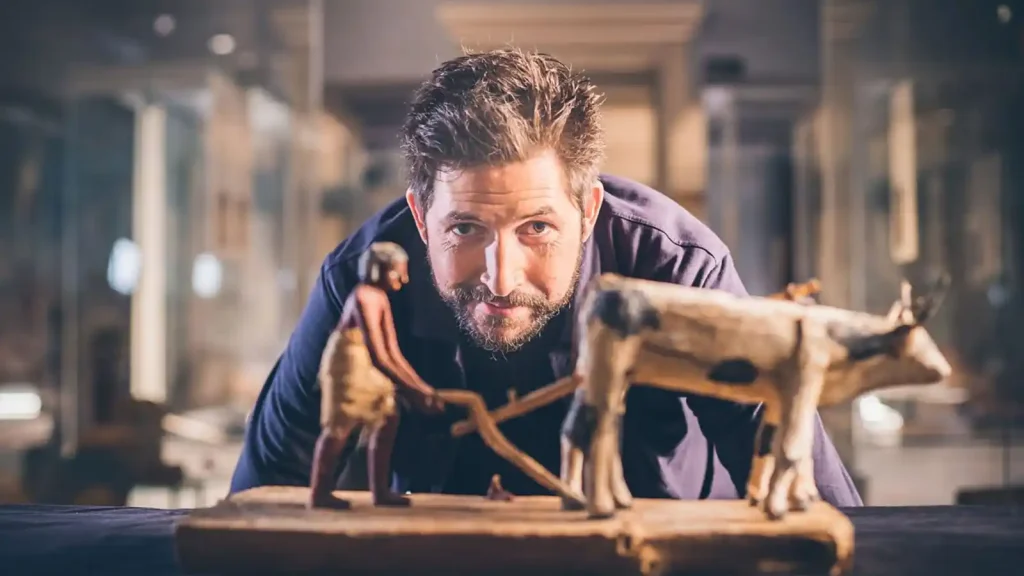
Nature and Us – A History through Art episode 3: In the captivating conclusion of the series, James delves into a century of art that mirrors humanity’s evolving relationship with nature. Over the last hundred years, we’ve experienced a profound shift—from an era where progress dominated, and nature was something to be tamed, to a renewed appreciation for its beauty. Post-World War II, the world witnessed a resurgence of reverence for the natural world, and today, artists are once again reimagining how we coexist with nature in the face of unprecedented environmental challenges.
The film sets the stage by taking us back to the early 20th century, a time marked by a bold sense of human ambition. It was a period when society, driven by rapid industrialization and technological innovation, believed it could conquer nature. Art, a reflection of these ambitions, began to move away from depicting the raw beauty of landscapes to capturing the sleek, ordered lines of modern life.
Piet Mondrian, once a painter of serene, natural scenes, epitomizes this shift. His journey from landscape artist to pioneer of abstract art symbolizes the era’s departure from nature’s messiness. Through Mondrian’s evolution, we witness how he “tidied” nature’s chaos, transforming it into sharp, geometric lines that echoed humanity’s desire for control and order.
James introduces us to another artist who wrestles with the consequences of rapid urbanization—Chinese artist Yang Yongliang. Standing amidst the towering skyscrapers of New York, Yongliang’s work raises poignant questions about our relentless drive toward urban growth. His sprawling digital landscapes merge modern cityscapes with traditional Chinese art, creating hauntingly beautiful reflections on how humanity continues to reshape the world. His work speaks not only to the aesthetic impact of this transformation but also to the environmental and cultural costs it exacts.
As James continues his journey, he brings us face-to-face with the photography of one of the 20th century’s most celebrated artists—Margaret Bourke-White. Her work embodies the fearless spirit of the era, as she became the first professional Western photographer allowed into the Soviet Union during the 1930s. Through her lens, she captured the Soviet Union’s rapid transformation from an agrarian society to a formidable industrial power. Her photographs, filled with striking contrasts of old and new, rural and industrial, serve as powerful visual testimonies to a world in flux. Bourke-White’s images don’t just document change; they invite us to ponder the human cost of progress, both in terms of what is gained and what is lost.
Nature and Us – A History through Art episode 3
But the 20th century wasn’t only a time of industrial triumphs and urban growth; it was also a period of deep anxiety. The destructive power of the atomic age, unleashed with the bombings of Hiroshima and Nagasaki, created a pervasive sense of dread that artists could not ignore. This terror and fascination with nuclear technology influenced a generation of creators, from painters to filmmakers. James explores this tension, starting with the works of artists like Gerald Bittinger, whose paintings from the 1940s and 1950s reflected the existential fear of atomic annihilation. Bittinger’s haunting depictions of apocalyptic landscapes serve as stark reminders of the precarious balance between progress and destruction.
Meanwhile, the burgeoning world of science fiction cinema became another outlet for exploring humanity’s atomic anxieties. Films like The Day the Earth Stood Still and Godzilla portrayed nuclear power not just as a scientific marvel, but as a terrifying force that could bring about the end of civilization. These films, while fictional, resonated deeply with audiences grappling with the real-world threat of nuclear war.
Throughout this exploration, James underscores a crucial theme: art, in all its forms, is a reflection of humanity’s shifting relationship with nature and technology. In the first half of the 20th century, progress was the ultimate goal, and nature was something to be shaped and controlled. But by the mid-century, as the consequences of this ambition became impossible to ignore, artists began to reexamine their relationship with the natural world. Whether through the abstract lines of Mondrian, the digital landscapes of Yongliang, or the stark photography of Bourke-White, the message is clear: our connection to nature is complex, and it is constantly evolving.
Today, as we face unprecedented environmental challenges—from climate change to mass urbanization—artists are once again at the forefront of imagining a new relationship with nature. They challenge us to reconsider what progress truly means and how we can harmonize our technological advancements with the preservation of the natural world. Through their work, they invite us to envision a future where nature and humanity coexist not in opposition, but in balance.
In closing, James’s exploration offers more than just a history of art—it is a reminder of the power of creativity to reflect, critique, and shape our understanding of the world around us. As we move further into the 21st century, these artistic reflections will only grow more vital, helping us navigate the complexities of a world where nature and technology are inextricably intertwined.
Forging a New Relationship with Nature: The Role of Art in Shaping Our Future
As the series approaches its conclusion, we witness the birth of a groundbreaking artistic movement: land art. Emerging in the late 1960s and continuing into the 1970s, this form of art marked a radical departure from traditional studio practices. More and more artists began leaving the confines of urban spaces and immersing themselves in nature, not merely as observers but as collaborators. They no longer painted or sculpted about nature—they worked with it. This shift reflected a deeper understanding and respect for the natural world, where art and the environment became intertwined in a dialogue of creativity and preservation.
In New Zealand, the breathtaking landscapes of the South Island provide the canvas for two such contemporary land artists: Philippa Jones and Martin Hill. Their work exemplifies the core principles of land art, using organic materials such as stones, leaves, and ice to craft temporary sculptures. These creations, forged from nature itself, are fleeting, meant to dissolve back into the earth with time. Jones and Hill don’t just create art that exists in nature; they embrace nature’s transience, allowing their sculptures to be shaped by the wind, rain, and elements. In doing so, they remind us of the impermanence of both art and life, echoing the rhythms of the natural world.
Jones and Hill’s work goes beyond aesthetics; it reflects a reverence for nature’s processes and cycles. Their sculptures are meditations on the delicate balance that exists between humanity and the environment, a balance that has become increasingly fragile in the face of climate change and environmental degradation. By creating art that lives and dies within nature, they invite viewers to reconsider our relationship with the natural world and to recognize the interconnectedness of all things.
The series then takes a leap into the future, introducing the artist collective Random International. These artists, unlike their predecessors, use cutting-edge technology to explore what our relationship with nature might look like in the years to come. Their work, though technologically advanced, maintains the same sense of wonder and curiosity about the natural world that defines land art. Through a series of mesmerizing installations, Random International blurs the boundaries between the organic and the synthetic, challenging our perceptions of what is natural and what is artificial.
One of their most famous works, “Rain Room,” allows participants to walk through a downpour without getting wet, thanks to an intricate system of sensors and water jets. This piece creates an uncanny experience, one where the familiar elements of nature—rain, water, motion—are reimagined through technology. It asks us to consider how human ingenuity might reshape our future interactions with the environment. Will technology further distance us from nature, or can it bring us closer in unexpected ways?
As the final episode draws to a close, James turns to the artists and thinkers who have appeared throughout the series to ask an essential question: What do they see as the future of humanity’s relationship with nature? Their answers are thoughtful and varied, reflecting the complexity of the issue. Some express hope, believing that through innovation and art, we can find new ways to coexist harmoniously with the natural world. Others are more cautious, acknowledging the challenges we face as a species in reversing the damage already done to the planet.
James concludes the episode—and the series—by offering his own reflections on the journey humanity has taken alongside nature. From our earliest ancestors who revered the land as sacred, to the industrial age when nature was seen as something to conquer, to today’s artists who are reimagining a new relationship with the environment, the role of art has been indispensable. Artists have not only reflected society’s changing attitudes toward nature, but they have also actively shaped them.
Through their work, they have helped us appreciate the intricacy of ecosystems, the awe-inspiring beauty of landscapes, and the delicate balance that sustains life on Earth. Now, as we face an era where the very future of the planet seems uncertain, artists may once again play a crucial role. They can help us forge a new understanding of nature—one that is not based on domination or exploitation but on respect, collaboration, and renewal.
James leaves us with a message of hope: Art, in all its forms, has the power to transform how we see the world. It encourages us to pause, to reflect, and to imagine new possibilities. As we look toward the future, it is clear that the intersection of art, nature, and technology will be a vital space for innovation and dialogue. Whether it is through the ephemeral sculptures of land artists like Philippa Jones and Martin Hill, or the futuristic installations of collectives like Random International, art will continue to challenge and inspire us to rethink our relationship with the natural world.
The journey, as James suggests, is far from over. If anything, it is just beginning. And as we move forward, art will remain a beacon of creativity and hope, guiding us toward a future where humanity and nature coexist in harmony, rather than in opposition. In a world where the planet’s survival seems increasingly at risk, artists have the unique ability to remind us of what is truly at stake—and what is still possible.
Piet Mondrian
Pieter Cornelis Mondriaan, was a Dutch painter and art theoretician who is regarded as one of the greatest artists of the 20th century. He is known for being one of the pioneers of 20th-century abstract art, as he changed his artistic direction from figurative painting to an increasingly abstract style, until he reached a point where his artistic vocabulary was reduced to simple geometric elements.
Mondrian’s art was highly utopian and was concerned with a search for universal values and aesthetics. He proclaimed in 1914: “Art is higher than reality and has no direct relation to reality. To approach the spiritual in art, one will make as little use as possible of reality, because reality is opposed to the spiritual. We find ourselves in the presence of an abstract art. Art should be above reality, otherwise it would have no value for man.” His art, however, always remained rooted in nature.
He was a contributor to the De Stijl art movement and group, which he co-founded with Theo van Doesburg. He evolved a non-representational form which he termed Neoplasticism. This was the new ‘pure plastic art’ which he believed was necessary in order to create ‘universal beauty’. To express this, Mondrian eventually decided to limit his formal vocabulary to the three primary colors (red, blue and yellow), the three primary values (black, white and gray) and the two primary directions (horizontal and vertical).
Mondrian’s arrival in Paris from the Netherlands in 1911 marked the beginning of a period of profound change. He encountered experiments in Cubism and with the intent of integrating himself within the Parisian avant-garde removed an ‘a’ from the Dutch spelling of his name (Mondrian)
Conclusion Nature and Us – A History through Art episode 3
As we conclude this exploration of the intersection between art and nature, it’s clear that our relationship with the natural world has been as fluid as the creative expressions that document it. From the early 20th century’s industrial ambitions, where progress and the taming of nature were prized, to today’s renewed appreciation of its fragility and beauty, art has played an essential role in shaping our understanding. Artists, like storytellers, have painted the evolving narrative of our connection to the environment—reflecting not only society’s desires but also its fears, hopes, and dreams.
What stands out most from James’s journey through these artistic movements is the realization that art and nature have always been in dialogue. Whether it’s the sharp, abstract lines of Piet Mondrian, symbolizing humankind’s urge to impose order on the chaotic natural world, or the ephemeral sculptures of land artists like Philippa Jones and Martin Hill, which celebrate nature’s transience, the conversation has shifted but never ceased. These works, while stylistically different, all invite us to pause and reflect on what nature means to us—and what it means to lose it.
In today’s world, where environmental concerns dominate headlines, this reflection feels more urgent than ever. Artists like Random International challenge us to look at the future through the lens of technology. Their mesmerizing installations blur the boundaries between the organic and the artificial, prompting us to consider how our innovations might both distance us from, and reconnect us with, nature.
As James aptly concludes, the role of artists in this ongoing conversation is vital. They are more than mere observers; they are visionaries, constantly reimagining our future with nature. Whether through paint, sculpture, or digital media, they inspire us to forge a relationship not based on dominance but on harmony and respect.
Art, in all its forms, serves as a beacon of hope—a reminder that we can, and must, find a way to coexist with the natural world. As we move forward, the lessons learned through these creative expressions will guide us, encouraging a future where humanity and nature thrive together, as partners in an interconnected web of life.
FAQ Nature and Us – A History through Art episode 3
Q: What is the main theme of Nature and Us – A History through Art Episode 3?
A: The central theme of the episode revolves around humanity’s evolving relationship with nature as seen through art. It traces the shift from an era where nature was tamed by industrial progress to today’s renewed appreciation for its beauty and importance, all reflected in the works of modern artists.
Q: How does Piet Mondrian’s work reflect humanity’s changing view of nature?
A: Piet Mondrian’s journey from landscape painting to abstract art symbolizes the early 20th century’s shift in attitude toward nature. His geometric compositions reflect the desire to impose order and control over nature’s inherent chaos, mirroring society’s industrial ambitions during that time.
Q: What role does art play in addressing today’s environmental challenges?
A: Art plays a crucial role in helping society reconsider its relationship with nature. Through their innovative and thought-provoking work, artists challenge the notion of progress, urging us to balance technological advancement with environmental preservation. They inspire us to imagine a future where humanity and nature coexist harmoniously.
Q: How does the work of contemporary artists like Yang Yongliang contribute to this conversation?
A: Yang Yongliang’s digital landscapes merge modern urbanization with traditional Chinese art. His work highlights the consequences of rapid urban growth, raising questions about how modernization impacts both the environment and cultural identity, and prompting viewers to reflect on these critical issues.
Q: How is land art, like that of Philippa Jones and Martin Hill, significant in the modern context?
A: Land art, which uses natural materials to create temporary sculptures, emphasizes the impermanence of both art and life. Artists like Philippa Jones and Martin Hill craft pieces that highlight the fragile balance between humanity and nature, encouraging viewers to contemplate nature’s processes and cycles in a world facing environmental threats.