Norman Walks episode 2 – Norman Conquest Beyond Hastings: The Making of the Welsh Borderlands
In the second installment of BBC’s “Norman Walks” series, historian Dan Snow journeys through the picturesque Welsh Marches. His expedition specifically focuses on Herefordshire and Monmouthshire, exploring how Norman influence transformed this contested frontier following their invasion of 1066.
The documentary brilliantly captures Snow’s authentic enthusiasm as he traverses the stunning landscapes of the Welsh borderlands. Throughout his journey, he examines the remarkable concentration of motte and bailey castles that dot the Monnow Valley. These imposing structures serve as physical reminders of Norman determination to secure their newly acquired territories.
Snow begins his exploration at Longtown Castle, a textbook example of Norman defensive architecture. He immediately establishes the documentary’s central question: what were the Normans trying to achieve with these numerous fortifications along the Welsh border? This inquiry sets the stage for a fascinating historical investigation that unfolds through Snow’s 12-mile trek across the marcher landscape.
The documentary excels in contextualizing Norman expansion beyond the standard narrative of the Battle of Hastings. Snow emphasizes how the Normans faced different challenges across Britain. While they inherited a well-organized Saxon state in much of England, the Welsh borderlands presented unique complexities requiring specialized strategies.
A pivotal moment comes when Snow visits Ewyas Harold, potentially the first Norman castle built in Britain. Remarkably, this fortress predated the invasion itself. As Snow explains, King Edward the Confessor, who spent his formative years in Normandy, authorized its construction in 1050. This revelation adds nuance to our understanding of Anglo-Norman relations before the conquest.
Snow then introduces viewers to William Fitz Osborne, a key figure in Norman border policy. Fitz Osborne, a close advisor and relative of William the Conqueror, received vast territories along the Welsh border. His mission: extend Norman control into these frontier regions through aggressive castle building.
The documentary benefits greatly from Snow’s meeting with Professor David Austin, an expert in medieval landscapes. Austin introduces the concept of “the March” – buffer zones created along empire boundaries. The Marcher Lords enjoyed extraordinary powers, essentially acting as kings within their territories. This system, borrowed from Charlemagne’s imperial strategy, allowed Norman influence to penetrate deeper into Welsh territory.
Snow’s physical journey connects three significant castles – White Castle, Skenfrith, and Grosmont. The documentary thoughtfully examines how their positioning reveals evolving Norman strategies. White Castle, perched high with commanding views, represents early defensive priorities. In contrast, Skenfrith sits beside the Monnow River, highlighting the waterway’s importance for transportation and communication.
At Grosmont, Snow meets castle expert Paul, who identifies authentic Norman stonework in the great hall. This surviving architecture reflects how quickly Norman priorities shifted from military defense to displays of status and power. Within just two generations, the border had moved westward, transforming these fortresses into elaborate residences for medieval lords.
The documentary skillfully connects physical structures to broader historical processes. Snow explains how Norman barons implemented forest law across vast territories, controlling local populations while encouraging new settlers from England and Normandy. This colonization process fundamentally altered the region’s demographic and economic character.
Perhaps most remarkably, Snow visits Kent Church Court, home to the Scudamore family. Jan Lucas Scudamore reveals her family has continuously occupied these lands since before the Norman Conquest. Their survival through centuries of political upheaval stemmed from “judicious marriages” and adaptability. Snow rightly identifies primogeniture – passing land to eldest male heirs – as a crucial Norman innovation that preserved such dynastic continuity.
The documentary culminates with Snow’s ascent of Garway Hill, offering panoramic views across seven counties. From this vantage point, he effectively summarizes the Norman achievement. Despite lacking a collective plan, successive generations of barons permanently transformed what had been a wild frontier land into a settled Norman territory.
Snow’s expertise shines throughout the production. His background as a respected historian allows him to present complex information accessibly without oversimplification. Unlike documentaries that rely heavily on dramatization, “Norman Walks” emphasizes authentic landscape exploration. Snow physically experiences the terrain, rivers, and elevations that shaped Norman strategic thinking.
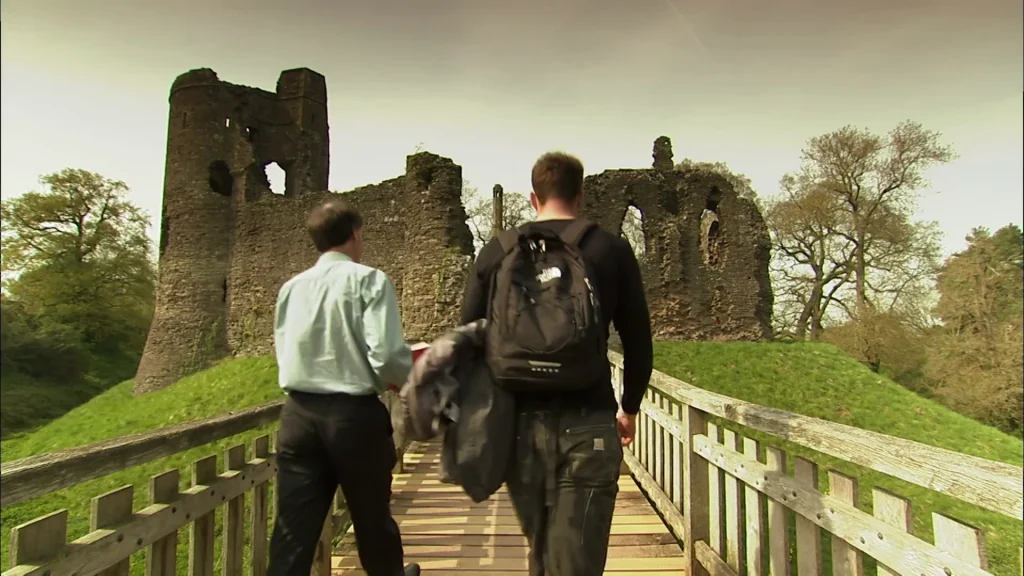
The production quality consistently impresses. Aerial photography captures the breathtaking Welsh borderlands, while close-up footage of castle ruins allows viewers to appreciate architectural details. Historical maps help orient viewers within this complex border region, clearly marking castle locations and territorial boundaries.
Compared to similar historical walking documentaries, “Norman Walks” stands out through its emphasis on landscape as historical evidence. Rather than focusing exclusively on written records or archaeological finds, Snow demonstrates how geography itself shaped historical events. The documentary shows how rivers, hills, and valleys influenced Norman decision-making and settlement patterns.
This episode significantly enhances our understanding of the Norman period by shifting focus away from familiar sites like Hastings, the Tower of London, or Canterbury Cathedral. Instead, viewers discover how Norman power manifested in less celebrated but equally important frontier regions.
Through Snow’s engaging narration and physical journey, viewers gain appreciation for the Norman conquest as “one of the greatest imperial expansions in the history of the British Isles.” His walk through the Monnow Valley reveals how Norman influence spread “in a chaotic, violent, unplanned way” throughout England, Wales, Scotland, and Ireland.
Conclusion: Footprints of Power in the Borderlands
Dan Snow’s journey through the Welsh Marches offers more than just historical insight—it provides a window into how landscape shapes destiny. The Norman castles standing today, though often reduced to romantic ruins, once represented the cutting edge of military technology and political control. Like chess pieces strategically placed across a living board, these fortifications speak to the calculated nature of Norman expansion.
Furthermore, the resilience of Norman institutions continues to influence modern Britain. The Scudamore family’s remarkable continuity illustrates how Norman systems of inheritance and land management created dynasties that outlived their founders. Their story, therefore, represents thousands of similar tales across Britain where Norman innovations took root and flourished.
Perhaps most importantly, Snow’s exploration reveals the borderlands as crucibles of cultural exchange. Despite their reputation for brutality, the Normans ultimately succeeded through adaptation. They blended their own traditions with local customs, thereby creating unique hybrid communities in these frontier zones.
The Monnow Valley, consequently, serves as a microcosm for broader historical patterns. Just as rivers carve paths through landscapes over centuries, the Normans gradually shaped British society through persistent pressure rather than sudden force. Their impact, like water on stone, transformed the cultural terrain through constant contact over generations.
Snow’s physical journey additionally mirrors our intellectual one as viewers. By walking these ancient paths, he connects us viscerally to historical figures who traversed the same hills and valleys. Through his footsteps, we can almost hear the hoofbeats of Norman cavalry or imagine the awe local populations felt when seeing stone castles rise against the skyline.
In the end, this documentary reminds us that history isn’t confined to battlefields or royal courts. It unfolds across entire landscapes, leaving traces for those willing to look beyond obvious monuments. The Welsh Marches, with their rolling hills and quiet rivers, still carry echoes of Norman ambition, determination, and adaptation.
As Snow concludes his journey atop Garway Hill, viewers gain both geographical perspective and historical insight. From this vantage point, we see not just counties and borders but the grand sweep of medieval power—how a relatively small group of Norman nobles forever changed the face of Britain through strategic vision and relentless implementation.
FAQ Norman Walks episode 2
Q: What was the primary purpose of Norman castles in the Welsh Marches?
A: Norman castles in the Welsh Marches primarily served as strategic control points to impose Norman rule on the frontier lands. Initially, these fortifications protected Norman territories from Welsh resistance. However, they quickly evolved into administrative centers for colonization efforts. Additionally, these imposing structures demonstrated Norman power to local populations. As time progressed, many castles transformed from purely military installations into status symbols for wealthy Norman lords, showcasing their dominance over the conquered landscape.
Q: Who was William Fitz Osborne and why was he significant to the Norman conquest of Wales?
A: William Fitz Osborne was a close advisor and relative of William the Conqueror who received extensive lands along the Welsh border after the Norman invasion. As the first Earl of Hereford, he initiated an intensive castle-building campaign throughout the Monnow Valley. Moreover, Fitz Osborne established the template for Norman expansion into Welsh territories. His influence was so profound that historians consider him the “origin myth” of the entire March. Despite his short tenure (he died in 1071), his strategic vision laid the foundation for Norman control of the borderlands for generations.
Q: What is a Marcher Lord and what special powers did they possess?
A: Marcher Lords were powerful Norman barons granted authority over the Welsh borderlands, known as “the March.” They possessed extraordinary “sub-regalian” powers, essentially functioning as independent rulers within their territories. For instance, they could create their own laws, levy taxes, and administer justice without royal oversight. Furthermore, they had permission to expand their holdings by conquering adjacent Welsh lands. This unusual autonomy stemmed from the Normans’ need to control turbulent frontier regions. Consequently, the March became a patchwork of mini-kingdoms where barons exercised almost royal authority.
Q: How did the Three Castles of the Monnow Valley demonstrate evolving Norman strategies?
A: The Three Castles (White Castle, Skenfrith, and Grosmont) collectively showcase the evolution of Norman control strategies. White Castle, positioned high with commanding views, represents early defensive priorities focusing on military dominance. Meanwhile, Skenfrith Castle, built beside the Monnow River, highlights the later importance of transportation networks and commerce. Finally, Grosmont Castle evolved into a sophisticated lordly residence, demonstrating how Norman priorities shifted from conquest to administration. Together, these castles reveal how Norman strategy transitioned from military occupation to economic development and eventually social integration within just a few generations.
Q: What was Forest Law and how did the Normans use it to control border populations?
A: Forest Law was a specialized legal system the Normans imported from continental Europe to control vast territories. Contrary to modern assumptions, these “forests” weren’t necessarily wooded areas but designated regions under direct Norman authority. Within these areas, Norman lords restricted local hunting rights, timber collection, and agricultural expansion. Moreover, they administered their own swift justice without royal interference. Essentially, Forest Law gave Norman elites comprehensive control over resources and populations. By applying these restrictions to nearly half the land in some border regions, they created an authoritarian regime favoring Norman settlers over indigenous populations.
Q: Why was Ewyas Harold castle historically significant in the Norman conquest timeline?
A: Ewyas Harold holds the remarkable distinction of potentially being the first Norman castle built on British soil. Surprisingly, King Edward the Confessor authorized its construction around 1050, approximately 16 years before the Norman invasion. This revelation challenges conventional timelines of Norman influence in Britain. Edward, having spent his formative years in Normandy, maintained Norman advisors who supervised the castle’s construction. Following the conquest, William Fitz Osborne refortified this strategic site. Therefore, Ewyas Harold represents both the pre-invasion Norman cultural influence and the post-conquest military consolidation, bridging two crucial historical periods.
Q: How did Norman settlement patterns change the demographic makeup of the Welsh borderlands?
A: Norman settlement permanently transformed the demographic character of the Welsh borderlands through systematic colonization efforts. Initially, Norman knights established military strongholds across the region. Subsequently, they encouraged English and Norman civilians to establish farming communities around these castles. The Normans also introduced new agricultural techniques that altered land use patterns. Furthermore, they established market towns that became centers of trade and administration. Through these coordinated efforts, the Normans gradually transformed what had been predominantly Welsh-speaking areas into multicultural communities with distinct Anglo-Norman characteristics that persist in local architecture, place names, and family lineages today.
Q: What role did the Monnow River play in Norman expansion into Wales?
A: The Monnow River served as a critical strategic corridor for Norman expansion into Welsh territories. Initially, it provided a natural boundary between English and Welsh lands. Additionally, it functioned as a transportation highway connecting the interior with the Bristol Channel. Norman forces utilized this waterway to move troops and supplies efficiently into frontier regions. Evidence of wharves at castles like Skenfrith confirms the river’s importance for commerce. Through controlling this vital waterway, the Normans established an economic lifeline that supported their military and colonization efforts throughout South Wales.
Q: How did the Scudamore family maintain continuous ownership of their lands for nearly a millennium?
A: The Scudamore family maintained their landholdings since pre-Norman times through remarkable adaptability and strategic marriages. Originally called “Escudamore” (meaning “Shield of Love”), they initially served Edward the Confessor before the Norman invasion. Throughout subsequent centuries, they survived by arranging advantageous marriages that secured additional lands and political connections. Furthermore, they demonstrated political flexibility, switching allegiances during civil conflicts and religious changes. The Norman introduction of primogeniture (inheritance by the eldest son) also helped preserve their estate intact. Their story represents a living legacy of Norman influence on British land ownership and aristocratic continuity.
Q: How does understanding the Norman conquest of the Welsh borderlands enhance our broader view of British history?
A: Understanding Norman activities in the Welsh borderlands provides crucial context for British history beyond the familiar Battle of Hastings narrative. Firstly, it reveals how Norman control varied significantly across different regions of Britain. Additionally, it demonstrates their sophisticated strategies for frontier management and colonization. The March system showcases how medieval powers adapted governance structures to local conditions. Moreover, many contemporary British institutions, land ownership patterns, and castle landscapes originated during this period. By examining these border territories, we gain insight into how Norman influence spread “in a chaotic, violent, unplanned way” throughout Britain and Ireland, ultimately transforming the cultural and political landscape of the entire archipelago.