Norman Walks episode 3: Echoes of Conquest and Faith – Yorkshire – The Northern Abbeys
The “Norman Walks” series offers viewers a compelling journey through Britain’s landscape. Historian Dan Snow guides this exploration. He reveals how the land itself tells stories of our Norman predecessors. Episode 3, “Yorkshire – the Northern Abbeys,” focuses specifically on the Norman impact in the north of England. This region endured brutal subjugation. However, it later became a heartland of Norman monasticism. The documentary promises insights into invasion, conquest, and ultimately, colonization. It uses Dan Snow’s final walk to investigate this complex legacy.
The episode begins in York, a city layered with history. Snow stands in the shadow of York Minster. He notes its Norman origins, particularly the crypt. This immediately establishes the Norman presence. He aims to show how Normans transformed York. It became the north’s political and religious stronghold. The narrative quickly introduces the harsh reality of Norman rule. Snow recalls the infamous “Harrying of the North”.
This brutal campaign occurred in the late 1060s. William the Conqueror’s forces repressed northern uprisings with extreme cruelty. Settlements between York and Durham faced destruction. Agriculture was deliberately ruined. The human cost was immense, with estimates of 100,000 deaths. Starvation followed, leading to horrific reports of cannibalism. This violence effectively unified England under Norman control. York became the regional capital.
However, the documentary pivots from this terror. It explores the subsequent era of Norman influence. This period brought long-term economic prosperity. Snow sets out on a five-mile walk. His route travels from Helmsley Castle to Rievaulx Abbey. This journey traverses landscapes once devastated by the Harrying. Yet, these same lands became the setting for a powerful Norman legacy: the great northern abbeys. The walk explores how these institutions arose. They shaped the region throughout the Middle Ages.
Before venturing into the moors, Snow visits St. Mary’s Abbey in York. He meets Professor Janet Burton, an expert on northern monasteries. Their discussion highlights the dual role of these early abbeys. They served as spiritual centers. Monks were seen as “spiritual soldiers” praying for the king. Simultaneously, these grand stone structures symbolized royal authority.
St. Mary’s, founded by William II, reinforced Norman power in a once-troublesome region. Professor Burton explains how Norman lords patronized such abbeys. They also founded their own, creating visible reminders of their power. These monasteries weren’t isolated. They interacted with society through estate management, education, and charity. They became, as Snow suggests, “little nuclei of Norman-ness”.
The narrative then follows the journey of Cistercian monks. They arrived from France in 1132, seeking an austere life. They came at the invitation of Walter Espec, the Norman lord of Helmsley. Espec was a powerful figure, the King’s Justiciar of the North. He built Helmsley Castle around 1120. This castle symbolized his dominance fifty years after the Harrying. Espec, portrayed as a scholar and military man, embodied the late Norman era. This period was a golden age for founding monasteries. For lords like Espec, founding an abbey offered spiritual security and political consolidation.
Snow’s walk commences from Helmsley Castle’s grounds. It traces the path toward Rievaulx, the site Espec granted the Cistercians. This land became the first Cistercian monastery in northern England. The walk traverses Duncombe Park, highlighting landscape continuity. Snow draws parallels between Espec and the later Duncombe family, both representing “new money” shaping the landscape. The faint outline of a Norman hunting enclosure provides a tangible link to the past.
The documentary effectively uses the landscape as evidence. Snow reaches the Rydale Valley, offering stunning views. He investigates the abbey’s infrastructure, starting with Griff Farm. Initially marked as a medieval village, archaeological investigation revealed it as a monastic grange. This farmstead, part of Espec’s original grant, was crucial from the start. It occupied land farmed since prehistory, likely by Viking communities. The Cistercians inherited this “island of arable”. They used entrepreneurial spirit to make the challenging moorland productive. Griff became the first node in a network of granges. These farms supported Rievaulx’s growing population and economy. By the 1300s, Rievaulx managed 20 granges, producing crops, fish, and wool.
The walk further reveals the monks’ impact on the environment. Snow examines the ancient woodlands lining Rydale’s steep slopes. Experts explain how these woods were intensively managed, particularly through coppicing. This provided timber and charcoal, vital resources. The presence of specific ground-level flora indicates the woodland’s ancient, managed nature. Nearby, Quarry Bank Wood shows scars from stone extraction. The monks quarried local limestone extensively for building the abbey. This meticulous examination of the landscape demonstrates the monks’ resourcefulness. They transformed their surroundings to ensure self-sufficiency.
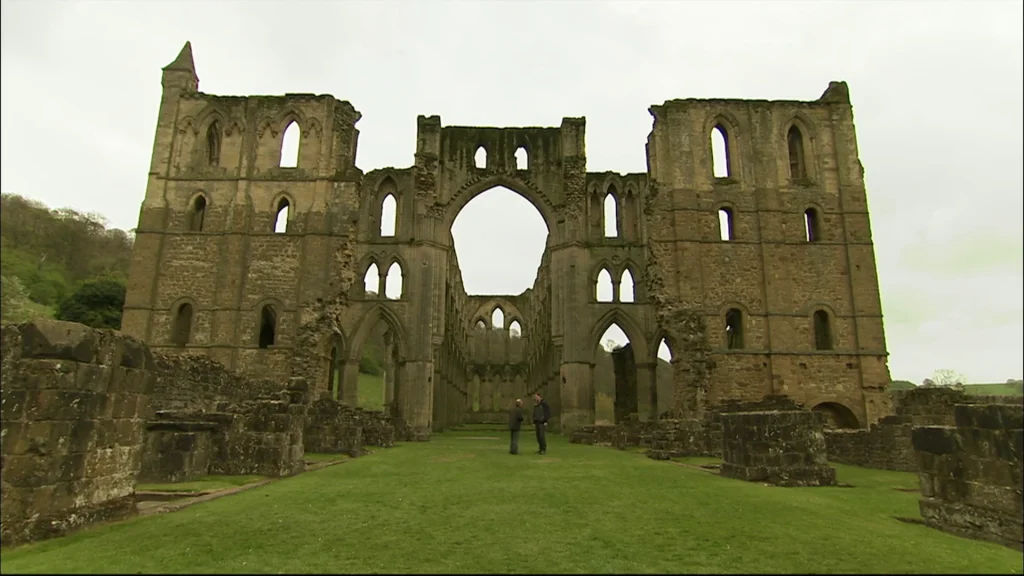
The climax of the walk, and the episode, is Rievaulx Abbey itself. Snow emphasizes the evocative power of the ruins. The abbey’s development owes much to Abbot Aelred, an influential theologian. Aelred, introduced to the area by Espec, presided during the late Norman period. He established Rievaulx as a major regional hub for commerce and community.
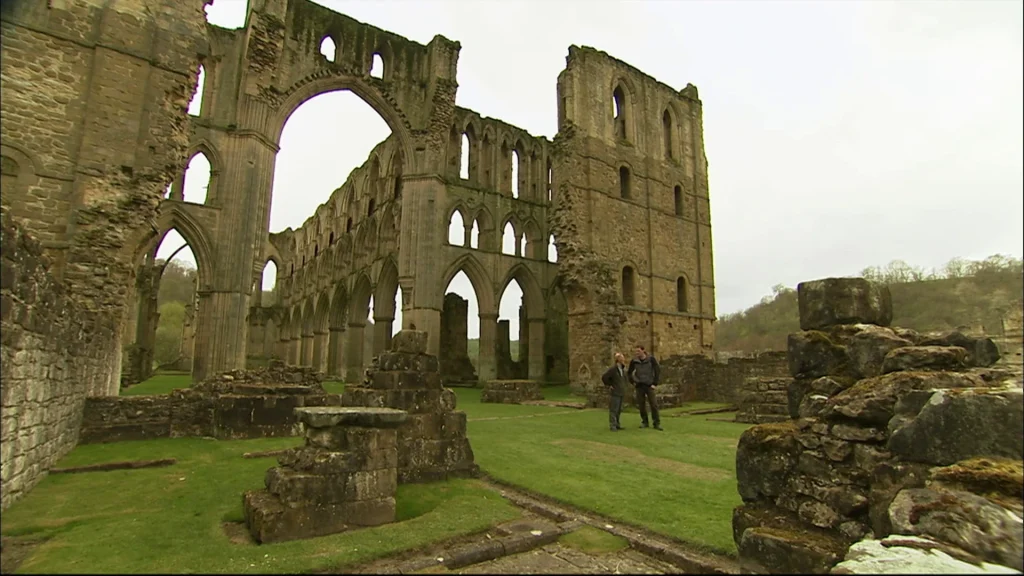
Snow explores the vast ruins, learning to distinguish Norman architecture (rounded arches) from later Gothic additions (pointed arches). At its peak, Rievaulx housed 150 choir monks and up to 500 lay brothers. This large community required extensive resources. They became leaders in the wool trade. They also engaged in iron smelting, utilizing local ore. This industry continued even after the Dissolution of the Monasteries.
A compelling narrative element involves Walter Espec’s fate. Having founded Rievaulx partly because his son died, Espec himself joined the abbey as a monk in his final years. He relinquished his power and prestige. This dramatic choice highlights the profound religious conviction intertwined with Norman ambition. Snow reflects on this act, finding it hard to grasp from a modern perspective. Yet, it underscores the complex motivations driving Norman actions.
The documentary excels in its presentation and subject matter expertise. Dan Snow is an engaging and knowledgeable host. His enthusiasm is infectious. He clearly explains historical contexts and landscape features. The inclusion of experts like Professor Janet Burton adds significant depth. Archaeological insights at Griff Farm provide tangible evidence of monastic life. Explanations of woodland management and quarrying demonstrate thorough research. The visuals are stunning, effectively capturing the beauty and history of the Yorkshire landscape.
Drone shots provide context for the walk and the scale of locations like Helmsley Castle and Rievaulx Abbey. The use of maps helps viewers follow Snow’s journey. The narrative flows logically, moving from the violence of conquest to the constructive, albeit still controlling, power of monasticism.
Norman Walks episode 3
Assessing the documentary reveals numerous strengths. It successfully links historical events to the physical landscape. The walk format provides a dynamic and engaging structure. The program balances broad historical narrative with specific local details. It presents the Normans not as monolithic conquerors, but as complex figures driven by violence, faith, ambition, and economics. The exploration of monasticism moves beyond simple piety. It reveals the abbeys as powerful economic engines and agents of colonization. The contrast between the Harrying’s brutality and the abbeys’ ordered prosperity is stark and effective.
Weaknesses are minimal but worth noting. While striving for accessibility, some viewers might desire even deeper historical analysis. The focus remains primarily on the elite Norman perspective, although the impact on the landscape and inferred local populations is addressed. The sheer number of abbeys mentioned towards the end feels slightly rushed. A map showing the distribution of these northern abbeys could have enhanced this section. However, these are minor points in an otherwise strong production.
The societal impact of a documentary like this lies in its ability to connect audiences with their past. It highlights how historical forces shaped the familiar landscapes of Britain. By exploring both the violence and the constructive legacies of the Normans, it encourages nuanced understanding. It challenges simplistic narratives of conquest. Furthermore, it showcases the enduring beauty and historical significance of sites like Rievaulx Abbey. This can foster appreciation for heritage preservation. The episode reminds us that history is etched into the land, waiting to be read.
Compared to other historical documentaries, “Norman Walks” distinguishes itself through its specific format. Unlike purely archive-based programs or studio discussions, the physical journey anchors the narrative. This approach echoes series like Michael Wood’s historical walks or Bettany Hughes’ explorations. However, Snow’s focus on the Norman imprint provides a specific thematic lens. It covers similar ground to documentaries focused solely on the Norman Conquest or medieval monasticism.
Yet, its strength lies in integrating these themes through the tangible experience of walking the landscape. It feels more grounded and immediate than purely academic treatments. The episode successfully blends popular history with accessible academic insight. It avoids excessive jargon while respecting the complexity of the subject.
The documentary effectively demonstrates the profound and lasting transformation the Normans wrought in northern England. From the initial terror of the Harrying emerged a new order. Grand castles asserted dominance. Subsequently, powerful monastic institutions like Rievaulx reshaped the economy and society. Walter Espec’s journey from powerful lord to humble monk encapsulates the era’s blend of worldly ambition and spiritual devotion. The ruins scattered across Yorkshire are not merely picturesque relics. They are monuments to a pivotal period. They testify to Norman power, faith, and ingenuity. These abbeys established infrastructure, managed resources, and fostered commerce. Their legacy, woven into the very fabric of the northern landscape, endured for centuries.
Walking Through Time: The Enduring Legacy of Norman Yorkshire
The journey through Yorkshire’s Norman landscape reveals a remarkable transformation etched in stone and soil. From the ashes of brutal conquest, a new world emerged—one that continues to whisper its stories across the centuries. Indeed, the path from Helmsley Castle to Rievaulx Abbey traces not just a physical route but a profound historical narrative.
When we consider the Normans’ legacy in northern England, we must acknowledge its dual nature. Initially, William the Conqueror’s “Harrying of the North” brought unimaginable suffering. Yet, from this devastation sprouted magnificent abbeys that would forever alter the region’s character and economy. These monasteries became beacons of Norman influence, radiating outward through carefully managed farms, woodlands, and quarries.
Moreover, these ecclesiastical centers functioned as economic powerhouses. The Cistercian monks of Rievaulx, for instance, pioneered sustainable resource management long before such concepts entered modern discourse. Through their innovative farming techniques and industrial ventures, they transformed harsh moorlands into productive estates. Consequently, their influence extended far beyond religious matters.
The story of Walter Espec particularly captivates our imagination. His transition from powerful Norman lord to humble monk represents the fascinating contradictions of medieval life. Furthermore, his personal journey embodies the complex motivations driving Norman colonization—ambition and piety intertwined like the interlaced arches of Rievaulx itself.
Today, the ruins standing amid Yorkshire’s rolling hills serve as portals to this vanished world. They remind us how thoroughly the Normans reshaped Britain’s physical and cultural landscape. Additionally, they challenge us to see beyond simple narratives of conquest to appreciate the nuanced reality of cultural transformation.
As Dan Snow’s final walk concludes, we’re left with a deeper understanding of how history inhabits the land itself. The Norman story isn’t merely confined to dusty chronicles but lives on in quarried stone, managed woodland, and abbey ruins. Therefore, when we walk these ancient paths, we aren’t simply observers—we become participants in an ongoing historical dialogue.
The Northern Abbeys stand as testament to humanity’s capacity for both destruction and creation. Their enduring presence in Yorkshire’s landscape offers a powerful lesson: even after violent beginnings, remarkable beauty and innovation can emerge. Thus, as we reflect on Norman Yorkshire, we recognize not just what was lost in conquest, but what was ultimately gained—a landscape forever transformed by faith, ambition, and the undeniable Norman genius for building toward eternity.
FAQ Norman Walks episode 3
Q: What is the main focus of Norman Walks Episode 3?
A: Episode 3 of Norman Walks, titled “Yorkshire – The Northern Abbeys,” explores the Norman impact on northern England. Historian Dan Snow guides viewers on a five-mile journey from Helmsley Castle to Rievaulx Abbey. Throughout the episode, he examines how this region transformed from a brutally subjugated territory into a heartland of Norman monasticism. Moreover, the documentary reveals how the landscape itself contains physical evidence of this dramatic historical transition, from the violence of conquest to the constructive power of abbey foundations.
Q: What was the “Harrying of the North” and why is it significant?
A: The “Harrying of the North” was William the Conqueror’s brutal campaign in the late 1060s to crush northern resistance. His forces destroyed settlements between York and Durham, deliberately ruined agriculture, and caused an estimated 100,000 deaths. Consequently, starvation became so severe that reports of cannibalism emerged. This devastating military action effectively unified England under Norman control and made York the regional capital. Furthermore, understanding this violent beginning provides essential context for appreciating the later Norman contributions to Yorkshire’s landscape and culture.
Q: Who was Walter Espec and why is his story compelling?
A: Walter Espec was the powerful Norman lord of Helmsley and the King’s Justiciar of the North who built Helmsley Castle around 1120. His life journey captivates viewers because it embodies the complex Norman character. Initially, Espec represented Norman dominance, but after losing his son, he invited Cistercian monks to establish Rievaulx Abbey. Remarkably, in his final years, Espec himself joined the abbey as a humble monk, relinquishing all power and prestige. This dramatic transformation illustrates the fascinating blend of worldly ambition and spiritual devotion that characterized the Norman era.
Q: How did Cistercian monks transform the Yorkshire landscape?
A: Cistercian monks radically transformed Yorkshire’s landscape through their entrepreneurial spirit and resource management. They converted challenging moorland into productive estates through a network of granges (monastic farms). Additionally, they practiced intensive woodland management through techniques like coppicing to produce timber and charcoal. The monks quarried local limestone extensively, leaving visible scars that persist today. By the 1300s, Rievaulx Abbey managed 20 granges producing crops, fish, and wool, effectively creating an economic empire. Their sustainability practices predated modern concepts by centuries.
Q: What dual purpose did Norman abbeys serve in northern England?
A: Norman abbeys served both spiritual and political purposes in northern England. Religiously, they functioned as centers of prayer and devotion, with monks considered “spiritual soldiers” praying for the king’s wellbeing. Politically, these grand stone structures symbolized royal authority and Norman power in a once-rebellious region. Furthermore, monasteries like St. Mary’s Abbey in York, founded by William II, reinforced Norman control. These institutions weren’t isolated; rather, they actively engaged with society through estate management, education, and charity, becoming what Dan Snow describes as “little nuclei of Norman-ness.”
Q: How did Rievaulx Abbey function as an economic powerhouse?
A: Rievaulx Abbey functioned as a remarkable economic engine beyond its religious role. The Cistercians became leaders in the lucrative wool trade, generating substantial wealth. Additionally, they engaged in iron smelting using local ore deposits, an industry that continued even after the Dissolution of the Monasteries. At its peak, Rievaulx housed 150 choir monks and up to 500 lay brothers, requiring extensive resources and infrastructure. This large community managed natural resources sustainably while developing diverse industries that brought prosperity to the entire region.
Q: How can viewers distinguish Norman architecture from later styles at Rievaulx Abbey?
A: Viewers can easily distinguish Norman architecture from later styles at Rievaulx Abbey by looking at the arches. Norman architecture features distinctive rounded arches, reminiscent of Roman designs. In contrast, later Gothic additions showcase pointed arches that soar upward. This architectural evolution tells the story of the abbey’s development over centuries. Furthermore, Norman sections typically display more massive construction with thicker walls, while later Gothic elements appear lighter and more delicate. These visual clues allow visitors to read the ruins like a historical timeline in stone.
Q: What makes the “Norman Walks” documentary format unique?
A: The “Norman Walks” format stands apart from other historical documentaries through its immersive, journey-based approach. Unlike studio discussions or purely archive-based programs, Dan Snow physically traverses historical landscapes, allowing viewers to experience sites contextually. Consequently, the narrative feels more grounded and immediate than academic treatments. The walking format creates a dynamic structure that physically connects historical events to the landscape. Moreover, this approach resembles Michael Wood’s historical walks but distinguishes itself through its specific focus on Norman influence, blending popular history with accessible academic insights.
Q: What evidence of Norman influence can still be seen in Yorkshire today?
A: Yorkshire today bears numerous visible traces of Norman influence. Most obviously, the magnificent ruins of abbeys like Rievaulx stand as monuments to Norman ambition and faith. Additionally, Helmsley Castle remains as evidence of Norman military dominance. The landscape itself reveals Norman management through ancient woodlands shaped by monastic coppicing practices. Archaeological sites like Griff Farm showcase the extensive agricultural system established by Norman monasteries. Even the quarries that supplied building materials show scars from extraction. These physical remnants collectively tell the story of how thoroughly the Normans reshaped Britain’s landscape.
Q: How does the documentary balance the negative and positive aspects of Norman influence?
A: The documentary skillfully balances the brutal conquest with constructive Norman legacies. It begins by acknowledging the terrible violence of the Harrying of the North without minimizing its horror. However, the narrative then pivots to explore how the same conquered lands later flourished under Norman monasticism. This nuanced approach presents Normans not as monolithic conquerors but as complex figures driven by violence, faith, ambition, and economics. Furthermore, the stark contrast between initial destruction and subsequent prosperity creates a compelling historical arc. By examining both aspects, the documentary encourages viewers to develop a more sophisticated understanding of this pivotal historical period.