The documentary Singapore 1942: End of Empire part 1 explores a military defeat that became a powerful symbol. The fall of Britain’s supposedly impregnable fortress in just 70 days was more than a battlefield loss. It was a humiliating event that shattered the myth of European superiority and signaled the beginning of the end for a global empire. This single campaign forever altered the course of Southeast Asia.
Before its fall, Singapore was a jewel in the crown of the British Empire. It stood as a thriving, multicultural world city and a massive commercial success. What began as a fishing village in 1820 had become Asia’s biggest commercial city a century later. However, beneath this polished surface of prosperity, deep-seated colonial tensions smoldered, ready to erupt with the coming of war.
The story of this collapse, as detailed in Singapore 1942: End of Empire part 1, reveals a complex interplay of factors. It examines the British colonial mindset, the rising imperial ambitions of Japan, and the weaknesses within the multinational defending force. The narrative follows the lightning-fast Japanese invasion of Malaya, which set the stage for one of Britain’s most devastating defeats.
The British built Singapore’s economy by bringing in vast numbers of Chinese and Indian workers. This policy fundamentally altered the region’s demographics. By 1900, people of Chinese descent comprised over 70 percent of Singapore’s population. This created significant resentment among the indigenous Malay community, who felt overrun in their own land. The British colonial rulers, however, remained largely oblivious to these brewing ethnic conflicts.
While Britain reveled in its imperial prestige, another nation harbored its own colonial ambitions. Japan saw itself as a major power destined to have an empire in Asia. Japanese leaders looked at the European empires in the region and felt a sense of racist condescension from the West. This frustration fueled a desire to expel the white colonials and establish their own dominance, setting the stage for a new chapter in World War II in Asia.
The conflict ignited on December 8, 1941. On that day, Japanese bombers struck a brightly lit, unsuspecting Singapore, just hours after their infamous attack on Pearl Harbor. The raid delivered a terrifying message to the island’s inhabitants. Their colonial masters could not protect them. This act of aggression began a brutal 70-day campaign that would culminate in the Fall of Singapore.
Singapore 1942: End of Empire part 1
The Colonial Bubble and British Myopia
Life for the British colonial ruling class in Singapore was one of privilege and prestige. They lived in lovely bungalows, attended to by local servants, or “amahs,” whose real names they often did not even know. This ruling class created a bubble for themselves, far removed from the lives of the Asian populations around them. They enjoyed a vibrant social life filled with sports days and parties, behaving as if their superior status was the natural order of things.
This sense of superiority created a rigid social hierarchy. Local people, referred to as “natives,” were not permitted entry into British clubs. They were forced to travel in separate compartments on trains. The British successfully maintained this illusion of inherent dominance for a very long time. This detachment left them unprepared for the social explosion the Japanese invasion would unleash.
Furthermore, this sense of racial superiority bred a dangerous underestimation of their enemy. Commonwealth troops were fed virulent anti-Japanese propaganda. Intelligence officers told soldiers that the Japanese were short-sighted, couldn’t see at night, and were equipped with inferior weapons. This propaganda cast the Japanese as subhuman, with Winston Churchill himself describing them as “yellow dwarves.” This racist caricature created a fatal overconfidence among Allied soldiers, who believed one Australian was worth ten Japanese.
A Gathering Storm: The Japanese Invasion of Malaya
Japan’s imperial ambitions were no secret. The nation had invaded Manchuria in 1931 and signed an alliance with Nazi Germany in 1936. Japan sent its rising general, Tomoyuki Yamashita, to Germany to learn from the Third Reich’s war planning. He was an accomplished, battle-hardened commander, described by historians as perhaps the best Japanese general of the war. He was tough, experienced, and clear-sighted.
In contrast, Britain’s leadership in the region was lacking. Malaya was considered a low priority compared to the campaigns in Europe and the Middle East. Consequently, Britain sent Lieutenant General Arthur Percival to command the multinational forces in Singapore. He was regarded as a poor choice for the command. Placing Percival in the ring against a general of Yamashita’s caliber was, as one historian noted, ludicrous.
On December 8, 1941, Japan launched its attack. An invasion force of 25,000 men assaulted the British colony of Malaya. The main landing at Kota Bharu quickly overran the defending 8th Indian Brigade. Simultaneously, Japanese forces landed on undefended Thai beaches and advanced swiftly. The British and Commonwealth forces were immediately plunged into a desperate fight in the unfamiliar jungles against a determined and well-prepared enemy.
Imperial Fault Lines in Singapore 1942: End of Empire part 1
The defense of Malaya quickly revealed deep cracks within the foundation of the British Empire. Britain had long promised to send a large naval fleet to defend Singapore and Australia. Yet, with the war raging in Europe, those forces were never available. The only Allied warships in the region were the Prince of Wales and the Repulse. Two days after the invasion began, Japanese bombers sighted the small fleet and sank both ships in less than three hours, killing 1,000 British sailors. The loss left the empire “weak and naked” across the Pacific.
The multinational army on the ground was also fracturing. Seeds of anti-British sentiment had been growing for decades in India. Many Indian soldiers questioned why they should fight for a freedom that was denied to them in their homeland. The Japanese cleverly exploited this discontent. After thousands of Indian troops surrendered, the Japanese recruited them to fight against their former colonial masters. Captain Mohan Singh became the commander of the new Indian National Army, which eventually grew to include 20,000 former British Indian Army soldiers.
Many indigenous Malays also saw the Japanese as liberators. They resented the British for allowing an unrestricted influx of Chinese and Indian workers into their country. The Japanese promoted a vision of a “Greater East Asia Co-Prosperity Sphere,” promising an honored place for Asian nations free from European rule. This message resonated, and many local Malays began actively helping the invading Japanese forces, further complicating the defense.
This breakdown of imperial loyalty was starkly illustrated during the evacuation of Penang. After days of relentless bombing, British commanders ordered the evacuation of white women, children, and military personnel. They abandoned the local Eurasian and Asian populations. This act of racial discrimination destroyed centuries of respect for British imperial power in a matter of weeks, demonstrating that in a crisis, the empire would only save its own.
Desperate Retreat and The Brutality of War
The Japanese military machine rolled through Malaya with devastating speed and efficiency. Contrary to British propaganda, they were masters of jungle warfare. A key element of their success was the use of bicycle brigades. These units bypassed British forces waiting on main roads by using small, hidden paths. Their routes were meticulously planned using intelligence gathered by a pre-war network of Japanese spies who had posed as barbers, dentists, and photographers.
The Commonwealth forces, by contrast, were ill-equipped and poorly prepared. The British had brought no tanks, believing they would be ineffective in the jungle. This proved to be a critical mistake. The only Commonwealth unit with any real jungle training was the Argyll and Sutherland Highlanders. These Scottish soldiers fought tenaciously but were consistently outmaneuvered and forced into retreat. Their stand at Slim River was heroic but ultimately ended in their near destruction.
The fighting was brutal, and atrocities were committed on both sides. At the Parit Sulong bridge, advancing Japanese troops massacred approximately 150 wounded Australian and Indian soldiers who had been left behind. The soldiers were shot or bayoneted before being set on fire. However, the conflict’s grim reality meant Allied troops were also ordered to kill wounded Japanese soldiers who, even when injured, might use grenades to attack advancing forces. As one veteran stated, “War is a terrible, stinking, horrible, shocking state of affairs.”
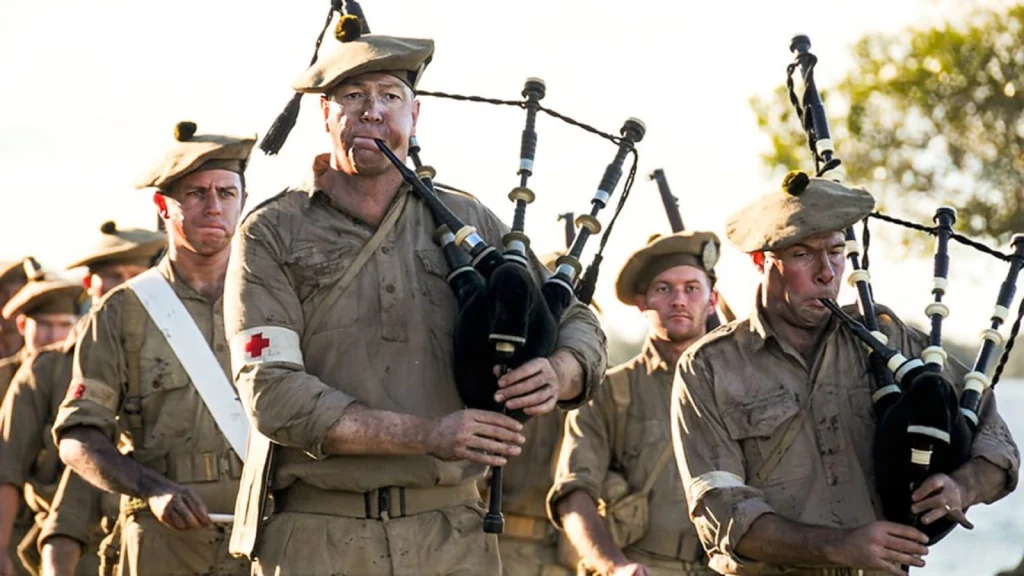
In just 55 days, the Japanese army had pushed the empire’s forces over 600 miles down the Malay Peninsula, killing or capturing over 20,000 troops. On January 27, 1942, General Percival received the order to withdraw all remaining forces to Singapore island. The last troops to cross the causeway were the surviving Argyll and Sutherland Highlanders. In a final act of defiance, they piped themselves across, a gesture of fighting spirit against impossible odds. The prized colony of Malaya had fallen, and over a million people were now trapped in the fortress of Singapore.
The Reckoning: When Empires Fall and History Changes Course
As the surviving members of the Argyll and Sutherland Highlanders piped themselves across the causeway to Singapore in those final January days of 1942, their defiant music echoed something profound—not just the end of a military campaign, but the death rattle of an entire worldview. In just 55 brutal days, the Japanese had accomplished what centuries of gradual colonial resistance could not: they had shattered the illusion of Western invincibility in Asia forever.
The fall of Malaya wasn’t simply a military defeat; it was a masterclass in how deeply rooted prejudices can become fatal blind spots. The British colonial bubble—with its racist propaganda about “yellow dwarves” and short-sighted Japanese soldiers—didn’t just foster dangerous overconfidence. It created a systematic inability to see their enemies, their subjects, and ultimately themselves clearly. When your worldview depends on believing you’re inherently superior, you stop preparing for the moment when someone proves you’re not.
Perhaps most striking is how quickly the empire’s carefully constructed social order collapsed under pressure. The evacuation of Penang, where British officials abandoned Asian populations while saving only white civilians, destroyed centuries of imperial credibility in mere weeks. It revealed the uncomfortable truth that colonial loyalty was largely built on power projection rather than genuine respect or shared values. Once that power wavered, the facade crumbled with breathtaking speed.
The Japanese success wasn’t just about superior tactics or jungle warfare expertise—though their bicycle brigades and meticulous intelligence networks were devastatingly effective. They understood something the British had forgotten: that empires are ultimately psychological constructs. By positioning themselves as Asian liberators fighting European oppression, they turned the empire’s own subjects against it. The 20,000 Indian soldiers who joined the Indian National Army weren’t just changing sides; they were choosing a different vision of the future.
Today, as we watch global power structures shift and established orders face new challenges, Singapore 1942 offers sobering lessons. It reminds us that no empire, no matter how mighty, is immune to the consequences of hubris and willful blindness. The British weren’t defeated by superior numbers or better equipment—they were undone by their own prejudices, their failure to understand the people they governed, and their inability to adapt when the world changed around them.
For modern leaders navigating an increasingly multipolar world, the fall of Singapore serves as both warning and opportunity. It shows how quickly seemingly stable systems can unravel when they’re built on outdated assumptions. But it also demonstrates that understanding your environment, respecting your opponents, and staying connected to the people you serve aren’t just moral imperatives—they’re strategic necessities for survival.
The pipes that played the Argyll and Sutherland Highlanders across that causeway weren’t just marking the end of a campaign. They were playing the funeral march for one era of global dominance and the birth song of another. The question for us today is whether we’re listening carefully enough to hear the music of our own times.
FAQ Singapore 1942: End of Empire part 1
Q: What was the significance of Singapore’s fall to the British Empire?
A: Singapore’s fall in 1942 marked a devastating turning point that shattered the myth of European invincibility in Asia. Furthermore, this defeat destroyed centuries of colonial credibility within just 70 days. The loss signaled the beginning of the end for British imperial dominance across Southeast Asia and fundamentally altered global power structures.
Q: How did British racial prejudice contribute to their military defeat?
A: British colonial racism created fatal blind spots that prevented proper enemy assessment. Additionally, propaganda portrayed Japanese soldiers as “yellow dwarves” with inferior equipment and night blindness. Consequently, this systematic underestimation led to dangerous overconfidence, with Allied forces believing one Australian soldier equaled ten Japanese fighters. Such prejudices ultimately proved catastrophic during actual combat.
Q: Why did many colonial subjects turn against the British during the invasion?
A: Colonial subjects had endured decades of racial discrimination and exclusion from British society. Moreover, many Indian soldiers questioned fighting for freedom denied in their homeland. The Japanese cleverly exploited this resentment by positioning themselves as Asian liberators. Subsequently, 20,000 former British Indian Army soldiers joined the Japanese-sponsored Indian National Army under Captain Mohan Singh.
Q: What made General Yamashita so effective compared to British leadership?
A: Tomoyuki Yamashita was a battle-hardened commander who studied German warfare tactics firsthand. In contrast, Britain assigned Lieutenant General Arthur Percival, widely considered inadequate for such command. Additionally, Yamashita possessed clear strategic vision and extensive combat experience. Historians describe this leadership mismatch as “ludicrous,” highlighting the vast disparity in military competence between opposing forces.
Q: How did Japanese bicycle brigades revolutionize jungle warfare?
A: Japanese bicycle units bypassed British defensive positions by utilizing small, hidden jungle paths instead of main roads. Furthermore, these routes were meticulously planned using intelligence from pre-war spy networks of barbers, dentists, and photographers. This innovative tactic allowed rapid troop movement through supposedly impassable terrain. Consequently, Japanese forces consistently outmaneuvered Commonwealth troops expecting conventional road-based attacks.
Q: What role did ethnic tensions play in Singapore’s vulnerability?
A: British immigration policies fundamentally altered Singapore’s demographics, with Chinese workers comprising over 70% of the population by 1900. Additionally, this created significant resentment among indigenous Malays who felt displaced in their ancestral homeland. However, British colonial rulers remained largely oblivious to these brewing ethnic conflicts. These unresolved tensions ultimately weakened social cohesion during the Japanese invasion.
A: Britain had promised substantial naval reinforcements but European warfare demands prevented their deployment. Instead, only HMS Prince of Wales and HMS Repulse were available for regional defense. Tragically, Japanese bombers sank both warships within three hours, killing 1,000 sailors. This devastating loss left the empire “weak and naked” across the entire Pacific theater.
Q: How did the Penang evacuation expose imperial hypocrisy?
A: During Penang’s evacuation, British commanders prioritized saving white civilians while abandoning local Asian and Eurasian populations. This blatant racial discrimination destroyed centuries of imperial credibility within mere weeks. Furthermore, the incident revealed that colonial loyalty was built on power projection rather than genuine respect. Consequently, this betrayal demonstrated the empire’s true priorities during crisis situations.
Q: What tactical mistakes did British forces make in jungle warfare?
A: British commanders failed to bring tanks, incorrectly believing they were ineffective in jungle terrain. Additionally, most Commonwealth units lacked proper jungle warfare training except the Argyll and Sutherland Highlanders. Meanwhile, Japanese forces had mastered tropical combat techniques and superior intelligence networks. These preparation gaps resulted in consistent tactical disadvantages throughout the Malayan campaign.
Q: What lessons does Singapore 1942 offer modern leaders?
A: Singapore’s fall demonstrates how hubris and willful blindness can topple seemingly invincible powers. Moreover, the defeat shows that understanding local populations and respecting opponents are strategic necessities, not moral luxuries. Additionally, outdated assumptions can rapidly undermine established systems during periods of change. Therefore, modern leaders must remain adaptable and connected to those they serve to avoid similar catastrophic failures.