Treasures of Ancient Egypt episode 1: In the captivating first episode of Treasures of Ancient Egypt, Alastair Sooke embarks on an extraordinary journey to unravel the artistic genius of one of the most fascinating civilizations in human history. With the majesty of Egypt’s greatest historical landmarks as a backdrop, Sooke explores 30 remarkable masterpieces that bring the story of Ancient Egyptian art vividly to life. From the sun-scorched dunes of the Sahara to the life-giving waters of the Nile, he delves deep into the origins of a visual style that continues to inspire awe today.
Egyptian art is more than just an aesthetic endeavor; it is a mirror reflecting the beliefs, values, and ambitions of an ancient people. Sooke begins his journey by uncovering the rarely seen artistic expressions of Egypt’s earliest inhabitants. Their depictions of daily life and spiritual practices set the foundation for a culture that would thrive for millennia. These early creations, crafted with simplicity yet bursting with meaning, reveal a burgeoning artistic sensibility that foreshadowed the grandeur to come.
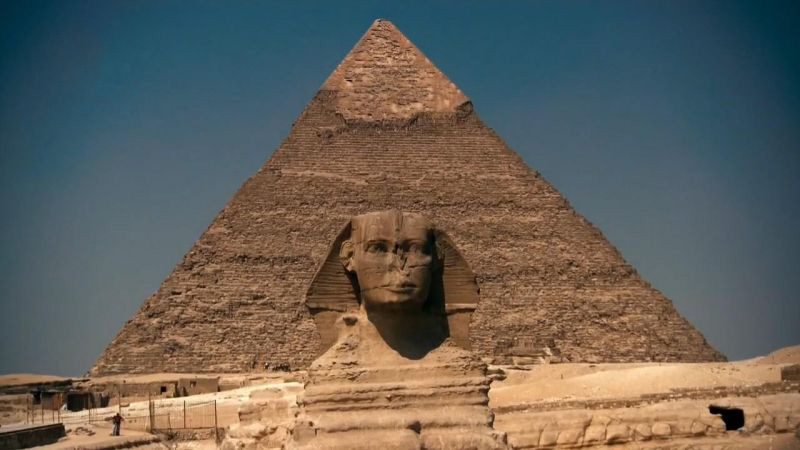
A significant portion of the episode is dedicated to examining how religion shaped Egyptian art. Sooke takes viewers to the iconic Great Pyramid of Giza, a marvel of engineering and symbolism that has stood as a testament to human ambition for over 4,500 years. With a sense of wonder, he reveals how this colossal structure, along with the intricate carvings and statues of the Old Kingdom, was not merely designed for visual impact but served as a bridge between the earthly and the divine. Every line, curve, and angle was meticulously planned to honor the gods and ensure the eternal journey of the pharaoh’s soul.
The technical brilliance of ancient Egyptian artists leaves Sooke astounded. Their mastery of tools and techniques, many of which baffle even modern craftsmen, speaks to a level of sophistication far ahead of its time. From the delicate brushstrokes in tomb paintings to the monumental statues carved from solid stone, their work demonstrates a remarkable understanding of proportion, perspective, and materiality. It is as if these artists—through sheer ingenuity and dedication—defied the limitations of their era to create something timeless.
As Sooke treks across the sunlit expanse of the Sahara, he uncovers hidden gems of prehistoric art etched into the desert’s ancient rock formations. These early works, though simple, carry profound significance, capturing the rhythms of a life intricately tied to nature. Moving closer to the Nile, he encounters the flourishing artistic achievements of later periods. The scenes depicted in tombs and temples—brimming with vivid colors and meticulous detail—serve not only as decorative elements but as visual prayers, immortalizing the deceased’s journey to the afterlife.
One of the most striking elements of Egyptian art is its ability to combine realism with idealism. While human figures are often portrayed in a stylized manner—with heads in profile and torsos facing forward—their expressions and gestures exude a lifelike vitality. This duality reflects a worldview that sought to balance the earthly and the eternal, the tangible and the transcendent. It is a style uniquely Egyptian, one that has inspired countless artists and historians through the ages.
Throughout the episode, Sooke’s passion for the subject is palpable. His storytelling is enriched by a sense of curiosity and reverence for the ancient world. As he marvels at the artistry of a culture that flourished thousands of years ago, he invites viewers to see these works not as relics of a distant past but as living testaments to human creativity and resilience. Whether it’s the serene smile of a statue or the intricate hieroglyphs adorning a temple wall, each piece tells a story that bridges the gap between then and now.
The journey concludes with a reflection on the enduring legacy of Egyptian art. It has influenced countless cultures and continues to captivate the modern imagination. As we look at these masterpieces today, they remind us of the universal human desire to create, to communicate, and to connect with something greater than ourselves.
In this first episode, Sooke not only uncovers the secrets of Egyptian art but also rekindles our sense of wonder for a civilization that, despite the passage of time, remains as mesmerizing as ever. It is a testament to the power of art to transcend eras, speaking to us across the ages with a voice that is both timeless and profoundly human.
Treasures of Ancient Egypt episode 1
Great Pyramid of Giza
The Great Pyramid of Giza (also known as the Pyramid of Khufu or the Pyramid of Cheops) is the oldest and largest of the three pyramids in the Giza pyramid complex bordering present-day Giza in Greater Cairo, Egypt. It is the oldest of the Seven Wonders of the Ancient World, and the only one to remain largely intact.
Based on a mark in an interior chamber naming the work gang and a reference to the Fourth Dynasty Egyptian pharaoh Khufu, some Egyptologists believe that the pyramid was thus built as a tomb over a 10- to 20-year period concluding around 2560 BC. Initially standing at 146.5 metres (481 feet), the Great Pyramid was the tallest man-made structure in the world for more than 3,800 years until Lincoln Cathedral was finished in 1311 AD.
Originally, the Great Pyramid was covered by limestone casing stones that formed a smooth outer surface; what is seen today is the underlying core structure. Some of the casing stones that once covered the structure can still be seen around the base. There have been varying scientific and alternative theories about the Great Pyramid’s construction techniques. Most accepted construction hypotheses are based on the idea that it was built by moving huge stones from a quarry and dragging and lifting them into place.
Old Kingdom of Egypt
In ancient Egyptian history, the Old Kingdom is the period spanning c. 2686–2181 BC. It is also known as the “Age of the Pyramids” or the “Age of the Pyramid Builders”, as it encompasses the reigns of the great pyramid builders of the Fourth Dynasty— among them King Sneferu, who perfected the art of pyramid-building, and the kings Khufu, Khafre and Menkaure, who constructed the pyramids at Giza. Egypt attained its first sustained peak of civilization during the Old Kingdom—the first of three so-called “Kingdom” periods (followed by the Middle Kingdom and New Kingdom) which mark the high points of civilization in the lower Nile Valley.